RTUs rank higher than traditional direct expansion split systems or other HVAC systems because of their simple, all in one packaging, energy benefits and space-saving nature.
Learning objectives
- Learn what a packaged rooftop unit (RTU) is, including its components and configurations.
- Understand the energy codes related to RTUs and how energy codes favor RTUs because of economizers.
- Review the benefits and limitations of packaged RTUs.
RTU insights
- Packaged RTU systems offer a space-efficient solution by combining all heating and cooling components into a single rooftop enclosure.
- Modern RTU technology provides significant versatility through various configurations like VAV and DOAS, as well as factory-installed accessories such as economizers that enhance energy efficiency and simplify maintenance and installation.
Packaged rooftop units (RTU) are factory-assembled packaged heating and cooling systems that are installed on the roof of a building. The units condition air and distribute it throughout a building’s airspace via ductwork installed within the building.

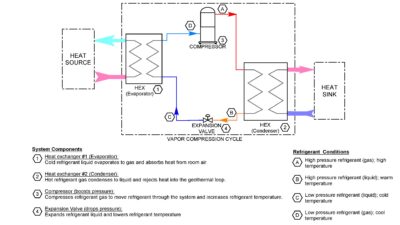
Unlike traditional split system heating, ventilation and air conditioning (HVAC) units, packaged RTUs combine all heating and cooling components into a single enclosure. These components include compressors, condenser and evaporator coils, supply and return fans, heating modules, filters, dampers and control systems. The capacity of RTUs ranges from 2 to 150 tons. Small, light commercial capacity RTUs fall in the 2 to 15 tons range. Medium commercial RTUs range from 15 to 25 tons. RTUs 25 tons and larger are considered heavy commercial/industrial.
Over the past few decades, RTU technology has evolved considerably. RTUs were once basic constant-volume systems and have become more sophisticated, containing advanced controls and components that provide more flexibility for building HVAC.
Packaged RTU configurations
Packaged RTUs have a broad range of configurations available for different building requirements. RTUs can meet varying occupancy loads, ventilation demands, climate conditions and energy efficiency requirements. While most standard rooftop HVAC units include the same components as split system units in a single package, RTUs can also be provided in different configurations to meet specific design needs.
These configurations include 100% dedicated outside air systems (DOAS), heat pumps, cooling only, variable air volume (VAV) or constant volume. RTUs can also be provided with electric or gas power inputs, providing versatility for different sites and the utilities that are available. To ensure the appropriate configuration is used for the specific application, it is essential to understand the different types of RTUs that are available.
Constant-volume RTUs: Constant-volume RTUs are the simplest and most widely used configurations. In this configuration, the supply fan provides a fixed airflow rate whenever the system is operating. Constant-volume RTUs are typically used in smaller commercial buildings where building loads typically remain consistent throughout operating hours. Constant-volume RTUs have relatively easy installation, simplified controls and lower maintenance requirements.
Variable air volume (VAV) RTUs: These vary the amount of supply air delivered to different zones based on thermal demand. In a VAV system, the VAV RTU supplies conditioned air to multiple terminal boxes located in different zones throughout the building. These terminal boxes regulate airflow to each zone or space according to temperature requirements. VAV RTUs are often used in office buildings and in educational facilities where occupancy and thermal loads vary throughout the day. VAV RTUs are generally more energy efficient than constant-volume systems and can provide more precise occupant comfort.
DOAS: A DOAS RTU provides conditioned outdoor ventilation air to a space. DOASs are typically used in buildings that have high outdoor ventilation air requirements, such as schools, healthcare facilities, office buildings and laboratories. A DOAS provides the ability to separate ventilation air and thermal conditioning.
Packaged RTU components
Packaged RTUs all include the same components as a typical direct expansion (DX) split system packaged into a single enclosure. However, RTUs can be provided with additional accessories in a much simpler manner than that required for a split system with the same components.
Economizers: One of the most common RTU accessories is the air-side economizer. In many jurisdictions, the energy code requires an economizer to be installed to provide cooling when outside air conditions are cool enough. When outside air conditions are suitable, the economizer uses the outside air for free cooling, shutting down the refrigeration cycle. This results in significant energy savings and reduces wear and tear on the system.
Packaged RTUs can easily be provided with an economizer option built into the unit. A split system that requires an economizer would result in installing motorized dampers on the return air mixing box, allowing the system to pull in outside air. Providing a split system with an economizer also requires additional controls and wiring to properly function.
With a packaged RTU, providing an economizer and the associated controls to meet code is much easier to achieve than with other types of HVAC systems as the economizer is factory installed with the packaged system.
Outdoor air intake hood: ASHRAE Standard 62.1: Ventilation for Acceptable Indoor Air Quality dictates the amount of fresh outdoor air that must be supplied to a space based on occupancy type. In a DX split system design, outdoor air is introduced into the indoor air handling unit via intake louvers and associated ductwork. This means additional space and openings must be accounted for.
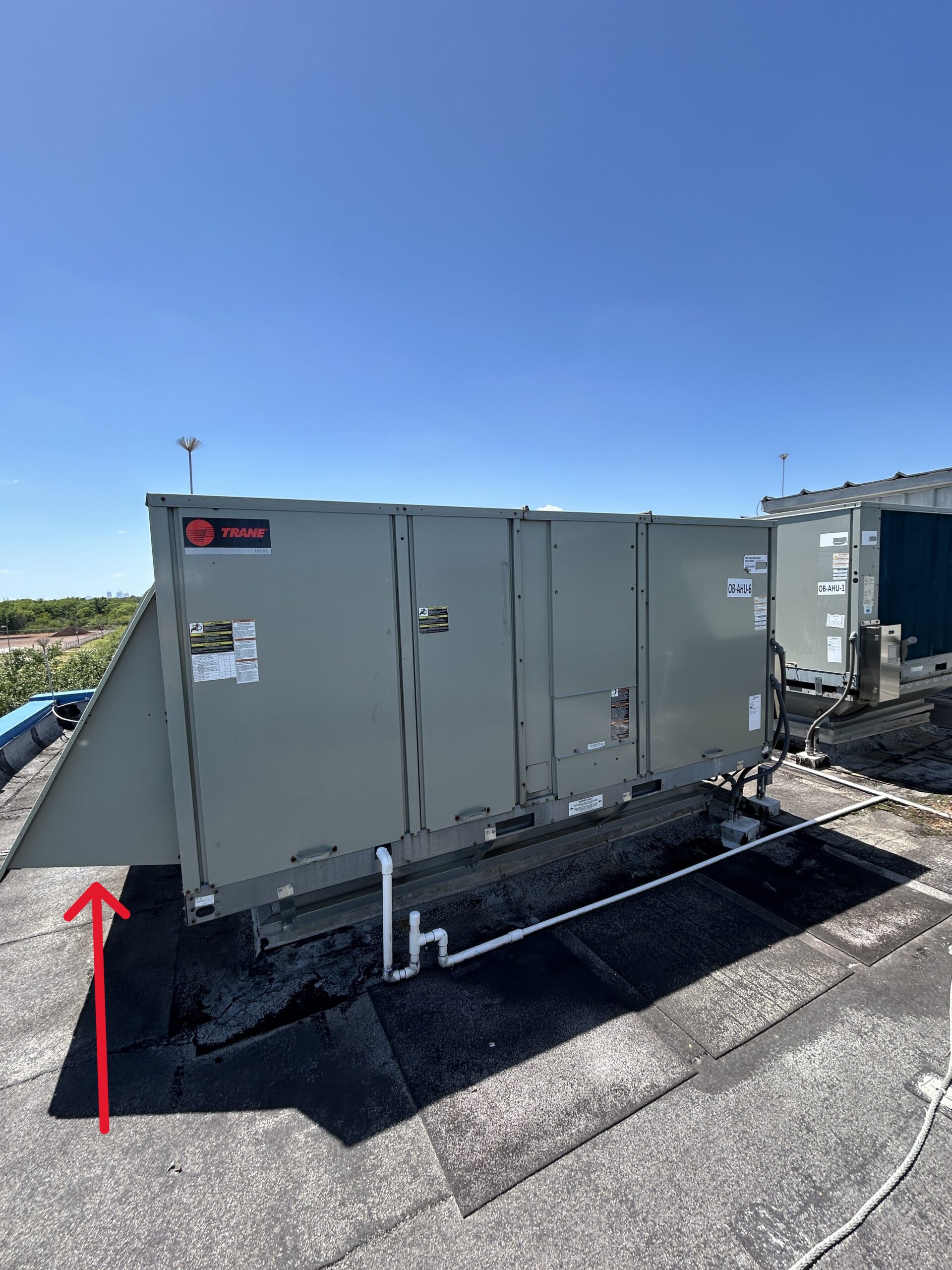
Alternatively, for a packaged RTU, outdoor air is simply introduced into the system by an outdoor air intake hood accessory added onto the unit. This eliminates the need for additional ductwork and wall space for an outdoor air intake louver, making providing outdoor air into the HVAC system much simpler. In Figure 1, the outdoor air intake hood is indicated by the arrow.
Energy recovery ventilator: Packaged RTUs can be provided with energy recovery ventilators for applications with high ventilation loads. The energy recovery ventilator transfers air from the exhaust airstream into the outdoor airstream. Energy recovery ventilators also assist in reducing the cooling and heating loads for the HVAC system. Some packaged RTU system manufacturers can factory install energy recovery ventilators directly into the unit.
Hot gas reheat: Humidity control in buildings is an important aspect in providing occupant comfort. Humidity control is also essential in maintaining quality in specific applications such as sensitive medical procedures. Packaged RTUs can be factory provided with a hot gas reheat coil downstream of the evaporator, allowing the unit to dehumidify the supply air without using new energy. Packaged RTUs with hot gas reheat coils installed provide the system with operational flexibility and enhanced humidity control.
Exhaust system: Packaged RTUs can be ordered with a factory-installed exhaust fan. The exhaust fan assembly helps maintain proper building pressurization. A packaged RTU with a factory-installed exhaust fan reduces the need for additional equipment and controls. Powered exhaust systems with dedicated fans are a common solution; however, a barometric relief damper can also be used to relieve excess air when the building becomes over-pressurized.
Controls: Controls for a packaged RTU are factory installed and integral to the unit itself. This allows for factory testing and installation ease. However, some owners opt to only have the minimum factory controls and integrate the RTU into their own control system.
Heating systems: Heat pump RTUs provide both heating and cooling using the refrigeration cycle. In cooling mode, the heat pump operates like a conventional air conditioner. In heating mode, the refrigeration cycle reverses. This allows the outdoor coil to absorb heat and transfer it indoors.
Other options for heating include auxiliary electric heating coils, natural gas heating and other fossil fuel heating sources.
Codes and standards governing RTUs
Multiple codes and standards pertain to packaged RTUs; key codes and standards are listed. Generally, these codes can be categorized as related to unit construction, building codes and other considerations.
Unit construction:
- NFPA 70: National Electrical Code: Electrical components, devices and accessories will be listed and labeled, as defined in NFPA 70, by a nationally recognized testing laboratory and marked for the intended location and application.
- NFPA 90A: Standard for the Installation of Air-Conditioning and Ventilating Systems: The design, fabrication and installation of RTUs and components will comply with NFPA 90A.
- ASHRAE Standard 15: Safety Standard for Refrigeration Systems: RTUs must comply with ASHRAE 15 for refrigeration system safety.
- ASHRAE Standard 90.1: Energy Standard for Buildings Except Low-Rise Residential Buildings: The energy efficiency of HVAC units, including RTUs, is governed by ASHRAE 90.1.
Building code:
- International Building Code (IBC): Either the IBC or the local jurisdiction equivalent covers structural support, rooftop loading, wind resistance, seismic restraint, fire ratings, equipment anchorage and roof penetrations.
- International Mechanical Code (IMC): Either the IMC or the local jurisdiction equivalent covers HVAC system installation, ventilation, equipment access, combustion air, exhaust systems, rooftop clearances and condensate disposal.
- International Energy Conservation Code (IECC): Either the IECC or the local jurisdiction equivalent covers HVAC efficiency, economizer requirements, insulation, controls, commissioning and energy performance standards.
Additional considerations:
- SMACNA HVAC Duct Construction Standards: The industry standard for duct gauge thickness, reinforcement spacing, flange construction, transverse joints, leakage classes, exterior duct construction, support spacing and weatherproofing.
- ASCE 7: Minimum Design Loads and Associated Criteria for Buildings and Other Structures: The standard for wind loads on rooftop equipment, seismic restraint requirements, equipment anchorage, curb attachment forces, exterior ductwork support requirements. This standard affects RTU anchorage details, supports and wind restraint cables/bracing.
- Occupational Safety and Health Administration: Walking-Working Surfaces Standards: This standard applies to rooftop access, fall protection, ladders, guardrails and maintenance pathways.
- Manufacturer required clearances: Manufacturers publish their required clearances for a unit’s maintenance, service, repair and for adequate airflow for proper operation.
Benefits of packaged RTUs
Space efficiency: One of the primary advantages of packaged RTUs is space efficiency. Packaged RTUs eliminate the need for the indoor floor space that is typically required for split systems, which have both an indoor and outdoor unit. Leveraging a packaged RTU can even eliminate the space needed for mechanical rooms or equipment closets.
Noise efficiency: Implementing a packaged RTU allows for any unit noise to be at the exterior of the building. This can be beneficial especially for noise-critical structures where sound levels inside the building may be sensitive. Lightweight roof structures, short ducts runs and lack of insulation at roof curbs can increase noise within the occupied area, but proper detailing can mitigate these concerns.
Piping efficiency: Because of the configuration of packaged RTU systems, all the refrigerant piping is internal to the unit, whereas split systems require refrigerant piping to be routed from the internal unit to the external unit. Packaged RTUs allow for fewer building penetrations, less complex pipe routing and reduced construction coordination.
RTU factory-installed and tested piping systems reduce the risk of improper refrigerant pipe installation (e.g., poorly brazed and flared joints, lack of pressure testing, failure to purge and evacuate piping, missing insulation, missing filters dryers and site glasses, improper oil traps and incorrect pipe sizes).
Energy efficiency: Most packaged RTU manufacturers tout that their units are more energy efficient because of variable speed fans, energy recovery systems, smart building controls, high-efficiency compressors and economizers.
However, the economizer function, which is an IECC requirement (with a few exceptions) is much more likely to be used and provide free cooling to a building than any other unit type because of the simplistic controls required to activate it. When compared to DX split systems, each RTU model is a complete system and does not require finding the efficiency of a particular indoor unit and outdoor unit combination.
RTUs have options for integrated economizers. Some RTUs include energy-efficiency upgrades such as multispeed or fully variable indoor fan controls, integrated energy recovery ventilation and staged or modulating heating and cooling capacities that are not typical on traditional DX split systems.
Ease of maintenance: Maintaining a packaged RTU allows for some unique benefits. Being located on the roof, unit service can usually occur without disrupting building occupants. Additionally, being on the roof usually permits greater service clearances as the RTU mechanic does not have to try and squeeze the unit into a small mechanical room or equipment closet. A single packaged unit from a single manufacturer provides factory-coordinated components and quicker troubleshooting.
Scalability: Buildings can be designed with multiple RTUs serving different areas. This scalability provides flexibility and reliability. If one unit stops working, the remaining units can continue to condition other building zones.
Packaged RTU applications
Scenarios in which these types of units are the most beneficial are space types that have limited physical space, are multitenant, are likely to undergo renovations or have high-airflow requirements. Some examples include:
- Gun stores
- Office buildings
- Supermarkets
- Restaurants
- Retail spaces
- Tollbooths
- Warehouses
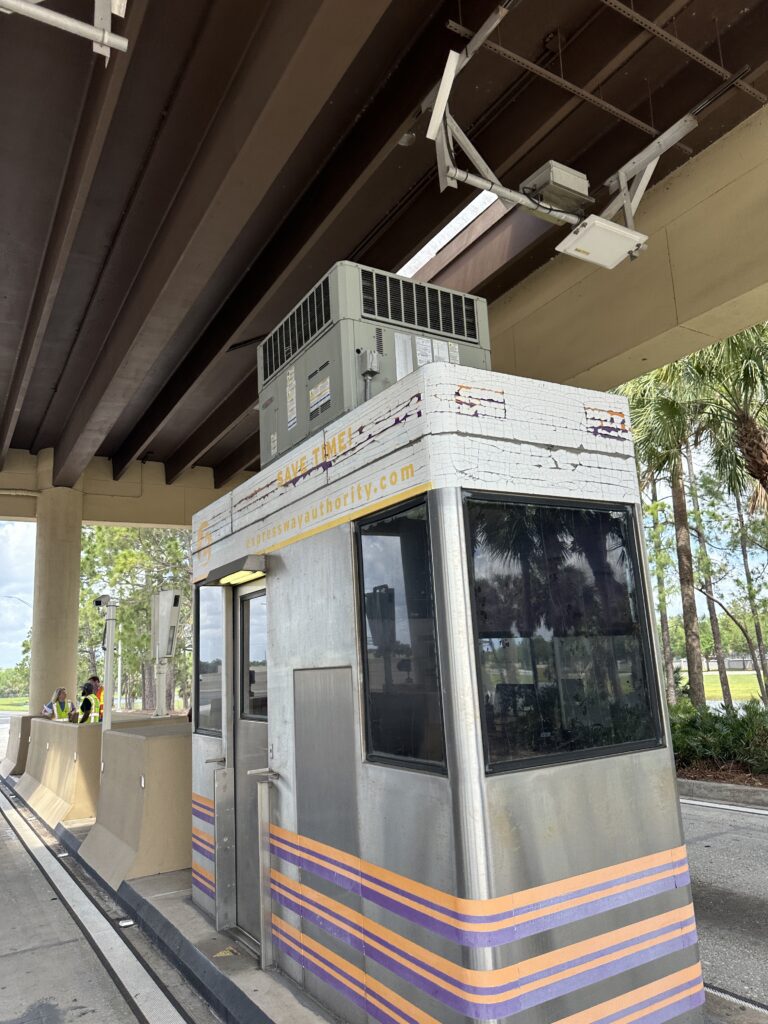
In Figure 2, a packaged roof top unit is provided to condition a tollbooth.
Limitations of packaged RTUs
While packaged RTUs provide many benefits, they also have limitations. A key design consideration for packaged RTUs is the structural effect on the roof. Therefore, during design, engineers must verify the roof can safely support the large equipment weight and they must account for wind load, seismic load and vibration isolation.
Another major concern is weather exposure. Rooftop systems are exposed to all types of weather year-round. Environmental exposure can cause corrosion and wear on the equipment. During design, engineers must determine the appropriate corrosion-resistant coatings and specialized materials to promote equipment longevity.
Although noise was mentioned above as a benefit, it can also be a concern for owners. In places where there are exterior noise restrictions, like in a neighborhood, keeping some equipment internal to a building may be a better alternative.
Careful attention also needs to be paid to sealing penetrations and making sure the building envelope is weathertight. If the roofing system is installed poorly, roofing and moisture problems can occur.
Last, when it comes to energy efficiency, the 2024 IECC has the same minimum efficiency requirements for air-cooled air conditioners regardless of whether they are single packaged systems or a split system.
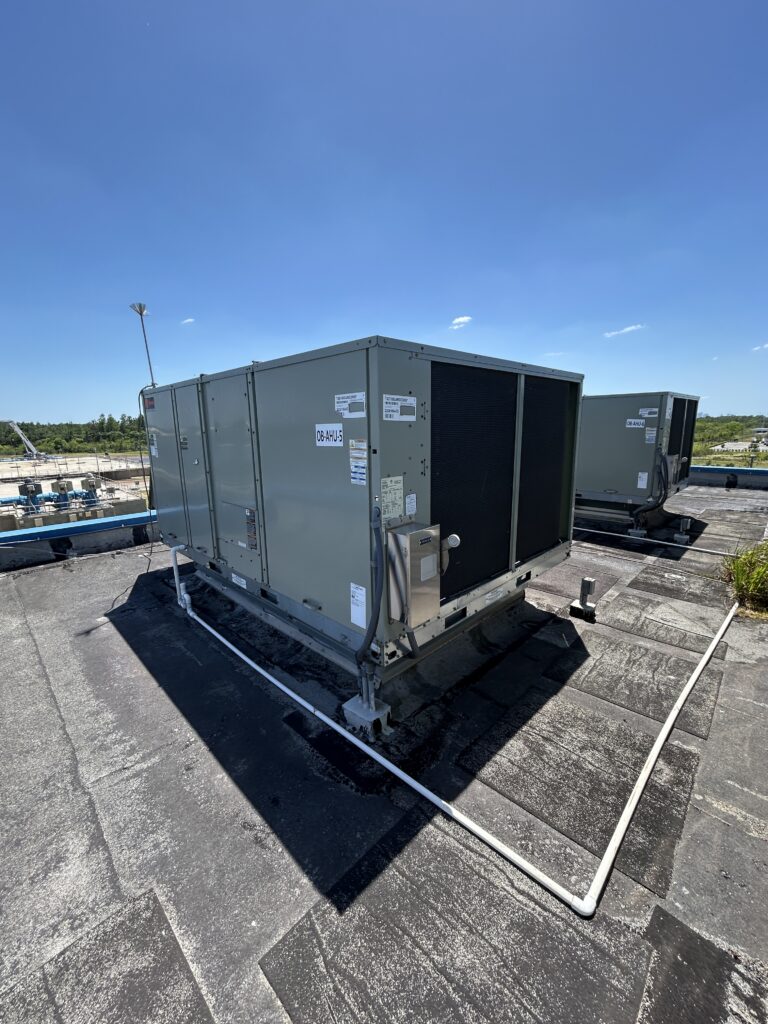
Although packaged RTUs reduce the need for refrigerant pipe routing, condensate discharge pipe routing must be accounted for. In Figure 3, the condensate piping is shown to run along the roof and is sustaining plant life. A concern for maintenance is that these units are out of sight and out of mind, so the systems and surrounds can become neglected without a careful maintenance plan.