While most people are aware of the application of air-to-water heat pumps to improve the efficiency of heating and cooling systems, the opportunities to consolidate infrastructure and maximize energy reuse are often overlooked.
Learning objectives
- Identify complementary building systems that can leverage energy reuse or waste heat recovery to improve the energy efficiency of heating and cooling systems.
- Understand how air-to-water heat pumps support heating-only and cooling-only solutions together with simultaneous heating and cooling (waste heat recovery).
- Appreciate how hybrid air-to-water heat pump solutions can augment traditional heating and cooling systems while enhancing energy performance.
Heat pump insights
- Mechanical system selection depends on factors such as building type, scale, climate, cost, energy goals and humidity control and the best solution often uses a heat pump strategy that matches those conditions to maximize performance and ROI.
- In simpler, lower-ventilation buildings, air-to-air heat pump systems can work well, while larger, more humid or more ventilation-intensive applications often benefit from hydronic or geothermal approaches, with air-to-water heat pump systems offering a flexible middle ground that can also recover waste heat.
- Leveraging combined solutions for heating and cooling can reduce costs while providing significant energy improvements.
The design of mechanical systems varies widely based on multiple factors that include program type, building scale, local climate, available resources, first and operating costs, energy performance, temperature and humidity constraints, code requirements, system complexity and reliability. The optimum solution balances these factors for each client to provide the best outcome and return on investment.

Air-to-air heat pumps extract or reject heat from outside air to provide heating or cooling to the building. These units are common in residences and for larger applications like office environments and others with reduced levels of ventilation.
Air-to-water heat pumps, conversely, extract or reject heat from outside air to condition water-based hydronic heating and cooling systems. Properly configured, these same air-to-water heat pumps can further support water-to-water heat exchange, allowing the heat pumps to cool one system while simultaneously heating another to recover waste heat.
Program type and building scale
A small office building with minimal ventilation and a wider acceptable range of relative humidity criteria can be supported easily by air-to-air heat pumps. Even larger versions on multiple floors leverage this same technology while incorporating free cooling and other efficient operating modes based on code requirements and performance goals. As program types change and ventilation rates increase or in more humid climates, air-to-air heat pump systems become challenged in both performance and efficiency.
With continuous system operation and humid outdoor conditions, the indoor relative humidity will fluctuate with compressor operation for sensible cooling. When the heat pump is cooling, the cold supply air removes excess moisture from the outside air. With the space temperature satisfied and compressor operation suspended, indoor humidity will quickly climb until cooling is needed again — which, over time, will lead to elevated indoor humidity levels. With elevated outdoor humidity, this same technology can support dedicated outside air systems (DOAS).
DOAS precondition outside air to be delivered to other heat pump units and when configured to provide a consistent cool supply air temperature will limit upper-level indoor humidity within allowable limits (typically 55% relative humidity or less). Note that in warmer climates it may be necessary to first use energy recovery with relief or exhaust air to lower the entering air temperature to the heat pump coil, allowing it to achieve the desired cool supply temperature year-round. The use of DOAS then allows the local heat pump units to cool only as needed for temperature without concerns of excess indoor relative humidity. With further increased ventilation or with excessive outdoor humidity levels, another systems approach is required.
Application of hydronic heating and cooling systems
Most air-to-air heat pumps are limited in the temperatures and excess humidity levels they can support. This is due to the characteristics of the refrigerants used and limitations of the associated refrigerant coils. Providing for increased ventilation, increased cooling and heating and/or tighter environmental controls is often achieved using hydronic systems.
With air-to-air heat pumps, the heating and cooling is local to the unit with the refrigerant providing the transfer of heating and cooling to the air directly. Hydronic systems decouple heating and cooling from the conditioning of the air. Hydronic heating and cooling systems, often centralized, are then distributed to air-handling units with hydronic coils. This simplifies maintenance and control of the air handling units, allowing them to support ever increasing levels of outdoor ventilation and associated space conditioning.
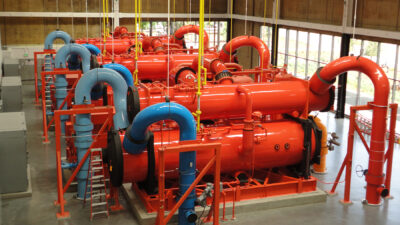
Traditional hydronic systems decouple heating from cooling. For heating water systems, they may use natural gas or electric boilers or steam with larger facilities or when located on a campus. Smaller chilled water systems may use air-cooled chillers with larger, more efficient systems leveraging water-cooled chillers and cooling towers for heat rejection. While these traditional approaches can be efficient and effective, they remain inefficient as they miss an opportunity to leverage waste heat rejection for space heating.
Geothermal water-to-water heat pumps
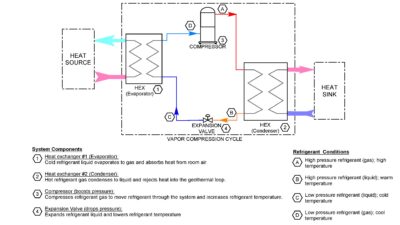
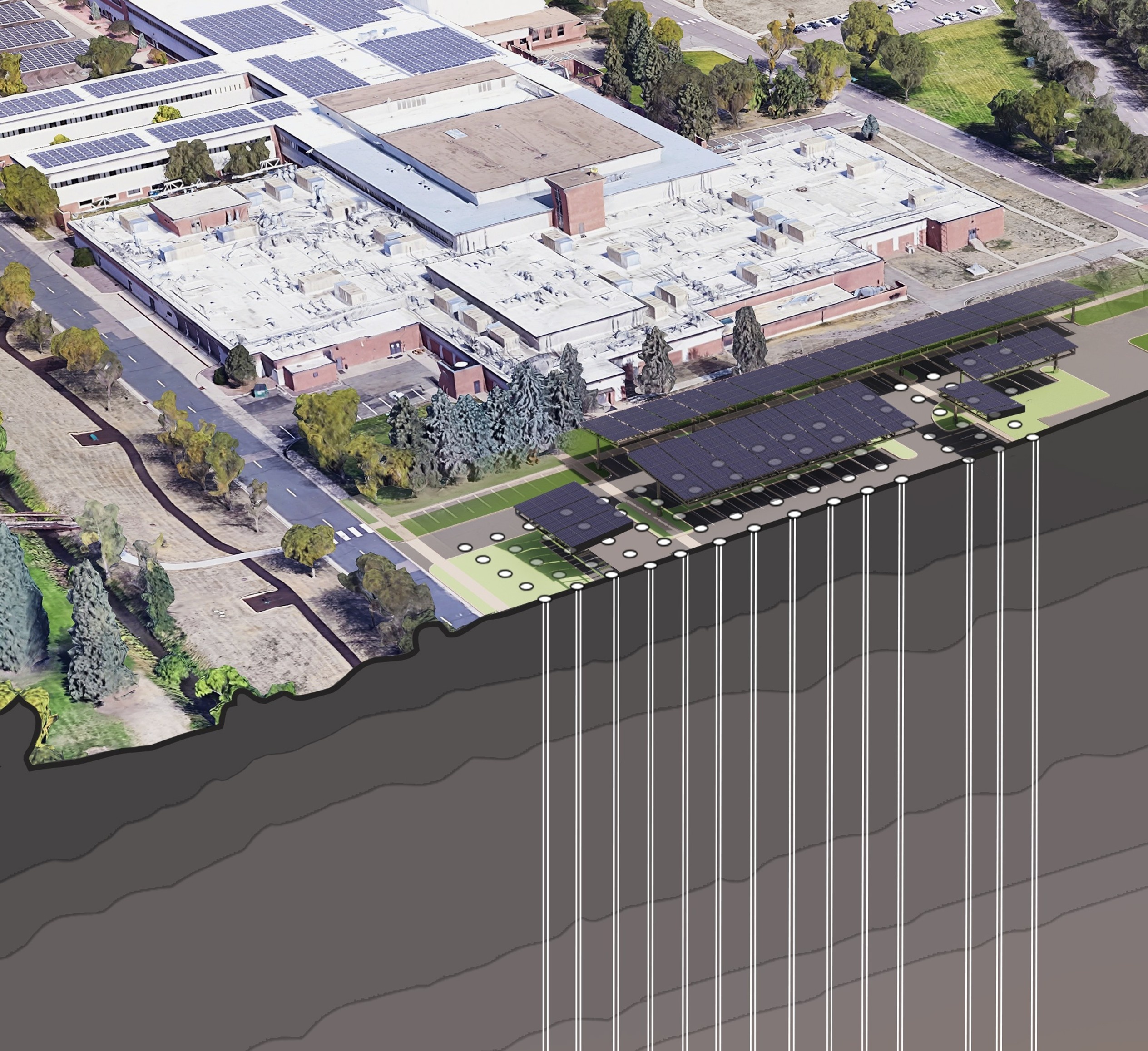
Geothermal systems use the ground as a heat sink to store and extract energy over the year. Water-to-water heat pumps using a geothermal borehole network extract heat from the ground and convert to beneficial heating in winter via the heating water system.
In summer months, heat from the building is exported to the ground using those same heat pumps, providing building cooling in the form of chilled water. Properly configured, these systems can also support simultaneous heating and cooling (independent of geothermal system) when similar quantities of heating and cooling demand occur within the building.
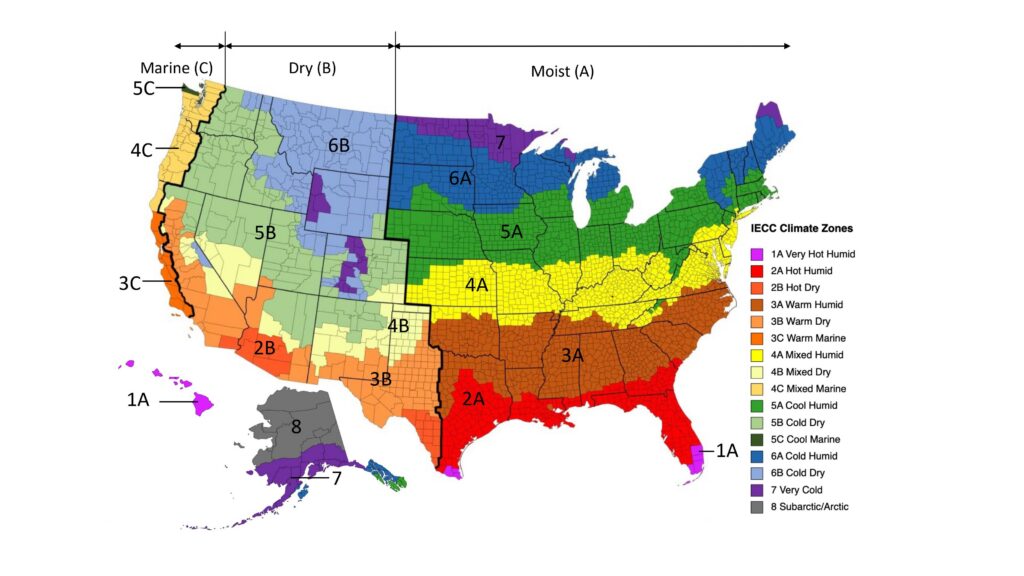
For geothermal systems to be effective they require balanced heating and cooling load profiles. The International Energy Conservation Code defines climate zones. In the United States, climate zones range from Zone 1 (very hot) to Zone 7 (very cold), with upper portions of Alaska as Zone 8 (subarctic/Arctic). Geothermal systems thrive in Zone 4 (mixed) but when designed appropriately with the right load profile can be effective in Zone 3 (warm) and Zone 5 (cool). Note that the climate zones have additional identifiers of A, B and C, representing humid, dry and marine (or coastal) climates.
Air-to-water heat pumps bridge the gap
While not as efficient as water-to-water heat pumps, air-to-water heat pumps can operate in a wide range of climate zones. Like the air-to-air heat pumps, air-to-water heat pumps extract or reject heat to the outside air but then transfer that energy to hydronic heating and cooling systems. Like water-to-water heat pumps, these same heat pumps also support simultaneous heating and cooling. With consistent heating and cooling loads year-round, these systems can minimize heat rejection (to outside air) and instead provide waste heat recovery to the heating systems.
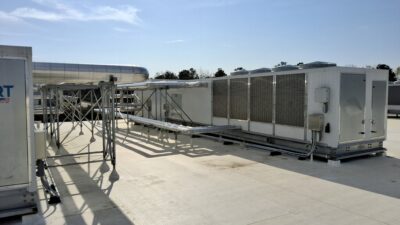
Most air-to-water heat pumps use modular construction, providing increased levels of reliability with the ability to continue normal operation with the failure of any single module. As they extract or reject heat from the outside air, the air-to-water heat pumps are located outdoors.
Given the region, the outdoor installation may further require the use of glycol-based antifreeze solutions in the heating and cooling systems to protect against freezing. Propylene glycol solutions are environmentally friendly but have a lower system efficiency as compared to ethylene glycol solutions which are toxic. The presence of either solution will de-rate the capacity of the system and must be factored into the system sizing. Switching between heating and cooling blends the heating and cooling systems over time, so both systems must have the same water chemistry and level of freeze protection.
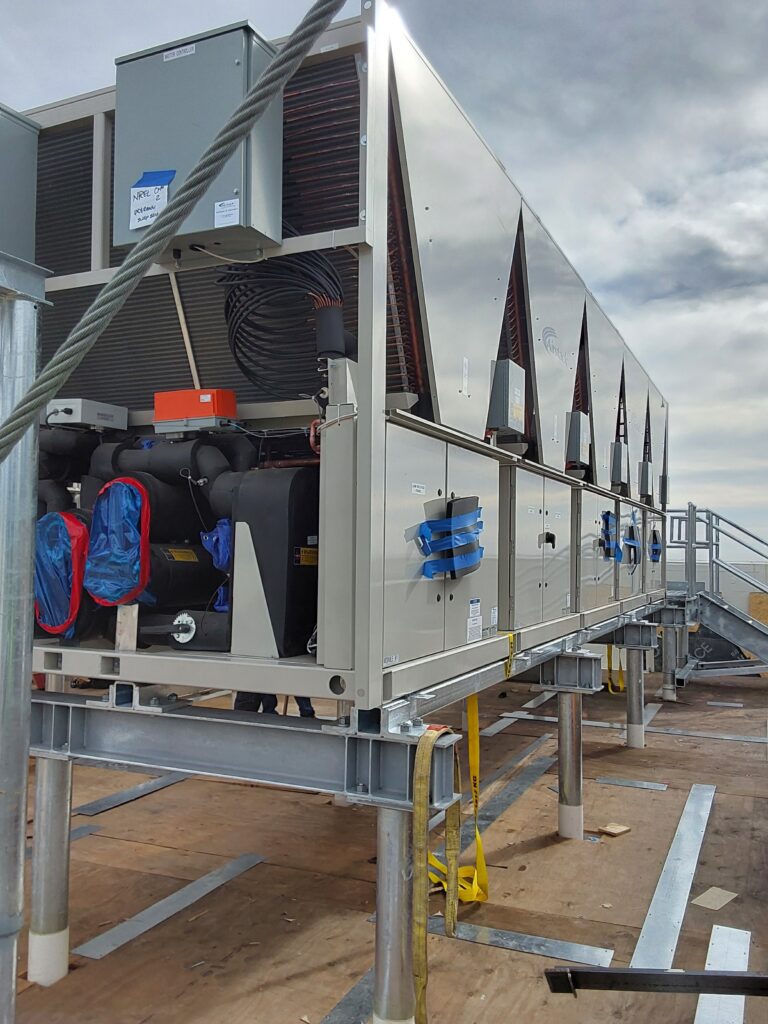
The modular approach of air-to-water heat pumps allows modules to stage on or off in response to the system load or during a defrost mode in winter. This results in a stepped water flow pattern through active modules as opposed to a more linear flow pattern with traditional heating and cooling equipment.
Note that modern digital scroll and screw compressors can adjust their capacity to meet the load but depending on the control method the system flow could still be stepped. The system pump configuration needs to be able to take this into account, providing additional control valves and sensing in variable-primary systems or dedicated primary pumps and local controls for primary-secondary pumping systems.
Another concern often raised by facilities is relative to system complexity. While most facility personnel are familiar with traditional heating and cooling hydronic systems, the different operating modes of air-to-water heat pumps (air-to-water heating, air-to-water cooling, simultaneous heating and cooling) and the modular design raise concerns. As a packaged piece of equipment, however, the controls for the operation of the air-to-water heat pumps are often built in, with the building controls simply enabling them.
Hybrid solutions for heat pumps
Consider existing facilities with traditional heating and chilled water systems. An expansion to the facility requires additional heating and cooling capacity, but the space within the central plant is limited. Trending from systems operation highlights that both the heating and cooling systems operate year-round, with the chilled water system challenged in winter when operating at low load conditions due to larger chillers.
Furthermore, space limitations do not support matching the existing heating and cooling equipment sizes without a central plant expansion, though there are sufficient power and space in an adjacent equipment yard for outdoor equipment. One potential solution has outdoor air-to-water heat pumps providing the increased heating and cooling capacity needed for the facility expansion. Because these provide both cooling and heating, they can be sized for the worst-case demand of either system, are connected to their respective systems and can be configured for simultaneous heating and cooling operation.
While air-to-water cooling on hot days has reduced energy performance, simultaneous heating and cooling shows significant energy improvements. Simultaneous heating and cooling also reduces natural gas use, and, in the case of water-cooled chilled water systems, saves water. From trending data, we know the simultaneous cooling capacity of the heat pumps will exceed the winter cooling demand.
In winter heating-dominated months, the air-to-water heat pumps are enabled to meet the winter cooling load while supplementing facility heating loads. This allows primary cooling equipment to shut down over this period, providing better control, reducing operating hours for primary equipment and potentially saving water for heat rejection for water-cooled systems. If the heating demand exceeds winter cooling demand, the remaining heat pump modules can operate in air-to-water heating to supplement heating.
In summer cooling-dominated months, air-to-water heat pumps meet summer heating loads while providing beneficial cooling. Like in winter, this allows primary heating equipment to shut down and can significantly reduce summer natural gas usage. With cooling demands exceeding simultaneous demands for heating, remaining heat pumps operate in air-to-water cooling to supplement the cooling system.
As seasons transition, the air-to-water heat pumps can cover both cooling and heating demands. This allows air-to-water heat pumps to be the first stage of cooling or heating, with their onboard controls optimizing their operation. Then as the cooling and heating loads increase beyond the capabilities of the air-to-water heat pumps, the base systems are enabled and operate to meet the balance of the load.