
Commissioning feedback revealed that refinements to discharge air temperature reset, economizer logic and operating state transition thresholds reduced reheat and humidification energy without compromising OR humidity control.
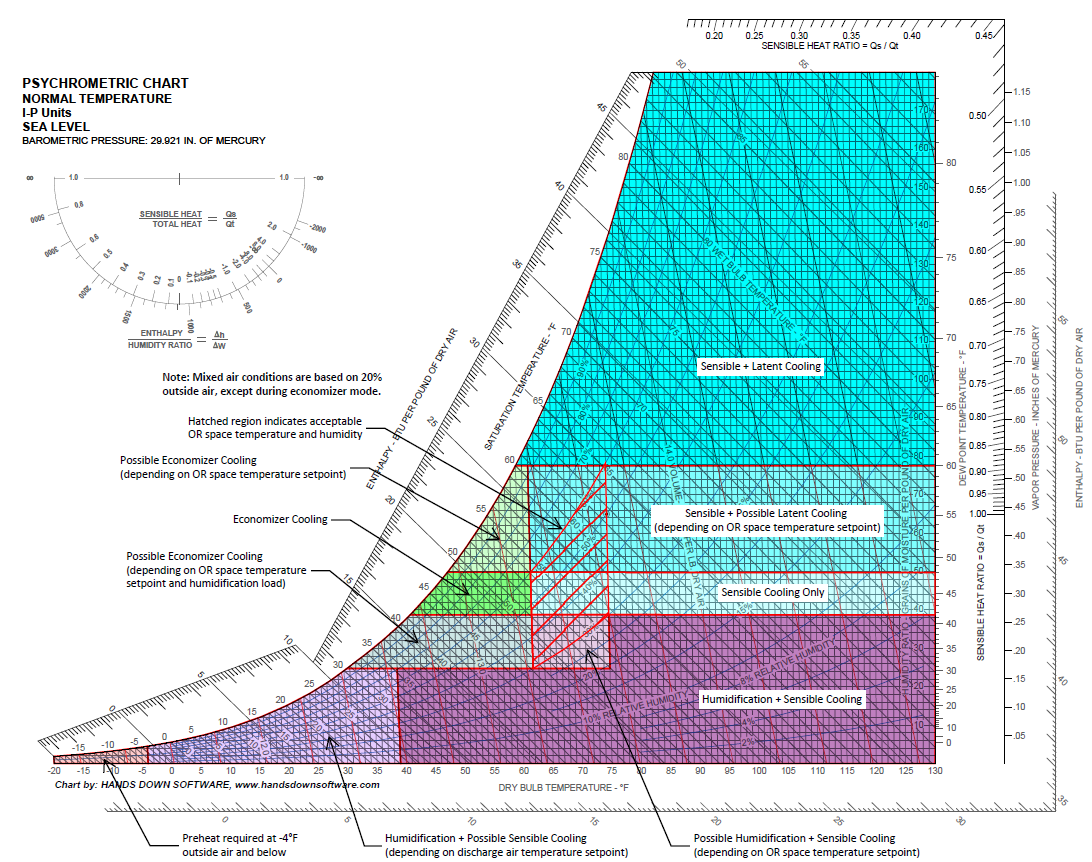
Operating room (OR) air handling units (AHUs) in hot‑humid climates present a unique control challenge. Space temperature must remain within ASHRAE Standard 170: Ventilation of Health Care Facilities allowable range while relative humidity is tightly maintained between 30% and 60%.
These requirements often limit the effectiveness of conventional energy‑saving strategies such as economizer operation and aggressive supply air temperature (SAT) reset. The following demonstrates how commissioning feedback and operational experience informed refinements to SAT and economizer control in dewpoint‑driven OR AHUs.
SAT reset in a hybrid OR AHU
The first project involved a hybrid operating room suite served by a dedicated AHU using a dewpoint‑based control strategy. The system featured a primary cooling coil with a desiccant wheel controlling to a low discharge air dewpoint to maintain latent performance and a secondary cooling coil trimming discharge dry‑bulb temperature. Active humidification was provided to maintain minimum space humidity.
Rather than operating at a fixed discharge air temperature, the AHU incorporated a zone demand‑based SAT reset strategy. At predefined intervals, the control system evaluated zone cooling demand using terminal unit cooling loop output as a proxy and adjusted the SAT setpoint incrementally. During periods of low demand, SAT was allowed to reset upward, reducing unnecessary cooling at the AHU and associated terminal reheat. As cooling demand increased, SAT was reset downward within defined limits to maintain space temperature control.
Critically, the AHU cooling control loop was intentionally designed to preserve dehumidification performance during SAT reset. The primary cooling coil and desiccant wheel continued to prioritize discharge air dewpoint, ensuring that latent control was not compromised during reset operation. Downstream of the desiccant wheel, the secondary cooling coil controlled discharge air dry‑bulb temperature to the setpoint dictated by the SAT reset sequence.
This approach demonstrated that, with appropriately configured cooling controls, SAT reset can be successfully applied in OR AHUs without increasing humidity risk. It also highlighted that fixed, low SAT — while robust for humidity control — can drive excessive reheat energy during low‑load conditions.
AHU economizer and operating state refinement
A subsequent project involving a surgical suite AHU serving multiple operating rooms provided an opportunity to refine economizer logic through commissioning. The AHU employed a similar dewpoint‑driven control strategy, including a primary cooling coil and desiccant wheel controlled to a 42°F discharge air dewpoint, a secondary cooling coil for dry‑bulb trim and active steam humidification. The unit operated in four discrete modes: full cooling, economizer with cooling, free cooling and preheat.
Commissioning identified several state‑transition thresholds that could lead to instability or unnecessary energy use. One issue was that the economizer-enabled temperature was below the minimum discharge air temperature setpoint. As a result, once the economizer enable criteria were met, the unit could be forced fully out of mechanical cooling because outdoor air alone was already cool enough to achieve the target discharge air temperature. Raising the economizer enable temperature to better align with the operating room space temperature produced a smoother transition from mechanical cooling to free cooling operation.
Additional refinements included tightening the transition from economizer with cooling to free cooling by reducing the cooling coil valve threshold from 20% open to 5% open, as commissioning observations indicated that meaningful latent cooling was still occurring with the valve at 20% open. This adjustment ensured adequate latent control before disabling mechanical cooling. A more robust return‑to‑cooling path was also implemented, triggering when either the economizer damper exceeded 95% open or the discharge air dewpoint rose above setpoint.
Finally, a humidification‑based economizer lockout was added. When humidifier output exceeded 5%, economizer operation was disabled and the unit reverted to minimum outdoor air. This safeguard prevented increased outdoor air intake from driving excessive humidification energy during dry conditions.
AHU commissioning importance
These projects reinforced that economizer availability does not guarantee energy savings in OR AHU applications. Humidity control frequently dominates system energy use and small control thresholds can significantly affect performance. Commissioning review proved essential in identifying these interactions and refining SAT reset and economizer logic to balance energy efficiency, stability and humidity control.