This case study explores how St. John’s University used geothermal systems, energy modeling and high-efficiency HVAC design to reduce energy use and carbon emissions at its new St. Vincent Health Sciences Center.
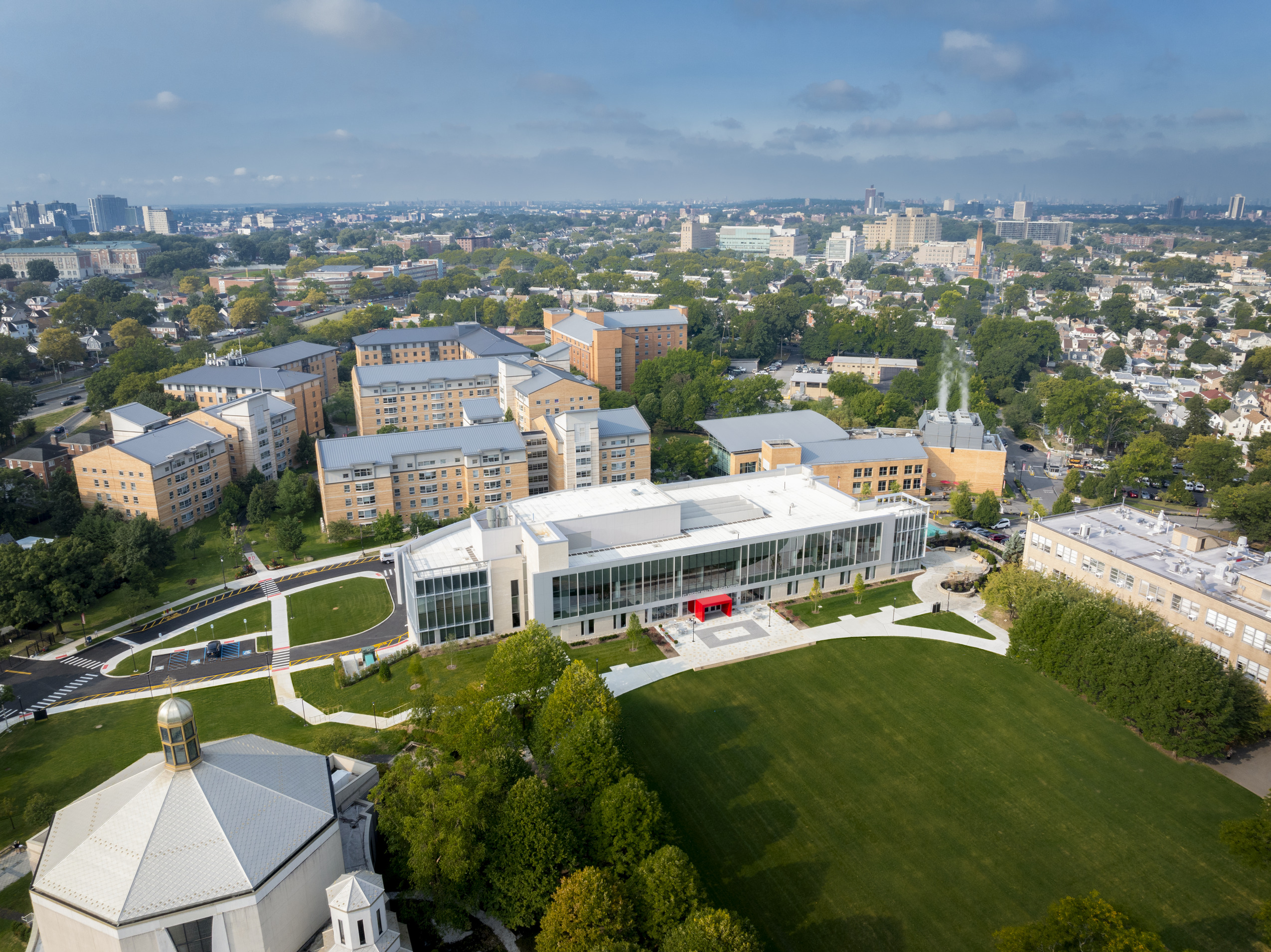
Located in the Queens Borough of New York, St. John’s University embarked on the St. Vincent Health Sciences Center, a $75 million, 70,000-square-foot building located on the edge of the campus’ historic Great Lawn. The building contains a variety of simulation labs, teaching labs, classrooms and faculty offices centered around a skylit three-story study commons that provides space for a new campus program designed to educate the healthcare workers of tomorrow. This building is LEED Silver certified, with solar panels, geothermal field and high-performance envelope design.
HVAC decarbonization goals
The initial plan for this project involved the use of conventional heating, ventilation and air conditioning (HVAC) systems integrated with the existing central utility plant. However, to meet ambitious sustainability targets and comply with New York City’s Local Law 97, an alternative HVAC solution was required. Local Law 97 imposes stringent carbon emission limits on buildings exceeding 25,000 square feet, regulating carbon output by establishing emission caps and enforcing financial penalties for any violations.
Driven by Local Law 97’s decarbonization goals, CannonDesign began energy modeling at the schematic design stage to evaluate several system options. Before selecting an HVAC approach, the team assessed how each option would affect both energy consumption and carbon emission penalties in the facility. The systems considered included:
- Geothermal systems paired with active chilled beams
- Decentralized geothermal water-to-air heat pumps with dedicated outdoor air system (DOAS)
- Centralized geothermal water-to-water heat pumps with DOAS (This was the selected system.)
- Geothermal water-to-refrigerant variable refrigerant flow (VRF) system with DOAS
- Air-cooled chiller and gas-fired boilers with active chilled beams
- Air-cooled VRF energy recovery system
- Distributed water-to-air heat pumps supported by an electric boiler and fluid coolers
Alongside the assessment of various HVAC systems, this project also concentrated on implementing passive design strategies to minimize the building’s energy load, thereby enabling optimal performance of the HVAC equipment. Energy modeling envelope strategies across different systems indicated that energy use intensity (EUI) ranged from 54 for the highly efficient geothermal with chilled beam system to nearly 100 for the conventional system integrated with a new gas-fired boiler system. These EUI values resulted in penalties. When considering the current electrical grid’s carbon emissions profile, the least efficient system incurred costs exceeding 50% greater than those of the most efficient option.
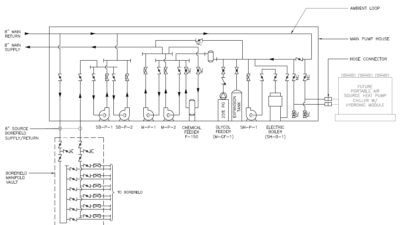
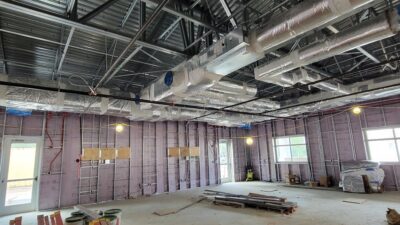
The system selected for the facility uses a four-pipe active chilled beam arrangement to provide both heating and cooling. Ventilation air is supplied by two dedicated outside air handling units, each rated at 16,600 cubic feet per minute. The central plant features a heat recovery heat pump system comprising 10 30-ton modules, delivering 300 tons of chilled water and 3,446 MBH (thousand Btu per hour) of low-temperature heating water. This plant is integrated with a geothermal well field containing 66 wells, each drilled to a depth of 500 feet. The geothermal well field design avoids carbon dioxide (CO2) emissions equivalent to 24,500 gallons of consumed diesel. Demand-controlled ventilation is deployed in all areas, managed through occupancy sensors and CO2 sensors to ensure optimal indoor air quality and energy efficiency.