An office building client opted for a unitary packaged RTU as its HVAC option.
A client initially requested that a new office building in a cooler climate (climate zone 4A) be conditioned using split systems, consistent with their approach on a previous project. However, after reviewing comparative 3D models and having the applicable code requirements explained, the client was persuaded that a packaged rooftop unit (RTU) solution would provide a more effective design for its needs.
The 2024 International Energy Conservation Code (IECC) requires an air or water economizer for certain cooling systems. Economizers are required for chilled water systems with a total cooling capacity as specified in the IECC, for individual fan systems with a cooling capacity greater than or equal to 54,000 British thermal units per hour (Btuh) in buildings other than Group R occupancy. They are also required for individual fan systems with a cooling capacity greater than or equal to 270,000 Btuh in buildings other than Group R occupancy.
A few exceptions to providing an economizer are permitted relating to climate zone, humidification and operation time, including supermarkets with open refrigerated casework, high-efficiency equipment and heat recovery systems. These code requirements are intended to improve energy efficiency by using favorable outdoor air conditions to offset mechanical cooling loads, thereby reducing overall energy consumption and having an added benefit of reducing operating costs.
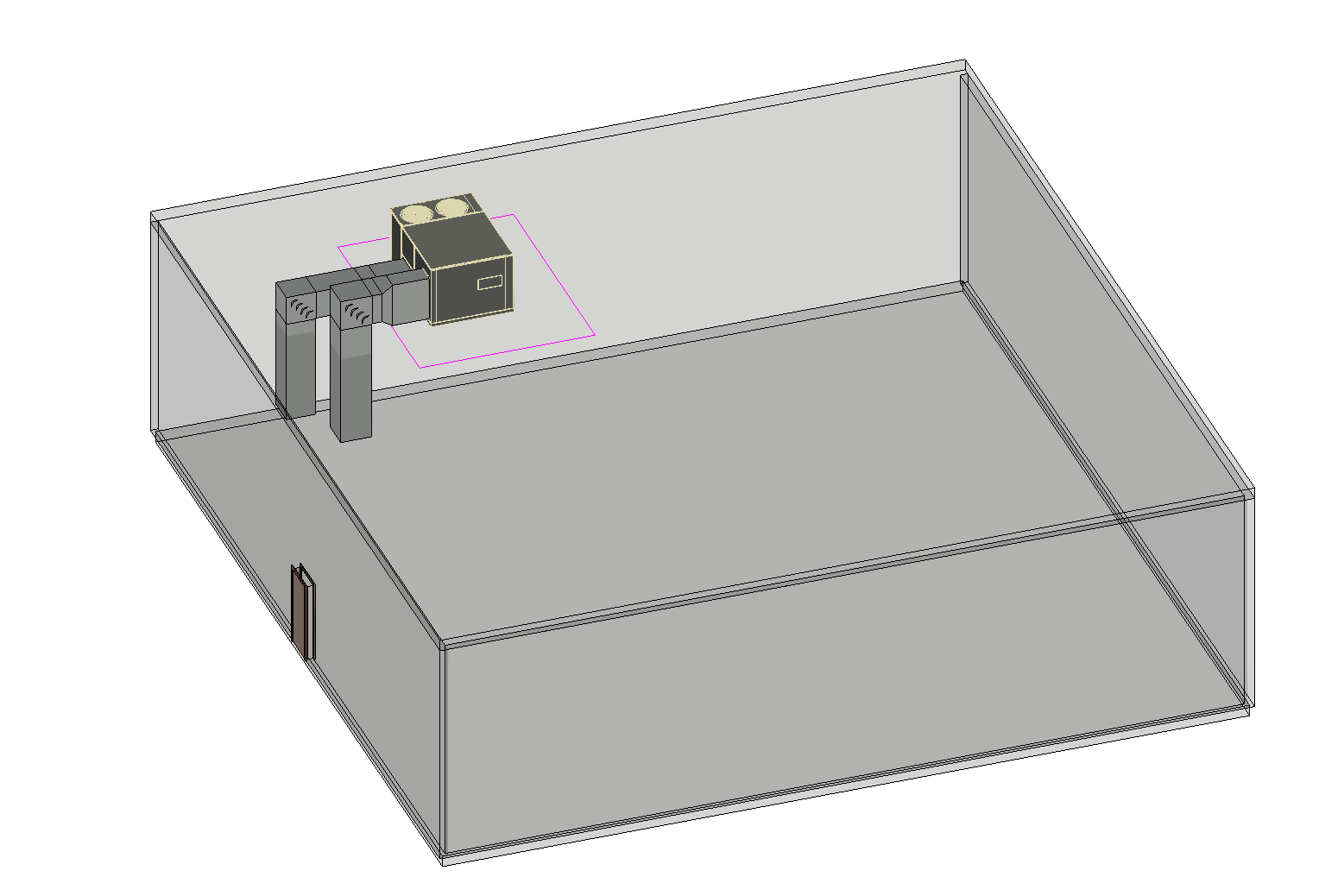
In Figure 4, the unitary packaged RTU is shown with the supply and return ductwork dropping through the roof structure and into the building. There are no secondary pieces of equipment required for the economizer to function; only the economizer built into the unit and the proper controls (which typically include outdoor temperature and humidity sensors) are needed. The packaged 20-ton unit has an airflow of 8,000 cubic feet per minute (cfm). The supply ductwork is 30×30 inches and the return ductwork is 32×32 inches. This configuration simplifies installation and minimizes the coordination needed between trades, making it a practical solution for many commercial applications so long as the roof structure can support the equipment.

In Figure 5, an example split system is shown with the supply and return ductwork for the building. Additional equipment is required for the economizer to function. An intake louver is connected to an outside air duct, which is tied into the air handling unit supply ductwork. An exhaust louver is connected to an exhaust air duct that is tied into the air handling unit return.
Components for controls are also needed; these can include dampers, controllers and an outdoor temperature sensor and humidity sensor. The 20-ton split system has an air handler with a capacity of 8,000 cfm. The supply ductwork is 30×30 inches and the return ductwork is 32×32 inches. Each louver is 6×6 feet. This added complexity increases both initial cost and coordination effort because of integrating more complex controls and ensuring proper sequencing of the economizer operation.
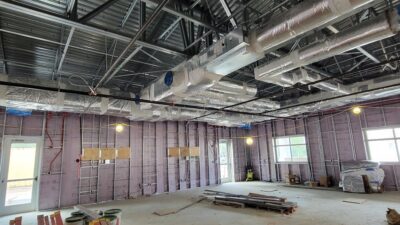
This split system configuration requires a large mechanical room to contain all of the ductwork and control components. An interior view is provided in Figure 6. The spatial impact can also affect architectural planning and reduce usable floor space, which is especially critical in space‑constrained facilities or facilities that lease space to tenants. A reduction in the usable floor area would mean decreased profits.
When an economizer is required, a unitary packaged system is a more logical choice than a split system because of the spatial requirements for intake and exhaust airflow, the additional building penetrations and additional controls components. Additionally, packaged systems often provide a more streamlined commissioning process and reduced maintenance complexity, further supporting their suitability for projects where space, cost and simplicity are key design drivers.
Packaged RTUs continue to grow in popularity in commercial and industrial building design because of their flexibility and customization, ease of maintenance and cost effectiveness. The self-contained aspect of RTUs has simplified installation, reduced required floor space and simplified controls.

As technology continues to advance, packaged rooftop systems have evolved from basic constant‑volume systems to systems that can meet complex thermal and ventilation requirements. Because of their continued increased efficiency, controls integration and electrification, packaged rooftop systems remain one of the most widely preferred heating, ventilation and air conditioning systems in the commercial and industrial building industries.