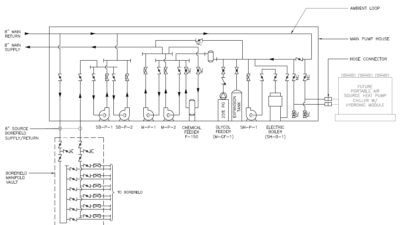
A hybrid air-to-water heat pump system enhances energy efficiency and saves resources by leveraging heat recovery for a healthcare facility.
New technology will almost always be met with a degree of uncertainty. Will the systems work as intended, will parts be available when something fails or needs to be replaced and will the facilities team know how to service it or do they have to rely on a specialist who may not be available when needed? Couple those concerns with a mission critical facility and it is easy to understand the hesitation with air-to-water heat pumps.
With that in mind, consider a remote healthcare facility in International Energy Conservation Code climate Zone 5B (cool and dry). There is a short cooling period in summer with limited monsoons and heating being the dominant mode of operation.
In addition to patient care, the facility also supports both emergency and operating rooms and as such requires a high degree of reliability. Imaging and other core systems will require a minimum level of year-round cooling. While water is available for cooling systems, the preference is to avoid its use should there be water shortages in the future. The facility also requires year-round heating, but at a reduced rate in summer. With no natural gas in the area, all building heating will be electric.
Given the scale and distribution of systems, the initial design concept employed centralized heating and chilled water systems to support continuous facility operation. Variable-speed air-cooled chillers provided cooling in summer and continue operating in winter to support year-round cooling. The air-cooled chillers are highly reliable, have limited maintenance and do not use water. The chillers also have high part-load efficiency pairing well with their limited peak summer operation. Heating is provided by electric boilers.
A waterside economizer was initially considered as an energy efficiency measure but was dismissed given the high part-load efficiency of the air-cooled chillers and concerns about water usage, freeze protection in winter and others. Air-to-water heat pumps were instead considered to efficiently provide year-round cooling and provide for waste heat recovery.
Given the concerns over reliability with new technologies, air-cooled chillers and electric boilers were sized to support the heating and cooling loads without redundancy. Modular air-to-water heat pumps were then sized to be the redundant heating or cooling source with a failure of the central equipment. The heat pumps were also large enough to support all the winter cooling and summer heating loads.
To simplify central plant controls, when enabled the heat pumps use onboard controls to optimize their operation. To limit heat rejection and maximize heat recovery, the central plant controls enable the heat pumps as the first stage of cooling or heating. Once heating or cooling demand exceeds what the heat pumps can provide, secondary equipment stages on. To minimize the electrical infrastructure, similar size heating and cooling equipment are paired on each electrical service with controls limiting simultaneous operation.
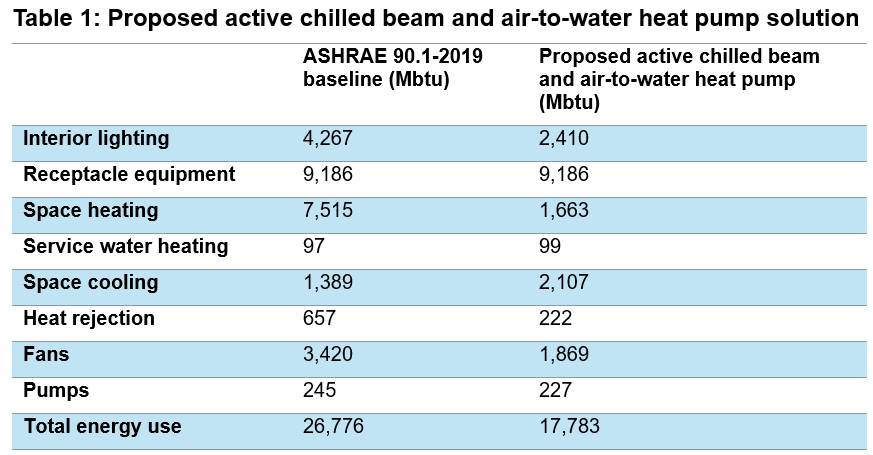
The result is a straightforward installation leveraging the energy benefits of air-to-water heat pumps, limiting secondary equipment uses outside of peak heating and cooling and ensuring the central plant continues in the event of a failure of the heat pumps. When combined with an active chilled beam solution, the use of heat pumps leads to a 32% energy reduction from an ASHRAE Standard 90.1: Energy Standard for Sites and Buildings Except Low-Rise Residential Buildings baseline system. While cooling energy increased relative to a water-cooled chiller baseline, waste heat recovery cut heat rejection energy use (cooling towers) by nearly 70% and space heating-only energy by nearly 80%.
Application of air-to-water heat pumps
Air-to-water heat pumps are also energy-efficient alternatives to electric and natural gas water heaters. Electric water heaters, while simple to operate, only meet baseline energy efficiency and can impact the electrical infrastructure. While natural gas water heaters have a higher energy density, the concern over greenhouse gas emissions has led the push into more electrically sourced alternatives. Air-to-water heat pumps leverage refrigeration cycles to improve efficiency two to three times (or more) over electric water heaters depending on the system configuration and the water temperatures maintained.
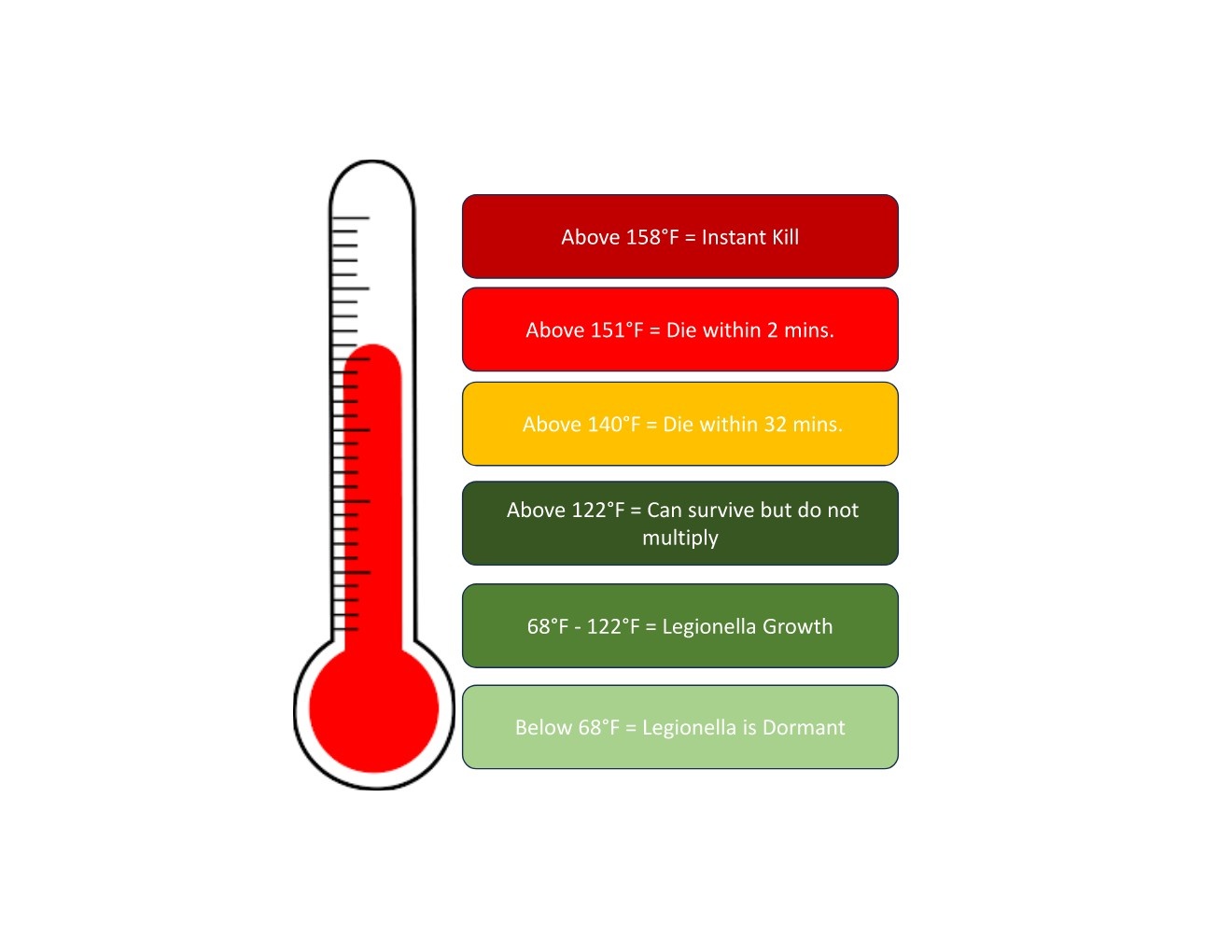
Due to Legionella outbreaks in the past, best practice guides and standards like ASHRAE Standard 188: Legionellosis: Risk Management for Building Water Systems require commercial domestic water heaters to operate at 140°F (or more) to inhibit the growth of Legionella bacteria or the facility needs to have a management plan to mitigate risk. Once neutralized, hot water is blended with master thermostatic mixing valves to a safe level (less than 120° to 122°F) to avoid scalding users at sinks and showers.
For specific plumbing fixtures, like public lavatories, code further requires local ASSE International 1070 mixing valves to protect users against scalding. Storage tank water heater assemblies are sized to ensure the minimum residence time needed to kill bacteria. Instantaneous water heater systems do not have a storage tank and operate at a temperature outlet of 158°F (or higher) to immediately kill bacteria passing through before blending to lower water temperatures.
Because some heat pump systems can exceed outlet temperatures of 158°F, it is common to see these heat pumps in a storage tank configuration for commercial domestic water systems. Note that air-to-water heat pump efficiencies vary directly with the temperatures at which the system is operated. Heat pump systems operating at 140°F will inherently be more efficient than instantaneous versions operating at 158°F and above.
Like building heating and cooling systems, domestic hot water heat pump systems are often backed up with an electric water heater (otherwise known as a swing tank) for continuous operation and to assist with low demand scenarios, limiting heat pump cycling. Note that air-to-water heat pumps are also limited by outdoor temperatures.
With outdoor temperatures below 10°F, the efficiency benefits of the heat pumps drop off significantly and when outdoor temperatures fall below 0°F, some heat pumps may shut down entirely as they are increasingly unable to extract heat from the cold outside air.
Air-to-water heat pumps in mechanical, plumbing systems
Traditional independent heating and cooling systems, which individually can be efficient, are inherently wasteful when serving concurrent heating and cooling loads as they cannot recover heat. In facilities with large process driven loads or data center equipment operating year-round in cooling (continually rejecting heat to the environment), this waste heat can be substantial and if recovered offers significant energy benefits in heating-dominated climates.
Air-to-water heat pumps step in to fill this gap, supplementing traditional systems while enabling waste heat recovery to improve system performance. With waste heat recovered and with additional heating or cooling demands, air-to-water heat pumps continue supporting building systems by efficiently extracting or rejecting heat to the outside air. Depending on the climate and application, air-to-water heat pumps can meet all the building heating and cooling needs on their own without other secondary equipment.
When reviewing energy performance data for air-to-water heat pump applications, we often observe increases in cooling energy use above baseline levels. The heat recovery energy (providing both cooling and heating) is usually categorized as cooling energy with heating savings appearing as reduced heating load. As such, the total heating energy used becomes a combination of heating only energy together with cooling energy (used for heat recovery).
While the application of air-to-water heat pumps feels new, the components of these systems have been in wide use. Air-cooled chillers use this same air-to-water heat pump technology in cooling only applications and water-to-water heat pump systems have been supporting geothermal systems for decades. Air-to-water heat pump systems simply combine these features with associated controls to leverage the energy benefits of both.
Heat pumps, whether water-to-water or air-to-water, enhance system performance by using heat recovery to minimize waste heat. In heating-dominated climates, this can result in significant energy savings in facilities that also have year-round cooling loads. Air-to-water heat pumps further incorporate the ability to supplement secondary heating and cooling systems, which can exceed the performance of baseline systems and improve system resilience. When evaluating energy performance improvements, look for opportunities to employ heat pump solutions to minimize waste heat while maximizing available waste heat recovery.