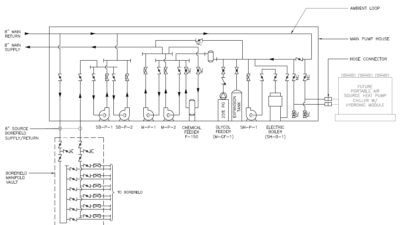
The simultaneous heating and cooling requirements for a biotech building, paired with geothermal usage, made this energy-efficient building succeed.
A research building for a Wisconsin biotech company that uses modular six-pipe heat recovery chiller (HRCs) has been in operation since 2021. The owner prides itself on purposeful innovation and forward thinking, so an energy-efficient building was highly sought after in design.
To help achieve this, the building’s heating and cooling system was designed with a modular six-pipe HRC. The six-pipe HRC, in combination with other sustainable energy sources like total energy recovery wheels in air handling units, solar photovoltaic panels and naturally ventilated double-façade, resulted in an energy savings of 197 kBtu/square foot/year compared to the 2007 ASHRAE Standard 90.1: Energy Standard for Buildings Except Low-Rise Residential Buildings baseline.
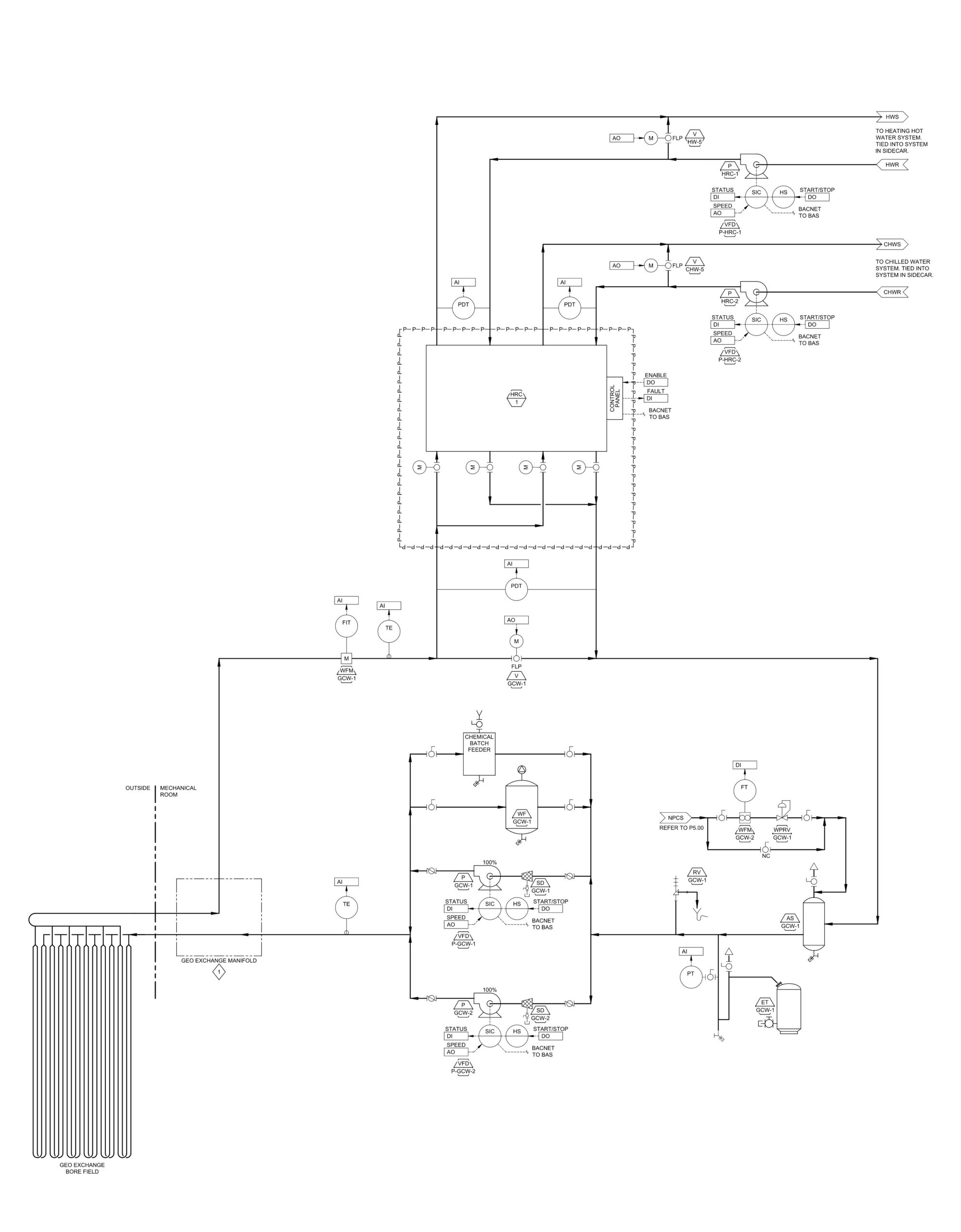
The HRC has four modules and uses a 56-bore geothermal field as a source/sink. The HRC is installed in sidecar at the return side of the chilled water and hot water heat exchangers that are fed from the campus central plant. These heat exchangers supplement return temperatures and bridge the gap not met by the HRC (see Figure 6).
The system design carefully considered how the HRC was integrated:
- Individually pumped hot and chilled water loops tied into the central system via sidecar arrangement help guarantee design flow via individual pumps.
- The HRC is tied into the central system upstream of primary equipment to allow heat exchangers to cover final gap to hot and chilled water temperature setpoint.
- Large piping volume throughout building provided adequate system volume and allowed for consistent return water temperature to the HRC.
- Bypass valves at each HRC header allow bypass of surplus flow. The HRC tie-in is located upstream of the primary equipment to allow gap to setpoint to be covered.
Typically, the capacity of four-pipe modular HRCs is limited to the amount of simultaneous heating and cooling the building is capable of, unless external valving can incorporate geothermal loads. When sizing the capacity of a modular six-pipe HRC, the package is all-in-one, with the ability to size the six-pipe chiller for simultaneous heating and cooling loads as well as geothermal (or source) loads.
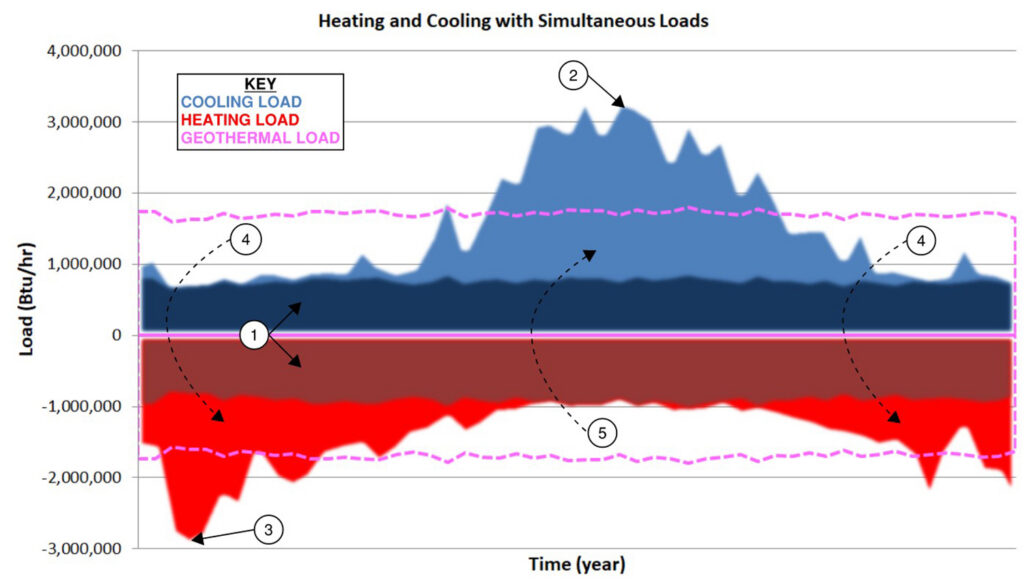
The load profile in Figure 7 was used to design the biotech building. The numbered items reflect the corresponding numbered areas on the chart and how the HRC is leveraged during the different load periods.
- Simultaneous heating and cooling: HRC modules stage up, pushing cooling to chilled water and heating to hot water simultaneously.
- Peak cooling: Primary cooling equipment (campus chilled water heat exchanger) is sized for the building’s peak cooling load demand and supplements cooling in addition to maximized HRC load plus geothermal load.
- Peak heating: Primary heating equipment (campus heating hot water heat exchanger) is sized for the building’s peak heating load demand and supplements heating in addition to the maximized HRC load plus geothermal load.
- Simultaneous heating and cooling plus geothermal reject cooling to source: The gap between Zone 1 and Zone 3 represents the load carried by the geothermal field. This highlights the load conditions when the HRC meets simultaneous heating/cooling loads and additional heating load. The heating load is larger than the cooling load, so the HRC is rejecting surplus cooling to the source side of the chiller, where it extracts heat from the earth via geothermal field.
- Simultaneous heating and cooling plus geothermal reject heating to source: The gap between Zone 1 and Zone 2 represents the load carried by the geothermal field. This highlights the load conditions when the HRC is meeting simultaneous heating/cooling loads and additional cooling load. The cooling load is larger than the heating load, so the HRC is rejecting surplus heating to the source side of the chiller, where it is rejected to the earth via geothermal field.
External coordination boosts energy goals
Working outside of the boundaries of internal knowledge is necessary when a new technology emerges in the market. Despite a designer’s well-rounded knowledge of low-capacity chillers, the category into which modular chillers fall, manufacturers know their equipment and its particulars better than anyone on the design or construction team and know where to find solutions to any sticking points.
In modular HRCs, acceptable parameters for flow, temperature and/or other key functional characteristics are specific to the equipment manufacturer and often “programmed” into the onboard computing systems. It is imperative that design engineers work closely with the equipment manufacturer to understand the parameters for the selected equipment and design the system to operate accordingly.
The HRC manufacturer should be consulted as the subject matter expert throughout design and during start-up. Have them review design documents, control diagrams and sequences and system piping layout. During start-up, some manufacturers can offer back-end programming changes to their internal controllers to fine-tune their equipment and align it with the overall building system.
To ensure competitive bids, it may be necessary to specify more than one manufacturer for the design. Modular six-pipe HRC manufacturers use different methods to design and control their modules. It is possible that a different manufacturer could be provided than what was designed and this could completely change the design control sequence.
Acknowledging this early on with owners and contractors could allow for more leniency or a contingency plan if change orders come because of this. If the situation is appropriate, it may even be beneficial to flat specify a single manufacturer.
Getting, staying involved enhances design
Engineers should get an early jump on startup. Balancing each system is like walking a tightrope and different load scenarios can lead to unexpected flow and temperatures at the HRC. The sooner startup and functional performance testing begin, the more time is available to work out the kinks, if any occur.
Every building’s central plant is laid out differently. If startup hits a sticking point, ask the manufacturer to send out a start-up specialist to help align the equipment’s internal controls with the building controls. Some manufacturers also offer wireless communication modules to allow their engineers to remotely log in and review the HRC’s telemetry.
Owners should recognize that there is generally more complexity with this system, so having the appropriate staff resources and training should be part of the project’s overall operational cost calculus. Although modular HRCs can be complex, they can improve the building’s overall energy efficiency, which pays dividends in sustainable energy usage and the owner’s utility costs. Attention to detail across all load scenarios during design can help the system succeed during peak load and ride out low-load conditions. If adequate flow and stable temperature are provided, the implementation of modular HRCs will be successful.