Advertisement
FREE subscription
Email
Print
Reprint
Learn RSS

ASHRAE Forum Examines Gray Water Use

By Geoff Weisenberger, Staff Editor -- Consulting-Specifying Engineer, 7/5/2005

Gray water, defined by some as recycled water for non-potable use, is gaining more and more attention in the building systems community, as illustrated in a forum that took place at the ASHRAE 2005 Annual Meeting last week in Denver, Colo.

One unified call from the ASHRAE members present at the forum, entitled "What You Need to Know About Grey Water Before it Can Be Used in HVAC Cooling," was for the industry to settle on a clear definition of the term gray water. While the U.S. Environmental Protection Agency defines it as tertiary treated municipal effluent, many members felt this definition was open to interpretation. For example, one member, representing an HVAC manufacturer, asked if there is a standard as far as chemical content for gray water, since OEMs “only have one chance to design the system right” in regards to filtering out certain chemicals. Another suggestion was that if different “categories” of gray water were to be defined, perhaps each category could have different uses within a building. One thing was made clear: gray water and storm water runoff are two different things.

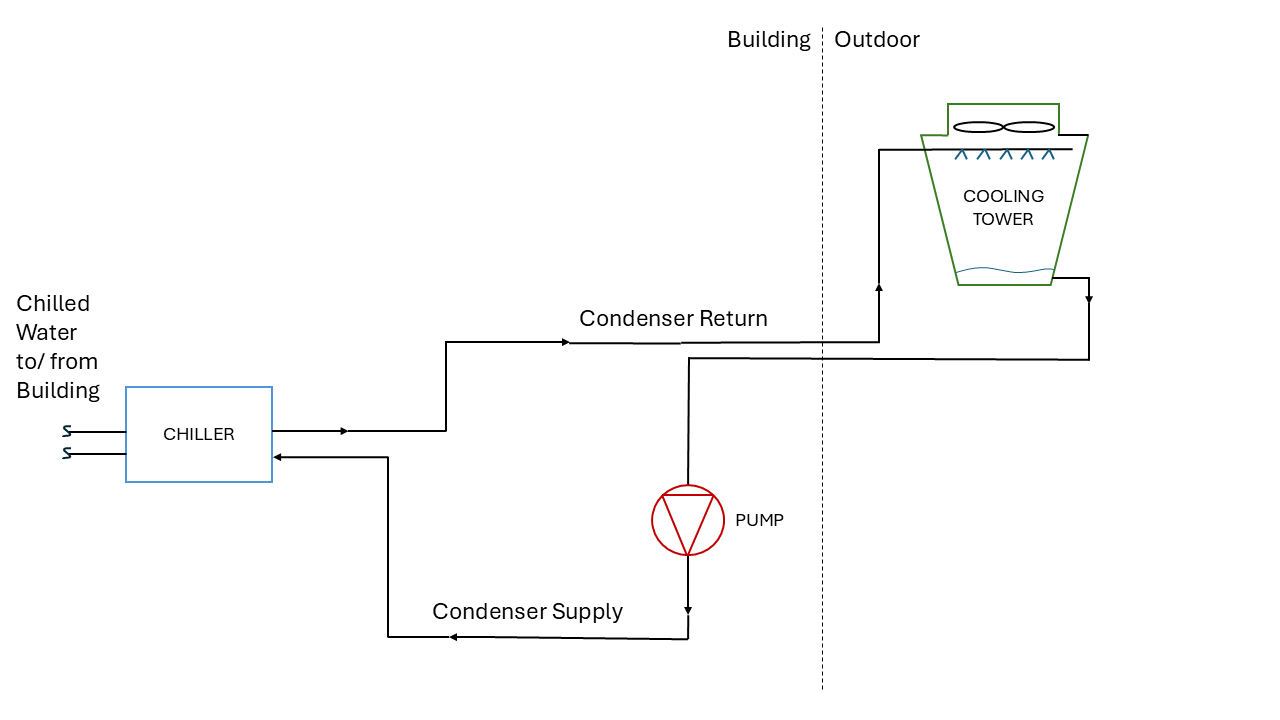
As for HVAC application of gray water, cooling towers were touted as the most obvious choice, and using gray water as a heat source was also suggested. Gray water benefits mentioned included high availability, a much lower cost than potable water, the fact that potable water isn’t necessary for many HVAC applications and its usefulness in areas where other water sources are scarce or nonexistent. One member noted that while cooling tower systems aren’t able to cycle gray water as many times as potable water--three times compared to six to eight times, due to the particulates in gray water--using gray water could still potentially provide a payback. Of course, this potential usage begged the question, Will this change the way engineers design cooling tower systems?

On the flip side, there are a number of issues and drawbacks, notably, significant changes to chemical treatment and a common lack of plumbing infrastructure in most buildings. For example, if sewage treatment is performed onsite, a building wouldn’t need to bring in gray water as a separate water supply. Most buildings, however, don’t have on-site treatment capabilities. Another concern is healthy and safety. Take Legionella; one member pointed out that even high levels of chlorine don’t always completely wipe out the bacteria in an instant.

Further complicating matters are legal issues. Certain states, including Colorado, only allow water to be used once. However, there was some speculation that mindset could change in the future as water becomes scarcer.

Perhaps the most significant concern with gray water use is safety. While the idea of using gray water is becoming more accepted, one engineer expressed that at this point, he would only feel comfortable using it for irrigation purposes and would use storm water in the building systems. There weren’t many examples of U.S. usage of gray water, but moderator Mark Hodgson, LRSC, MIWSoc., director, Indoor Environmental Quality Occupational Health and Safety with Clayton Group Services, Edison, N.J., did point out that in certain world regions where water is scarce, such as Australia and Saudi Arabia, gray water use is prevalent. In these areas, purple dye—and often, purple pipes—is used to differential gray water from potable water (see Hydromancy? for more on Australian efforts in this area).

In the end, Hodgson said that engineers need to educate people on the technology. While safety concerns seem to be the main obstacle to gray water use, he said that engineering is a matter of solving a problem, and engineers need to keep solving this one step by step.

Email
Print
Reprint
Learn RSS

Talkback

We would love your feedback!

Post a comment

» VIEW ALL TALKBACK THREADS

Related Content

Related Content


By This Author


SPONSORED LINKS

 
Advertisement
Sponsored Links

More Content

  • Blogs

Blogs

  • Michael Ivanovich
    Give and Take

    August 8, 2008
    Rollercoaster Energy Prices vs. Conservation Momentum
    The roller coaster of oil prices did something quite amazing this year: It went up long enough to ca...
    More
  • Michael Ivanovich
    Give and Take

    July 18, 2008
    Gore: "Go solar or die." Walk the Talk, Take 1
    In a speech at an energy conference in Washington, D.C., Nobel laureate, Academy award winning filmm...
    More
  • » VIEW ALL BLOGS RSS
Advertisements


NEWSLETTERS
Plug in and get the latest CSE news, trends and industry updates delivered directly to your inbox!

Green Scene
CSE Codes & Standards
CSE NewsWatch
CSE Fire and Life Safety Solutions
CSE Business of Engineering Management Report
CSE Electrical Solutions
CSE HVAC Solutions
Pure Power
CSE Product Showcase
©2008 Reed Business Information, a division of Reed Elsevier Inc. All rights reserved.
Use of this Web site is subject to its Terms of Use | Privacy Policy
Please visit these other Reed Business sites