The charging of electric vehicles (EVs) presents challenges and emerging considerations. Learn the risks associated with charging and the safety measures to address those risks.
Learning objectives
- Learn the basics of electric vehicle (EV) charging.
- Understand the electrical risks of EV charging.
- Identify safety measures to take to mitigate risk,
EV charging insights
- As EV charging infrastructure has expanded from a handful of grid-connected installations to tens of thousands of power conversion systems nationwide, electrical engineering considerations — such as transformer sizing, switchgear protection, AC/DC conversion, load management and fault mitigation — have become central to safe and reliable deployment.
- Although EV charging is now widespread globally, with millions of public ports in operation, the hazards, regulatory frameworks and mitigation strategies associated with EV charging continue to evolve alongside the technology and its accelerating deployment.
In 2007, the electric vehicle (EV) boom had not taken hold yet. With just 139 public EV charging stations in the United States, EVs, let alone charging infrastructure, were still in early adoption. It wasn’t until 2011 when EV charging stations started to proliferate.
According to the U.S. Department of Energy, as of 2023, at least 64,641 EV charging stations and 168,388 charging ports were operational — a 500-fold increase in less than two decades. The infrastructure to provide energy to the vehicles that move us throughout the world is still catching up to the widespread adoption of EVs.

Globally, as of 2025, there are 5.45 million publicly available charging ports. At this stage in the development and adoption of EVs and supporting infrastructure, based on the rapid expansion of adoption and infrastructure, one can be forgiven for assuming that EV charging hazards are well understood and thoroughly regulated.
However, the regulatory framework is still very much evolving and, like infrastructure, has been playing catchup for the past 10 years.
EV charging process
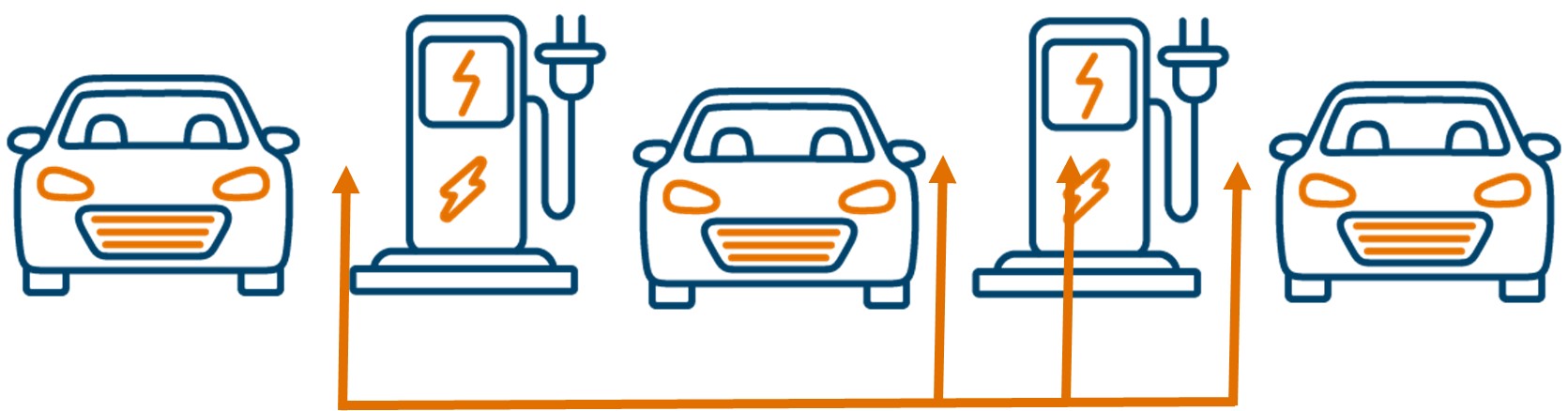
EVs fundamentally change how energy is delivered to vehicles. Unlike internal combustion engines (ICE), which are fueled with fossil fuels (gasoline/diesel) transported to gas stations by tanker trucks, charging stations for electric vehicles are typically connected directly to the power grid (see Figure 1). Energy from the grid is transferred to EVs by means of power conversion (if necessary), charging ports and a connector. Components of the charging system are commonly referred to as electric vehicle supply equipment. The EV “fueling” process is compared to the analogous process for ICE vehicles in Figure 2.

Power grid: Electricity comes in two forms: alternating current (AC) and direct current (DC). AC is an oscillating voltage that continually reverses polarity in a smooth wave appearing as a sine graph, completing one oscillation in 1/60 of a second. DC provides a constant voltage to the user and does not change polarity.
Most energy transmission within a power grid is supplied with AC electricity. Energy providers use AC because it is easier to transport over long distances as Westinghouse demonstrates in the 1900s, owing to its inherent properties (constantly changing voltage). Batteries provide DC voltage and hence EV batteries are recharged using DC electrical power but is limited in its ability to travel over long distances.

Power conversion: Power conversion is one of the main components of EV charging, translating the grid’s AC electrical power into the appropriate DC voltage and current to charge the EV’s battery. The power conversion components can consist of a transformer, switchgear, AC/DC converter and control circuitry, dependent on the power supply and the level of charger.
The primary function of a transformer is to adjust the transmission or distribution voltage to the appropriate use voltage on the facility. A transformer can either increase or decrease voltage. When connecting directly to a power grid, it is common to decrease the voltage to the desired use value. Transformers use electromagnetic induction consisting of a primary winding, secondary winding and magnetic core. The transformer is then connected to electrical distribution equipment, such as switchgear, distribution boards or cables, to distribute the energy to the load.
In charging systems, the conversion of AC power to DC is typically done with a switch-mode power supply. A switch-mode power supply works by converting the AC power to raw DC through rectifiers, using the frequency of the AC energy to rapidly turn the AC wave on and off ching to efficiently convert that power to the voltage the charging circuit needs.
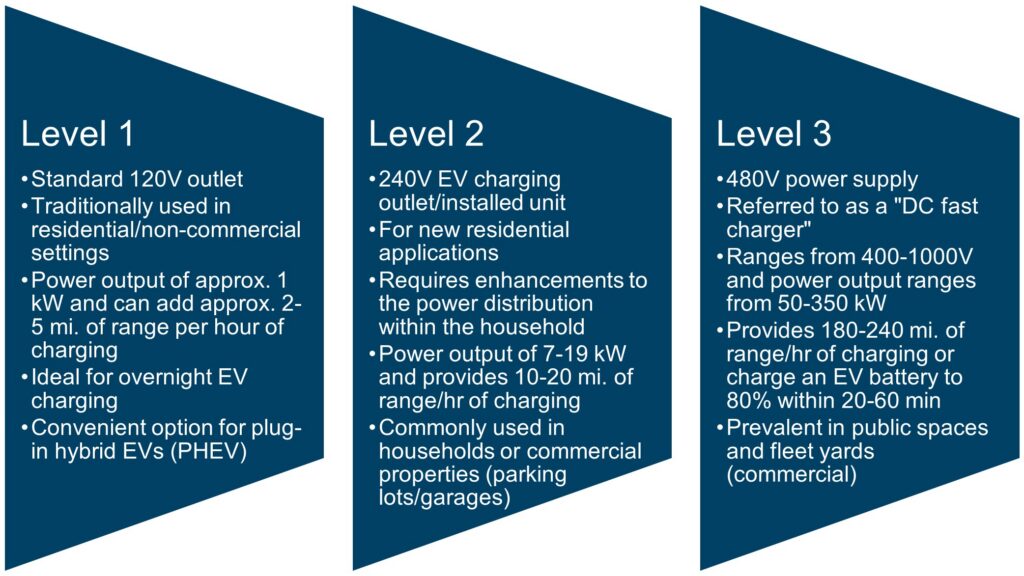
Fast charging (via Level 3 chargers) requires DC electricity; for Level 1 and 2 charging, EVs have a built-in AC/DC converter, which is also known as an on-board charger and allows for an AC electrical supply. Power conversion equipment will typically be contained in an enclosure. The enclosure safeguards the electronics and electrical equipment from environmental factors, such as rain, snow, dust or debris (NEMA 3R, NEMA 4X, IP67, etc.) and also designed to dissipate the heat created by the conversion process.
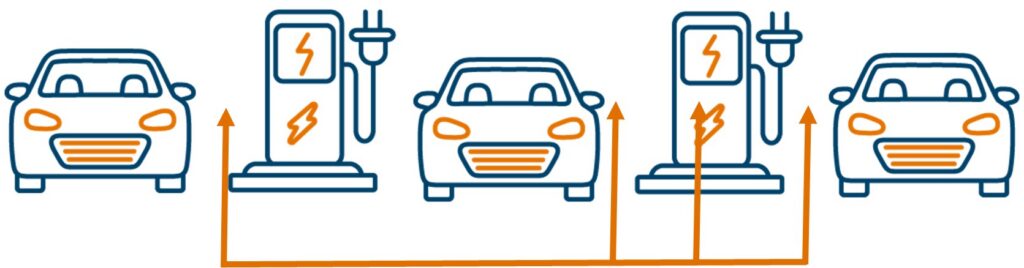
Charging stations and ports: A charging station is a physical location that provides one or more EV charging ports, typically found in parking garages or parking lots. These stations include control equipment that manages the charging process by communicating with the connected vehicle to ensure power is delivered at the right speed. An EV charging port provides power to charge one vehicle at a time. The unit that houses EV charging ports is sometimes called a charging post, which can have one or more EV charging ports. Most charging stations include a user interface, which can range from simple indicator lights to advanced touchscreens that display charging status, power usage and other operational details.
EV charging stations
Charging stations are grouped into different categories, based on the voltage provided to the EV — currently grouped into one of the following:
Cable and connector: Charging cables need to handle significant currents while maintaining flexibility for maneuverability and ease of use. Generally, the thickness varies by charging level, with thicker cables required to support higher amperage (greater the charger level, thicker the cable). The cable extends from the charging port and ends in a connector, which plugs into the electric vehicle.
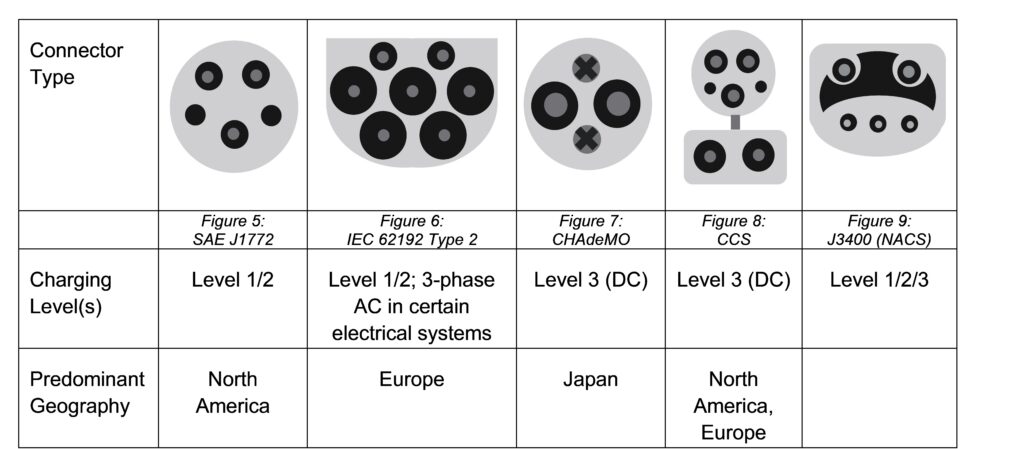
The design of the connector varies by the standards it supports; standards include Society of Automotive Engineers J1722, International Electrotechnical Commission (IEC) 62196, North American Charging Standard, Combined Charging System or CHArge de Move (“charge and go”). Some connectors support only AC charging (Level 1 and 2) while others support DC fast charging. In addition to power transfer, cables and connectors must carry communications signals between the charging station controller and EV (see Figures 5 to 9).
Electric vehicles: EVs can include many different modes of transportation, including a wide range of cargo trucks (18-wheelers), passenger automobiles, recreational craft (boats) and even micro-mobility devices (e-bikes/scooters). This article’s focus is on automobiles inclusive of various classes such as compact cars, sport utility vehicles (SUVs), trucks and commercial fleets (buses, delivery trucks, etc.).
The two primary types of vehicle electrification using charging are battery electric vehicles (BEVs) and plug-in hybrid electric vehicles (PHEVs). Typical components of a BEV include an electric motor, battery pack, power inverter, DC/DC converter and a port for the connector to charge. A PHEV contains the same components as a BEV, however the battery pack stores less energy and it is equipped with an engine that runs on gasoline.
The battery pack consists of numerous physically connected modules that store energy supplied to the electric motor when required. Each module contains battery cells, physically connected to one another. The resulting battery pack voltage can range anywhere from 200 to 800 volts (V) in contemporary EVs. The battery pack has an integrated battery management system to ensure proper operation during storage, discharging and charging.
The battery pack is typically contained along the length and width of the car between the front and rear wheels, under the floor. This high-voltage battery is different from a vehicle’s 12-V battery that powers lighting and instrumentation systems. A DC/DC converter allows the high voltage vehicle battery pack to provide power to the 12-V system.
Typical EV motors are powered by AC electricity. As the battery pack stores DC, a power inverter between the battery pack and motor allows energy to flow between the battery and the electric motor.
Risks of EV charging
When discussing risk, it is important to understand that risk is a product of likelihood and severity of hazardous events. In this section we will discuss topics that affect both the likelihood and severity of events.
Initiating cause frequency (likelihood) x event severity (consequence) = Risk
Likelihood: Thermal events at charging stations can occur due to electrical malfunctions, short circuits, damaged cables, faulty charging equipment, electrical surges, overheating of the charging equipment (e.g., when the battery is charged too rapidly), improper use and maintenance of the charging equipment or lightning strikes.
The charging stations themselves do not significantly change the fire risk in terms of fire load, while it is known that fully charged batteries have more energy to release in fire scenarios. Research has shown that the risk of starting thermal runaway is increased during charging operations. While charging, the battery is in an electro-chemically active state and electrical energy is being supplied into the system. As a result, the risk of fire initiated by the EV battery is higher in charging areas than in other parking areas. Failure inside the battery can occur because of the charging process without being visible from the outside; failures and consequences may not be immediately recognized as EVs are often unattended during charging.
The risk may change as the number of charging stations increases in a single area and start to age in service. In general, the greater the number of chargers, the greater the overall likelihood of failure. Similarly, the likelihood of failure may increase with age, especially for systems not properly maintained per manufacturer instructions.
Consequence: EV fires are comparable to ICE vehicle fires when comparing characteristics such as fire load, fire intensity and smoke production. (Research and testing on single passenger vehicle fires have yielded peak heat release rates of 20 megawatts — a maximum fire size comparable across ICE vehicles and EVs.) There are other characteristics of battery fires that are unique to EVs: they are difficult to extinguish and can unexpectedly reignite — sometimes hours after visible signs of products of combustion have receded. Thermal events may also include the release of flammable/toxic/corrosive gases. Depending on the initial configuration of EVs, heat released in fire scenarios can easily cause multivehicle fires.
Charging stations in parking garages presents unique hazards. Parking spaces are generally becoming smaller, while the vehicles are becoming larger (e.g., SUVs), resulting in smaller separation distances between vehicles which promotes fire spread between vehicles. Sprinkler systems (if provided) are intended to contain the fire, protect the building and increase life safety until fire services arrive.
Furthermore, sprinklers protect adjacent vehicles by inhibiting fire spread, limiting temperatures and heat radiation to protect load-bearing structural elements (ceiling, pillars, walls) and shorten recovery time afterward. A significant portion of existing parking garages within the United States, particularly open parking garages, are not sprinkler-protected.
Charging stations in open air, surface level parking lots allow for ease of access during a thermal event. However, if charging stations are located on exterior walls of buildings or near buildings, a fire originating near the charging station may serve as a hazard to the nearby structures. If a thermal event was to occur, the location may affect the severity of that event.
Safety measures for EVs
Many industry organizations and governing bodies provide requirements on how to safely install and operate an EV charging station. IEC publishes both IEC 61851-1 and IEC 62196-1. IEC 61851-1 applies to EV supply equipment for charging electric road vehicles. IEC 62196-1 applies to EV plugs, EV socket-outlets, vehicle connectors, vehicle inlets (herein referred to as “accessories”) and cable assemblies for EVs intended for use in conductive charging systems.
In the United States, the NFPA 70: National Electrical Code (NEC) also provides requirements for the installations of charging equipment, including detailed requirements on wiring, ventilation, protection against overcurrent and emergency disconnects. The International Building Code (IBC) references the NEC for installation requirements. Both the NEC and IBC reference UL listed and labeled components of charging stations. The critical UL listings include both UL 2022: Standard Testing for EV Battery Chargers and UL 2594: Electric Vehicle Supply Equipment. Listed equipment ensures that the equipment has been evaluated and tested for quality and safety.
There are both preventive and mitigative measures to address EV and charging station hazards.
Preventive measures include:
- Ensure the EV charging stations and associated equipment meet minimum quality manufacturing standards such as ANSI/UL 2202: DC Charging Equipment for Electric Vehicles. Equipment meeting these standards can be identified by the certifications provided with the product or by markings/labels on the product itself.
- Minimize fire risk, it is important for charging station operators and manufacturers to follow local standards and guidelines for electrical and fire safety, as well as conducting regular maintenance and inspections of the charging equipment.
- Establish guidelines for users on how to handle equipment and charge EVs.
- Prohibit combustible materials such as gasoline, oil, chemicals, vegetation, wood or cardboard near charging station locations.
Mitigative measures include:
- Provision of a fire services information point
- Provisions for disconnection of power supply to the charging stations are included in the installation. If the electric vehicle is being charged, the charging infrastructure must be disconnected from the power supply before starting firefighting against a fire. Information on any necessary deactivation of the high-voltage parts of the vehicle is also publicly available on the National Highway Traffic Safety Administration website.
Additional measures for indoor charging locations in commercial occupancies:
- Even if “open” to the exterior, parking garages should be equipped with an automatic sprinkler system. Currently adopted codes specify minimum sprinkler system criteria of Ordinary Hazard Group 2. Regardless of the presence of batteries, the fire protection industry has questioned whether this design is sufficient to mitigate modern vehicle hazards. Vehicles today contain more combustible material and are larger. Currently, testing is being conducted to determine the appropriate level of sprinkler protection by the NFPA’s Fire Protection Research Foundation. Upon completion of this fire testing, code and regulations, such as NFPA 88A: Standard for Parking Structures, may adopt different sprinkler criteria. Insurance providers (Factory Mutal Data Sheet 03-26) currently recommend a sprinkler system that aligns with Extra Hazard Group 1 Occupancies. When installing a new EV charging station in a parking garage, stakeholders should consult subject matter experts to conduct a risk assessment to determine appropriate protection, considering the exposures and preventive/mitigative measures reasonably available.
- As an engineering best practice, an air aspirated smoke detection system or heat detection can be added to the existing fire alarm system to serve the areas where EVs charging stations are located to provide an early alarm of a fire event. This may allow for expedited fire department response, as well as providing more time for occupants to exit the structure.
- Ensure mechanical exhaust systems, if installed, within the parking garages are maintained and routinely tested in accordance with International Mechanical Code (IMC) and NFPA 92: Standard for Smoke Control Systems or the locally applicable mechanical code requirements for the occupancy.
- Maintain fire protection and life safety systems in accordance with relevant standards such as NFPA 75: Standard for the Fire Protection of Information Technology Equipment, NFPA 72: National Fire Alarm and Signaling Code, NFPA 80: Standard for Fire Doors and Other Opening Protectives and in accordance with manufacturer’s recommendations. As an example, ensure passive fire resistive assemblies such as rated walls and associated door opening systems are maintained and functional, as well as ensuring fire/smoke door assemblies are not propped open within the parking garage.
There is no limit to where owners can charge an EV nowadays, as charging stations are becoming increasingly prevalent. There are inherent hazards in the charging process. To address those hazards, we recommend:
- Conduct engineering evaluation to establish which protective measures reduce risk for any given project.
- Understand feasible preventive measures.
- Specify listed/labeled equipment. While using low-quality options may look appealing due to lower upfront costs, they may lead to much higher costs in the likelier event of failure.
- Understand guidance is unclear on sprinkler design criteria for EV hazards and this is one mitigation measure to be weighed against other prevention/mitigation techniques used for any given installation.