Advertisement
FREE subscription
Email
Print
Reprint
Learn RSS

Creative Chiller Construction

A new chiller plant and a tri-fuel energy approach yield a reliable HVAC system for New York City's Time & Life Building.

By BRYAN H. ATKINSON, P.E., Atkinson Koven Feinberg Engineers, LLP, New York -- Consulting-Specifying Engineer, 1/1/2001

Home to several major international magazines, the Time & Life Building in New York City was due for a chiller retrofit. Because much of the original photographic work for the company's magazines is completed within the building, the chiller plant needed to provide process cooling as well as comfort cooling. Chiller capacity had to be increased, reliability was critical and separate chilled-water risers had to be provided to allow the occupants to tap into the process cooling source.

The existing refrigeration plant was actually two separate and independent plants. One was located in the sub-basement, and a second was designed for the 47th floor. The lower plant consisted of two 1,300-ton steam-turbine-driven chillers and one 1,600-ton electric-driven chiller, which served the basement area mechanical-equipment room (MER) and the 10th floor MER.

The upper-level chiller plant contained an 850-ton and a 1,700-ton steam-driven chiller, which served the 36th floor MER and upper level MERs located on the 47th, 48th and 49th floors. Separate cooling towers were located on the roof, one for each plant, with a 24-inch condenser water riser to the sub-basement chiller room.

Because the building owner-the Rockefeller Group Development Corp.-offers Time & Life employees and other tenants chilled water 24 hours per day all year long, tenants had to install simple fan-coil units, rather than refrigerant-condensing units. This reduced the electrical operating load and cost, and greatly simplified the equipment installed and the maintenance requirements.

Getting down to work

After the engineering team from Atkinson Koven Feinberg Engineers LLP (AKF) sat down with the owner's engineering group, several ideas for the new plant were reviewed, including:

  • Consolidating both plants into a single plant that would be more easily operated and also provide better diversity in operation. It was determined that the lower-level chiller room was the only location with sufficient area.

  • With utility deregulation, alternate energy sources for the plant would provide the flexibility to choose the optimum energy source based on availability and cost.

  • While it was recognized that the existing plants were close to the ends of their useful rated lives, first cost was a major consideration and any new technology required a reasonable payback.

  • No interruption of chilled-water services to the end-users would be tolerated.

  • The existing condenser-water risers had to remain, because it was impractical to replace them due to service interruption to tenants, time constraints and costs.

  • The operating temperature difference of the chilled water could not be changed because of the existing air-handling equipment.

In addition to modernization of the chiller plant, the existing chilled-water distribution required modification to allow for changeover from the old plant to a new plant, and to accommodate a single plant located in the basement. Because the original configuration of the system was split into high- and low-rise systems, the lower mechanical-equipment cooling coils and pumps would not be able to handle the increased static head when the upper MERs were connected. AKF engineers resolved the problem by providing a "break" in the form of a plate heat exchanger on the 10th floor MER.

The engineers also studied primary and secondary pumping for the new chilled-water distribution. It was determined that primary pumping was considerably simpler with lower first costs and operating costs than primary/secondary pumping.

Chiller construction

To avoid any disruption to the chilled-water service, the new plant was constructed during the winter months when the building load was greatly reduced. During this period, the upper chilled-water plant was kept operational to provide required cooling. The 10th -floor heat exchangers were installed prior to decommissioning the lower plant in order to "break" the static head from the upper plant. Temporary chilled-water pumps were installed in the lower MER until changeover to the new plant could be achieved.

Scheduled shutdowns were required to accommodate the construction of the new plant.

Several plant configurations were studied, and the scheme chosen to best fit the design criteria included:

  • Two 1,850-ton dual-drive chillers-a gas engine-driven refrigerant compressor as primary energy source and an electric-driven refrigerant compressor as the secondary source.

  • One 2,100-ton electric drive.

  • One 1,500-ton steam-turbine drive.

In the initial design, the dual-drive machines were to be rated at 2,100 tons. However, the gas engine was a much larger industrial engine and noise was a concern. Since the configuration included a 1,500-ton steam-turbine unit and the peak measured demand had never exceeded 5,400 tons, it was determined that there would be adequate capacity available with the smaller, 1,850-ton dual-drive machine. The total installed capacity of the new plant was 7,300 tons and, theoretically, the 1,500-ton steam machine was considered to be a spare.

Because some of the spare capacity had been recently dedicated to tenants asking for additional chiller capacity, the upper existing plant may not be decommissioned immediately. It may be upgraded at some future date to provide additional process chilled-water capacity by adding new process risers.

The new configuration-with three energy sources-provides the operating engineer with maximum flexibility. The modern equipment is also more efficient, and by base-loading the plant with the gas-engine units operating during peak-demand periods and using the electric drives during off-peak periods, calculations indicate a potential annual energy savings of $650,000. Currently, refining the plant's operation is being considered in order to utilize new rates.

Dealing with noise

One other area of concern was engine noise. During a visit to a similar installation in Atlanta, AKF engineers were shown a smaller package than the original Time & Life design concept for 2,100 tons, which allowed for the use of a different type of industrial engine. With the assistance of acoustics/vibration consultant Shen Milsom Wilke, Inc., New York City, the decision was made to reduce the dual-drive machines to 1,850 tons rather than 2,100 tons and use the smaller engine. The design also allowed for an acoustical enclosure to be added at some future date.

The new plant began operation in June of 2000, and the noise has been well within an acceptable range. Vibration, which was another major concern, is also not a problem. In fact, a nickel can stand still on the edge of the engine's base.

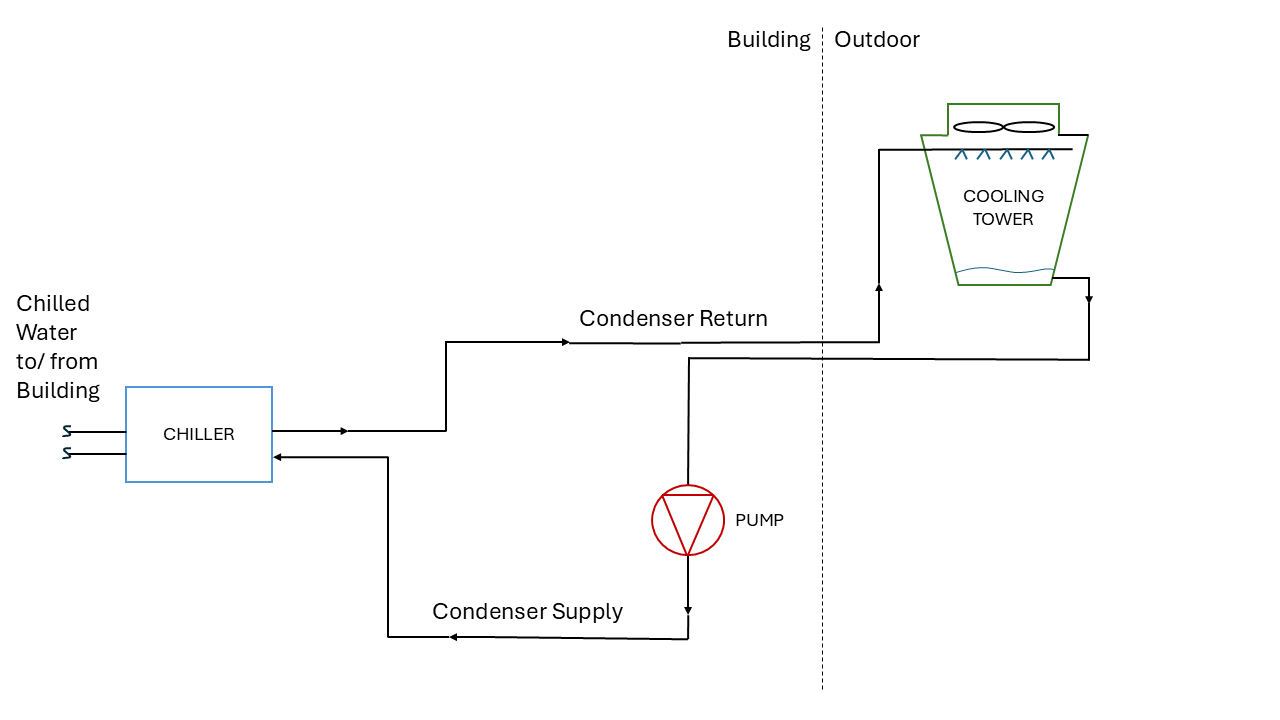
Because the entire plant was located in the basement, the existing condenser-water riser needed to carry additional capacity. And because the original plant was primarily steam driven, the two towers were considered physically large enough to handle the load. The towers were cross-connected and the fill was upgraded. This essentially solved the tower capacity issue. However, the 24-inch riser could not be replaced and although calculations indicated that the velocity in this riser would theoretically increase to about 20 ft. per second, there were no real alternatives. Further, because most plants operate at greater diversity than calculated-and with variable-speed drives on the 500-horsepower condenser water pumps-it was felt that no energy penalty would occur and the 20 feet-per-second velocity would rarely, if ever, be reached.

Email
Print
Reprint
Learn RSS

Talkback

We would love your feedback!

Post a comment

» VIEW ALL TALKBACK THREADS

Related Content

Related Content


By This Author

There are no other articles written by this author.


SPONSORED LINKS

 
Advertisement
Sponsored Links

More Content

  • Blogs

Blogs


Sorry, no blogs are active for this topic.

» VIEW ALL BLOGS RSS

Advertisements


NEWSLETTERS
Plug in and get the latest CSE news, trends and industry updates delivered directly to your inbox!

Green Scene
CSE Codes & Standards
CSE NewsWatch
CSE Fire and Life Safety Solutions
CSE Business of Engineering Management Report
CSE Electrical Solutions
CSE HVAC Solutions
Pure Power
CSE Product Showcase
©2008 Reed Business Information, a division of Reed Elsevier Inc. All rights reserved.
Use of this Web site is subject to its Terms of Use | Privacy Policy
Please visit these other Reed Business sites