Advertisement
FREE subscription
Email
Print
Reprint
Learn RSS

Chiller Upgrade Adapts to New Uses

Staff -- Consulting-Specifying Engineer, 10/1/2000

As one of the nation's largest firms involved in consumer and commercial credit reporting as well as credit-card and check transactions, the professionals at Equifax Inc. understand money. Upon learning that the upgrade of one of the facility's chillers could reduce operating costs at its St. Petersburg, Fla., facility and improve systems operation and reliability, facility personnel didn't waste any time-or any more money.

"We're seeing reductions of more than $25,000 per month, and a large part of this is attributable to the HVAC system improvements," says building chief engineer Steve Miller.

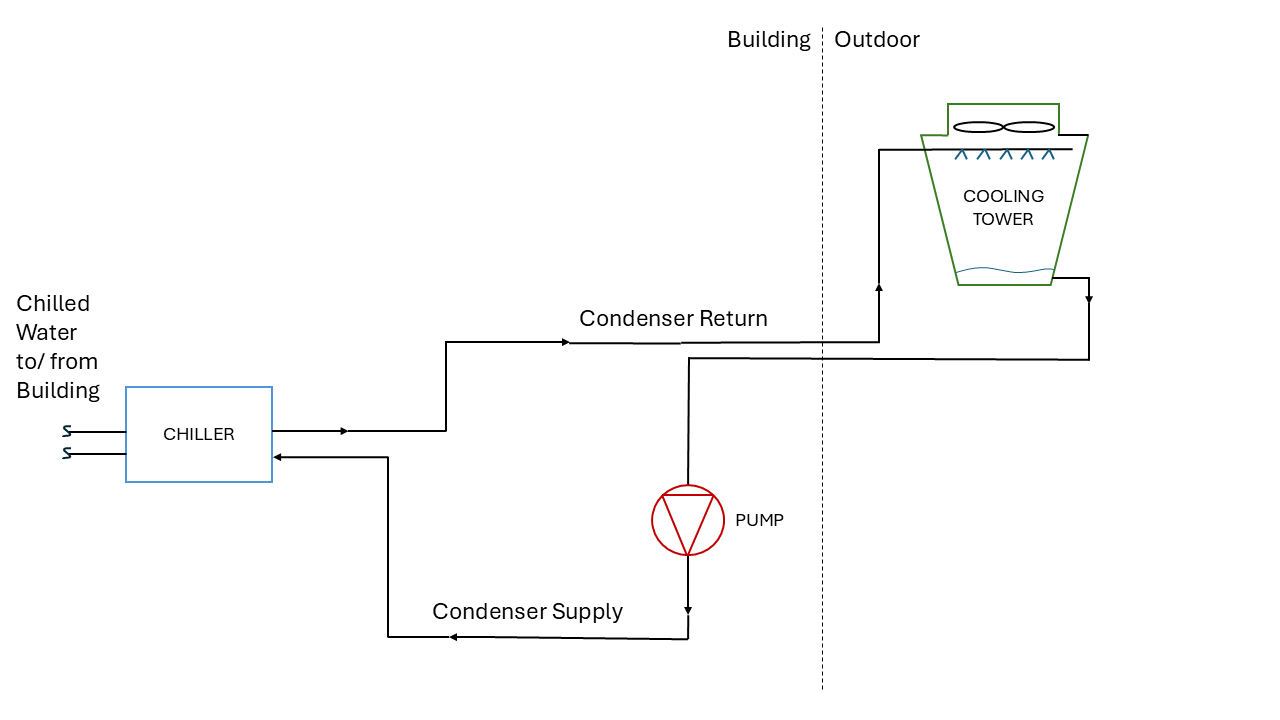
A major part of the heating, ventilation and air-conditioning (HVAC) enhancement was converting the second of two chillers serving the one-story, 300,000-square-foot facility. Built in 1980 and originally used by General Electric as a manufacturing plant, the facility initially featured two 800-ton centrifugal chillers with 100-percent chiller redundancy. Two 125-horsepower, constant-speed chilled-water pumps delivered chilled water to 31 central-station air handlers, and 210 pneumatically controlled variable-air-volume (VAV) boxes delivered conditioned air throughout the building.

Adaptive reuses

In 1986, Honeywell Avionics bought the facility and switched its use to offices and light manufacturing. As a result, the cooling load dropped to 400 tons. In the course of upgrading the system, parts of one of the chillers-the compressor, motor, starter and controls-were replaced; the condenser and evaporator were retained. Also, the refrigerant was changed from R-11 to R-123. With a rating of 650 tons, the chiller's efficiency was improved from 0.9 kilowatts per ton to 0.57 kilowatts per ton.

When Equifax moved into the facility in 1996, building use once again changed. Cooling loads increased from higher building occupancy and greater equipment-related internal heat loads. In 1997, Equifax decided to review systems operation, and a plan was developed for upgrading the second chiller. As with the first upgrade, the compressor, motor, controls and starter were replaced, and the chiller was rated at 650 tons. However, 10 variable-frequency drives (VFDs) were installed: one on one of the chilled-water pumps and the rest on the fans of nine of the 31 air handlers. The building-management system was also upgraded to provide complete system energy management.

Although Equifax operates its facility 24 hours, the building's occupancy ranges from 1,850 people at peak hours to as few as 75 people during the third shift. With the new energy-management strategy, all of the air handlers and VAV boxes-as well as the two chillers and the cooling tower-are controlled to closely match changes in cooling requirements caused by changes in external and internal heat loads. Controls on the VAV boxes were also changed from pneumatic controls to electronic controls operated by the energy-management system.

As a result of the upgrade, Equifax now has two chillers that operate at 0.55-kilowatt-per-ton efficiency at full load, and the system once again provides 100-percent chiller redundancy. "A loss of cooling for even a short time is a major problem," Equifax's Miller says, "especially in the computer rooms."

Work was completed in July 1999, and payback is estimated at less than three years. Another advantage to the upgrade approach was that it required less disruption and rigging in the mechanical room. The largest components moved in and out were the compressor and the motor. Direct access to the room with new chillers also would have been difficult.

"We didn't want to wait until components failed," Miller explains. "When we looked at the numbers, we saw the paybacks were short, and it just made good sense to complete the whole upgrade at once."

For more information about the Trane TriStar conversion process, circle 101 on the Reader Service Card, page 77.

Email
Print
Reprint
Learn RSS

Talkback

We would love your feedback!

Post a comment

» VIEW ALL TALKBACK THREADS

Related Content

Related Content


By This Author


SPONSORED LINKS

 
Advertisement
Sponsored Links

More Content

  • Blogs
  • Podcast

Blogs


Sorry, no blogs are active for this topic.

» VIEW ALL BLOGS RSS

Podcast

Senior Editor Amara Rozgus (pictured) speaks with John Suzukida, PE, president of Lanex Consulting LLC, Shoreview, Minn. This conversation is about the role of electricity in the future and zoned heating and cooling.
Cooling People, Not Buildings with John Suzukida, PE
Senior Editor Amara Rozgus (pictured) speaks with John Suzukida, PE, president of Lanex Consulting LLC, Shoreview, Minn. This conversation is about the role of electricity in the future and zoned heating and cooling.
Listen Now | Download MP3 | Subscribe
» VIEW ALL PODCASTS Subscribe Now to HVAC & Building Automation and never miss an episode
Advertisements


NEWSLETTERS
Plug in and get the latest CSE news, trends and industry updates delivered directly to your inbox!

Green Scene
CSE Codes & Standards
CSE NewsWatch
CSE Fire and Life Safety Solutions
CSE Business of Engineering Management Report
CSE Electrical Solutions
CSE HVAC Solutions
Pure Power
CSE Product Showcase
©2008 Reed Business Information, a division of Reed Elsevier Inc. All rights reserved.
Use of this Web site is subject to its Terms of Use | Privacy Policy
Please visit these other Reed Business sites