Energy Solutions for Uncertain Times
Meeting the nation's future energy needs will largely depend on retrofits and upgrades to existing facilities, says the Nation's Energy Czar, among others
By Scott Siddens, Senior Editor -- Consulting-Specifying Engineer, 7/1/2002
Energy concerns, particularly in the form of price spikes over the past few years, have fueled discussion about finding new or alternative sources of energy. On the design side, it has also helped spur the implementation of cutting-edge sustainable technologies like fuels cells or solar panels into new buildings. While sexy from a developer's standpoint, these promising green systems are not necessarily ready to help building owners here and now.
By some estimates, one-third of the cost of operating an office building goes to utilities, mostly for lighting and HVAC. So indeed there is a need for not only energy conservation, but a focus on upgrading M/E systems in existing facilities, especially as international events cast further shadows over the stability of the fossil-fuel resources the nation relies so heavily upon.
In assessing such a situation, it's natural to look to the future and concentrate on promising new technologies, such as a greater implementation of solid-state LEDs for general-purpose lighting. But many designers are finding success elsewhere by revisiting readily available technologies, which when combined with sound engineering principles, offer reasonable payback periods to their clients.
Helping hand?Ultimately, it is the engineer who must convince building owners that using such technology will indeed offer a reasonable payback—a tough sell. But one way to bring this message home is to use a little PR, and the government and several non-profit groups are prime resources.
For years, state and federal agencies have been a driving force in promoting energy-efficient design. In fact, at the 13th annual Energy Efficiency Forum at the National Press Club in Washington D.C., this past June, U.S. Secretary of Energy Spencer Abraham acknowledged the key role that energy efficiency in existing facilities will play. At the event, co-sponsored by the U.S. Energy Association and Johnson Controls, Milwaukee, Abraham pointed out that 54 of the 105 points in President Bush's National Energy Policy are contingent upon modernizing energy efficiency and increasing the use of renewable energy resources.
"The United States consumes almost 99 quadrillion BTUs of energy annually," says Abraham in summarizing the nation's long-term energy supply challenge. And according to estimates from the Energy Information Administration (EIA), he adds that, in just two decades, the nation will need 175 quads of energy per year. Further, of the additional 76 quads needed, Abraham points out that EIA estimates almost two-thirds of that amount will have to come from conservation and energy-efficiency measures.
"Because if we can't get those conservation and efficiency gains, it won't make any difference how much oil we recover in Alaska or how many new power plants we build. We won't be able to keep up with the demands of a dynamic and growing economy," he states.
Try this LEEDAnother telling indication of the nation's increased focus on existing facilities is the launch of the U.S. Green Building Council's newest green building rating system: LEED for Existing Buildings (LEED-EB). The pilot program is trying to piggyback on the success of USGBC's well-received LEED 2.0 for new construction, which debuted in 2000. "The challenge has been to adapt LEED 2.0 for the nearly 250,000 major building-improvement projects that are undertaken every year on existing buildings," says Christine Ervin, President and CEO of USGBC. "Given the magnitude of potential economic and environmental benefits, we're eager to get the LEED-EB product tested and into the marketplace."
Lighting the wayGovernment initiatives aside, what can engineers do here and now for energy-efficient retrofits? Perhaps the easiest point of entry into energy conservation in existing buildings starts with lighting. What makes lighting retrofits so attractive is that it is a low-risk, short-payback investment that can produce up to 30% annual savings, compared with other types of renovations intended to save energy. A number of energy-services companies (ESCOs), such as Eco Engineering, Louisville, Ky., and Orion Lighting, Plymouth, Wis., are spreading the word.
ESCOs, not surprisingly, are often marketing partners to utilities and provide turnkey implementation and demand-side management services to facilities. But in the last 10 years, they've been involved with the installation of a number of innovative energy-saving technologies and are another valuable source for information on the efficiencies gained by using T-8 lamps with trouffers, T-5s with indirect luminaires, compact-fluorescents (CFLs) in downlights, as well as savings associated with the employment of electronic ballasts.
For example, Orion's hundreds of industrial and commercial lighting projects include retrofits for manufacturers like the Kohler Co. and Bemis Manufacturing, both of Sheboygan Falls, Wis.; Toro's distribution center in Plymouth, Wis.; and a Simplicity Manufacturing facility in Port Washington, Wis. According to Neal Verfuerth, Orion's founder and CEO, these projects together have reduced energy consumption by at least 42,000 kilowatts. The Bemis installation alone, he says, reduced power consumption by the equivalent of approximately 8% of the city's entire municipal electrical load.
Verfuerth hopes such savings will entice more utility companies to buy into its "Virtual Power Plant" concept—a notion that reducing energy consumption is equivalent to—or even better than—producing more energy.
"We call it displaced capacity," says Verfuerth, adding that the idea intrigues utilities because there's an underlying notion that investing in energy-efficient technology will play well with their own investors, government regulators and the public in general.
"It's going to take some time to get utilities on board," he says, "but we've made in-roads."
For example, the Bemis lighting retrofit alone has dropped pollution levels significantly. Specifically, company officials calculate that they're removing 4,725.22 tons of carbon dioxide, 17.36 tons of sulfur dioxide and 40.27 tons of nitrogen oxide from the atmosphere—the equivalent of planting 1,156 acres of trees annually, or removing 892 cars from the road each year.
Down the road at Kohler, the company experienced similar results after bringing the virtual power plant "on line" for its generator division in 2001.
Heating and air conditioningWhile improved lighting is certainly a no-brainer in reducing energy bills, upgraded mechanical systems—while not as fast to deliver instant results—can also produce much needed savings. Thermal ice-storage, cogeneration/trigeneration and geothermal systems are among the HVAC technologies generating serious savings. But state-of-the-art HVAC systems are not always an easy sell to facility owners concerned about first cost.
At the Energy Efficiency Forum, Abraham addressed this issue in his speech, saying that such mindsets must change.
"This is a difficult challenge since budget constraints often force project managers to cut corners on energy-efficiency features that may cost a little more upfront, but pay for themselves many times over during the life of the building," says Abraham.
In fact, for any building with antiquated systems, almost any type of retrofit will aid the cause of energy conservation. Take the Centre Street Building of Walters Art Museum in Baltimore, as an example. Built in 1974, the addition suffered a terrible deficiency in climate control, which was exacerbated by poor overall HVAC performance due to worn-out parts that were no longer available. Facility managers acknowledge that the original HVAC scheme was a poor design all around. Problems, such as open soffits leaking air, were a common sight. In fact, if the building got too cold, they had to close it.
According to Bob Marino, P.E., a project manager for Mueller Associates, Baltimore—the MEP firm brought in to design new mechanical and electrical systems as part of a comprehensive renovation—they could only go forward. "The Walters Art Museum renovation presented an opportunity to turn an energy hog into a building that was much more energy-efficient," he says.
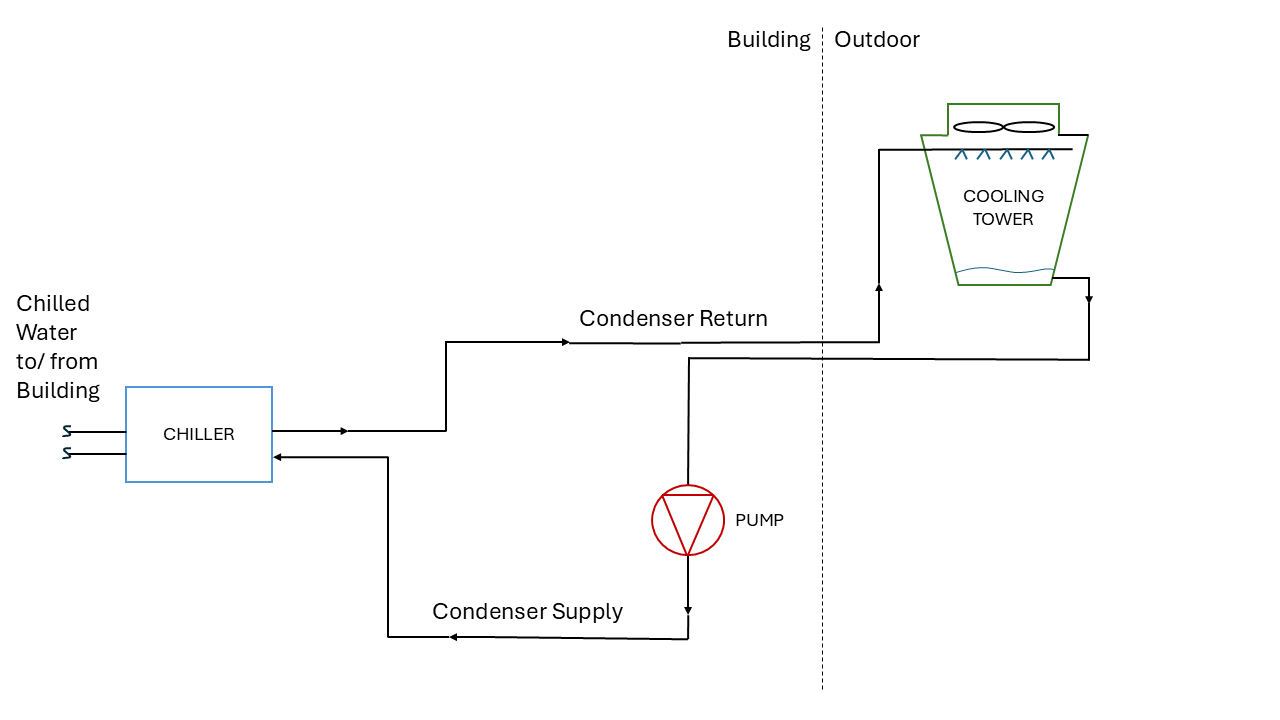
The most immediate goal was simply to replace the building's constant-air system with a variable-air-volume system that would also include a new condenser water-free cooling system and improved control systems.
"We had to phase the installation in order to protect the art during the renovation, but we've solved all their temperature and humidity control problems. The Walters now has a museum-quality system that will show tremendous energy savings over time."
In fact, the museum is expected to realize savings of close to $80,000 annually in energy and operating costs.
State-of-the-art HVACMore exotic systems, however, like geothermal, remain a hard sell. Once again, turning to the public sector is a sound strategy. For example, back in the Midwest, the state of Wisconsin has been experimenting with not only geo-thermal systems, but heat-recovery as well. The state, in fact, has been at the forefront of promoting energy efficiency through its Focus on Energy program. As an example, officials readily point to Fond du Lac High School. In conjunction with Alliant Energy, the Wisconsin Geothermal Association and the Geo-thermal Heat Pump Consortium, the state helped the school district implement a geothermal system for the 400,000-sq.-ft. facility.
Geothermal heat pumps, of course, are not new to Wisconsin, but the use of this type of system for a building of this size was. Specifically, the design included a geothermal closed-loop pond system. Heat recovery recaptures more than 80% of the heat exhausted when fresh air is brought into the building. The scheme also makes it possible to have a smaller ground-source heat pump. In extreme weather conditions, four 1.9-BTU high-efficiency boilers back up the loop and ventilation system.
While some initial costs were higher than they would be for more conventional alternatives, it is anticipated that the school's operating and maintenance costs will be lowered by 40%.
From an environmental perspective, by reducing its use of coal-fired electricity for air conditioning and natural gas for heating, the school should be able to realize about a 15% reduction in CO2 emissions.
The school board has begun to share its achievements with organizations outside the community, and is even opening its doors as a geothermal showcase for other school officials, architects and engineers across the state.
Engineering = EfficiencyWhile it doesn't hurt to have government leaders trumpet the cause or even champion more initially expensive technologies, ultimately, it is the engineer who must sell and then incorporate these items into a building's design. One need not preach energy efficiency to engineers. It's what the profession is all about. Certainly, the projects and technologies highlighted here are by no means an exhaustive list. And the pursuit of new technology should not totally be off a designer's radar screen. LEDs, for example, have the government's attention right now.
"At the Dept. of Energy we are looking to do more to advance this solid-state technology from the lab to the marketplace, and we expect to formalize a new partnership with industry and devote more resources to the development of next-generation solid-state lighting in the near future," noted Abraham in his energy address.
However, as with all developing technologies, it isn't at all clear how soon LEDs will become competitive with conventional technology. Estimates range from 5 to 10 years, but LEDs are starting to carve a niche or two (see "LED Industrial Retrofit.")
Building designers, of course, need not wait for LEDs, or any other technology to develop to realize amazing energy-efficiency gains. Hopefully, these examples may provide some ammunition for engineers' ongoing effort to convince clients that an investment now will pay considerable dividends in the future.
|