Presenters from the September 29, 2026, webcast, Ways to Incorporate Safe and Effective Battery Energy Storage Systems, answer audience questions.
BESS insights:
- Proper BESS sizing requires evaluating both power capacity (MW) and energy capacity (MWh) to ensure grid stability and adequate discharge duration.
- BESS safety depends on comprehensive hazard mitigation analysis, compliance with NFPA 855 and careful consideration of battery chemistry and fire protection risks.
Learning objectives
- Define the key components and operational principles of battery energy storage systems commonly used in nonresidential buildings.
- Identify and apply relevant NFPA codes and standards, including NFPA 70 and NFPA 855, in the design and installation of BESS.
- Analyze fire protection and safety challenges associated with BESS and implement effective mitigation strategies in building design.
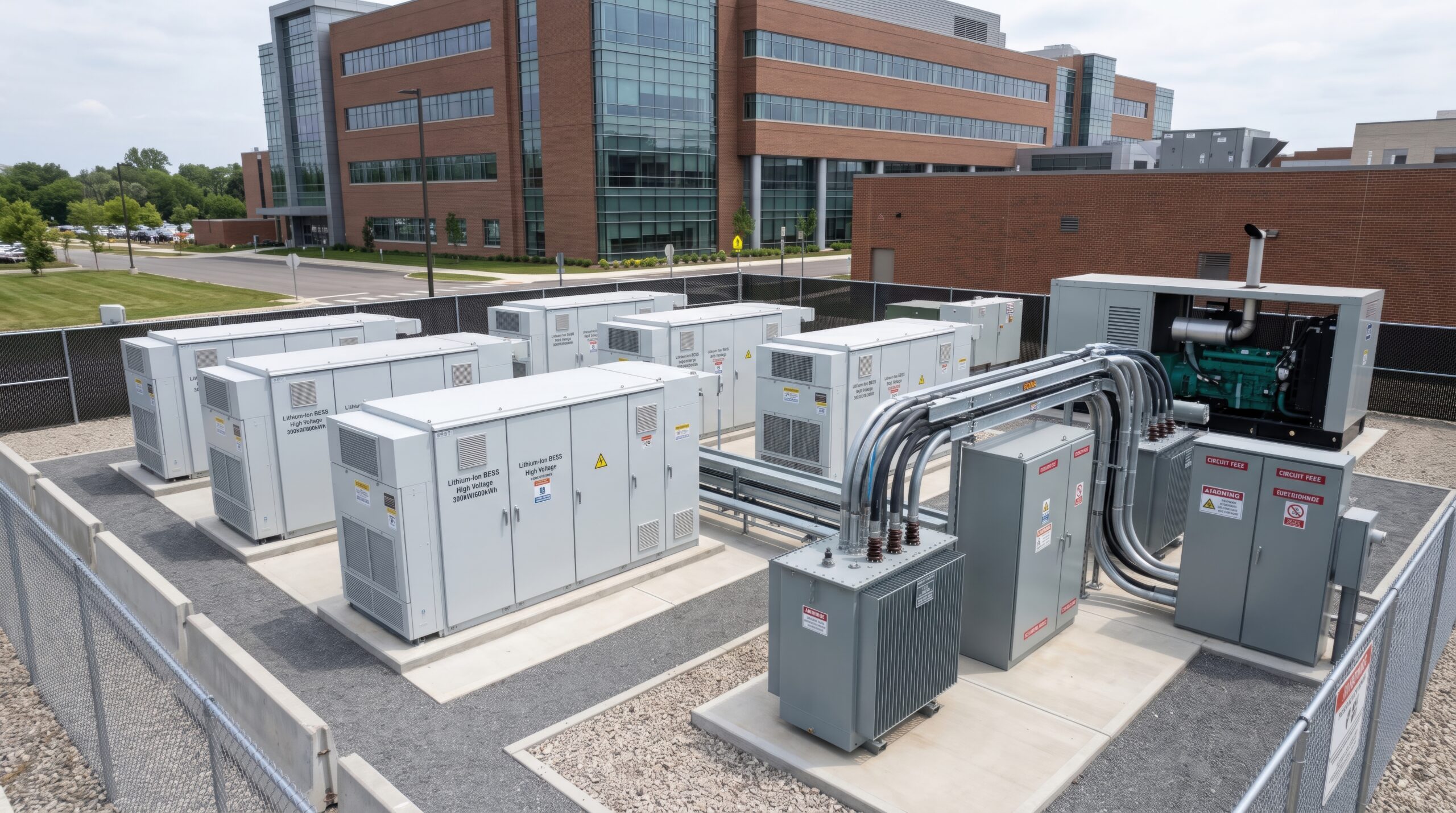
Battery energy storage systems (BESS) are increasingly integral to the design of modern nonresidential buildings, providing critical support for energy efficiency, power quality, and resilience.
Paul Pabst, PE PMP, Director of Electrical Utility Systems, and John Jennings, PMP, Senior Electrical Engineering Project Manager, both from Jacobs, discussed the fundamentals and advanced considerations of BESS design, with a focus on the technologies used in schools, data centers, office buildings and hospitals.
After the presentation, audience members had a chance to ask questions to the experts. Below are some highlights from the Q&A, covering topics such as fire protection, safety protocols and energy efficiency considerations.
When developing hybrid systems consisting of photovoltaics (PV), BESS, diesel generation and weak utility supply, do you recommend sizing the BESS primarily from the energy requirement (MWh), transient/grid-support requirement (MW), or performing both independently and selecting whichever requirement governs?
The recommendation is to size the BESS using both MW and MWh requirements independently and using the worst case for sizing. Sizing for MW ensures maintaining grid stability, and sizing for MWh ensures sizing for duration of discharge.
Do any of the required standards listed in the presentation address harmonics and subharmonics limits?
Harmonics are included for the inverter in UL 1741. This is primarily an electrical safety and product testing standard, and specifically states that interharmonics and subharmonics are excluded
What’s the rough life span for the BESS system for a 100 MW system? What is the ballpark cost $/MWh?
System lifespan is at 80% state of health of the battery cells; most vendors use a 15-20 year lifespan for the BESS but it is variable based on one cycle per day when the BESS is used. In terms of cost, refer to the NLR electricity annual technology baseline, which includes $/kW and $/kWh values: https://atb.nlr.gov/electricity/2024b/data
Does BESS have round-trip efficiency (RTE) degradation, and how does that compare to capacity degradation?
The BESS vendor has capacity and RTE degradation curves that are published. Capacity degradation is the loss of energy over time, while the RTE degradation is due to internal resistance of aging cells causing that energy to be lost as heat energy.
For a complete hazard mitigation analysis (HMA), how much of the effort falls on the BESS supplier versus the project engineering team?
NFPA 855, Section 14.5.2 indicates that a written hazard analysis prepared by a registered design professional shall be submitted to the authority having jurisdiction (AHJ) for review and approval. The BESS vendor needs to supply the base test data and manuals (about 40%), while the project engineering group is responsible for preparing the site-specific HMA (60%)
Does the MWh capacity of a battery reduce when it black starts?
The MWh nameplate rating stays the same during a black start.
Are you finding that the battery manufacturers are accurate when they state a MWh rating?
Yes, BESS vendors are generally good at posting their test data for rated capacity and degradation curves.
What about zinc-based BESS?
Zinc-based BESS offer an alternative to lithium-ion batteries as they eliminate thermal runaway risks. However, commercial field deployment data is still developing compared to lithium-ion BESS.
How different is the failure modes and effects analysis (FMEA) from HMA? Whose responsibility is it to provide them?
The FMEA and HMA are fundamentally different. The FMEA focuses on product failures and is an input to the HMA. The FMEA is issued by the BESS product vendor. The HMA is a requirement per NFPA 855 for the entire site evaluation and is performed by the project developer. Nearly always, the HMA is from a third-party fire protection engineering firm.
Is the frequency reference for BESS based on power electronics?
Yes, BESS systems use power electronics in the power conversion system for frequency reference.
How are these systems tested for transaxial conditions, seismic, blast and vibration?
The individual components undergo shake table testing to get seismic ratings. The structures are typically qualified by analytic methods and drawings sealed by a registered professional engineer (PE).
Since the latest approach to fires is to let them burn out because of thermal runaway, does that mean any exhaust fans serving the space need to be sized for high-temperature exhaust to keep rated performance under long-term high heat? Do codes require this?
No, the expectation is that the plastics will be consumed in the fire in the unit under test.
What battery chemistries beyond lithium iron phosphate (LFP) are data centers asking about the most?
There are a lot of alternatives to LFP batteries, but they all have pros and cons. Sodium ion and flow batteries are being discussed, but both have fairly large physical footprints compared to Li-ion.
Is there a system where you can individually replace batteries?
Yes, most major BESS vendors can provide replacement batteries.
Which communications protocols are the manufacturers currently supporting?
Typically, the internal battery modules communicate via CAN bus or Modbus to the battery management system (BMS) controller. BMS controllers act as an interface to the site and based on the BMS vendor, various communication adapter modules are used such as Modbus TCP/IP, Profinet and Ethernet/IP.
Are you aware of any microgrid systems installed in Los Angeles?
There are microgrids across the U.S. For Los Angeles, check out the LADOT Washington Yard Microgrid Project, Anheuser-Busch brewery in Van Nuys and the SoCalGas Monterey Park and Pico Rivera facilities.
When sizing BESS, do we need to consider the discharge rate?
Yes, energy alone is not enough to size a battery. You must consider both energy capacity (MWh) and power rating (MW). How fast it can charge and discharge depends on the power rating.
For projects in weak grid environments or microgrids with high renewable penetration, what criteria do you use to determine when a BESS should use grid-forming rather than grid-following PCS controls?
I typically recommend grid-forming (GFM) controls when the BESS may need to establish or maintain voltage and frequency, such as in islanded microgrids, black-start applications, weak grids or systems with high renewable penetration. For a strong utility grid where the BESS is primarily providing energy shifting or ancillary services, grid-following (GFL) controls are usually sufficient. See www.epri.com/research/products/000000003002033960 for a good reference on GFM inverter technology
Concerning discharge cycles, does the BESS manage total cycles when the batteries are being used in only partial discharging scenarios?
Yes, a battery cycle is about total energy moved, so the BMS tracks partial discharges and charges into equivalent full life cycles.
Are there any free tools that can assess the financial model of a BESS integrated with other generation resources such as solar?
Yes, the NLR REopt web tool is free and publicly available. NREL also has a free system advisor model (SAM) desktop application.
When BESS and the utility work in parallel, how are these two systems synchronized?
The BESS power conversion system (inverter) manages synchronization with the utility system.
We are looking at BESS for power quality improvement. Does this make sense?
Yes, BESS are an excellent solution for grid stabilization and power quality issues, especially for solar and wind farms.
What are the off-gases with a runaway battery?
UL 9540A requires capturing off-gassing content during battery cell testing. Typical gases include carbon monoxide, hydrogen, carbon dioxide, hydrogen fluoride and other trace gases. The off-gassing content is specific to the battery vendor.
What are the key design considerations for BESS systems used to backup AI data centers where there is no downstream uninterruptible power supply (UPS) installed?
The UPS and BESS perform different functions, so a combination of both are a good solution. If there is no UPS installed, the most important feature of a BESS is response time for an AI data center and grid fault events.