OR AHUs operate under some of the most restrictive environmental requirements in the built environment. Learn practical, efficient control strategies.
Learning objectives
- Understand how operating room temperature and humidity requirements influence AHU operating states, economizer viability and discharge air temperature selection.
- Apply temperature- and enthalpy-based economizer logic that avoids unintended increases in cooling or humidification energy.
- Implement discharge air temperature and fan static pressure reset strategies that reduce cooling, reheat and fan energy while preserving OR environmental control.
OR AHU insights
- An OR AHU in a healthcare setting must balance energy conservation with strict requirements for ventilation, temperature control, humidity control, infection prevention and reliability, making economizer decisions far more complex than in typical commercial systems.
- The most effective OR AHU energy strategy is to maintain minimum outdoor air, enable economizer only when both temperature and enthalpy are favorable, account for humidification penalties and use discharge air temperature reset and static pressure reset to reduce cooling, reheat and fan energy.
Energy conservation has become increasingly important in heating, ventilation and air conditioning (HVAC) design and operation as the industry responds to tighter energy codes, owner sustainability goals and the broader impacts of energy consumption. Healthcare facilities are among the most energy-intensive building types and represent a significant opportunity for energy savings. At the same time, they are one of the most difficult environments in which to pursue energy reductions responsibly because HVAC systems must support occupant safety, infection control, reliability and redundancy and strict environmental control requirements.

Operating rooms (ORs) are a prime example of this complexity. OR HVAC systems must maintain temperature and humidity within a narrow allowable band while delivering high outdoor air rates and high air change rates. While ASHRAE Standard 170: Ventilation of Health Care Facilities permits temperature in an OR to range from 68°F to 75°F, some clinical users prefer a cooling setpoint as low as 62°F and some jurisdictions impose different maximum temperature requirements. Throughout that range, ASHRAE 170 also requires the system to maintain the relative humidity between 30% and 60%.
Meeting both temperature and humidity requirements often increases reheat demand well beyond what is typical in non‑healthcare systems. Because the required air change rate is maintained regardless of cooling load, the reheat system must be sized to temper the full supply airflow from the cooling coil leaving condition up to the temperature required to maintain space conditions, particularly following dehumidification during humid outdoor conditions.
Typical OR AHU configuration and why it matters
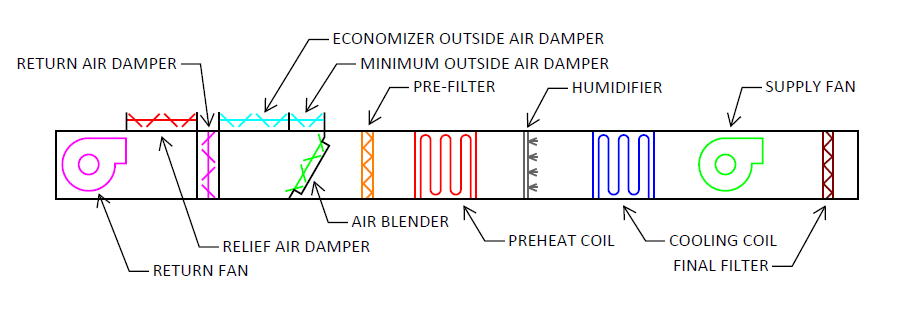
While OR AHU designs vary by facility, climate and owner preferences, many systems share common elements intended to meet temperature, humidity, filtration and reliability requirements (see Figure 1). A representative OR AHU configuration may include:
- Outdoor air intake section with damper(s), often including:
- A single modulating outdoor air damper that varies between a minimum position to maintain the code‑required outdoor air flow rate and a maximum position during economizer operation when outdoor conditions are favorable; or
- A minimum outdoor air damper that maintains the constant required outdoor air flow rate, paired with a separate economizer damper that modulates additional outdoor air during economizer operation.
- Mixing section where outdoor air and return air combine:
- In some designs, a channel blender or mixing device is used to improve air mixing and reduce stratification, which supports stable sensing and control.
- Prefilters and final filters:
- A two‑stage approach (prefilter and final filter) is common for protecting coils and maintaining air quality; typical arrangements include minimum efficiency reporting value (MERV) 8 to 11 prefilters with MERV 14 to 16 or high-efficiency particulate air final filters, depending on facility requirements.
- Preheat coil (often hot water or steam):
- Used to prevent excessively cold mixed air, avoid coil freezing and reduce discomfort risk during cold weather operation.
- Cooling/dehumidification coil(s):
- Depending on humidity requirements, chilled water temperatures and climate, OR AHUs may rely on conventional cooling coil dehumidification and/or enhanced dehumidification strategies such as glycol cooling coils or desiccant wheels.
- A glycol cooling system can be used to support lower chilled water operating temperatures by providing freeze protection, enabling the cooling coil to cool the supply air to the desired dewpoint temperature (e.g., 42°F). Glycol is mixed into a separate chilled water system at a specified concentration (e.g., 30% propylene glycol) to lower the freezing point and protect coils when operating with colder water temperatures (e.g., 32°F supply, 42°F return). This approach enhances latent performance while avoiding coil freezing risk, at the expense of reduced heat transfer efficiency and additional pumping energy.
- A desiccant wheel can also be used to achieve lower dewpoint temperatures. In a common configuration, the desiccant wheel is installed between a primary and secondary cooling coil. The primary cooling coil typically cools the air to approximately 49°F to 52°F, after which the air passes through the desiccant wheel, where additional moisture is removed to achieve the target dewpoint. The desiccant process adds sensible heat to the air stream, requiring the secondary cooling coil to perform sensible‑only cooling to meet the desired supply air temperature. The desiccant wheel is regenerated using the mixed air upstream of the primary cooling coil, preheated if necessary to achieve the required dehumidification performance.
- Humidification system (using central plant steam when available, gas-fired or electric point-of-use steam generators):
- Used to maintain the minimum relative humidity (RH, at 30%) during dry outdoor conditions.
- Supply and return fans and controls (variable frequency drive, or VFD, per fan motor or single VFD for fan array), along with sensors for discharge air temperature and duct static pressure.
OR environmental requirements’ impact on operating states
OR HVAC controls are constrained by three nonnegotiable requirements:
- Ventilation and minimum outdoor air must be maintained.
- Temperature must be controllable across the required range.
- RH must remain between 30% and 60% across those temperature conditions.
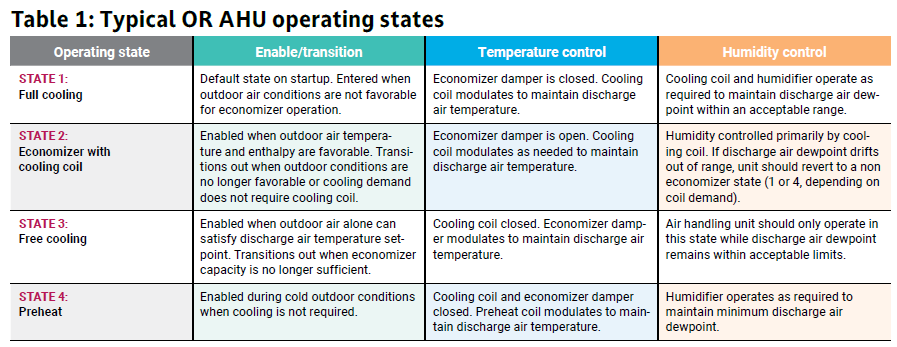
These constraints must be met across a set of major AHU operating states that should be considered explicitly in the sequence of operations:
- Full cooling (often summer and humid shoulder days)
- Economizer with cooling coil (when outdoor air can reduce mechanical cooling energy)
- Free cooling (when outdoor air can meet the full cooling load)
- Preheat (cold weather protection and conditioning)
A common mistake is to treat economizer logic as a standalone “enable” decision based only on outdoor air conditions. For ORs, economizer should be considered in the context of which other components are active, especially regarding dehumidification and humidification (see Table 1).
Economizer decisions must consider temperature, enthalpy
Economizer mode is often described as “free cooling,” but that description can be misleading in OR applications because the air must still be conditioned to meet both temperature and RH constraints. In many climates, outdoor temperature alone is a poor indicator of whether economizer operation will save energy. Moisture content can dominate the total energy required to condition air and that moisture contribution is reflected more accurately by enthalpy.
A useful way to conceptualize the importance of moisture is this: it takes roughly three times the cooling energy to reduce the dry‑bulb temperature of saturated air compared to dry air by the same amount.
For OR AHUs, economizer enable decisions should therefore consider both:
- Outdoor air temperature, and
- Outdoor air enthalpy (relative to return air enthalpy)
Even that is not always sufficient because economizer can still create downstream impacts (especially humidification demand) that negate savings. However, temperature and enthalpy are the right starting point and are more robust than temperature alone.
In many operating room AHUs, the minimum outdoor air percentage is often 20%, driven by the ASHRAE 170 requirement of four outdoor air changes and 20 total air changes per hour, but may be higher depending on system configuration and space zoning. Economizer operation can significantly increase the outdoor air percentage above minimum, amplifying the impacts of sensible and latent conditioning.
Example 1: cool outdoor air with high moisture content
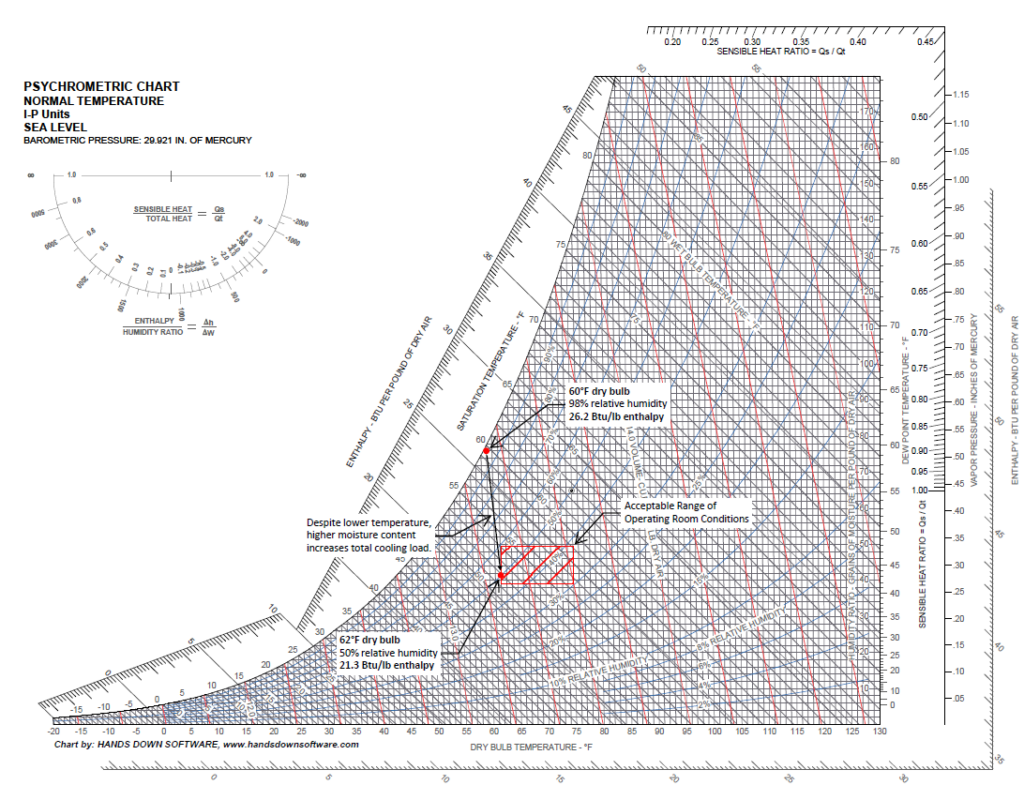
Consider a humid climate scenario: it is a rainy day and the outdoor air temperature is 60°F. A temperature‑only economizer sequence would likely enable economizer cooling because outdoor temperature is below typical OR setpoints.
However, if outdoor air is near saturation, adding more outdoor air increases the moisture entering the AHU. Even though the dry‑bulb temperature is “cool,” the total energy in the air can be higher than return air due to latent heat content.
In this case, increasing outdoor air can increase the dehumidification burden and mechanical cooling energy needed to achieve the supply air condition that keeps the OR potentially as cool as 62°F and within 30% to 60% RH. Enthalpy‑based economizer logic is specifically intended to prevent this outcome. When outdoor enthalpy is higher than return air enthalpy, economizer should remain at minimum outdoor air, even if the outdoor temperature is lower.
Practical takeaway: In humid conditions, temperature‑only economizer logic can create an energy penalty. Enthalpy comparison is necessary to avoid bringing in “cool but wet” air that increases total conditioning energy (see Figure 2).
Example 2: warm, very dry outdoor air
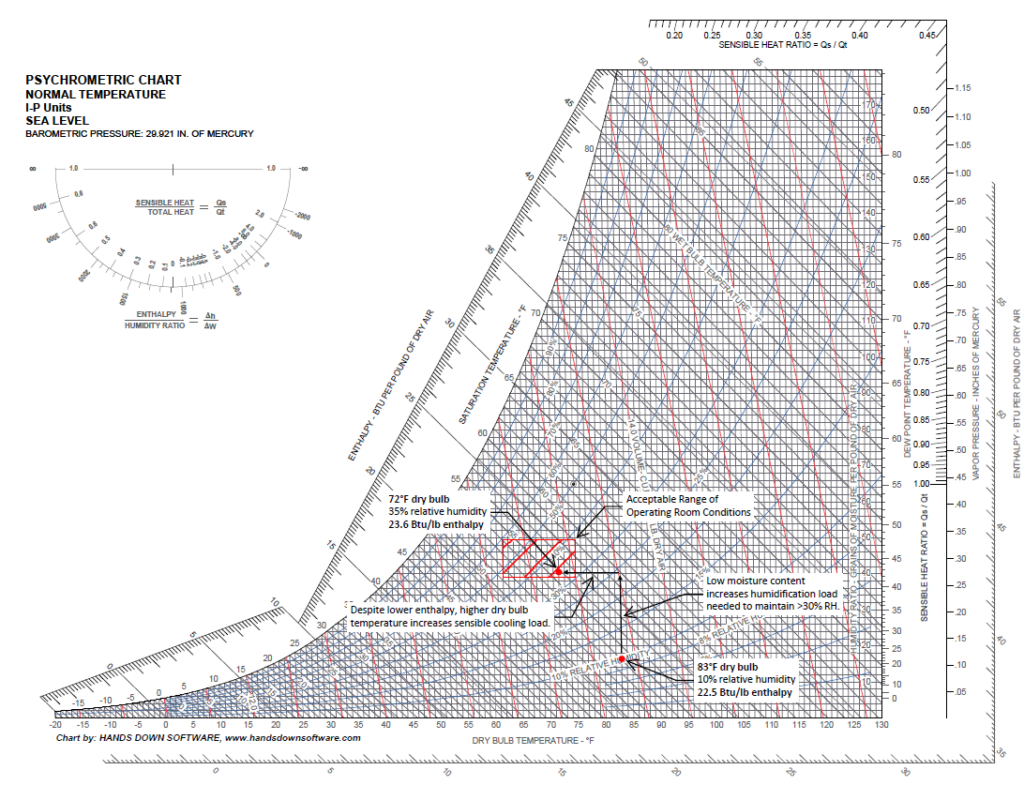
Consider a different scenario: a spring afternoon in the desert. Outdoor conditions might be hot and very dry (e.g., 83°F and 10% RH) while the OR is maintaining 72°F and 35% RH. In such conditions, outdoor air enthalpy can be lower than return air enthalpy even when outdoor dry‑bulb temperature is higher. If economizer enable is based on enthalpy alone, it can lead the sequence to enable economizer in a way that still increases overall energy use.
For ORs, this creates two primary concerns:
- Temperature impact and cooling load: Even if outdoor enthalpy is lower, bringing in significantly warmer air increases the sensible cooling load the AHU must remove to meet discharge air temperature requirements and maintain the OR temperature setpoint.
- Humidity impact and potential humidification demand: Very dry outdoor air can drive the space RH downward. Because the OR must remain above 30% RH, increasing outdoor air in dry conditions can push the AHU into humidification mode. Humidification energy, especially with electric steam, can be substantial. This creates a condition where enthalpy might suggest economizer is favorable, but the OR RH constraint makes it unfavorable in practice.
Practical takeaway: Enthalpy is necessary to consider but may not be sufficient on its own. Economizer enable in ORs should consider both temperature and enthalpy and should be considerate of when humidification is required (see Figure 3).
Economizer enable logic
A commissioning-friendly way to document economizer enable logic is to structure it as a set of gates. This makes it easier to explain, test and troubleshoot.
Gate 1: Minimum outdoor air requirement: Minimum outdoor air must always be maintained to satisfy ventilation, infection control and pressurization requirements. Economizer operation is never allowed to reduce outdoor air below this minimum.
Gate 2: Temperature and enthalpy conditions: Economizer should be enabled only when outdoor conditions are favorable compared to return air:
- Outdoor air temperature must be lower than return air temperature (or below a defined economizer high-limit temperature); and
- Outdoor air enthalpy must be lower than return air enthalpy (or below a defined economizer high-limit enthalpy)
If either temperature or enthalpy is not favorable, economizer should remain at minimum outdoor air.
Gate 3: Humidification energy: For operating room AHUs that must maintain relative humidity at or above 30%, humidification energy can quickly become the dominant component of total system energy use during dry outdoor conditions. While there are scenarios in which increased outdoor air may provide a modest cooling energy credit, the net benefit depends on both the efficiency of the cooling system and the energy intensity of the humidification source.
A practical approach is to estimate the cooling energy credit associated with increased outdoor air during economizer operation and compare it against the additional humidification energy required to maintain the minimum 30% RH. This comparison can be used to identify an outdoor condition threshold at which the humidification penalty outweighs the cooling benefit. When that threshold is exceeded, economizer operation should be disabled and the AHU should revert to minimum outdoor air.
Although this balance point will vary by climate, system type and utility rates, explicitly evaluating it allows the economizer strategy to be tailored to the actual system economics rather than relying solely on generic temperature or enthalpy limits.
From an energy standpoint, the least expensive air to condition for an OR is often the air that just returned from that OR.
Influence of OR temperature setpoint on economizer viability
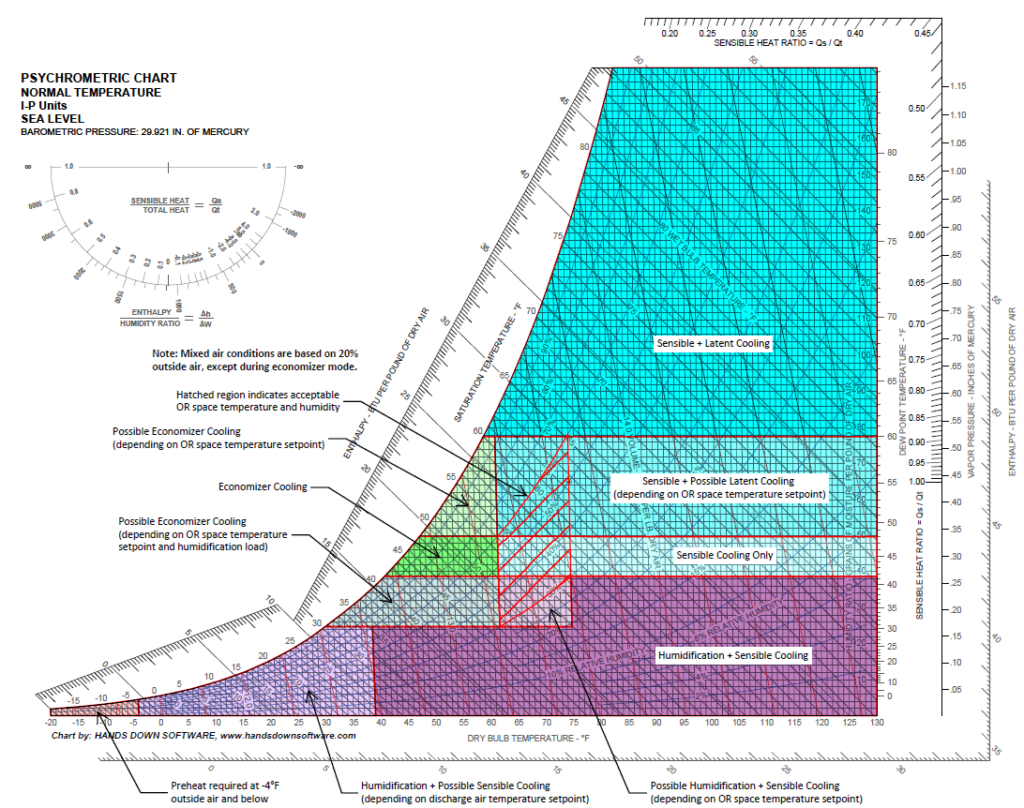
For AHUs serving single operating rooms, the room temperature setpoint has a significant influence on both the discharge air temperature required to maintain space conditions and the range of outdoor air conditions under which economizer operation can provide meaningful energy benefit. An OR operating near the upper end of the allowable temperature range (for example, 75°F) can tolerate higher discharge air temperatures and mixed air conditions, which expands the range of outdoor air conditions under which economizer cooling can offset mechanical cooling.
In contrast, an OR operating at a low temperature setpoint (such as 62°F) necessitates lower discharge air temperatures and substantially narrows the economizer window. Designers should therefore evaluate economizer enable criteria in the context of the specific OR temperature setpoint, particularly for single‑zone systems where the AHU is tightly coupled to a single space condition (see Figure 4).
Discharge air temperature reset
Supply air temperature (SAT) reset is a separate but complementary strategy that can reduce energy use by minimizing unnecessary cooling and reheat. Importantly, SAT reset can be valuable not only in winter but also during shoulder seasons, including periods when humidification may be required and economizer may not be desirable.
SAT reset can significantly reduce reheat energy by avoiding overly cold supply air when space sensible loads are low. A practical SAT reset strategy in variable air volume (VAV) systems is to monitor the cooling demand of all terminal units in the system. One example logic sequence is:
- Raise SAT by 0.5°F if no VAV in the system has a cooling demand greater than 80%, subject to a defined maximum SAT limit.
- Lower SAT by 0.5°F if any VAV in the system has a cooling demand greater than 90%, subject to a defined minimum SAT limit.
This approach can be enhanced by incorporating reheat coil control valve positions for constant volume terminal units:
- If reheat coil control valve positions are consistently high, SAT may be too cold and raising SAT can reduce reheat energy.
- Conversely, if any reheat coil control valves are fully closed and cooling is still required, SAT may need to be lowered to satisfy cooling demand.
In constant-volume OR systems, SAT reset can be a key way to provide significant energy savings when the mixed air dewpoint is within the target range and the space cooling loads do not require the design SAT. This strategy should be bounded by the need to maintain OR temperature and RH within allowable limits. In practice, owners often set conservative SAT limits and then tune reset rates based on observed OR performance and commissioning feedback.
Practical takeaway: Even when economizer is locked out due to humidification, SAT reset can still provide meaningful savings by reducing unnecessary cooling and reheat during low-load conditions.
Static pressure reset
In VAV systems serving operating rooms and associated support spaces, duct static pressure reset can provide meaningful fan energy savings when implemented with appropriate safeguards. Rather than maintaining a fixed, conservative static pressure setpoint, reset strategies adjust fan pressure based on actual terminal demand, reducing fan speed and fan energy during periods of low airflow requirement.
A common and effective approach is to reset duct static pressure based on VAV terminal damper positions. When most terminal dampers are operating at relatively closed positions, this indicates that system static pressure is higher than necessary and the supply fan static pressure setpoint can be reduced incrementally. Conversely, when one or more terminals approach their fully open position, static pressure can be increased to ensure adequate airflow is delivered to the most demanding zone.
For OR AHU applications, this approach should be implemented with careful attention to system sensitivity and redundancy. Reset logic should be based on the most open terminal device, rather than an average damper position, to ensure critical spaces are protected. During system balancing, all VAV terminals should be set to their maximum airflow setpoints and the static pressure at which the most open terminal damper is 95% open should be established as the maximum static pressure setpoint.
Likewise, with all VAV terminals set to their minimum airflow setpoints, the static pressure corresponding to a most‑open damper position of 95% should be established as the minimum static pressure setpoint. The static pressure reset sequence can be structured in a manner like the discharge air temperature reset logic discussed previously, using incremental adjustments based on demand with defined upper and lower limits.
Some codes and facility standards allow reduced air change rates during defined unoccupied modes, which can further enhance the effectiveness of static pressure reset when permitted. ASHRAE 170 Table 7‑1 identifies which space types permit unoccupied turndown. Any such reductions should be carefully coordinated to maintain required pressure relationships to adjoining spaces.
When properly tuned, static pressure reset complements discharge air temperature reset by reducing fan energy during low‑load conditions without compromising airflow control or room pressurization. Together, these strategies allow OR AHUs to respond dynamically to actual demand rather than operating continuously at worst‑case design conditions.
Design and controls takeaways
For OR AHUs that must remain within 30% to 60% RH, the most reliable approach is to focus on robust, commissionable control strategies:
- Maintain minimum outdoor air at all times.
- Enable economizer only when both outdoor temperature and enthalpy are favorable.
- Treat humidification active as a practical economizer lockout condition.
- Use discharge air temperature reset to reduce unnecessary cooling and reheat across shoulder seasons and winter, bounded by OR temperature and RH requirements.
- Use fan static pressure reset to reduce fan energy during low airflow conditions.
These principles strategically limit economizer operation to the periods when it is most likely to deliver true net savings without creating downstream penalties in humidity control.