When considering long-term resilience in heating, ventilation and air conditioning, decarbonization and risk management go hand in hand.
Learning objectives
- Understand the key decarbonization concepts and terminology used throughout the industry.
- Know the common risks facing HVAC systems and how decarbonization strategies can help mitigate them.
- Consider a holistic decarbonization framework when designing systems for both sustainability and low risk.
Decarbonization insights
- Buildings account for nearly 40% of global carbon emissions, pushing engineers to prioritize decarbonization, energy efficiency and resilient building systems.
- Owners and designers are increasingly seeking integrated solutions that balance sustainability goals with long-term operational performance and occupant needs.
Risk arises from uncertainty and heating, ventilation and air conditioning (HVAC) systems are exposed to uncertainty from many directions. Consider something as simple and integral to HVAC design as outdoor design conditions: Cooling systems must meet demand during the warmest outdoor conditions, yet no weather forecast can accurately predict the temperature over the lifetime of the equipment. Unless equipment is severely oversized, there remains a risk that the highest temperature is beyond what a building can accommodate.
Mechanical designers weigh many risks in the design process: the potential for unforeseen maintenance snafus, changes in municipal code, supply chain issues and even natural disasters all impact the approach to good mechanical design. The list of catastrophes to consider — and strategies to avoid them — can become dizzying. While decarbonization is not synonymous with risk avoidance, it provides a framework to approach longer-term risks.

Emissions measurement
Combustion systems, such as those that burn natural gas, coal or oil, play many roles in the built environment. When fuel is burned to generate heat, power the electric grid or move vehicles, waste gases are also generated, which are exhausted from the system. The waste gases, typically carbon dioxide (CO2), nitrogen dioxide and methane, enter the atmosphere and impact the way radiation from the sun warms the planet, trapping heat like windows of a greenhouse.
Global scientific consensus ties these atmospheric changes to warming ocean temperatures, glacial melt resulting in rising sea levels and more extreme temperatures and weather events. Per research from RMI, buildings make up 40% of global energy greenhouse gas (GHG) emissions, with mechanical systems contributing a significant amount to overall operational emissions.
Common language is key to understanding the impact that mechanical strategies have on decarbonization. As sustainable design becomes a fixture in the built environment, the industry has adopted standardized language to discuss decarbonization. Key terms for mechanical designers to be familiar with are explained below.
Global warming potential (GWP): Different gases emitted have different impacts on the greenhouse properties of Earth’s atmosphere. The GWP of an emitted gas is the impact that it has relative to CO2, which has a potential of one. This provides a consistent metric for understanding the impact of all gases emitted from a process.
The Intergovernmental Panel on Climate Change quantifies the global warming potential for seven main GHGs.
Scope emissions: The GHG Protocol established scope emissions as a standard framework for carbon accounting. The three scopes break down where emissions originate across a value chain:
- Scope 1 emissions are direct emissions from on-site installations, such as from fuel burned by a natural gas steam boiler.
- Scope 2 emissions are indirect emissions associated with energy purchased from off-site, in the form of electricity, heat or steam, such as from a coal-fired powerplant generating electricity supplied to a building.
- Scope 3 emissions are other indirect emissions associated with the production, transportation and disposal of purchased materials, such as from a diesel truck delivering construction materials to a site.
Embodied versus operational emissions: This is another framework, often used in conjunction with the GHG Protocol’s scopes, to address how a building’s emissions are reflected over the course of its entire lifetime.
Operational emissions refer to emissions associated with the energy a building needs to operate, such as those tied to the electricity and natural gas that keep the lights on and the boiler running. For most buildings, emissions associated with mechanical system operation makes up a significant portion of operational emissions.
Embodied emissions (also referred to as embodied carbon) are the emissions generated from manufacturing, transporting, constructing, maintaining and disposing of building materials. Mechanical, electrical and plumbing (MEP) systems can account for more than half of a building’s embodied emissions. Total operational emissions over the course of a building’s lifetime plus its embodied emissions make up “whole life carbon.”
Decarbonization as a risk management strategy
The consequences of choices made regarding the environment will be felt for generations. While the future remains opaque, scientists connect the actively occurring phenomena of droughts and wildfires across the Western U.S., increased hurricanes and flooding across the Eastern U.S. and record temperature highs across the continent to human-caused atmospheric changes. The World Health Organization expects climate change to contribute to at least 250,000 additional deaths per year — with 3.6 billion people living in areas currently susceptible to climate change.
Engineers have an ethical imperative to design systems that hold paramount the safety, health and welfare of the public; as such, engineers have a responsibility to consider how their designs contribute to this ongoing crisis.
The industry is collectively leaning into this responsibility. According to AIA, more than 1,350 architecture firms have signed onto the AIA 2030 Commitment, an industry commitment to climate action toward net zero in the built environment. Other popular industry commitments address more specific aspects of building emissions, such as SE2050 tracking structural embodied carbon or MEP 2040, which challenges signatories to commit that “all systems engineers shall advocate for and achieve net zero carbon in their projects: operational carbon by 2030 and embodied carbon by 2040.”
The Contractor’s Commitment notes that, “Supply chain volatility, carbon reporting requirements and labor standards have become financial and operational risks,” and advises contractors to track their sustainability metrics “before those risks become problems.” In its official Position Document on Climate Change, ASHRAE urges designers and decision makers to consider practices that “lower the risk of environmental degradation and its damaging effects on health and the economy worldwide through activities such as the development of green building design guides.”
Engineers also have a responsibility to their clients. Decarbonization strategies continue to be highly sought after, even as regulatory barriers in the U.S. have increased with the rollbacks of Inflation Reduction Act (IRA) credits and complex permitting processes. A 2025 study published in the Harvard Business Review found that, while political pressure has resulted in the dissolution of coalitions and visible collective action, most companies are maintaining their sustainability commitments. And BloombergNEF reports that while investment in renewables in the U.S. has decreased as investors adjust to political and regulatory shifts, the global energy transition investment hit a new record.
Setting aside several motivators, the power of decarbonization extends beyond industry goals and client wishes into the fundamentals of good design: Decarbonization strategies are also risk management strategies. When considering the lifetime of mechanical systems, decarbonization can be a framework to build toward resiliency against unknown changes to come.
Climate risk
Decarbonization strategies can be separated into three fundamental pillars: reducing the energy used, managing energy sources and considering materials. As these strategies support decarbonization goals, they also support risk management goals.
Weather in the 2020s has been different than weather in the 1990s. Weather is getting both warmer and more extreme. More catastrophic weather events are being recorded, with droughts on the western side of the U.S. and hurricanes in the eastern U.S. While exact changes are difficult to predict, major shifts to climatic conditions are likely to continue to occur.
Outdoor conditions are integral to mechanical engineering: From a purely psychrometric point of view, changes in climatic conditions will impact sizing and performance of systems and viability of passive strategies. While exact trends in future temperatures are unpredictable, the ASHRAE Handbook of Fundamentals urges the consideration of projected future data as a design exercise.
Extreme temperatures introduce additional uncertainty. In February 2021, severe winter storms across Texas caused a major power crisis. Millions went without electricity as natural gas power plants struggled to keep up with the increased demand during the cold snap. Energy systems can be sharply impacted by temperature fluctuations. As demand spikes to keep up with cooling in the summer or heating in the winter, generation must keep up. These stressors on the grid can introduce increased demand charges or lead to brownouts or blackouts.
Catastrophic weather events threaten energy systems even more directly. Hurricanes, flooding, wildfires and tornados can cause power outages lasting anywhere from minutes to days. For many buildings, a power outage is a major inconvenience. For some, outages can present crippling expenses or significant safety hazards. Sensitive buildings such as laboratories or hospitals often cannot afford to be subject to power outages.
Regulatory risk
Buildings continue to exist through political and regulatory changes. For example, 2025 saw many changes regarding federal support of sustainability initiatives, including the freezing of Department of Energy (DOE) loans and a rollback of some IRA tax credits.
Other changes are happening at the state and municipal levels. Twenty-three states have a policy establishing climate action plans, while eight states released new or updated climate plans in 2025. All of these plans incorporate building energy performance standards and many include energy codes, appliance efficiency standards and benchmarking or reporting requirements. Twelve states have fast-tracked renewable siting and permitting.
Globally, regulations are also changing. The United Kingdom has strengthened building codes and net-zero mandates, Australia has implemented climate reporting regulations and France has implemented strict building regulations for both operational and embodied emissions.
Regardless of where the building is located, it will be subject to changing regulations. Throughout the lifetime of an HVAC system, it is likely to be held to increasingly higher standards.
Financial risk
Financial uncertainty is perhaps the easiest risk to quantify yet the hardest to predict.
In October 1973, text across a full-page ad in a Maine newspaper voiced a fear many Americans were facing at the time: “Will there be enough oil to keep us warm this winter?” The price of oil had just quadrupled, from $2.90 to $11.65 a barrel because of the 1973 OPEC oil embargo and subsequent energy crisis. Many homeowners attempted to reduce energy bills by turning down their thermostats and installing better insulation. Woodstoves, a fading alternative to heating oil, skyrocketed in popularity as residents sought ways to stay warm.
While price spikes have yet to be as drastic as those of the 1973 oil crisis, the cost of oil continues to fluctuate unpredictably. As geopolitical conflict raised the cost of gas in March 2026, some people turned to electric vehicles to insulate themselves from unpredictable budgets.
Electricity is also subject to these fluctuations. The U.S. Bureau of Labor Statistics reports that electricity has risen roughly twice as fast as overall inflation since the pandemic. This can be attributed to an aging electric grid as well as an unprecedented rise in demand, much of it attributed to data centers serving artificial intelligence. As utilities attempt to manage peaks, time-of-use demand charges are driving utility costs.
A strategy for decarbonization
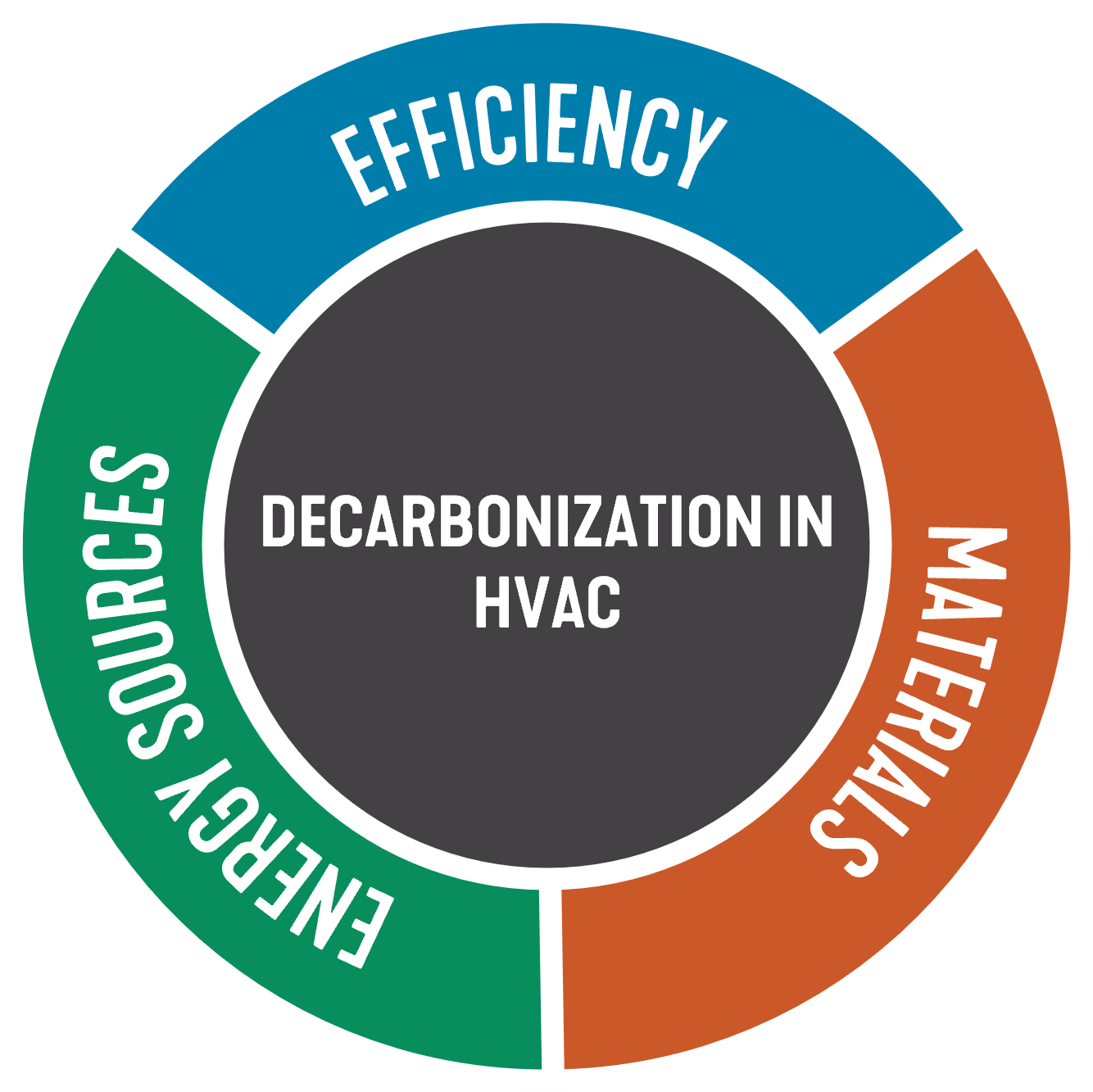
Decarbonization strategies will vary by building and location, but all can be sorted into three pillars.
1. Use less energy: A building that uses less energy contributes fewer operational emissions to the environment. It is also less sensitive to shocks to the energy system. A building that requires less energy to operate will spend less on utility bills if there is a spike in gas or electricity costs and will reach smaller peaks during extreme weather events. It will be easier to store enough energy to weather gaps in supply and if energy supply is short, will allow more buildings to operate.
Decarbonization strategies for using less energy:
- Choose efficient equipment: Designing around equipment with a higher coefficient of performance (COP), such as geothermal heat pumps, will help the same amount of energy result in more heat or cooling.
- Right-size equipment: Improperly sized equipment will run less efficiently.
- Improve the building envelope: Consider where equipment is located as well as penetrations in the envelope to keep the energy that was already used.
- Capture waste energy: Technology such as heat recovery chillers can reuse energy that would otherwise be exhausted, which can reduce overall consumption when deployed properly.
- Use economizers: Outdoor air can be levered to an advantage, helping meet a building’s internal load when conditions are appropriate.
2. Consider energy sources: A building that designs around a reliable energy source or generates its own energy is insulated from many shocks. Independent energy sources are becoming easier, greener and cheaper to install locally and when directly attached to a project can help reduce energy bills and withstand outages.
Decarbonization strategies for energy sourcing:
- Electrification: Buildings that burn fossil fuels on site will always generate the same emissions. Buildings attached to an electric grid will automatically become greener as more renewable energy sources continue to be installed.
- Design for time of use: Electricity drawn from the grid during hours of peak generation, especially from intermittent renewables like solar, results in fewer Scope 2 emissions and fewer demand charges.
- Energy storage: Thermal storage or electric storage can help systems undergo outages or shift usage times.
- Renewable generation: Solar panels, connected wind and even micronuclear generation can remove a project’s reliance on outside energy sources.
3. Manage material sourcing: Considering material sourcing and required maintenance reduces a project’s embodied emissions. It can also be a key strategy for reducing construction and maintenance costs and avoiding supply chain issues.
Decarbonization strategies for materials:
- Adaptive reuse: When feasible, renovating existing buildings can avoid the material cost — and embodied emissions — of building from scratch.
- Sustainable refrigerants: High-GWP refrigerants can contribute significantly to a building’s embodied emissions and leaks over time can potentially compound this impact. Lower-GWP refrigerants avoid this risk. As regulations and guidance around refrigerants shift, systems that depend on refrigerants with high GWPs will face more restrictions and be harder to maintain.
- Local sourcing: Emissions associated with material transportation and risks associated with complicated supply chains can be reduced by sourcing local materials where possible.
The art of decarbonization
Mechanical design is called design for a reason: Good engineering requires creativity. Many strategies for decarbonization and risk management can be contradictory and different engineers will arrive at different solutions. Refrigerants provide a fantastic example: Some sustainable refrigerants may make the system cheaper to maintain and easier to dispose of — and may also make the system operate at a lower COP, raising operational energy costs and exposing a system to fluctuations in energy pricing.
Costs, regulations and equipment constraints complicate the puzzle. It falls to the engineer to determine the appropriate balance of efficiency and lower embodied emissions. Looking into the future and considering the risks that the system will be exposed to can provide clarity. One project may prioritize a more efficient system, while another may choose a more sustainable refrigerant, while a third may consider a combination that prioritizes reducing whole-life carbon.
While no project can implement every single decarbonization strategy, every project will find benefit in considering tools for a greener design. The role that decarbonization plays in design will change depending on the project, client and geographic region. Weighing decarbonization from a risk management perspective can reframe the process of mechanical design from an immediate-cost perspective to a long-term, future-proof one.
Mechanical engineers have a unique opportunity and responsibility to build systems for a greener and safer future.