Hospital decarbonization requires a systems-based approach that balances carbon reduction, patient comfort, financial constraints and operational resiliency rather than optimizing any single objective.
Learning objectives
- Explain how early planning and building design decisions influence a hospital’s long-term energy use, carbon footprint, infrastructure requirements and occupant comfort.
- Evaluate the tradeoffs between decarbonization, cost and resiliency when selecting healthcare facility systems and technologies.
- Identify multi-benefit strategies such as heat recovery, energy storage and microgrid-enabled infrastructure that support both carbon reduction goals and operational continuity in healthcare environments.
Hospital decarbonization insights
- Hospital decarbonization requires balancing carbon reduction, cost and operational resiliency while maintaining the continuous, reliable systems essential to patient care.
- Multi-benefit strategies such as heat recovery, thermal energy storage and microgrids can reduce carbon emissions while improving efficiency, flexibility and long-term resiliency.
In healthcare facilities, carbon reduction is not an isolated sustainability objective. Every decision that affects energy demand also influences infrastructure size, operational flexibility, maintenance access and patient care. Successful decarbonization therefore depends less on selecting technologies and more on understanding how decisions made early in design cascade through the entire hospital ecosystem.

Acute care facilities demand continuous operations, precise environmental control and layered redundancy. This requires a fundamentally different approach that balances carbon reduction, capital cost and operational resiliency rather than optimizing for any single objective.
A different kind of decarbonization challenge
Most hospital decarbonization conversations begin in the central utility plant. However, by then, many of the most consequential decisions have already been made. Long before mechanical and electrical engineers size equipment, choices around building geometry, glazing strategy, departmental adjacencies and envelope performance establish the energy demand that every downstream system must support. The largest drivers of energy use and carbon consumption in a new hospital include required air change rates, process loads and lighting. These early planning decisions ultimately shape carbon emissions, infrastructure costs and resiliency.
Unlike commercial buildings, hospitals cannot simply trade resiliency for efficiency. Clinical operations require continuous environmental control, uninterrupted power and maintainable infrastructure. As a result, healthcare decarbonization is less about maximizing a single sustainability metric and more about managing the consequences of interconnected design decisions.
Healthcare organizations are facing increasing pressure to reduce their carbon footprint. Environmental, social and governance commitments, regulatory requirements and public accountability are accelerating the push toward electrification and energy efficiency. However, hospitals are not commercial office buildings and treating them as such can lead to unintended consequences.
The question is how to achieve meaningful carbon reductions without compromising patient care or the potential impact of financial costs. A hospital’s decarbonization strategy cannot begin and end in the central plant. It must start with the building envelope. However, a growing architectural preference for expansive, clear, non-tinted glass is actively working against energy goals. While visually appealing and beneficial for daylighting, highly glazed facades amplify solar heat gain in summer and thermal loss in winter. For acute care facilities, managing this architectural desire against strict environmental control is a complex balancing act.
To reduce solar heat gain without compromising the desired daylight aesthetic, the engineering team must evaluate the relationship between glazing percentages, shading and glass performance. While minimizing the overall window-to-wall ratio yields the highest energy savings, external shading strategies can mitigate solar loads where glass is non-negotiable, although this approach frequently collides with the building’s aesthetic intent.
The goal is to achieve a lower solar heat gain coefficient (SHGC) to minimize radiant heat transfer, while also considering the climate zone. Historically, a lower SHGC required dark, heavily tinted glass. Now, modern spectrally selective low-E coatings allow high visible light transmittance while reducing solar heat gain.
Beyond pure energy calculations, the evaluation of perimeter heating versus glazing efficiency is directly tied to occupant comfort. In patient rooms, cold glass surfaces can create drafty downward convection currents during the winter, while unchecked summer solar radiation creates localized hot spots. The design team has found that using advanced thermal modeling software to evaluate occupant comfort and indoor thermal gradients is essential.
Designers must carefully evaluate exterior diffuser orientation and velocity profiles to ensure stable air distribution and consider separate high-performance requirements for vision glass (such as triple-pane systems) versus insulated spandrel glass panels to maintain a continuous thermal barrier.
The illusion of isolated decisions
Healthcare projects rarely fall short of sustainability goals due to a single poor decision. Rather, challenges to reach these goals emerge when teams evaluate carbon, cost and resiliency independently. The reality is that these variables behave more like interconnected gears where movement in one inevitably affects the others. Decisions made to reduce first costs can increase long-term carbon emissions or erode system reliability. Likewise, strategies that maximize energy efficiency may introduce new risks if these rely too heavily on a potentially unstable electric grid.
In healthcare projects, financial pressures frequently dominate early decision-making. Measures that do not meet short payback thresholds — often less than eight years — are at risk of elimination. At the same time, resiliency features exceeding code minimums are often value-engineered out, despite their importance in maintaining operations during outages or system failures.
Electrification, while central to decarbonization, adds another layer of complexity. Increasing reliance on electricity without addressing grid vulnerability can expose hospitals to new operational risks. What emerges is not a simple optimization problem but a balancing act.
Early decisions shape performance and infrastructure
Many of the most impactful decisions affecting energy use and cost are made long before mechanical systems are designed. Building form and envelope geometry inherently dictate baseline system demands. For example, while simple rectangular footprints maximize thermal efficiency and minimize exterior surface area, modern healthcare architecture often favors complex, articulated geometries. These sprawling, angled floorplans inherently increase structural costs and inadvertently create geometrically awkward, unusable spaces that force the expansion of gross mechanical, electrical and plumbing square footage to route utilities.
When paired with expansive glazing, these geometric choices compound cooling demands and solar heat gain management challenges. In a fully electrified building, varying architectural demands directly dictate the scale of the downstream electrical infrastructure. In traditional fossil-fuel hydronic systems, oversizing a heating coil has minor consequences as total hydronic system flow rates remain relatively static. In an all-electric reheat system, however, oversized heating coils instantly trigger massive downstream scaling of the electrical distribution network and the essential electrical system (EES).
Over-designing mechanical modules unnecessarily inflates the cost, footprint and complexity of generators, transfer switches and switchgear. True optimization requires right-sizing mechanical demand at the massing stage, preventing a runaway financial chain reaction in the electrical room. These early design choices often establish a baseline energy demand that mechanical systems must accommodate, limiting the effectiveness of downstream efficiency strategies.
Resiliency under budget pressure
Resiliency is essential in healthcare, yet it is often one of the first areas impacted during cost reduction efforts. Systems that enhance redundancy, flexibility and maintainability frequently carry longer payback periods, making these vulnerable in budget-driven decision processes.
Features such as expanded system redundancy, thermal energy storage and advanced heat recovery solutions may be scaled back or eliminated. However, these same features provide crucial benefits, including improved outage survivability and reduced operational disruption.
Reliance on short-term financial metrics can obscure the long-term value of resiliency investments. In an environment where downtime is not an option, these tradeoffs carry significant risk (see Figure 3).
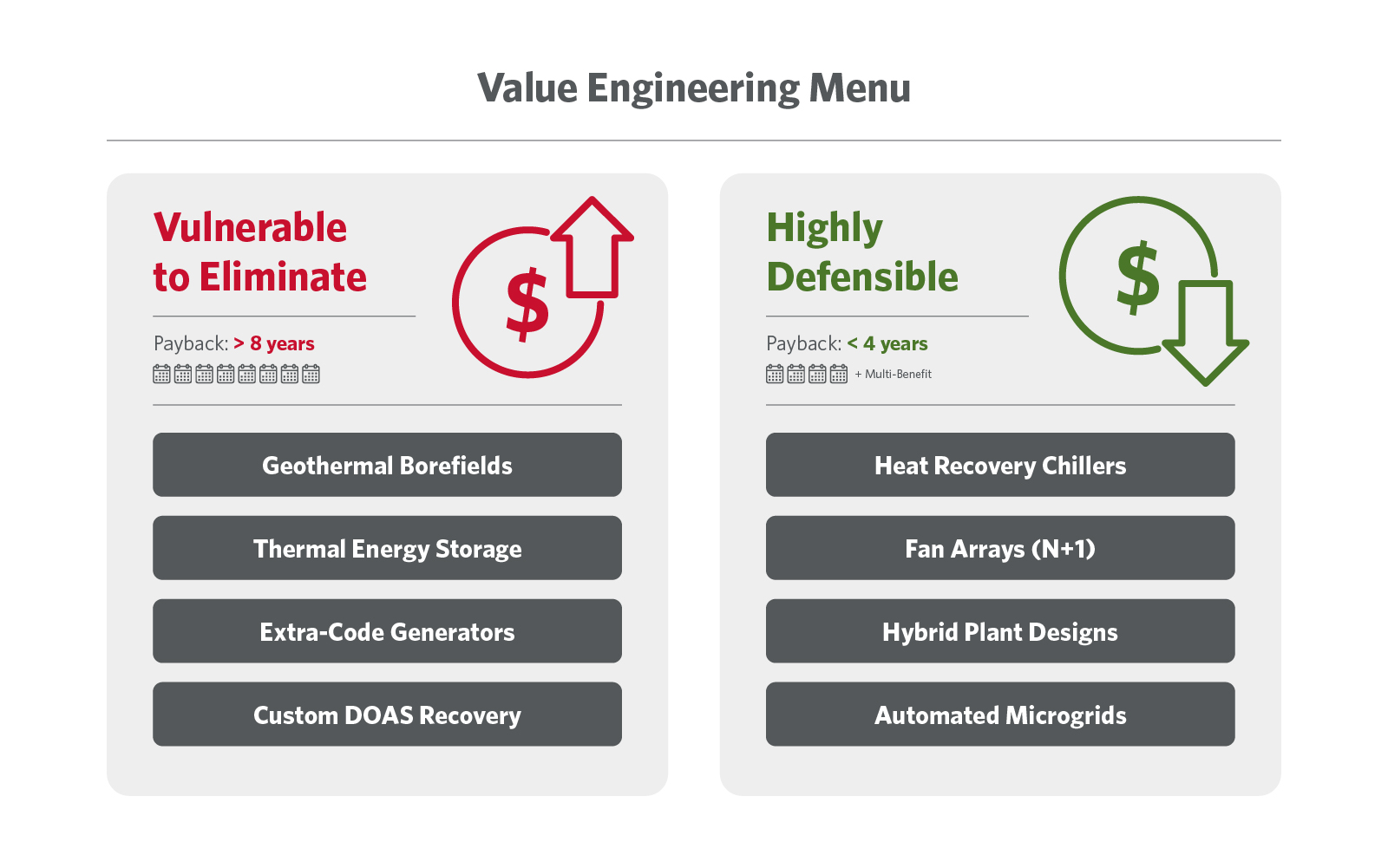
The dividing line between those elements that survive and those that are cut from the budget typically comes down to a multi-variable calculation of initial cost, payback thresholds and owner’s project requirements, along with Facility Guidelines Institute requirements and code mandates. Designers must anticipate the vital systems that are most at risk:
Air-side redundancy versus first cost: Custom air handling units (AHUs) using internal N+1 fan arrays are frequently targeted for downgrades to dual-fan configurations. While dual-fan units reduce initial expenditures, they can only provide approximately 70% airflow on a fan failure. This sacrifices the 100% airflow redundancy that allows a hospital to service equipment without compromising airflow to critical spaces like operating rooms.
Generator scope dilemma: While electrical codes mandate strict baseline requirements for the EES, engineers often advocate for backing up non-critical yet operationally vital infrastructure (such as standard diagnostic equipment or cooling plants). Under budget constraints, the generator scope is often dragged back to the minimum code requirements, stripping the facility of long-term climate adaptation flexibility during prolonged regional outages.
Energy savings versus first cost: For energy savings strategies that go beyond the energy code, such as dedicated outdoor air systems with high-performance run-around loops, these are easily cut if their standalone payback exceeds the standard eight-year threshold. However, this ignores their systemic benefit in downscaling the central heating plant.
Rethinking carbon beyond energy use
While sustainability efforts have traditionally focused on operational energy, attention is shifting toward embodied carbon — the emissions associated with building materials and construction.
Envelope systems and structural materials now represent significant opportunities for carbon reduction. Lower-carbon facade systems and material substitutions can achieve meaningful impact without the operational constraints associated with some mechanical strategies.
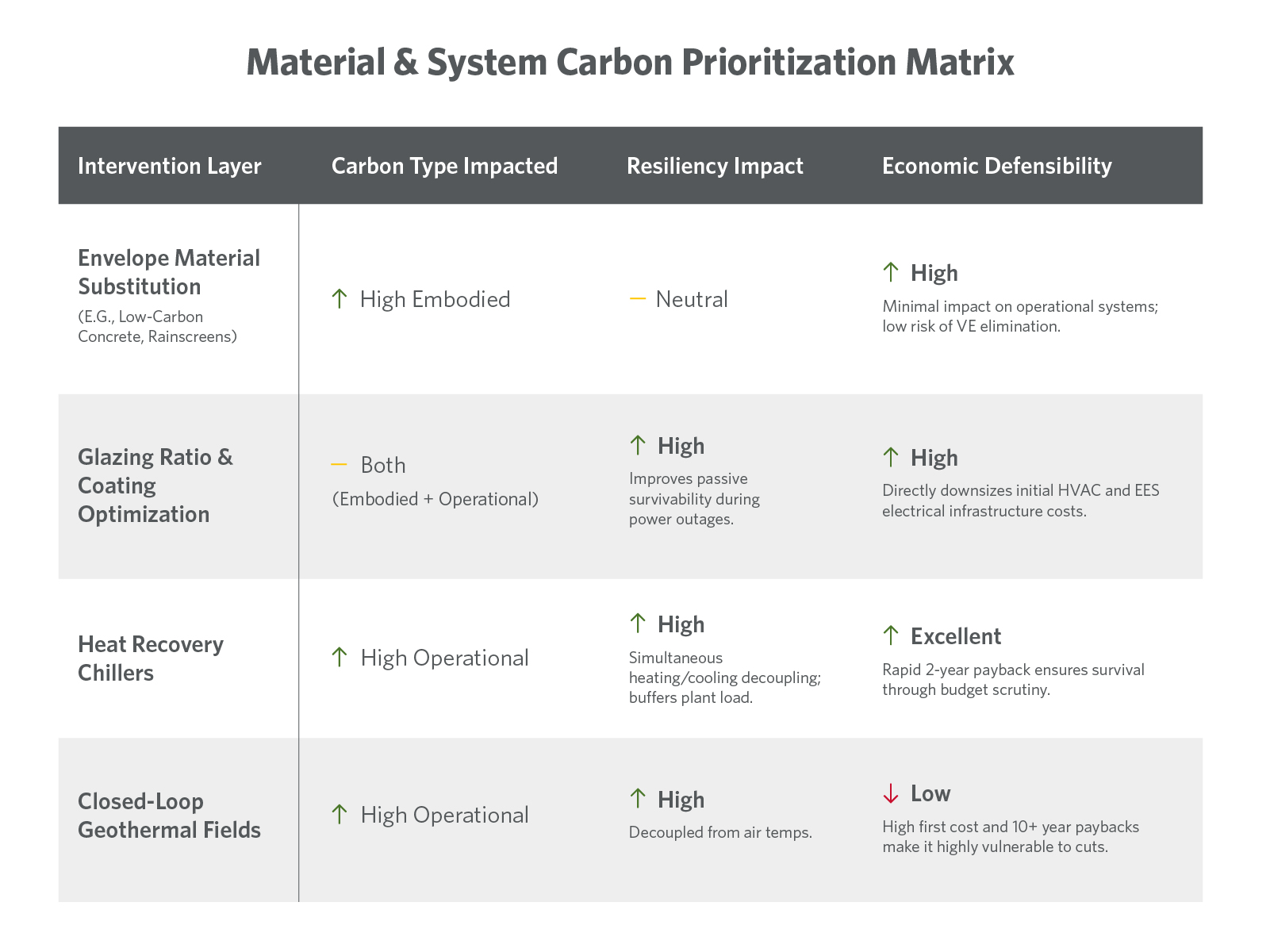
To navigate these options, many teams are adopting multidimensional evaluation frameworks. These tools assess strategies based on carbon reduction potential, cost implications and contributions to resiliency. Rather than optimizing for a single metric, these enable more balanced, informed decision-making (see Figure 4).
Emerging strategies
Not all sustainability strategies are equally resilient in the face of financial scrutiny. To survive budget cuts, the strategy must deliver benefits across multiple operational dimensions simultaneously. Single-benefit systems are easily engineered out while multi-benefit systems are highly defensible.
Heat recovery chillers (HRCs) represent the gold standard of this principle. As acute care facilities generate a continuous, simultaneous demand for both heated and chilled water, HRCs capture the heat rejected by cooling processes and elevate it for space heating and domestic hot water instead of discarding the heat through a cooling tower. This yields massive operational savings, drastically reduces domestic water consumption and delivers an attractive, undeniable payback period — frequently less than two years.
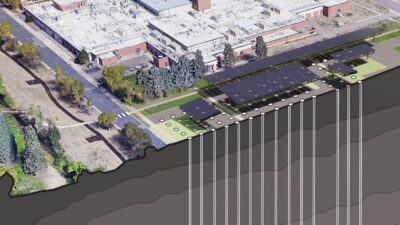
Conversely, technologies like geothermal systems face steep financial friction. While leveraging stable subterranean temperatures provides excellent lifecycle efficiency, their performance depends heavily on localized groundwater movement to prevent thermal saturation of the wellfield. Coupled with a high installation cost that often pushes payback periods past the decade mark, standalone geothermal fields are highly endangered during a budget crisis. Forward-thinking teams bypass this by deploying hybrid configurations such as sizing a smaller, cost-effective geothermal loop to handle predictable baseloads while relying on traditional fluid coolers or cooling towers to manage extreme peak summer rejection.
For facilities burdened by highly volatile electrical rate structures, thermal energy storage (TES) provides an elegant economic shield. Rather than targeting absolute energy reduction, TES focuses on strategic demand-shifting. By running chillers to “charge” chilled water or ice storage tanks during cheap, off-peak night hours, the hospital can offset its electrical demand during expensive, peak daytime windows.
This load flexibility aligns perfectly with recent advancements in electrical codes and control infrastructure. The historic reliance on diesel-engine-driven generators for the EES is giving way to diversified microgrids. Modern regulations now permit the integration of fuel cells, battery energy storage systems, and onsite photovoltaic (PV) arrays to satisfy healthcare resiliency requirements. By pairing these emerging power assets with artificial intelligence (AI) capable of real-time load optimization, modern healthcare campuses are transforming into grid-interactive assets. This approach is proving that focused decarbonization efforts and absolute operational reliability are no longer mutually exclusive mandates.
The defining characteristic of these approaches is their ability to meet multiple objectives simultaneously, making these elements more defensible during the design process.
From code compliance to true resiliency
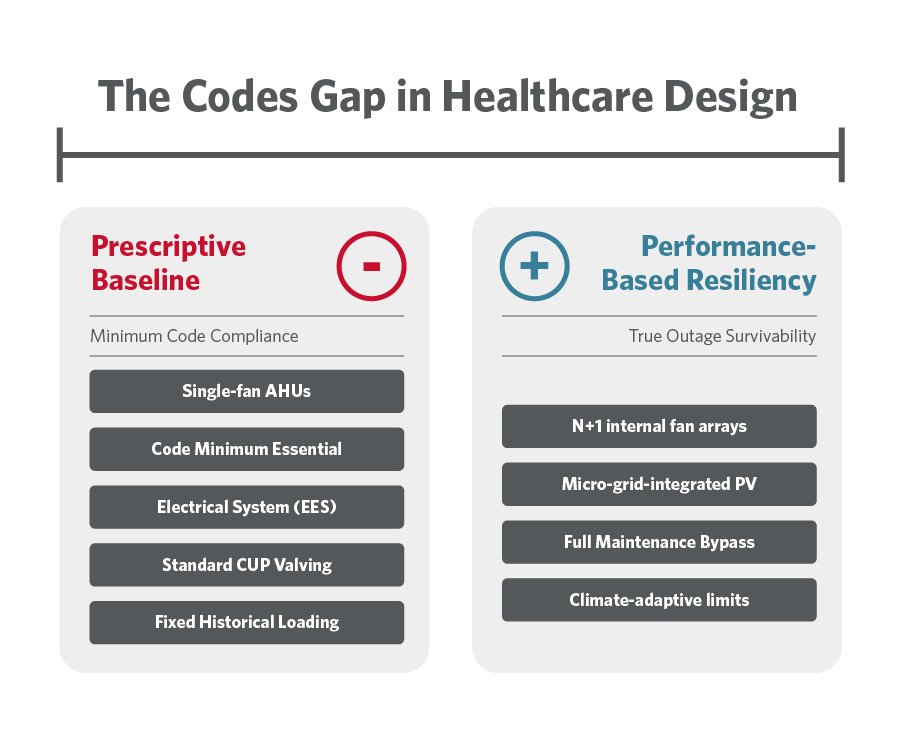
Building codes establish a baseline for life safety and system reliability, yet these are inherently backward-looking. They do not fully account for the long-term operational realities of a rapidly shifting climate, an aging regional grid and an evolving risk landscape. To protect patient care over a 50-year building lifespan, healthcare infrastructure must transcend prescriptive code compliance and move toward performance-based design that prioritizes real-world, long-term outcomes.
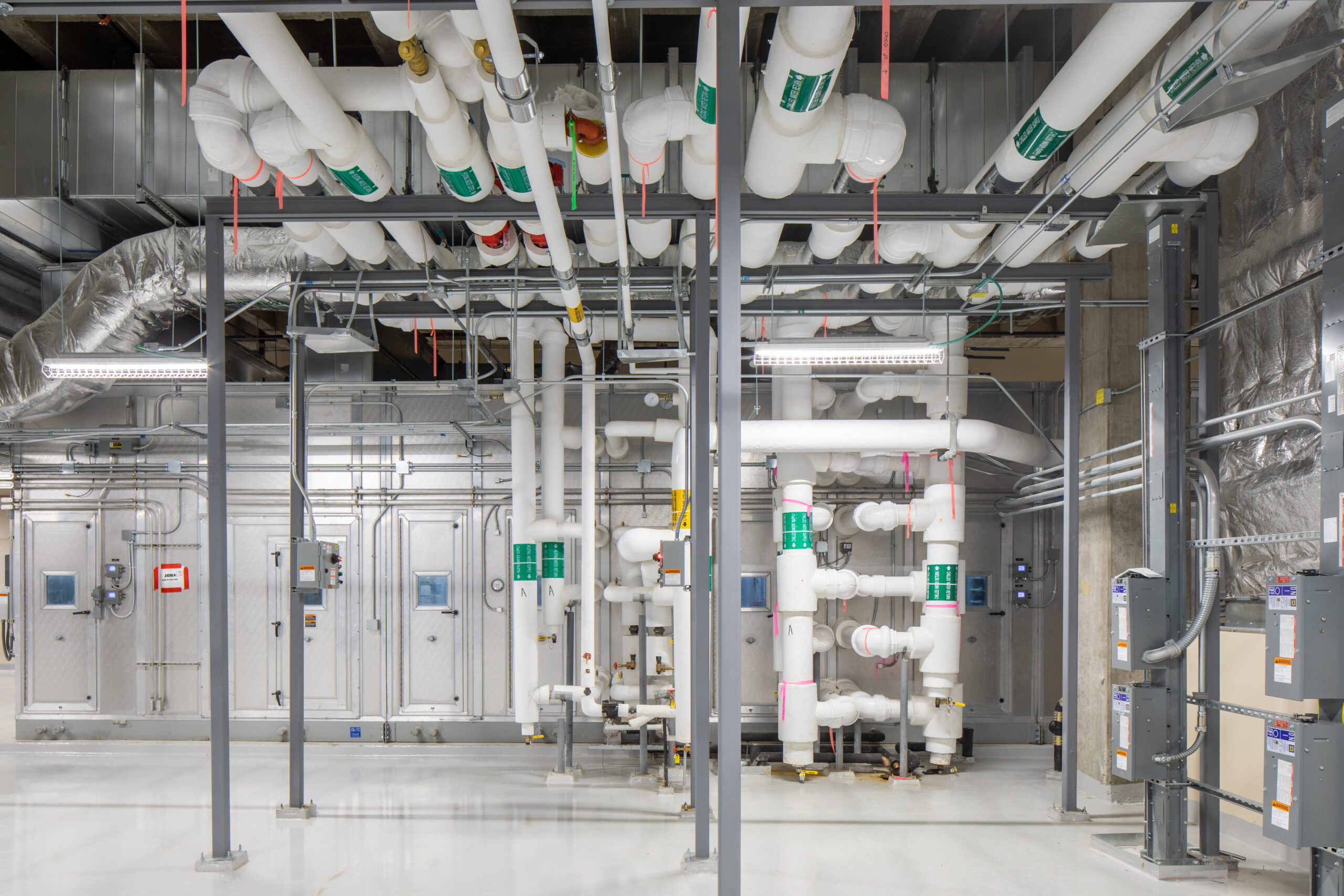
True operational resiliency requires designing for continuous maintainability and ultimate outage survivability. For example, rather than specifying standard single-fan air handling units, engineering teams are increasingly shifting to custom AHUs equipped with internal N+1 fan arrays. This design allows the hospital to lose an individual fan module or perform routine maintenance without dropping a single cubic foot per minute of supply air to critical spaces like surgical suites.
Similarly, central plants must incorporate intelligent bypass configurations and modular isolation valving. This allows full-scale component maintenance or component replacement without triggering a campus-wide shutdown.
On the electrical side, on-site renewable assets such as PV arrays are being reevaluated. Historically viewed as strictly carbon-reduction tools, PV arrays become dynamic resiliency assets when paired with modern microgrid controllers and battery storage, capable of supporting critical non-code-mandated loads during extended utility failures (see Figure 5).
Designing for an uncertain future
Healthcare facilities must now be designed to operate in an environment defined by uncertainty. Grid instability, extreme weather events, fuel supply disruptions and rising utility costs all pose risks to continuous operation.
To mitigate these external threats, design teams are prioritizing fuel diversity and islanding capability. By using hybrid central plants that combine all-electric heat recovery machinery with highly reliable combustion or backup generation infrastructure, facilities avoid single-point-of-failure utility risks. If the regional grid falters, islanding capabilities allow the campus to cleanly detach from the utility network and manage internal generation and storage assets seamlessly to protect clinical environments without interruption.
Future of healthcare campuses
Looking ahead, decarbonization and resiliency efforts are expanding beyond individual facility footprints into integrated, campus-scale networks. District thermal energy networks and ambient loop systems allow interconnected medical buildings to share energy dynamically, using the rejected cooling heat from a data center or imaging wing to heat an adjacent outpatient clinic.
Simultaneously, the integration of AI is transforming hospitals from passive consumers into dynamic, grid-interactive buildings. AI-driven building automation systems can predict weather anomalies, anticipate peak utility pricing and orchestrate real-time optimization schedules, thus balancing energy efficiency, carbon impact and critical operational demands simultaneously. Complete electrification remains the goal. However, industrywide success will depend entirely on adoption of system flexibility rather than design rigidity.
Integration, not tradeoffs
Decarbonizing healthcare is not about choosing between sustainability or resiliency. It is about integrating both within the constraints of future thinking and intelligent capital budgets.
The most successful healthcare projects of the next decade will be guided by three non-negotiable principles:
Prioritize multi-benefit strategies: Allocate capital dollars to technologies such as heat recovery chillers that simultaneously defend the budget, drive down carbon and protect operations.
Anchor decisions in lifecycle value: Look past the initial capital expenditure hurdle and evaluate system investments using robust lifecycle analysis rather than simplistic, short-term payback metrics.
Design for adaptability: Build modularity and fuel flexibility into the central plant today to insulate the facility against the utility instabilities of tomorrow.
By shifting the conversation away from frustrating trade-offs and toward smart, systemic integration, healthcare organizations can achieve ambitious carbon reductions while preserving the absolute reliability that patient care demands.