When I started my last post on the cooling tower level control issue on a current project, I had planned to use a string of posts to discuss what we learned on the project. But, it turned out that Michael Ivanovich (CSE Editor in Chief) was putting together the April issue, which focused on campus systems, and my pending string of posts looked like a perfect article for the issue to him. So watch for the April issue of CSE if you want to find out more about the cooling tower issues I mentioned or just want to learn more about campuses and engineering on them. Meanwhile, we've run into several other interesting problems on the project that I thought I would share.
The project is approaching substantial completion, so our focus has been to work with the contractors to get systems stable, reliable and robust, starting with the basic utility systems like the cooling tower and related condenser water system and the steam and condensate system. Getting these systems up lets us turn our focus to the chilled water system and heating water system respectively. In turn, stable operation of these systems allows us to focus on the air handling equipment that serves the occupied areas in the building, either directly in the case of the constant volume systems, or via the terminal equipment in the case of the variable volume systems. The project is a library that houses some very, very rare documents, and thus requires very stable and somewhat exotic control of humidity and temperature in order to minimize the potential for degradation over time. Here is a picture of the project site take from the perspective of a kite mounted camera.

Being an aviation buff, the photo really appealed to me . It was taken by a UC Berkeley Building Sciences professor, who, it turns out, was one of Ryan Stroupe's professors. Ryan is the person I work with when I teach at the Pacific Energy Center; small world. If you want to see some more great photos from a wonderful perspective, you should visit Chris' web site.
In the photo, the project site is the building in the center with the construction trailers off to the side. The picture appears to have been taken fairly early in the project, before the cooling towers had been set on the roof.
Returning to our technical discussion, we have been having some difficulty getting the chilled water system to run steady state at the design 39°F supply water temperature. The team has made great progress in identifying and correcting the issues identified to date, but we are not quite there yet. This is not unusual at all and in my experience is simply part of the normal start-up process. You fix the big issues which then allows the smaller issues to make themselves known. Recently, we have been having occasional chiller trips on low saturated suction temperature. Since I was on site in and in the chiller room yesterday and one of the machines was running at part load, I thought I would watch it for a while and see what I could learn. To date, most of my experience with chillers has been with centrifugal compressors, reciprocating compressors, and absorption machines, so I was curious to spend a little time watching how the screw compressors on these chillers worked.
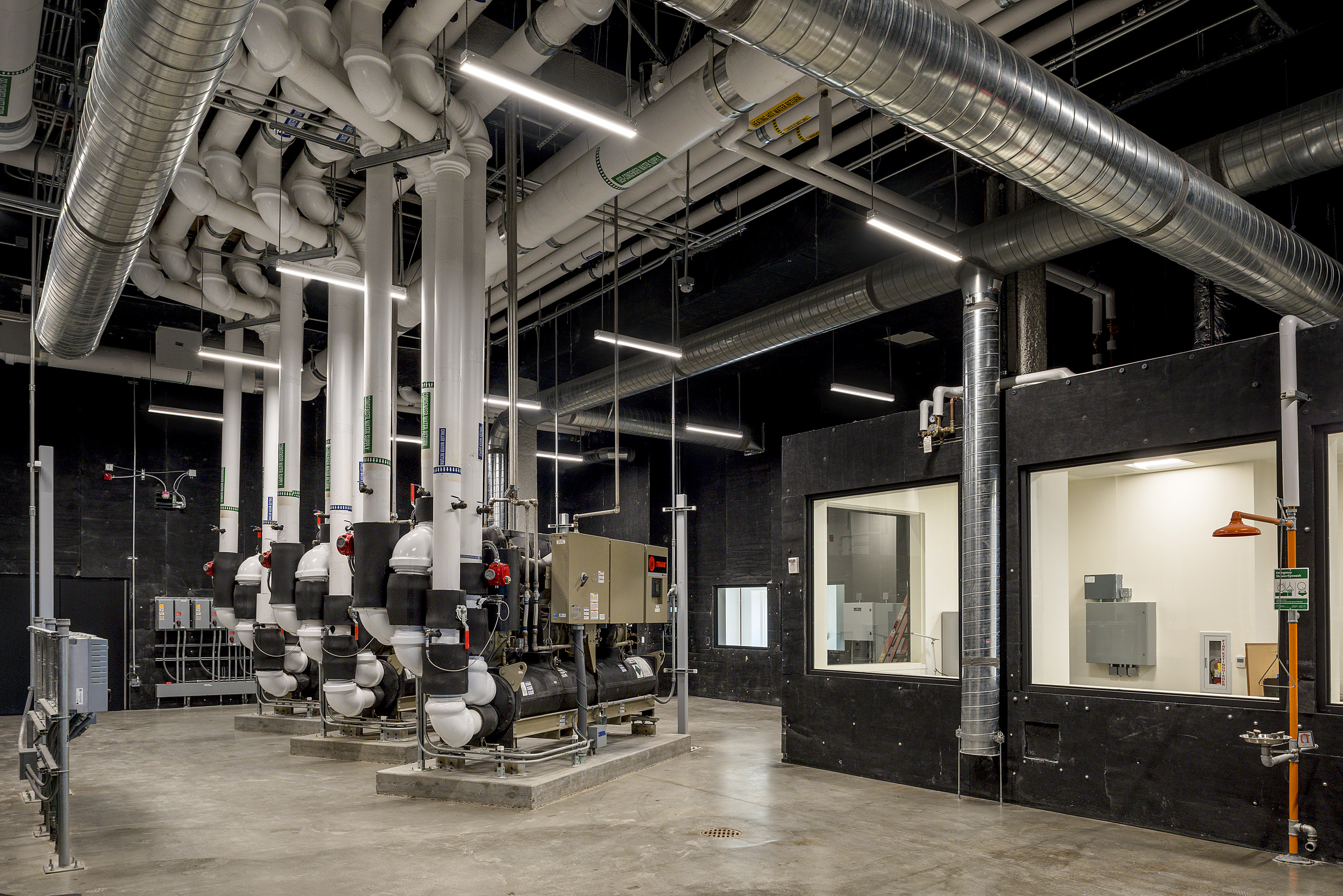
My first challenge was figuring out what I was looking at. This is often the case out in the field; you find yourself confronted with a machine that you are not familiar with but at the same time, you need to understand what it is doing. For me, the trick is to stay calm and remember that the machine is likely based on the same principles as any other machine of its type and draw on that experience. In this case, I was dealing with water cooled chiller with a vapor compression type refrigeration cycle. The biggest difference in my case was that the compressor on this machine was a rotary screw compressor instead of the centrifugal compressor or reciprocating compressor that I was more familiar with. (If you are not familiar with screw compressors, ESource has a good brochure on their web site with some diagrams of how they work. Even more information can be found on one of the ASHRAE Equipment handbooks. For instance, Chapter 34 of the 2000 Equipment and Systems Handbook has several pages of detailed information).
To understand what I was looking at, I used my general knowledge of the refrigeration cycle and a bit of engineering logic. I've inserted a picture of the actual machine I was looking at along with a diagram of its refrigerant circuit that I subsequently retrieved from the O&M manual to allow you to follow the thought process I used to figure things out.


Standing there looking at the chiller, what I knew for sure was that the compressor (circle A) was sitting on top. I was pretty sure of that because it had the power connections to it and it, if nothing else, it was the place where the operating sound was coming from. I was able to deduce which tube bundle was the condenser (circle B) and the evaporator (circle C) simply by looking at the piping connections (which I assumed were correct; usually a good assumption, but I have seen coils piped back wards and to the wrong source, never a chiller though).
Having established a frame of reference, I then deduced that the suction connection to the compressor would have to be a fairly large line from the evaporator, which is the blue line in the pictures (in reality, it is mostly behind the big cylindrical muffler in the hot gas discharge line highlighted in red).
In a typical vapor compression cycle, the refrigerant moves from the compressor to the condenser, so I looked for a large line between the two (the red line in the pictures). Temperature would have also been a clue.
Finally, the liquid refrigerant has to make its way back to the evaporator via some sort of expansion device. I deduced that the line highlighted in green was the liquid line because it had a sight glass (red arrow), a filter/dryer, and went between the condenser and evaporator. At first, I was not sure what the large brass fitting above the sight glass was, but then I realized it was the expansion valve, probably an electronic one given that the machine is a current technology chiller and the fact that it had some wiring connected to it.
Having gained an understanding of the circuit, I started to watch the sight glass and noticed two things. One was that the moisture indicator in it was green, which is a good sign since water and refrigerant are not a good combination in the same pipe. We had been watching the indicator on this particular circuit a bit more than the others because one of the oil lines had been damaged during construction. If the damage had been severe enough to cause us to loose the holding charge in the machine, then atmospheric moisture could have found its way into the system and caused some corrosion. All evidence suggests that this has not happened and that the contractor took care of the problem immediately when they became aware of it. But a little precautionary monitoring is probably in order just to be sure.
The other thing I noticed was that the sight glass seemed to have a lot of bubbles - running white with foam at some times -especially if the machine was loaded up. Below is a very low res picture of what it looked like. It's from a little video I took with my camera to share with the contractor and chiller technician to see what they thought. The video is more informative because you can see the motion of the bubbles, which just look like a white cloud here.

The bubbles caught my attention for a number of reasons. For one thing, on most refrigeration systems, the sight glass should be pretty clear most of the time, like looking through crystal clear water. Bubbles, if they appear at all, will usually only persist for a moment or two after a transient condition like a start-up. The fact that I was seeing bubbles continuously and that they got worse as the machine loaded made me wonder if the machine was low on refrigerant. In the past, low refrigerant charge had correlated with low suction pressure shut downs and bubbles in the sight glass. But, given my lack of experience with screw chillers, I wasn't sure, so I looked for some more evidence.
One of the neat things about current technology electronics is the amount of information they can put out our fingertips about the machinery they serve. The chiller I was working on was no exception. It included a hand held interface that had all sorts of useful operating data. The picture below is of one of menu selections that covers operating temperatures.

Note that the SH.A temperature (which is the A circuit superheat pointed to by the red arrow) shows up as a differential of over 32°F. A little bit of superheat in a refrigeration circuit is a good thing because it protects the compressor from slugs of liquid. But a lot of it means that the system is not making very good use of the heat transfer surface it has available to it. (If you are not familiar with superheat, I'll put up a post in a day or so that will give a familiar example in an effort to explain it, so tune in then.)
At first, I thought what I was looking at was a temperature, not a differential temperature, but then I noticed the little delta symbol. Plus, if it really was superheat, it would be physically impossible for it to be lower than the saturated suction temperature, which shows up as 36.7°F in the picture (SST.A and the blue arrow). So, to me, the high superheat collaborated my low charge theory; if there was not enough charge in the system for the load it was designed for - which would be reflected by the physical size of the evaporator and the heat transfer surface it contained - then the refrigerant that was available would be evaporated with out using all of the heat transfer surface and the unused heat transfer surface would superheat the resulting vapor more than necessary to protect the compressor.
When I got back to the construction trailer, I took a look in the O&M manual. The word search feature associated with .pdf files allowed me to quickly peruse the electronic document on my laptop (two more cool benefits of the electronic age) and discover some more information that made me think my observation were worthy of at least bringing up for consideration by the manufacturer. On page 55, I discovered that while bubbles in the sight glass are not an absolute indication of low charge, if the machine is fully loaded and you see them, then it’s a distinct possibility.

I had not run the procedure discussed in the manual to verify the machine was fully loaded, but I was pretty sure it was because the 2nd compressor kept cycling on and off as I watched things happen. I interpreted that to mean that the load was at a point where the smaller lead compressor was on the edge of not being able to handle it and the controls were brining on more capacity on occasion as a result.
On page 69, I found a troubleshooting table, which indicated that if the compressor was cycling off on low saturated suction temperature (which was the problem we were having), then one possibility could be that the machine was low on charge.

On the plane home last night, with my confidence rising, I decided to compose an e-mail to the contractor noting my observations and suggesting that it may be worth having the vendor take a look. I've already heard back from him and they're on it (hows that for responsive!). So, we will soon see if my suspicions were right or wrong; stay tuned and I'll let you know. In the mean time, I hope my sharing the details of my analysis helps you see how you can build off the knowledge you have, trust fundamental physics, leverage modern technology, and gain some insight into something you have never had first hand experience with before.