Advertisement
FREE subscription
Email
Print
Reprint
Learn RSS

Frequently Overlooked Issues in Designing Fire Pump Systems

By John D. Jensen, P.E., Idaho National Engineering and Environmental Laboratory, Idaho Falls, Idaho -- Consulting-Specifying Engineer, 4/1/2004

Some important considerations are often missing in fire pump system design. Asking the following questions will help the designer avoid overlooking some key concerns:

Were adjustments made for altitude, pump-room temperature and for a right angle drive on a diesel-engine pump? On one engine derating table, the temperature graph begins at 77ºF. The horsepower can be increased 1.0 % for each 10ºF increase in temperature. Add 3% horsepower for each 1,000 ft. of elevation.

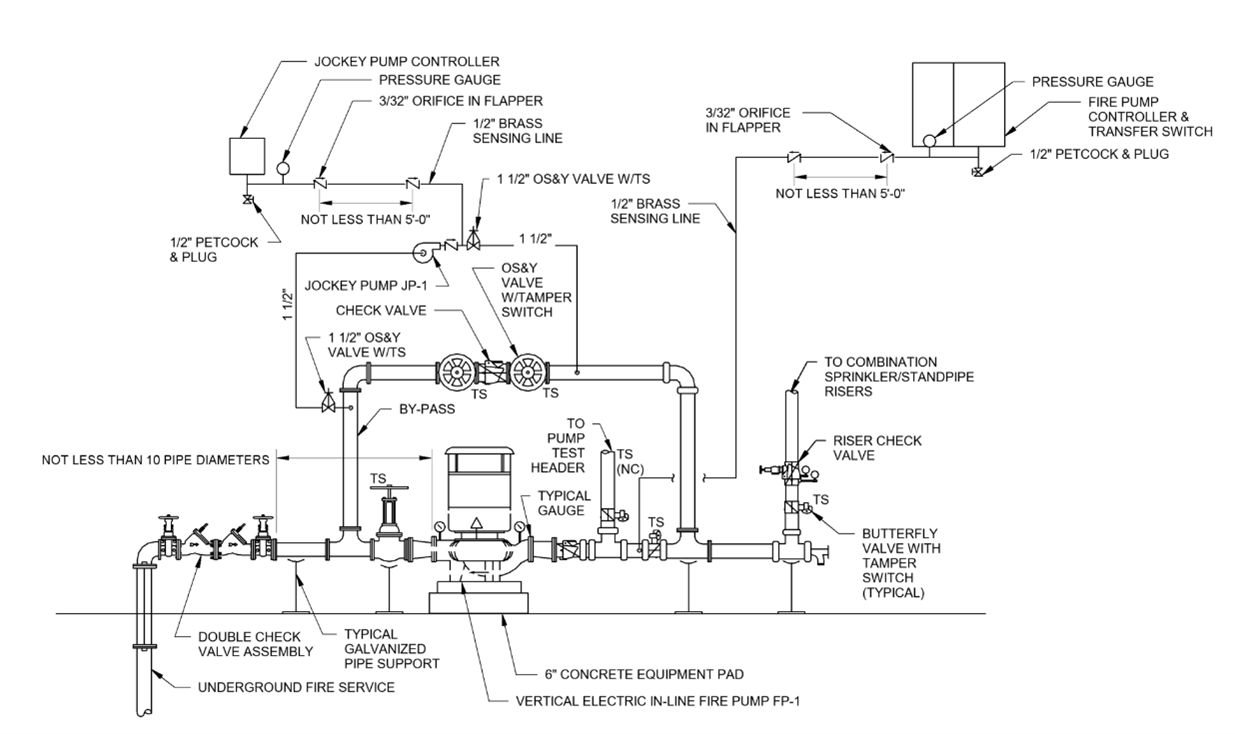
Have all of the devices in the suction line been included in the design? This is so that the correct inlet pressure to the pump can be determined. Devices include check valves, gate valves, elbows, tees, backflow devices, reducers and meters. If everything is not included, the pump discharge pressure may be too low to supply adequate pressure and flow.

For diesel-engine pumps, is the bottom of the fuel tank at or above the level of the injectors? The required location for the fuel storage tank is the fire pump room, with the bottom of the tank at or above the fuel injectors. In this way, even if the fuel pump fails, fuel can still be gravity fed into the engine without shutting down.

Is the suction pipe installed so that it will not have an air pocket next to the suction inlet? One of the most common problems in fire pump installations is the eccentric reducer in the suction piping. When this occurs, the suction piping is not level with the pump inlet, and air is trapped in the piping. When started, the pump sucks in air causing cavitation inside the pump.

Is an electric-motor fire pump equipped with a casing relief valve? These pumps are all required to be equipped with a small, 3/4-in. to 1-in. pressure-relief or solenoid valve that opens when the pump is started and stays open until the pressure in the discharge piping is reduced when the water discharges.

Are heating and cooling adequate in the pump room? The heating load must take into consideration the radiant energy produced by the diesel engine. The derating of the temperature is used to make sure that the engine will operate under all conditions.

Has the designer considered the pressure rating of the fire-protection system installed downstream from the fire pump? There is a greater need today for fire pumps that have very large capacities and lower pressure limitations on the discharge to keep pressures below the rating of the pipe, fittings and sprinklers.

Is a backflow prevention device required by the AHJ to be installed upstream from the fire pump? At present, good engineering practice in most areas requires the use of a backflow device where the water is taken from the potable water source and pumped into a fire protection system.

Editor's Note:

These are just a few often overlooked fire pump system design concerns. For the complete article, go to the Fire, Life Safety and Security community at www.csemag.com by clicking the red button on the left.


Fire Pump Design Checklist

  • Adjust for altitude and temperature
  • Include all devices in the suction line
  • Properly position diesel fuel tanks
  • Include relief valves on electric pumps
  • Consider system pressure rating downstream from pump
  • Install backflow prevention device
Email
Print
Reprint
Learn RSS

Talkback

We would love your feedback!

Post a comment

» VIEW ALL TALKBACK THREADS

Related Content

Related Content


By This Author

There are no other articles written by this author.


SPONSORED LINKS

 
Advertisement
Sponsored Links

More Content

  • Blogs

Blogs

  • Michael Ivanovich
    Give and Take

    August 8, 2008
    Rollercoaster Energy Prices vs. Conservation Momentum
    The roller coaster of oil prices did something quite amazing this year: It went up long enough to ca...
    More
  • Michael Ivanovich
    Give and Take

    June 19, 2008
    After the flood: mold. Learning from Katrina.
    As Iowa’s flood waters recede and recovery ramps up, the race begins to minimize problems with...
    More
  • » VIEW ALL BLOGS RSS
Advertisements


NEWSLETTERS
Plug in and get the latest CSE news, trends and industry updates delivered directly to your inbox!

Green Scene
CSE Codes & Standards
CSE NewsWatch
CSE Fire and Life Safety Solutions
CSE Business of Engineering Management Report
CSE Electrical Solutions
CSE HVAC Solutions
Pure Power
CSE Product Showcase
©2009 Reed Business Information, a division of Reed Elsevier Inc. All rights reserved.
Use of this Web site is subject to its Terms of Use | Privacy Policy
Please visit these other Reed Business sites