A new data center campus in rural Nevada requires a reliable campus fire water system.
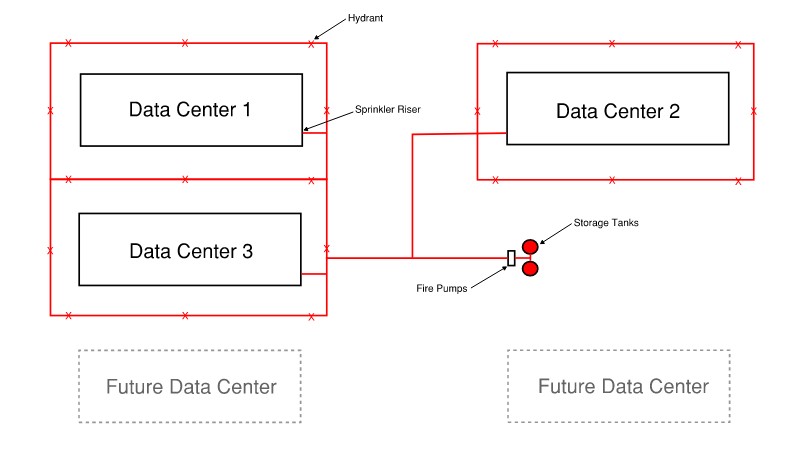
A new data center campus is being built in rural Nevada. There are currently three buildings in the initial scope of work, with plans for future expansion (see Figure 1 above). It has been documented that there is no municipal fire water system supply available and power cannot be considered reliable.
Each one-story building is fully sprinklered and has a Class I manual standpipe system per the local authority having jurisdiction (AHJ) requirements. Hydrants are supplied from the dedicated fire line because there is no municipal water supply available.
The anticipated flow and pressure demand was calculated for each system for the most remote building, with results shown in Table 1.
Table 1 – Summary of fire protection system demands
| System type | Flow demand | Pressure demand |
| Sprinkler | 1,400 gpm | 95 psi |
| Standpipe | 1,000 gpm | N/A* |
| Fire flow (hydrants) | 2,000 gpm | 20 psi |
*Manual Class 1 standpipe system. Supply supplemented by fire department. Courtesy: Stantec
Because there is an energy storage system present, sprinkler demand was calculated for 0.3 gallons per minute (gpm) per square foot over 2,500 square feet per the International Fire Code (IFC). A 20% overage factor was included and a 500 gpm hose stream was added. Despite not being the largest flow required onsite, the elevation change and pressure loss across the system resulted in a 95 pounds per square inch (psi) demand from the fire pump discharge outlet.
The campus fire water system must be capable of supplying the 1,000 gpm standpipe demand from the hydrants through the fire department connection for fire department use. Because the Class I standpipe is manual type, the fire department pumper provides the pressure boost required to fight the fire within the building.
Each data center is 150,000 square feet and of Type IIB construction. Because the IFC and Appendix B are adopted by the AHJ, a fire flow of 2,000 gpm at 20 psi is required. This is the greatest flow demand, which will drive the fire pump flow capacity rating.
After discussions with the owner and their insurance underwriters, consensus was reached to provide 2N redundancy across the campus fire water system. This means two fire pumps (one electric- and one diesel-type) and two fire water storage tanks are required. In addition, emphasis was placed on mitigating single points of failure and having the system remain fully operational during annual maintenance.
The fire pumps were specified to be rated for 1,500 gpm at 115 psi. The fire pumps are designed to operate at 133% of their rated capacity, which is under the 150% permitted in NFPA 20: Standard for the Installation of Stationary Pumps for Fire Protection. Despite both pumps being rated for the same flow and pressure, they will be programmed with different start and stop points to ensure the electric fire pump operates as the primary pump and the diesel fire pump acts as the backup.
No automatic refill consideration could be given for the fire water storage tanks. Therefore, each tank had to be sized for the largest flow demand over two hours, which was the longest duration driven by the fire flow requirements.
Finally, due to the fast-paced construction schedule, it was determined that a prefabricated fire pump enclosure would help accelerate site work and minimize field construction. The design team worked closely with a fire pump distributor to specify the exact enclosure size, connection points and weight requirements for the structural slab.