Mechanical engineers can enhance data center cooling system reliability and sustainability with strategic water treatment planning.
Learning objectives
- Understand the role of water quality in data center cooling performance and system longevity.
- Identify how to integrate water treatment planning into HVAC and liquid cooling system designs.
- Apply best practices for specifying chemical feed, monitoring technologies and pretreatment systems tailored to data center conditions.
Water treatment insights
- As data centers adopt AI-driven, high-density workloads, cooling system reliability hinges on integrating water treatment strategies during design to prevent scaling, corrosion and microbial fouling.
- Addressing water treatment early reduces energy costs, extends system life and safeguards uptime, especially as liquid cooling technologies become essential for next-generation performance.
As data centers expand to support artificial intelligence (AI), cloud computing and high-density processing, specifying engineers face increasing pressure to ensure cooling systems deliver 24/7 reliability under greater thermal loads. While design specifications often prioritize chiller efficiency and airflow performance, one crucial factor is frequently overlooked until problems arise: water treatment.
If not addressed during system design, water quality issues can lead to scaling, corrosion, microbial fouling and underperforming heat transfer systems. These risks translate to higher energy consumption, increased maintenance and reduced system life. The solution lies in integrating a water treatment strategy into the design phase of the heating, ventilation and air conditioning (HVAC) system, long before operations begin.
Why water treatment must be a design priority
Cooling systems in data centers often depend on large volumes of water that vary significantly in quality depending on geographic location, seasonal changes and source type. Even treated municipal water can contain problematic levels of hardness, silica, chlorides or organic material. Without proper treatment, scaling can insulate heat exchanger surfaces, corrosion can damage equipment and microbial growth can lead to biofouling and under-deposit corrosion — all of which compromise cooling efficiency and uptime.
In a data center environment where even slight efficiency losses can cascade into energy cost increases and reduced equipment reliability, these water-related risks demand proactive attention. The long-term impact of neglecting water treatment in the design phase is not just higher maintenance costs, but also potential threats to information technology uptime and sustainability goals.
Integrating water treatment into cooling system design
Specifying engineers can significantly improve system resilience and life cycle performance by addressing water treatment requirements in the early stages of design. This begins with understanding the characteristics of available water sources, including potential seasonal variability in hardness, microbial content and dissolved solids. With this knowledge, engineers can select materials and treatment technologies compatible with the anticipated water profile.
Effective system designs typically include pretreatment strategies such as filtration, softening or reverse osmosis to reduce the contaminant load entering cooling circuits. Treatment equipment like chemical dosing systems should be specified to deliver corrosion inhibitors, dispersants and biocides with automated, feedback-driven control. Side-stream filtration adds further protection by continuously removing particulates that contribute to fouling and heat transfer efficiency loss. Instrumentation for monitoring pH, conductivity, oxidation-reduction potential and chemical concentrations should also be incorporated for precise control of system chemistry.
Closed-loop systems, which are becoming more common in liquid-cooled and direct-to-chip applications, demand especially tight control of fluid purity and stability. In these cases, engineers should design around the system’s metallurgy, flow rates and volume turnover to ensure the selected treatment program performs under real operating conditions.
Preparing for AI and liquid cooling
The rise of AI workloads has changed thermal profiles across the data center industry. Rack power densities now exceed 30 kilowatts in many facilities, pushing conventional air-cooled systems to their limits. This is leading to broader adoption of liquid cooling technologies, including direct-to-chip and rear-door heat exchangers.
Direct-to-chip systems are becoming central to reliable, energy-efficient data center operations. However, their performance is directly tied to the quality of the water treatment program applied. Poor treatment practices in these systems can lead to reduced uptime, decreased heat transfer, thermal stress on central processing units (CPUs) and higher power consumption caused by overheating. These impacts may result in diminished power usage effectiveness, lower chiller efficiency and unexpected maintenance events that reduce overall system reliability.
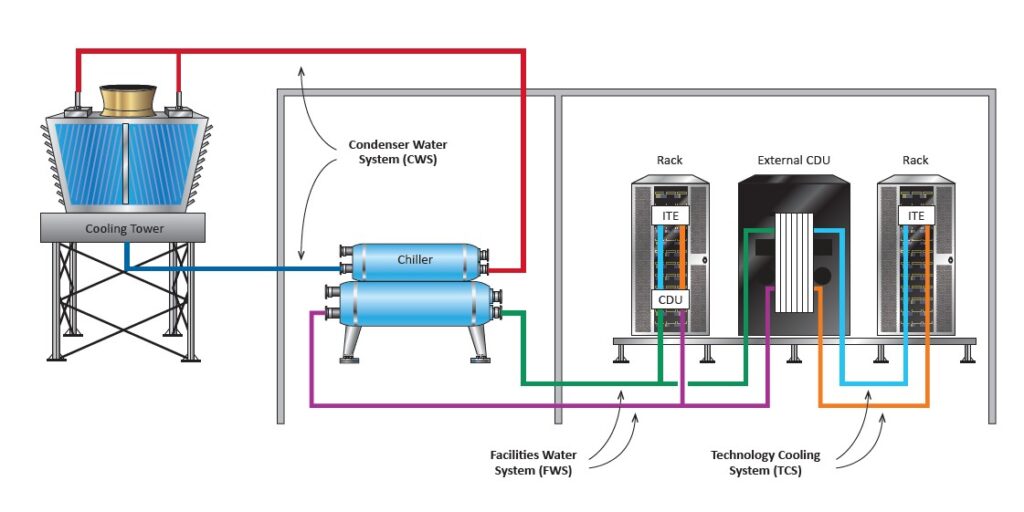
Improper startup procedures, such as failing to flush and clean the system before commissioning, can leave behind particulates and biofilm that accelerate corrosion and microbial fouling. Inadequate inhibitor levels or biocide dosing, low flow conditions and high suspended solids can also cause deposition formation, microchannel plugging and erosion within critical cooling components.
In high-performance loops, even small deviations in water chemistry can lead to CPU throttling, server shutdowns or reductions in the service life of cold plates and heat exchangers. These outcomes not only jeopardize uptime but can also require emergency maintenance and shorten the useful life of critical assets.
In closed-loop designs, the margin for error is even more narrow. Corrosion or microbiological contamination can compromise performance or damage sensitive components. Engineers must ensure that low-conductivity, biologically stable and corrosion-resistant fluids are maintained through compatible chemical treatment and continuous monitoring. Control systems must be designed to provide early warnings of system changes and enable corrective action before performance is affected.
Best practices for mechanical engineers
To support efficient cooling performance long-term, engineers should incorporate design specifications for chemical feed and control systems into request for proposal documents so water treatment vendors can offer recommendations based on specific system conditions and water quality. By identifying and determining treatment feed and control needs in the initial design phase, their integration into building automation systems can be ensured.
Sensor-based control technologies, including chemical tagging and real-time diagnostics, enable accurate dosing and remote oversight. Space, access and plumbing should be planned to accommodate side-stream filtration and future upgrades.
Treatment specifications should be tailored to source water conditions, system metallurgy and cooling load profiles. Clear documentation of water treatment goals, design parameters and maintenance procedures in operations and maintenance manuals is essential for ensuring long-term continuity. Partnering with water treatment specialists early in the process allows engineers to model corrosion, scaling and fouling risks before construction begins, helping avoid costly and complex retrofits later.
Water treatment as a design imperative
Data centers demand more than thermal capacity; they require cooling systems that are sustainable, scalable and operationally resilient. As engineers design these systems, water treatment must be treated as a core performance variable, not a post-construction patch.
Whether supporting traditional HVAC loops or advanced liquid cooling technologies, integrated water treatment planning helps improve uptime, reduce life cycle costs and protect infrastructure investments from the first day of operation.