In this roundtable, engineers talk about some of their most interesting HVAC office building projects and results.
HVAC insights
- Designing heating and cooling systems for long-term climate resilience is increasingly complex, requiring strategies such as system expandability to balance future temperature extremes, cost control and operational efficiency.
- Advanced solutions such as radiant systems paired with dedicated outdoor air, heat recovery chillers and demand-controlled ventilation are gaining traction as engineers work to reduce energy use, manage ventilation challenges and adapt to evolving refrigerant regulations.
Respondents:
- Phil Beadle, PE, Senior Mechanical Engineer, HDR, Phoenix
- Thomas J. Fields, PE, LEED AP, HBDP, EBCP, Associate Principal, MG Engineering, D.P.C., New York
- Niki Fox, PE, LEED AP, Principal, Syska Hennessy Group, New York
What unique heating and cooling systems have you specified into office building projects? Describe a difficult climate in which you designed a heating, ventilation and air conditioning (HVAC) system.
Phil Beadle: Although not overly difficult, there are challenges when applying packaged equipment to designs within the southwest desert of Arizona. Even though ASHRAE weather data for Phoenix documents cooling temperature at 110°F there are still many hours significantly warmer, as well as the heat island effect on roofs or within yards where the equipment is located. Typically, there are requirements for this equipment to have an operational summer condenser design temperature of up to 120°F. At these types of temperatures, the capacity derate of the equipment is significant and larger frame sizes are generally required. In these environments, electronics controls and variable frequency drives need to be cooled to have an acceptable life span and avoid failure after one summer.
As climate conditions evolve, determining appropriate design temperatures for buildings expected to last 50+ years is increasingly complex. Oversizing systems for future extremes can drive up costs and reduce efficiency, while designing for current conditions may limit adaptability. A balanced approach may be system expandability, allowing for efficient operation today with the flexibility to scale capacity as future demands change.
Niki Fox: Multiple chillers for dual temperature design. Elevated chilled water temperature for underfloor air distribution and low temperature chilled water for latent cooling of outside air.
What unusual or infrequently specified products or systems did you use to meet challenging HVAC needs?
Niki Fox: Heat recovery chillers.
Have you specified a radiant heating or cooling system into an office building? Describe the project.
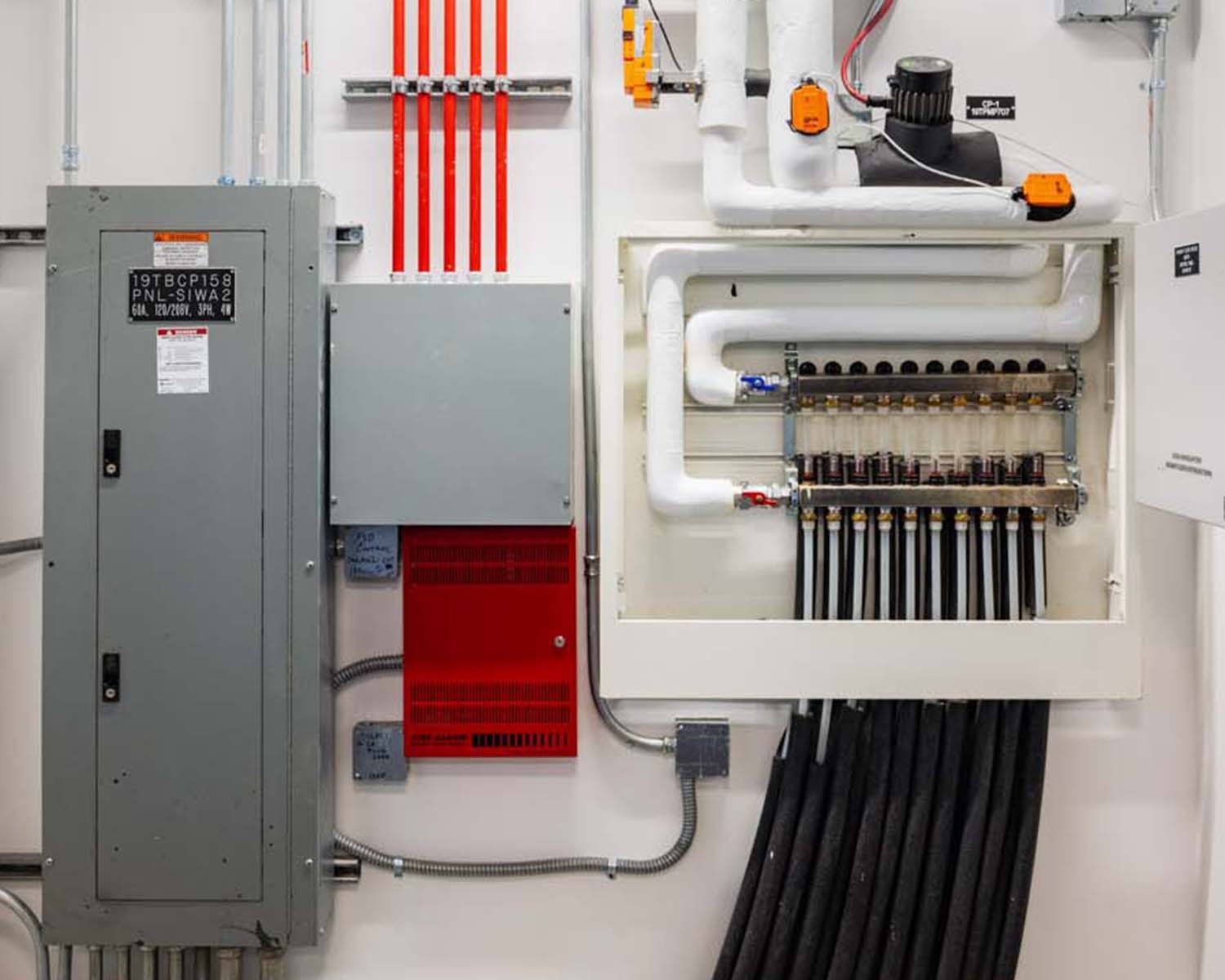
Phil Beadle: The building design for the Orange County Sanitation District headquarters building is a mass timber construction structural solution with a two-level high bay lobby showcasing an expressed wood “diagrid” ceiling, limiting the air conditioning solutions. The HVAC system uses hydronic radiant floors as the primary means of heating and cooling. This solution consists of multiple zones of cross-linked polyethylene piping embedded throughout the concrete floor slab, with circulation of medium temperature chilled water or heating water to provide cooling and heating respectively.
The dedicated outdoor air system (DOAS) supplies the necessary ventilation air into the space discreetly through low wall displacement diffusers, localized around the reception station and with upper-level air return using temperature stratification.
Niki Fox: Yes, minor electric radiant heating.
How have changes in codes or standards impacted the design of HVAC systems for office buildings?
Niki Fox: Changes in refrigerants for HVAC equipment and the availability of the equipment have presented challenges.
Describe an HVAC ventilation system you’ve worked on or encountered in an office building that included hoods, fire suppression systems or other specialized ventilation systems.
Thomas Fields: Some of our Class A office clients have included commercial kitchens in their office fit-outs. This presents challenges with kitchen exhaust routing. Often the exhaust must be routed through a sidewall, requiring a pollution control device. Other options have included recirculating hoods when the kitchen program allowed. Traditional exhaust systems require significant makeup air, which will increase the energy use of the building. Demand control ventilation strategies are necessary to keep the energy impact of these systems as low as possible.
Niki Fox: Kitchen exhaust for a Type 1 hood in a commercial kitchen environment with a dedicated makeup air system. Hoods connected to a black iron exhaust system comprised an electrostatic precipitator to scrub the air prior to discharge.
How have you worked with HVAC system or equipment design to increase a building’s energy efficiency?
Phil Beadle: Lawrence Berkeley National Laboratory (LBNL) Welcome Center Building. The Welcome Center houses the LBNL Campus Central Cafeteria, together with their support department office spaces and a conference center.
The dining area function, in conjunction with the temperate Berkeley, California, climate and the steady prevailing winds on site, created an excellent opportunity to incorporate the capacity for passive, buoyancy force driven, natural ventilation.
The building location is sufficient to satisfy the required air quality in the Atrium, Level 1 corridors and Level 2 servery and dining hall. The design incorporates operable windows with actuators controlled by the building management system at four locations to provide a low energy ventilation and conditioning system when conditions allow. To further extend the available hours without mechanical cooling, ceiling fans are activated.
The wind analysis result, based on data from the past 15 years, determined natural ventilation would provide more than the minimum design target flowrate (one air change per hour) during 95% of workday hours (8 a.m. to 5 p.m.) and mechanical cooling would only be required during 5% of workday hours for a substantial portion of the building. For thermal comfort, heat removal is sufficient based on the expected hourly gains — from solar, occupants, lighting and equipment — over a representative day and acceptable heat removal is expected up to 98% of the time.
Niki Fox: We have changed from standard packaged air conditioning units to multizone variable refrigerant flow.
Have refrigerant changes impacted the design of HVAC systems in office buildings?
Niki Fox: Yes, the phase-out of refrigerant and production of new equipment with new refrigerant has been challenging.
What is the most challenging thing when designing HVAC systems in office buildings?
Phil Beadle: A common challenge faced is balancing the owner’s construction cost budget with the energy efficient design approaches and the complexities of sustainable system design/controls. There is only so much money for the construction “first cost,” and it is common to value engineer mechanical systems down to bare equipment requirements, removing energy recovery type systems. This may occur even if life cycle cost analysis of these systems shows a payback on investment within an acceptable time period.
Building renovations present particularly challenging obstacles. Architectural designs that do not improve the envelope and fenestration can significantly impact the opportunities for systems installed. In buildings with leaky envelopes, applying decoupled sensible cooling systems such as chilled beams is often inappropriate. If the internal dewpoint cannot be reliably controlled, even a well-designed and operated DOAS cannot prevent condensation risks. This underscores the importance of envelope performance when selecting HVAC strategies that rely on precise humidity control.
In addition, the renovation of older buildings that have really low structural floor-to-floor introduce complexity in the design integration of overhead HVAC systems within restricted ceiling plenum space in coordination with other engineering system designs.
Niki Fox: Coordination of existing conditions when trying to maximize ceiling height.