Ask these fundamental questions to help identify an outdated electrical specification.
Learning objectives
- Understand why outdated electrical specifications may increase risk and inefficiency.
- Learn about technological advancements in wire and cable technology that can be overlooked.
- Know that using updated codes and standards and application-specific design are crucial in electrical specifications.
Electrical specification insights
- Electrical engineering relies heavily on managing risk and outdated wire and cable specifications can introduce unnecessary complexity, delays and safety hazards.
- These electrical specifications often reference obsolete materials, manufacturers and standards, leading to confusion, miscommunication and potential noncompliance with current codes.
At their core, electrical construction and engineering are about managing risk. However, outdated electrical specifications can cause multiple inefficiencies, resulting in unnecessary increased risk, as well as time-consuming requests for information and substitutions, which only add to the already complex workflow for all involved. In addition, incorrect specification can lead to miscommunication with the authority having jurisdiction, increasing the risk of project delays due to improper application of products.
Surprisingly, wire and cable have traditionally been an afterthought in electrical system specifications unless the project type requires more precision or a specific configuration that accounts for the usage and environment of the installation. However, these specifications often retain outdated technologies, nomenclature and manufacturers.
Furthermore, it is not uncommon for specifications to cite industry standards that have been superseded by newer, safer versions. If the company electrical specifications are referencing manufacturers that are no longer in business, there is an opportunity to clarify, refresh and make them simpler for all project stakeholders to execute.
Whether they are printed on faded, crinkly paper or lurking in the depths of a digital folder, using outdated cable power system specifications is a surefire way to cause chaos during project execution. Even if the engineering team is working with a modern file format, the content itself may be obsolete. The impact of this potential confusion must be understood and addressed to improve project timelines and outcomes.
How to know if electrical specifications need to be updated
How do you know if your wire and cable specs need to be updated? Below are some indicators that your specification may need to be updated.
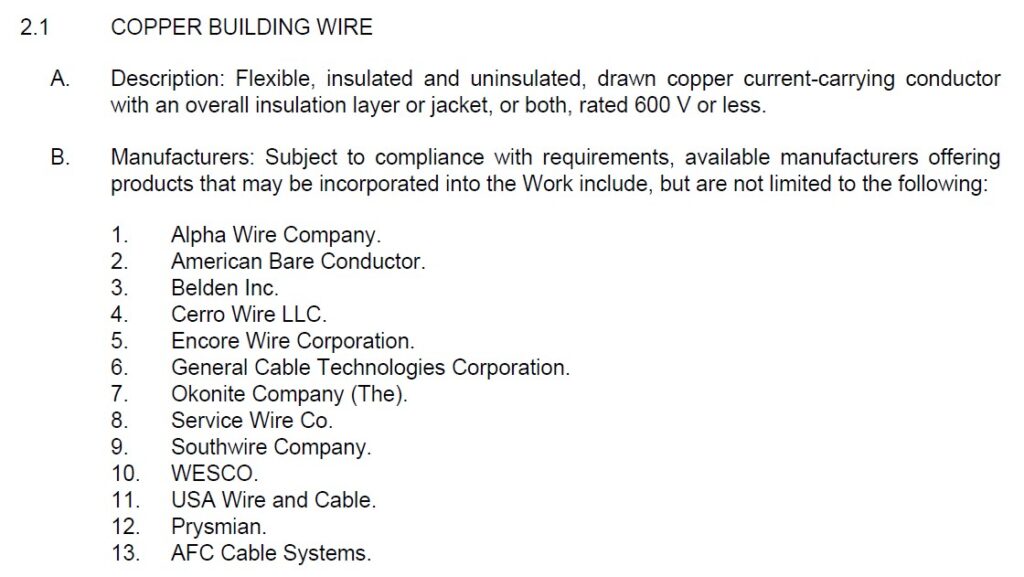
Do they reference now-obsolete cable type insulation materials that are no longer code-compliant or even safe?
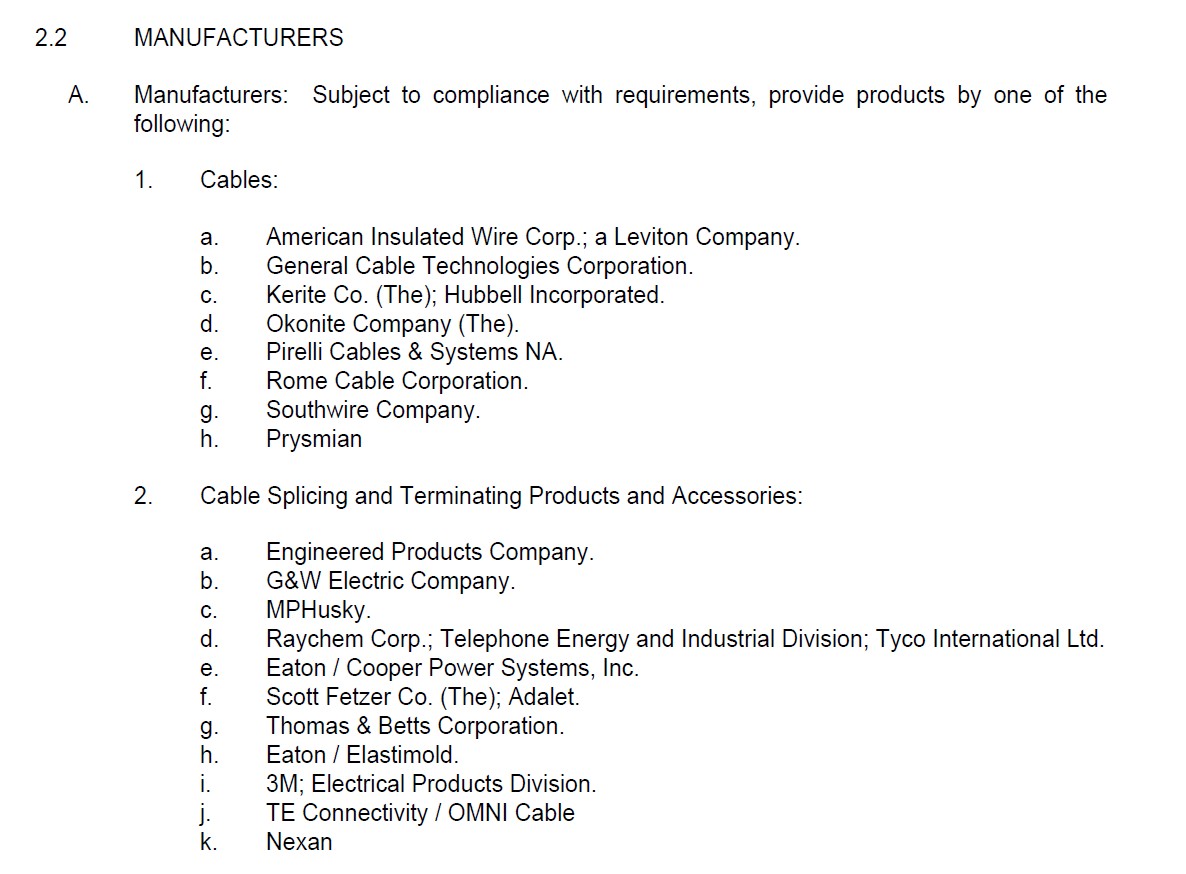
For example, Figure 1 from a mission critical facility site owner has not been updated, despite three of the brands no longer existing, which could cause immense confusion for teams ordering products.
Does the specification reference wire gauges that are no longer standard?
Are the insulation types outdated or worse, potentially hazardous?
For example, ethylene propylene rubber does not require lead as an additive and maintains the same performance.
Hypalon chlorosulfonated polyethylene was phased out by DuPont in 2009. This product continues to be specified, yet jacketing materials for harsh environments have undergone significant improvements. For example, thermoplastic compounds such as thermoplastic elastomer and chlorinated polyethylene can withstand the harshest environments, such as petrochemical applications and wastewater treatment plants.
Are the ampacity ratings still accurate, given current code requirements and ambient temperature considerations?
Do the specs account for the intended application environment (wet, dry, hazardous)?
Are the cable jacket materials appropriate for the intended use or the best option for the application in question?
Outdated specs might not reflect current safety standards or best practices, putting projects and equipment warranties at risk. Failing to integrate new technologies increases the inherent complexity of the product’s installation, as outlined in the means and methods sections of the specifications.
For example, advances in jacket compounds have greatly improved the coefficient of friction and allow for installation without the use of lubricants in raceways. This innovation has numerous advantages for the sustainability of a long-term cable system, such as reduced sidewall pressures and the potential for conductor elongation during installation. To date, very few manufacturers stipulate the jacket coefficient of friction on medium-voltage and 600-1000 volt wire and cable products.
When it comes to safety and efficiency in branch circuit metal-clad cable, older specifications often ignore major advances in equipment bonding and ground solutions, which are code-compliant to NFPA 70: National Electrical Code (NEC) Article 330, covering standard commercial and health care facilities per NEC 517.13.
Does the specification include advancements in wire and cable technologies and standards, as in the case of variable frequency drive (VFD) cables?
As reported in a study by Southwire’s Application Engineering team, extensive testing has shown that the correct selection and installation of VFD cables, particularly those that are properly shielded and terminated, are crucial to minimizing high-frequency ground currents and reducing electromagnetic interference (EMI), thereby improving the reliability of factory floor operations. Nonetheless, in this context, THWN-2 or XHHW-2 cable is still more often specified in motor-to-drive connections.
Findings from the Southwire study revealed that radiated EMI can adversely affect nearby electrical equipment, causing intermittent operation, false alarms and premature failure. Properly terminated VFD cable creates a low-impedance path at high frequencies via the cable shield. It pushes most of that unwanted, noisy current along this controlled path. It isolates it from the building ground, thus minimizing the ground current spikes from flowing past factory equipment, where it can cause damage.
In 2024, ANSI and ICEA published standard S-138-738-2024: Power Cables Rated 2000 Volts or Less for use Between Variable Frequency Drives and Motors. This standard publication will help engineers and consultants to properly specify the correct cable between the drive and motor to maximize the performance of the systems.
Stay current to avoid electrical specification struggles
Whether paper or digital, outdated wire and cable specifications can lead to confusion, cost overruns, installation errors and, most importantly, safety hazards. Keep an eye on the details: wire gauges, insulation types, ampacity ratings, industry standards, version control and accessibility. Don’t let wire and cable specs become fossils. Keeping them current is an investment in the safety and efficiency of electrical systems.
Look to partner with a manufacturer that has extensive experience in reviewing and updating wire and cable power system specifications. Their team should be able to handle technical requests to assist end users, engineers, contractors and installers in meeting project requirements, gaining approvals from project owners or building inspectors and responding to issues in the field. By working with a trusted partner, you can confidently move forward with engineering and project execution, knowing that specifications are kept current and risks for confusion, delay and rework are avoided.