As electric vehicle (EV) adoption becomes more common, it is important to stay informed about the variations in electric vehicle supply equipment (EVSE).
Learning objectives
- Be informed about the different types of EV charging stations.
- Understand the design considerations necessary to install EV charging stations.
- Learn about the NEC codes and standards pertaining to EVSE.
EV insights
- EV charging infrastructure requires careful planning to match the type of EV, charging speed and facility power capacity, while complying with codes such as the NEC for EV supply equipment (EVSE).
- Different EV charging technologies and levels — from Level 1 to fast-charging Level 3 — offer varying power outputs and charging times, allowing facilities to choose EV solutions that balance operational needs, cost and electrical system capabilities.
As the requirement to install electric vehicle supply equipment (EVSE) becomes more frequent at facilities, it is important to become familiar with this growing technology. There are several types of technologies, all with coordinating codes and standards with which to comply.
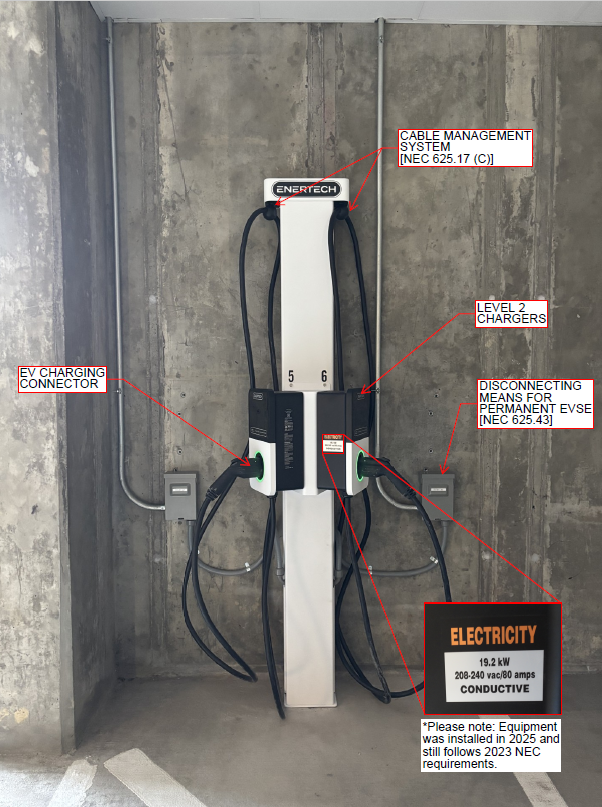
Per the 2026 edition of NFPA 70: National Electrical Code (NEC), EVSE are defined as the equipment and accessories (EV charger, wiring, disconnecting means, etc.) needed to transfer power from the premises wiring to the EV (see Figure 1).
The first step in the process — before choosing the appropriate EV charging station — is to determine the type of vehicle that requires charging as well as the number of chargers, the required charge time and amount of charge expected. To make this determination, ascertain the expected usage of the vehicle and the amount of time it can spend on an EV charging station.
If a work or personal vehicle can be left overnight to charge, the need for fast-charging capabilities is lessened. If the facility has a fleet of electric buses versus a fleet of light-duty work vehicles, the required infrastructure will be completely different.
EV chargers
When it comes to EV charging stations, there are three technologies: pantograph charging, induction charging and plug-in charging.
Pantograph charging technology uses a large apparatus attached to the top of a vehicle to connect to an overhead charging system. These systems can deliver large amounts of direct current (DC) power and can typically charge an electric bus in approximately 5 to 20 minutes.
Induction charging technology is a wireless method for charging a battery by using a magnetic field. This technology is still relatively new and the standards for it is rapidly developing with the yearly changes to the technology. In theory, this method is convenient because it does not rely on direct contact, but it is less efficient for power transfer compared to direct connections.
The last type and focus of this article is the plug-in charging technology. Plug-in EV chargers use a plug that connects to a car’s power outlet to deliver electricity through a direct connection with the car’s battery system. This technology is the norm for most light-duty vehicles; facilities with light-duty work vehicles and personally owned vehicles will be designed with this technology.
Plug-in type EV charging stations are commonly available in three types, based on the speed of vehicle charging and power output. Charging capabilties can be dependent on limitations of the electrical vehicle.
- Level 1 charger: This is the slowest level charger, often using a 120-volt (V) alternating current (AC) branch circuit. This can be sourced from a standard three-prong household outlet. The power output of a Level 1 charger is typically 1 to 2 kilowatts (kW). Because this type of charger has a low power output, it takes a substantial amount of time for the car battery to be fully charged (more than 30 hours to charge an EV with a 45 kilowatt-hour [kWh] battery from empty to full). This level of charger would only be used to charge a personal vehicle at home overnight.
- Level 2 charger: This is a midrange charger, using 208 to 240 VAC power inputs. This type of charger can still be installed at a residential dwelling with a high-powered three- or four-prong outlet (e.g., NEMA 6-50 or 14-50). It can output approximately 7 to 19 kW of power — a larger amount than the Level 1 charger output. The Level 2 charger would take approximately 6 hours to fully charge an EV with a 45 kWh battery (from empty). This is the first level worth considering for a facility installation or for public areas.
- Level 3 charger: This is the fastest commercially available option, also known as direct current fast chargers (DCFC). DCFC uses three-phase 480 or 208 VAC power input. The input AC power is converted to a DC of 200 to 1,000 VDC. Because the vehicle batteries operate using DC instead of AC (by designing the EV charger to deliver DC), it can significantly minimize the charging time. These chargers can deliver 50 to 350 kW to a vehicle, thereby reducing charging times from hours to minutes.
Because of the charging speed of this technology, DCFCs are becoming a common choice for metered public space parking and facility vehicle use. Unfortunately, that charging speed does come with a cost, as these types of chargers are the most expensive. Existing facilities may not be capable of providing three-phase power or have the capacity to meet the higher power demand from these EV charging stations. Therefore, electrical upgrades or retrofits might be required, which further increases the cost. The National Electric Vehicle Infrastructure Formula Program may offset some of this cost.
Careful consideration should be given when deciding which level charging station to pursue and the amount of power output from the chosen level. There will be several reasons to choose one type over another. A substantial deciding factor for any facility will be the project budget. Because DCFC chargers are more expensive and require a more robust electrical system, it might make Level 2 chargers the better choice.
However, depending on operations, the facility may need to install more Level 2 chargers to ensure facility-owned vehicles have enough charge. In some cases, a power control system (PCS) with fewer DCFCs might be the cheaper option because it charges faster and applies a demand cutoff for the chargers during high-demand hours. A PCS is an important consideration, especially when deploying new chargers to an existing facility with limited electrical infrastructure capacity.
Another factor to consider is whether users will be charged for using the stations (e.g., public spaces or apartment parking spaces) or if users will not be charged (e.g., for work vehicles or employee vehicles).
The next important consideration is the amount of charging the user expects and how quickly they will need their vehicle to be charged. Staff with a long commute or an employee driving long distances every day will need enough charge to reduce range anxiety. Staff required to drive long distances to meet the needs of the facility operations (e.g., field investigations, transporting people from one area to the next based on a schedule) may require a lot of power and will likely need to charge quickly, possibly during a break, to then drive to the next site or task.
EV charging connectors
Multiple EV charging connectors are available and the type of connector can be specified to align with the type of EV charger used. The Society of Automotive Engineers (SAE) International has standardized one of the most common EV charging connectors, SAE J1772, for Level 1 and Level 2 EV chargers within the United States.
The North American Charging System (NACS) has developed a different set of connectors that can work with Level 1 and 2 chargers as well as DCFCs. NACS has standardized its EV charging connector under the name SAE J3400.
Another commonly used connector is the Combined Charging System (CCS) connector because it can connect to Level 1 and Level 2 chargers and DCFCs (see Figure 2). To ensure flexibility and adaptability for users, most EV manufacturers will often provide adapters with the EV for different connector types.

Design limitations and code/standard requirements
EV power transfer equipment is required to meet federal, state and local requirements and guidelines while also meeting client needs/requirements. NEC is frequently the first code referenced, however, Institute of Electrical and Electronics Engineers, UL, SAE, NEMA and many more should be considered when designing EVSE.
EV power transfer equipment can only be permanently installed by qualified personnel with the appropriate training and certifications per NEC 625.4. Additionally, the equipment is required to be “listed for the purposes of charging, power export or bidirectional current flow” per NEC 625.2. EVSE equipment is required to have visible field markings, including the following per NEC 625.5:
- Supply voltage, number of phases, frequency and full load current.
- Short-circuit current rating of the EVSE, whether that is the rating of a listed and labeled assembly or rating that is established using an approved method per UL 2594: Electric Vehicle Supply Equipment.
The NEC considers EVSE to be a continuous load (see NEC 625.41). Wiring, grounding and power distribution equipment (e.g., panels, switchboards, protective devices) are required to be sized per NEC 625 to meet the maximum demand required by EV chargers.
However, with a PCS used to provide load management of the EVSE, the power demand from a charger or chargers can be limited. Therefore, as opposed to sizing the circuit to meet the maximum load, the circuit supplying the EVSE per NEC 625.42 can be sized to meet the maximum load permitted by the PCS.
For example, an owner may have two chargers for work vehicles but programmed the PCS to ensure the total EVSE demand is only equivalent to one charger at 100%; thus, if two chargers are in use, each is only outputting at 50% of its typical capacity. Facilities can also use a PCS to manage power according to the time of day or depending on loads that need prioritization. Additional requirements for PCS are detailed in NEC 130.
Another exception to sizing the EVSE at the maximum demand required by the EV charger(s) is if the EVSE has a current adjustment setting only accessible to qualified personnel. If the settings impact the rating label, then changes must be made in accordance with the manufacturer’s instructions and need to be visible on a field-installed label that meets NEC 110.21 requirements.
For permanently connected EVSE, a disconnecting means needs to be lockable and it must be provided and installed in a readily accessible location per NEC 625.43. If the disconnecting means are installed remotely, signs (e.g., plaque or directory) indicating the location of the disconnecting means need to be installed on the equipment. If the EVSE rating does not exceed 60 amperes or does not exceed 150 V to ground, then the cord and plug for a cord- and plug-connected EVSE must be permitted to serve as a disconnecting means.
EV chargers are also known to cause voltage or harmonic distortions in electrical systems because of the sudden changes at the start or end of a charging session and AC to DC power conversion. Voltage or harmonic distortion can cause nuisance tripping, interference with communication equipment and other damage to equipment connected to the electrical system. IEEE 519: Standard for Harmonic Control in Electric Power Systems recommends a standard percentage of harmonic distortions at the point of common coupling between the utility and the customer.
Harmonic distortions can be mitigated through the installation of harmonic filter equipment. There are three main types of harmonic filters: passive, active and a hybrid of both. Passive harmonic filters use reactors and capacitors to target a particular frequency and integral contactors to reduce chances of resonance. Active harmonic filters inject equal and opposite frequencies to mitigate harmonics; however, they tend to be more costly than passive filters and are (typically) only recommended for high-powered loads.