This discussion explores how industrial facility engineers are addressing electrification, automation, AI integration and supply chain pressures.
Learning objectives
- Understand how electrification and decarbonization goals are reshaping industrial facility design.
- Learn how automation, AI and digital tools are influencing manufacturing infrastructure and operations.
- Identify strategies engineers use to improve flexibility, resilience and scalability in industrial projects.
Industrial insights
- Engineers are prioritizing modular, scalable infrastructure to accommodate rapidly evolving manufacturing and industrial technologies and future expansion.
- Electrification, automation and reshoring initiatives for industrial buildings are driving higher power demands and increased coordination between engineering, IT and operations teams.
Respondents:
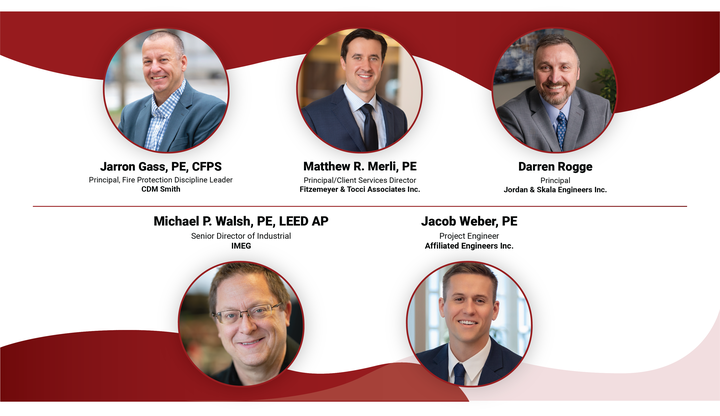
- Jarron Gass, PE, CFPS, Principal, Fire Protection Discipline Leader, CDM Smith, Pittsburgh
- Matthew R. Merli, PE, Principal/Client Services Director, Fitzemeyer & Tocci Associates Inc., Woburn, Massachusetts
- Darren Rogge, Principal, Jordan & Skala Engineers Inc., Norcross, Georgia
- Michael P. Walsh, PE, LEED AP, Senior Director of Industrial, IMEG, Cincinnati
- Jacob Weber, PE, Project Engineer, Affiliated Engineers Inc., Madison, Wisconsin
What are some of the biggest trends in industrial and manufacturing facilities that engineers should be aware of?
Jarron Gass: Key trends include the rise of smart factories leveraging artificial intelligence (AI), digital twins and generative design for optimized operations; widespread electrification and decarbonization of process loads; reshoring/nearshoring driven by supply chain resilience; and advanced automation/robotics integrated with internet of things (IoT).
Sustainability mandates and workforce upskilling via alternate reality/virtual reality (AR/VR) tools are also accelerating. Engineers are prioritizing modular construction for scale, edge AI for real-time analytics and cyber-resilient infrastructure to stay competitive. These shifts support an agile, future-ready facility that can be expanded or modified quickly amid growth in advanced manufacturing.
Matthew Merli: Certainly, one of the biggest trends we’re seeing is the electrification of the mechanical systems in these facilities. Many are looking to be fully decarbonized by certain timeframes as part of overall infrastructure master plans. We continue to do a lot of variable refrigerant flow (VRF), heat pumps and other technologies for heating, ventilation and air conditioning (HVAC) systems throughout these facilities.
Darren Rogge: The industrial market has been evolving to accommodate several challenges. Clients are shifting from fossil fuels to all-electric heating systems, requiring higher electrical demand to support increased robotics and automation systems. They are also pushing for net-zero carbon emission solutions or life-cycle carbon reduction.
Michael Walsh: One of the biggest trends is the need to make critical facility decisions earlier, often before the manufacturing process is fully defined. Compressed design and construction schedules are pushing building design ahead of process development, which introduces risk if decisions are made without sufficient data.
To address this, engineers are leveraging AI-driven and automated design tools to evaluate site layouts, utility demands and building configurations in the earliest project phases. These tools allow teams to test multiple scenarios quickly and give owners better information to make informed decisions sooner, resulting in more flexible facilities that can adapt as process requirements evolve while maintaining schedule and budget alignment.
Jacob Weber: Within industrial research and development (R&D) facilities, we are seeing growing demand for specialized applications like electric vehicle (EV) safety testing, hydrogen fuel cell development and hydrogen combustion development. On the manufacturing side, AI and data center growth are driving massive investments in semiconductor manufacturing, while EVs and grid-scale battery energy storage systems (BESS) are driving similar investments in battery plants.
We also see major reinvestment in existing automotive assembly plants as original equipment manufacturers adapt facilities for new products and processes. For such projects, engineers need to gain an early understanding of the process systems and equipment because they ultimately define utility capacity, safety systems, environmental controls and required long-term flexibility.
What are professionals doing to ensure such projects meet challenges associated with emerging technologies?
Darren Rogge: Emerging technologies present some unique challenges to project design. To help protect clients from having to upgrade systems as these technologies change, designs must include flexible infrastructure such as modular electric rooms, scalable electrical distribution systems or space-protected equipment layouts. This is a crucial element to be discussed during project conception to determine the level of risk and cost the client is willing to integrate into their project.
Michael Walsh: To address the pace of emerging technologies, professionals are prioritizing flexibility as a core design principle. This includes planning for expansion zones within the facility and designing “capacity ready” infrastructure, such as electrical, mechanical and utility systems that can support future growth without major rework.
A key challenge is that technologies often evolve between the start of design and construction, requiring teams to make decisions with incomplete information. By building in flexibility through modular layouts, scalable systems and reserved capacity, engineers can help owners adapt to changing process requirements while minimizing future cost, schedule impacts and disruption to operations.
Jacob Weber: Identifying and involving the right stakeholders early is critical to integrating emerging technologies into both new and existing facilities. These technologies can frequently come with challenges like incomplete information, proprietary equipment, limited operating history, evolving safety requirements and codes and changing design criteria. Input from the owner’s researchers, manufacturing engineers and facilities staff, as well as equipment vendors, is essential to fully understand the process and capture the associated facility requirements.
For existing buildings, there is the added necessity to closely evaluate what the facility can realistically support. This includes floor loading, clear heights, space classifications and utility capacity and distribution. There is an added challenge in making these new processes and equipment operate safely and reliably within existing constraints, rather than a purpose-built environment.
Jarron Gass: Professionals integrate building information modeling (BIM) and digital twins early for simulation and predictive modeling, collaborate cross-functionally with information technology (IT)/operational technology (OT) teams and conduct pilot testing of AI-driven automation and robotics. They perform gap analyses against codes like ASHRAE Standard 90.1: Energy Standard for Buildings Except Low-Rise Residential Buildings and National Fire Protection Association (NFPA) standards while using modular/prefabricated mechanical, electrical and plumbing (MEP) systems to accelerate deployment.
Ongoing training in cybersecurity and edge computing addresses interoperability risks. Value engineering and phased retrofits keep existing structures compliant and competitive without full rebuilds. This proactive approach mitigates adoption barriers while delivering resilient, high-performance facilities.
Matthew Merli: Equipment vendors for these systems are changing and rapidly becoming more efficient. Things like a VRF system’s low ambient temperature performance have improved greatly over the past decade such that they can operate in heating mode even during very cold stretches, which happens frequently in New England, where a decade ago we may not have used that sort of system. Additionally, ongoing refrigerant changes are always something to consider with emerging technologies.
How are electrification and decarbonization goals reshaping industrial and manufacturing facility design, particularly for process loads?
Jacob Weber: Some owners have shifted from a first-cost decision-making approach to a more holistic evaluation of operational costs, total cost of ownership and emissions impacts. This often includes comparing traditional fossil-fuel-based heating systems against multiple electrified alternatives. Paired with broad societal pressure to reduce carbon emissions, the electrification of processes and HVAC has become more prevalent in industrial facilities. This can create opportunities for technologies like heat recovery, heat pumps and thermal energy storage to serve simultaneous heating and cooling demands at the temperatures required by processes. The biggest challenge in implementing these strategies is limiting the impact on process reliability, production uptime and operational flexibility.
Jarron Gass: Electrification is shifting process heating from fossil fuels to high-efficiency heat pumps, induction systems and resistive/electrochemical technologies, targeting up to 70% of industrial process heat by 2050. This reduces Scope 1 emissions while demanding upgraded electrical infrastructure, microgrids and energy storage. Decarbonization drives waste-heat recovery, renewable integration and process redesign for variable renewable power.
Designs now balance high process loads with grid constraints via smart controls and efficiency measures. The U.S. Department of Energy’s Industrial Decarbonization Roadmap and ASHRAE 90.1 updates guide these changes, improving long-term operational resilience and sustainability.
Darren Rogge: Increased electrification has been challenging in most markets across the country. The electric utility providers’ infrastructure is inadequate to support the larger electrical demand being requested to serve client needs. The timelines for electric utility providers to upgrade their infrastructure can take up to two years, which makes some project sites unattractive to clients. A solution may be to provide microgrids, on-site generation or energy storage systems, which come at a great cost to the project.
The design can also include renewable energy (solar and wind) and/or implement BESS along with load management systems to help offset peak electrical demand on the utility infrastructure.
Michael Walsh: Electrification and decarbonization goals are significantly increasing facility power demands, particularly as traditional fossil fuel-based processes shift to electric alternatives. At the same time, greater use of automation and advanced manufacturing equipment is further driving up electrical loads. As a result, engineers can no longer rely solely on historical data to size infrastructure.
Instead, there is a greater emphasis on early load modeling, scenario analysis and close coordination with process teams to understand future-state requirements. This often leads to designing more robust and scalable electrical systems, with added capacity and flexibility to accommodate evolving technologies while supporting long-term sustainability and operational goals.
How are workforce challenges influencing facility design and system selection?
Matthew Merli: Many of our clients on the electronics manufacturing side are turning to automation and robotics on their assembly lines. Previously, we would design lines with people at the stations where we are now seeing robots doing the work. There may be less people, but the advanced electronics and controls are something designers must pay close attention to.
Michael Walsh: Workforce challenges are closely tied to automation, safety and facility performance. Labor shortages are driving increased adoption of automation to maintain productivity, which in turn raises electrical loads and system complexity. As processes become more automated, engineers must carefully consider how people interact with equipment, leading to greater emphasis on safety systems, clear circulation paths and separation between human and robotic operations.
At the same time, more advanced systems require a workforce with different skill sets, influencing how facilities are designed for access, maintenance and training. The result is a more integrated approach where system design, safety and workforce considerations are addressed together rather than independently.
Jarron Gass: Labor shortages and skills gaps are pushing designs toward greater automation, robotics and AI-assisted interfaces that reduce manual tasks and enhance safety. Facilities incorporate intuitive controls, AR/VR training modules and ergonomic layouts to support upskilling. Safety expectations drive redundant systems featuring advanced detection and compliance with the Occupational Safety and Health Administration, NFPA and other industry standards. Modular construction and predictive maintenance analytics are helping minimize on-site labor needs. These choices are thought to improve productivity and lower injury risk while attracting and retaining talent and addressing the projected multimillion jobs gap in manufacturing.
Jacob Weber: Labor shortages in manufacturing are driving changes to process design, including greater reliance on automation. Similarly, shortages in facilities and maintenance staff are influencing facility design and system selection. Owners are prioritizing equipment and systems that provide better maintenance access and easy troubleshooting, use clear control sequences, have intuitive graphics and installation, operation and maintenance procedures and offer strong safety features or a proven operating history. Experienced maintenance staff is difficult to find and retain. Designing systems with health, safety and ease of use in mind can help streamline the training of new staff, reduce the burden on experienced staff and support long-term workforce retention.
How are you working with IT experts to meet the needs of industrial or manufacturing facilities?
Jarron Gass: Engineers partner with IT experts to converge OT and IT systems via IoT platforms and interoperability standards. Joint teams design secure networks for real-time data flow, enabling predictive maintenance and process optimization. Cybersecurity protocols are embedded from the concept stage. This collaboration ensures scalable digital twins, cloud-edge analytics and seamless integration of smart devices, aligning facility performance with enterprise goals while meeting emerging technology demands and keeping client digital assets safe.
Michael Walsh: As manufacturing becomes more automated and data-driven, IT systems are now critical to maintaining uptime and operational performance. This has led to much closer coordination between engineering and IT teams, particularly around network infrastructure, data integration and system reliability.
We are collaborating earlier in the design process to align building systems with OT and enterprise platforms, ensuring proper space, power, cooling and redundancy for IT infrastructure. At the same time, increased connectivity brings greater cybersecurity risks, requiring a more intentional approach to network segmentation, system hardening and secure integration of building and process systems to protect operations.
In what ways have supply chain issues impacted the industrial and manufacturing sector?
Darren Rogge: While supply chain issues have improved, there continues to be issues with timely procurement for electrical gear, generators, pad-mounted transformers and other equipment. We typically try to identify long-lead procurement items early in project design and collaborate with the construction team on an early release package to facilitate procurement of this equipment sooner than through the typical design process.
Jacob Weber: Supply chain issues have made early planning and procurement much more common and important on large manufacturing facility projects. Major mechanical, electrical and controls equipment are frequent candidates for early or long-lead procurement packages. On fast-moving manufacturing projects, waiting until design drawings are fully complete to procure these items is often not realistic if the project is to maintain construction and turnover schedules. We work with owners to identify long-lead equipment and critical path system items early, then develop procurement packages based on the best available information at that stage. As the full facility design advances, we coordinate design changes around the equipment purchased.
Michael Walsh: Supply chain challenges have made early planning and decision-making more critical than ever. Engineers are working closely with owners to identify long-lead equipment early in the process, aligning on procurement timelines that often drive key design milestones such as system sizing and infrastructure requirements.
In parallel, designs are increasingly developed with flexibility in mind, allowing for multiple equipment vendors to be accommodated without significant redesign. This includes planning for adaptable system layouts, connection points and space allocations. By combining early coordination with flexible design strategies, teams can reduce risk, maintain schedules and better navigate ongoing supply chain uncertainty.
Jarron Gass: Supply chain disruptions have accelerated reshoring/nearshoring efforts, increasing domestic construction demand and increasing material/labor costs and lead times. Engineers work with owners on resilient designs, including diversified supplier strategies, on-site generation and storage and modular MEP systems that shorten timelines. Early stakeholder engagement and workshops identify critical-path equipment and long-lead item equipment; value engineering and prefabrication mitigate delays. Government incentives and policy support can be leveraged to justify investments, ensuring facilities remain competitive and adaptable.
How are engineers designing these kinds of projects to keep costs down while offering appealing features, complying with relevant codes and meeting client needs?
Jarron Gass: Engineers use value engineering, modular/prefabricated MEP components and BIM-driven clash detection to reduce on-site labor and waste. Energy modeling per ASHRAE 90.1 and International Energy Conservation Code ensures code compliance while optimizing HVAC/lighting for lower life cycle costs. Flexible layouts can accommodate future technology upgrades and expansions while minimizing business interruption and renewable/microgrid integration delivers appealing sustainability features. Phased implementation and early owner collaboration help balance initial or upfront cost control while still allowing for high-performance outcomes.
Matthew Merli: First and foremost, engineers are designing for now with the future in mind. What I mean by that is designing a system that is scalable, but the Day 1 cost can be reduced by meeting Day 1 needs. These clients grow fast, so they need to be modular and scalable and for Day 1 you may need just one chiller module, for example. We will bring power and pour a pad to be able to handle three more chiller modules down the road. Doing life cycle analyses of mechanical and electrical systems can help make the best decisions for these systems.
Jacob Weber: Focusing on specific process environmental requirements early in the design schedule can reduce both construction and operating costs. Industrial and manufacturing projects often find savings by identifying and challenging overgeneralized requirements. For example, does the entire test lab need to maintain a specific test temperature or only the air entering the unit under test? Does the entire cleanroom need to be ISO 7 or can an ISO 7 softwall area be provided where needed, with ISO 8 conditions elsewhere? Separating what truly requires tight environmental control from what can be served by simpler systems can reduce capital and operational costs. The goal is not to make the facility less capable or flexible but to right-size spaces and infrastructure in key locations.
Darren Rogge: Most developers we partner with already have a solid design criteria program that they prefer to standardize their portfolio. For clients that lean on us to develop systems to meet their needs, we work with them to identify Day 1 and Day 2 operational needs along with any code challenges into a robust design that meets their cost levels. There is an entire series of Q&A sessions needed to work through the pros and cons of various design elements to tailor project design to meet their needs and expectations.
Michael Walsh: Engineers are increasingly focused on early-stage decision-making to balance cost, performance and compliance. By using modeling and AI design tools early in the process, teams can evaluate multiple design options and help owners understand the cost implications of key decisions, not just for initial construction, but for long-term operations and future expansion.
This proactive approach allows for more informed tradeoffs, such as right-sizing systems, phasing infrastructure and minimizing disruption to ongoing operations. By aligning design decisions with both immediate and future needs, engineers can deliver facilities that meet code requirements while optimizing total cost of ownership and overall project value.
What technologies within the manufacturing plant are you helping design?
Darren Rogge: We typically provide HVAC, plumbing, compressed air, process water, wastewater, electrical, lighting, lighting controls and building management control systems design. These systems can range from simplistic to extraordinarily complex (high-reliability power systems, precision cooling systems and controlled environments) to meet the operational challenges of the facility.
Jarron Gass: Engineers design integrated robotics, AI-enabled process lines and specialty systems like advanced battery production or cleanroom environments with precise environmental controls. Digital twins simulate operations for optimization and generative design tools accelerate custom equipment layouts. IoT sensors and edge computing enable real-time monitoring. These solutions seek to enhance and increase throughput, quality and flexibility while aligning with industry safety and efficiency standards.
Michael Walsh:Engineers are increasingly involved in designing the infrastructure that enables advanced manufacturing technologies rather than the process equipment itself. This includes supporting robotics and automated material handling systems such as automated storage and retrieval systems and conveyor networks, along with the power, controls and safety systems required for reliable operation.
We also design process-intensive systems such as industrial ventilation, process cooling and compressed air, as well as utilities for production processes. In addition, there is growing demand for integrated solutions like energy recovery, on-site water reuse and central utility plants. The focus is on creating flexible, scalable infrastructure that can support evolving manufacturing technologies over time.
Does your firm anticipate more industrial or manufacturing building projects, considering the supply chain issues with non-U.S. facilities?
Jarron Gass: Yes. Reshoring, driven by supply chain vulnerabilities and favorable monetary policy incentives, appears to be boosting domestic projects. Firms engage clients through targeted outreach that highlights resilience benefits, site-selection support and incentive navigation (e.g., federal programs). Business development emphasizes early MEP feasibility studies, cost and energy modeling and the demonstration of code-compliant, future-ready expandable or scalable designs. This positions our firm to be a strategic partner for owners seeking to take advantage of the current opportunities for reshoring operations to reduce risk and enhance competitiveness.
Matthew Merli: There’s a lot to unpack here. Certain industries are very sensitive to supply chain issues and are hopeful to do more local manufacturing if the costs work out. But often they don’t and they’re still manufacturing overseas. However, even though many of our clients manufacture overseas, there are still a lot of U.S. operations: R&D, C-Suite, offices and assembly spaces are very common. Parts and pieces are being manufactured overseas, but they’re being assembled, tested and shipped out of local facilities.
Darren Rogge: We see the industrial and manufacturing market continuing to be strong for the foreseeable future. There has been a push to warehouse products within the U.S. to better manage supply chain issues associated with shipping from non-U.S. manufacturers and to be more resilient on speed to market. We focus on supporting our clients in developing new facilities within their portfolios to meet their goals.
Michael Walsh: We anticipate continued growth in industrial and manufacturing projects, driven in part by reshoring and the desire for more resilient, U.S.-based supply chains. Activity remains strong across sectors such as advanced manufacturing, food and beverage, life sciences/pharma and defense/aerospace.
From a business development perspective, success is built on long-term partnerships rather than one-time projects. Many clients have ongoing facility needs and supporting them across projects, large and small, builds trust and continuity. A key advantage is combining local presence with national expertise, allowing teams to provide responsive, relationship-driven service while bringing specialized knowledge and resources to complex industrial projects.
Jacob Weber: Yes, we anticipate continued growth beyond what we have already seen in recent years in industrial and advanced manufacturing facilities. EVs and grid-scale BESS are driving demand for existing and new lithium-ion battery chemistries and cell geometries, increasing investment in research labs, pilot plants and full-scale production facilities. AI and data center growth are also driving significant semiconductor demand, leading to increased spending on fabrication and support facilities. Many facilities are being reshored or onshored as companies serving North America seek federal and state incentives for domestic production, insulation from supply chain uncertainty, better quality control and better protection of intellectual property.
Like other markets, the business development process for these clients is based on relationships and technical excellence. However, because speed to market is critical for many of these companies, it also depends heavily on responsiveness. These projects often move on extremely fast schedules and require flexibility as design criteria change throughout the project. Owners need teams that can progress designs with limited and evolving information while still meeting project requirements and deadlines.