Presenters from the March 10, 2026, webcast, Detecting and Managing Unique Power Quality Challenges in AI Data Centers, answer audience questions.
Presenters from the March 10, 2026, webcast, Detecting and Managing Unique Power Quality Challenges in AI Data Centers, answer audience questions.
AI data center insights:
- AI-driven data centers are reshaping how facilities interact with the grid. Consulting and specifying engineers must be prepared to address faster and larger power changes than ever before.
- Unique grid-interaction and power quality issues are being created by modern AI workloads, including rapid load swings and unusual oscillatory behaviors.
Learning objectives:
- Understand how modern AI training workloads drive new power behavior in data centers and increase the importance of grid-aware design.
- Identify key power quality challenges introduced by rapidly changing AI loads, including load swings, oscillatory events and other atypical grid interactions.
- Learn how continuous monitoring and metering support early detection of emerging issues and strengthen data center grid citizenship.
Understanding the evolving power behavior of AI data centers is vital for modern engineers working on such facilities.
Karen Cheung, Product Manager, and Keith Watson, Senior Application Engineer, both from Eaton, covered monitoring strategies that support improved grid citizenship, system resilience and decision making.
After the presentation, audience members had a chance to ask questions to the experts. Below are some highlights from the Q&A, covering topics like subsynchronous oscillation (SSO) event detection, impacts on the utility grid and reliable SSO monitoring.
Why is detection of subsynchronous oscillations important?
SSO has a history in microgrids and renewables, with the burden incumbent on the microgrid owner to resolve. Now, with artificial intelligence (AI) data center load behavior exhibiting similar characteristics, the problem exists at the grid level and the impacts are further reaching.
Where in the electrical infrastructure should SSO monitoring be deployed — utility interconnection, switchgear, power distribution units (PDUs) or multiple locations?
Installing the meter at each main input switchgear should capture any SSO events. Typically, this switchgear would distribute power to the uninterruptible power supply (UPS) and the mechanical equipment that supports the data center.
Could SSOs affect other rotating equipment at the data center site?
Pumps, chillers and other rotating equipment at a data center have the potential to be impacted by SSO.
With a monitoring solution in place, how will I be notified if an event occurs?
Most monitoring solutions provide some form of notification (whether it is email or over a communication protocol) and can tie into an electrical power monitoring system so notifications are coming through the same system as other devices.
Does the utility continue to monitor for SSO?
Utilities, like ERCOT and Dominion from the presentation, can determine that SSO occurred but would then need to investigate. Detection at the load could provide insight into the issue and allow for faster correction.
Why is edge-based processing the recommended method of subsynchronous event detection?
Edge-based monitoring is important because it puts the burden on the meter and not the customer. It is faster and more accurate because it leverages more data than systems where data is sent to a centralized location for processing and decision.
Does SSO impact UPS performance and lifetime?
The load variations are at subsynchronous frequencies but do not exceed the capabilities of the UPS supporting the load.
Is SSO detection available in existing Eaton meters on the market?
Yes, Eaton’s PXQ (Power Xpert Quality) offers SSO detection.
Can power quality meters with SSO detection be directly interfaced with medium voltage (MV) circuit breakers or relays to cause tripping in case SSO exceeds a defined threshold?
SSOs emerge over a matter of seconds, so power quality meters that can detect these and report threshold status on a second-by-second granularity are great inputs for a control system that interfaces with circuit protection.
How do passive or active harmonic filters fit into the broader landscape of managing harmonics related to data centers?
These filters would become part of a dynamic system and have interaction with other equipment in the distribution. Passive filters would have designs for particular frequencies but could also change the resonant frequency of the system and potentially cause issues. Active filters would be good at reducing harmonics but also add another component that has some switching that could occur and cause control instability due to the filter and other switching loads responding to the same issue.
Would large, old style synchronous condensers help this issue?
A synchronous condenser would provide more inertia in the system and may strengthen the grid and possibly change the resonance frequency but may not completely eliminate the potential within the distribution.
What is the frequency of SSO issues statistically?
We have seen reports of frequencies from 1 to 30 hertz (Hz). AI data center loads can have frequencies from 1 to 12 Hz.
Other than voltage transients and SSO, what power quality challenges are experienced in data centers?
Data centers can also experience harmonics and distortion, sags and subcycle disturbances.
Do UPS systems protect against transients or SSO events upstream?
The UPS can help protect the upstream distribution system by power smoothing the fluctuations of the changing load on the output of the UPS. This requires some energy storage to be used to minimize those fluctuations.
Have there been any instances recently where a grid has sustained damage from transients linked to AI data centers?
Most of what the industry knows about SSO and grid interactions comes from renewables (which are similarly dynamic) and microgrids. The science is well proven as evidenced by the examples from ERCOT.
If we want to temporarily connect a meter to check power quality regarding transients, are there any specific metrics we should ask to be measured?
Because both SSO and transients are not steady state conditions, they can only be measured while they are occurring. Therefore, a temporarily connected meter may not detect these issues if they are not actively occurring at that moment.
Specific detection capabilities include “SSO detection” and “transient capture” (requires sampling of 1 MHz or higher). The meters would then have to be configured for these two specific detection types.
Is there a measure of average power factor of a typical data center?
Typical data centers would be in the 0.95 to 0.99 power factor range to stay in line with many utility requirements.
Do PXR25 trip units capture these issues, or will there be a new trip unit?
The types of issues discussed here — things like subsynchronous interactions or very fast transient behavior — generally require specialized, high‑speed measurement technology. Most broadly deployed meters (standalone or embedded as part of a trip unit, protective relay or other power distribution equipment) are designed for protection, steady‑state power quality, billing or compliance use cases. They are intentionally not built to capture these kinds of fast, dynamic phenomena, because doing so would significantly increase cost and complexity.
Should data centers be required to isolate themselves from the grid? How would they do that?
The recent Texas Senate Bill 6 allows utilities to request a data center to reduce power or isolate from the grid during critical events when generation could be limited. Using onsite generation (diesel generators, a microgrid, etc.) would give data centers the ability to disconnect from the utility.
How does this over-voltage data center issue affect regular grid customers?
Over‑voltage transient behavior is mostly confined inside the data center itself. Those events are very fast and localized, and they don’t really propagate out onto the surrounding distribution system. Other power quality events related to AI data centers that may impact the grid include: SSOs (caused by the dynamic power consumption of AI graphics processing units with power generation equipment, resulting in potential utility damages and outages), harmonics and voltage sags.
Do you think SSO will need to be considered for industrial applications with lighting inverters, welding machines, variable frequency drives and process equipment?
Motors, drives, generators and other rotating equipment have the potential to be impacted by SSO. The level of design consideration would depend on how closely they are located to something like an AI data center or renewable generation, which tend to introduce fast, dynamic power use or supply changes.
The speakers mentioned UPS in the context of SSO. I would like to know how to evaluate specific UPS-load combinations.
Typical UPS behavior would increase/decrease input power demand based on load. With AI loads having large power swings with low frequency oscillations between the load steps, this can cause these swings to be reflected on the input and subsequently into the distribution system. Having a UPS that can help minimize those fluctuations will help ensure it is not reflected into the distribution.
How will solid-state transformers affect these events?
Without some energy storage system, the solid-state transformer alone would not be able to provide any smoothing capability.
From a distribution system perspective, what is the best way to model the data center and look for short circuit contributions?
Modeling the data center is a compilation of many different pieces of equipment in the distribution. Start at the main input transformer(s) to the data center and work your way through each piece of equipment to include the wiring. Eaton offers tools on our website that provide guidance in calculating the short circuit contribution and also provides services to perform the calculations.
Should monitoring equipment for the facility be located near the point of common coupling?
Placing the monitoring at the secondary side of the MV to low voltage (LV) transformer should provide the monitoring needed. If there are MV motors or drives, then placing the monitoring on the MV side would be appropriate.
What is load training?
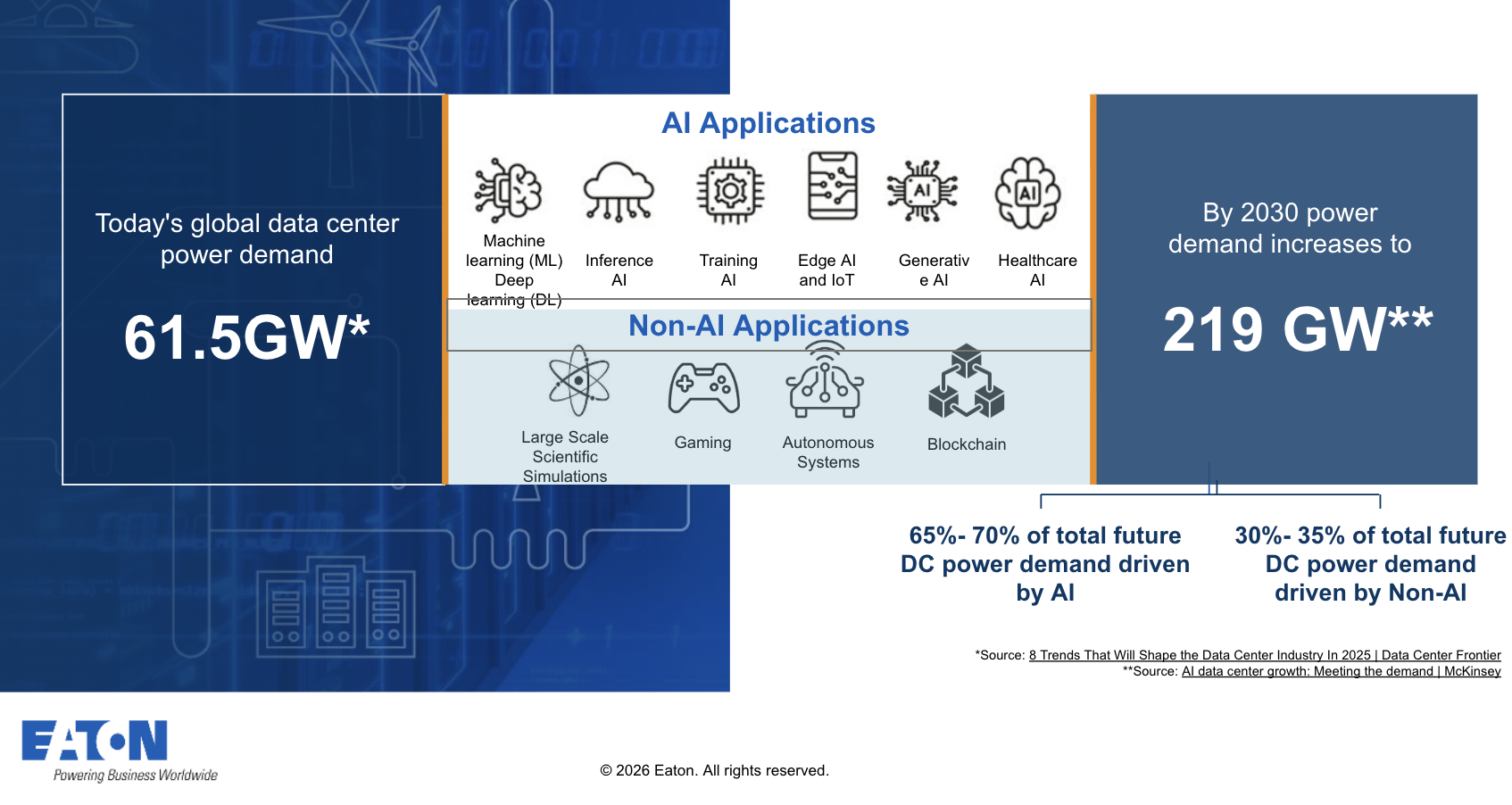
AI has a few different “modes.” Training (or learning) is when the AI model is being created or refined. So, AI load training refers to the power consumption (load) during the training phase. A lot of power is being used in a synchronous way during AI training. When AI is not undergoing training, it may be performing a variety of other tasks, like inference (using existing AI models to answer questions or perform tasks) or communication or transfer (transmitting responses to you).
What is the typical power usage effectiveness (PUE) observed in data centers?
PUE can vary based on size, age and location of the data center, with most around the 1.54 to 1.58 level globally. The more modern data centers are between 1.2 and 1.5 and some large hyperscalers have PUEs at 1.10 and below.
Will double conversion UPS automatically protect from incoming transients through the direct current (DC) link?
Double conversion is designed to protect the load from issues on the incoming line. Converting alternating current (AC) to DC and then back to AC gives the UPS the ability to control the voltage on the output.