Presenters from the March 11, 2026, webcast, Smarter Fire Protection Strategies for Healthcare, Commercial, and Correctional Facilities, answer audience questions.
Fire safety insights:
- Modern fire protection must address environments where downtime, disruption or evacuation carry serious operational and life-safety risks.
- From health care campuses and commercial buildings to correctional facilities, today’s projects demand earlier detection, smarter system design and practical strategies that work in real-world conditions.
Learning objectives:
- Understand evolving fire risks in health care, commercial and correctional facilities.
- Review relevant codes, standards and compliance considerations impacting system design.
- Explore real-world design, installation and commissioning challenges from field projects.
Presenters from the March 11, 2026, webcast, Smarter Fire Protection Strategies for Healthcare, Commercial, and Correctional Facilities, answer audience questions.
Modern detection approaches can improve response time, reduce nuisance alarms and help teams design, install and commission systems that perform reliably in complex environments. Khaleel Rehman, Associate Director – Business Sales Development and Jonathan McConnell, Sales Leader, Professional Solutions and Services, both from Edwards, covered practical insights that can be applied to new projects and retrofit upgrades — whether you are designing, specifying, installing or maintaining fire protection systems.
After the presentation, audience members had a chance to ask questions to the experts. Below are some highlights from the Q&A, covering topics like pipe length and materials, backup batteries, product life span and ensuring code compliance.
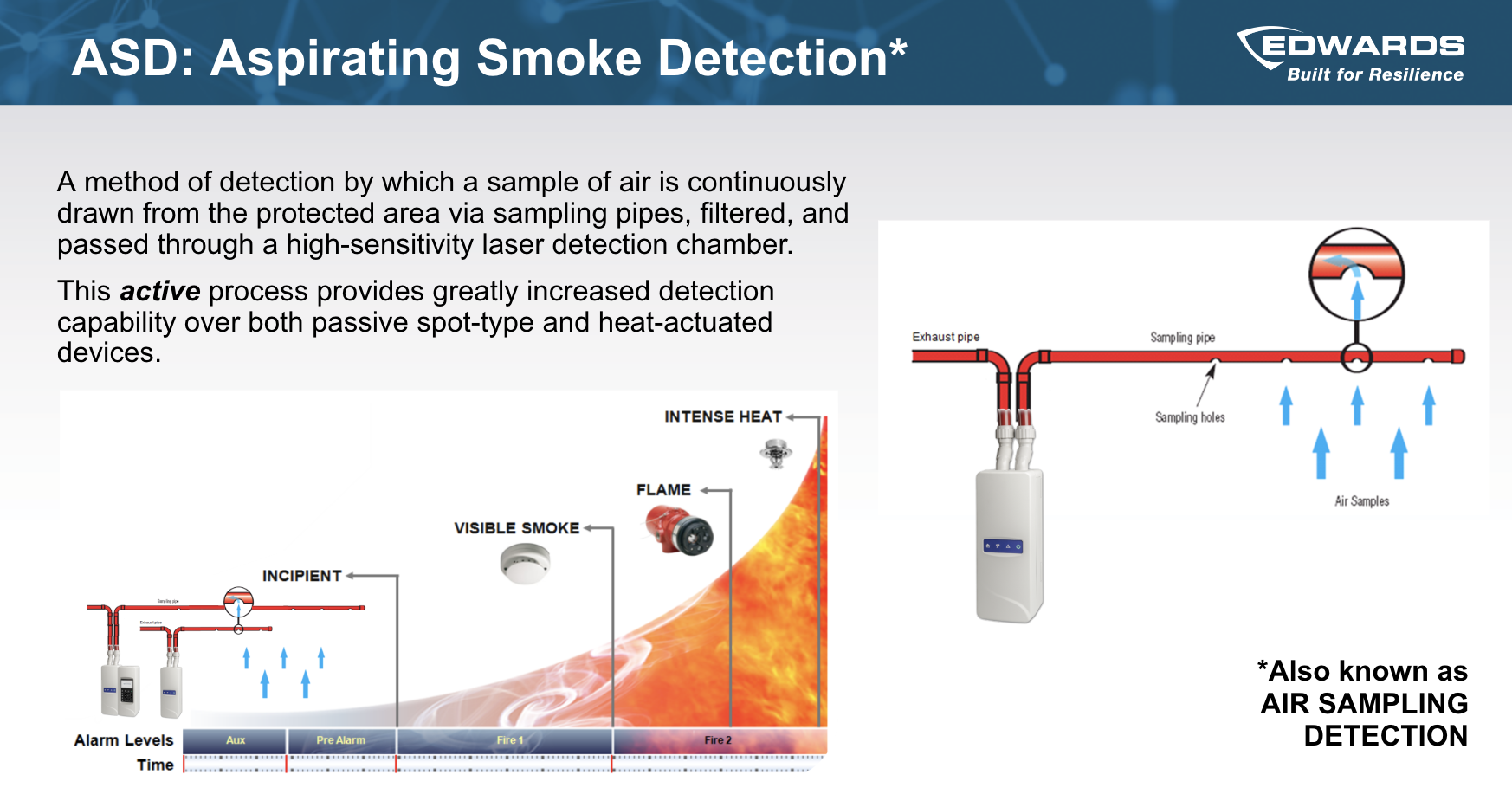
How much area we can serve from one of these aspirating smoke detection (ASD) equipment units?
Sampling pipe length is up to 820 ft (250 m) combined per detector module; quantity of sampling holes is up to 50 and depends on PipeCad calculations.
Are all products in compliance with UL 7th edition updates?
Fully compliant with UL 268 7th Edition and ModuLaser Mini is underway with UL/ULC listing.
In the MRI example, can this system sense low O2 or helium in addition to combustion products?
The ModuLaser ASD can detect aerosol smoke particle sensitivity in the range of 0.003 to 10 microns.
Is this system supposed to replace or supplement conventional detection and what is a general price difference between the two?
ASD is deployed in challenging applications to replace conventional detection and pricing is based on the application.
How do you keep inmates from blocking the ports to prevent sampling? Can the system tell if ports have been blocked and are not sampling?
We use vandal-resistant sampling points. If a sampling point is blocked, the ASD system will generate an airflow fault to indicate trouble in the system.
Does the air filter cause a fault after a set time? For example, in two years?
The detector indicates a filter fault (on the detector status screen) when the filter value reaches 20% of its remaining life.
Does this aspirating equipment have backup batteries to keep it operational during a power outage per NFPA 72, similar to fire alarm panels and fire alarm remote power supplies?
Yes, we do provide UL-listed power supply units with backup batteries.
PVC pipes are not usually used in above ceiling and plenum applications. Is there another option we can use or specify?
CPVC pipe can be used for plenum-rated areas.
Can the detector tell the difference between vapor from a humidifier and smoke?
The ModuLaser ASD can detect aerosol smoke particles with sensitivity to particles in the range of 0.003 to 10 microns.
Why are the pipes insulated in one of the photos?
ASD pipe insulation is provided as a jacket to protect from impacts of condensation and water precipitation on the pipe network.
Can we install this modular system in our high-rise building?
Yes.
How does your ASD system interface with fire suppression systems such as clean agent or preaction systems?
It is done via relay outputs available on the detector.
Is a forced mechanical system used to move air through the CPVC pipes or does the air move freely through the pipes?
The ModuLaser ASD solution has a 16-speed fan used as an aspirator for drawing smoke particles via a pipe network for air sampling.
What is the expected life span of these new ASD units? Do they need to be replaced after 15 years?
The life span of ModuLaser ASD depends based on application/environmental conditions. We offer a five-year warranty on the ModuLaser ASD product.