Engineers can cut building emissions by addressing embodied carbon in piping systems, where material choices, joining methods and design strategies can significantly reduce long-term environmental impacts.

Learning objectives
- Recognize the scope and significance of piping systems’ carbon impact throughout building life cycles and why traditional assessment approaches miss this critical component.
- Implement strategic design decisions that reduce piping system carbon footprint through material selection, joining method optimization and manufacturing proximity considerations.
- Apply life cycle thinking to mechanical system design by incorporating maintenance, adaptability and end-of-life considerations that eliminate cut-and-replace carbon penalties during inevitable building evolution and system upgrades.
Piping insights
- While the construction industry has traditionally focused on operational carbon, mechanical, electrical and plumbing systems can account for 15% to 50% of a building’s embodied carbon throughout its lifespan, rising to 70% or more in commercial retrofits.
- Identifying the key decision points in piping system design that create long-term environmental impact enables engineers to shift from operational carbon tunnel vision to strategic.
While the construction industry focuses on operational carbon, consulting engineers are missing significant opportunities to reduce building emissions. According to the Carbon Leadership Forum, mechanical, electrical and plumbing (MEP) systems account for 15% to 50% of a building’s embodied carbon throughout its lifespan, rising to 70% or more in commercial retrofits.
Understanding where carbon impacts occur throughout a building’s life cycle helps engineers identify the most effective intervention points. While operational carbon has dominated industry attention, embodied carbon from material production, construction and end-of-life phases represents significant opportunities for immediate reduction.
Despite these figures, piping systems are often excluded from whole-building carbon analysis due to limited data and the industry’s lack of standardized evaluation methods. With building codes constantly evolving and owners facing increasing pressure to reduce carbon footprints, this represents a critical blind spot that compounds over decades.
Strategies to limit carbon in piping systems are available right now and many engineers understand it’s their professional responsibility to implement them, even with imperfect data.
Piping design phase strategies
Low-carbon piping systems begin in the design phase, where early decisions create the foundation for a building’s environmental impact over its entire life cycle.
Think of this as the “carbon calories” of the mechanical system. Every design decision either adds or eliminates carbon debt over a building’s 60-plus-year lifespan. Just as nutritional calories accumulate over time, carbon calories compound through repeated maintenance cycles, system modifications and eventual replacements.
Material selection: where the biggest impact lies
The largest hurdle for engineers seeking to limit embodied carbon is lack of information. Environmental product declarations (EPDs) for certain MEP system components remain scarce globally. Within engineers’ specification authority, material selection, joining methodology and manufacturing proximity represent the factors with the greatest potential to reduce embodied carbon.
Pipe materials dominate a piping system’s carbon footprint, with different material choices creating vastly different environmental impacts. Using 100% recycled steel generates significantly less carbon than virgin material extraction and processing. Copper piping carries higher embodied carbon due to energy-intensive mining and refining, while chlorinated polyvinyl chloride systems have different carbon profiles tied to petrochemical production. Stainless steel applications typically require more carbon-intensive production processes.
Additionally, specifying thinner pipe walls or lower schedules where pressure ratings allow reduces material quantities and associated embodied carbon. System designers should specify high recycled content across all material categories and prioritize materials that can be effectively recycled rather than downcycled or landfilled.
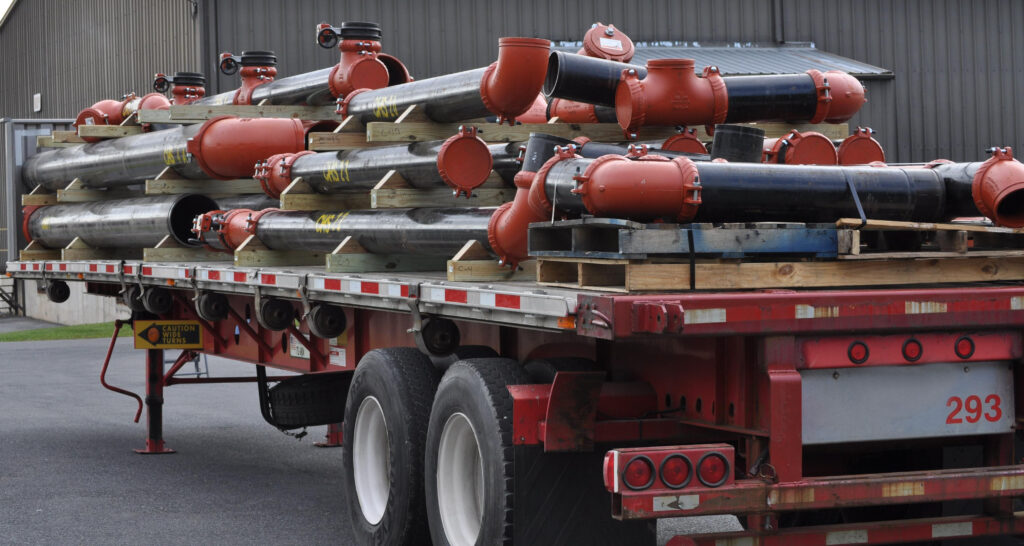
Where products are manufactured significantly impacts a piping system’s carbon footprint. Pipes and fittings can easily travel 2,000 miles or more from factory to jobsite, generating emissions throughout their journey. Engineers can reduce these impacts through specification decisions: considering supplier location alongside capability when evaluating manufacturers. Specifying products from manufacturers with regional facilities rather than defaulting to distant suppliers can substantially reduce a system’s carbon footprint.
Include modeling and circular design principles
Digital changes require mere mouse clicks, while field changes require contractors to cut, dispose and replace materials. Virtual mockups can identify installation challenges before materials are ordered and delivered.
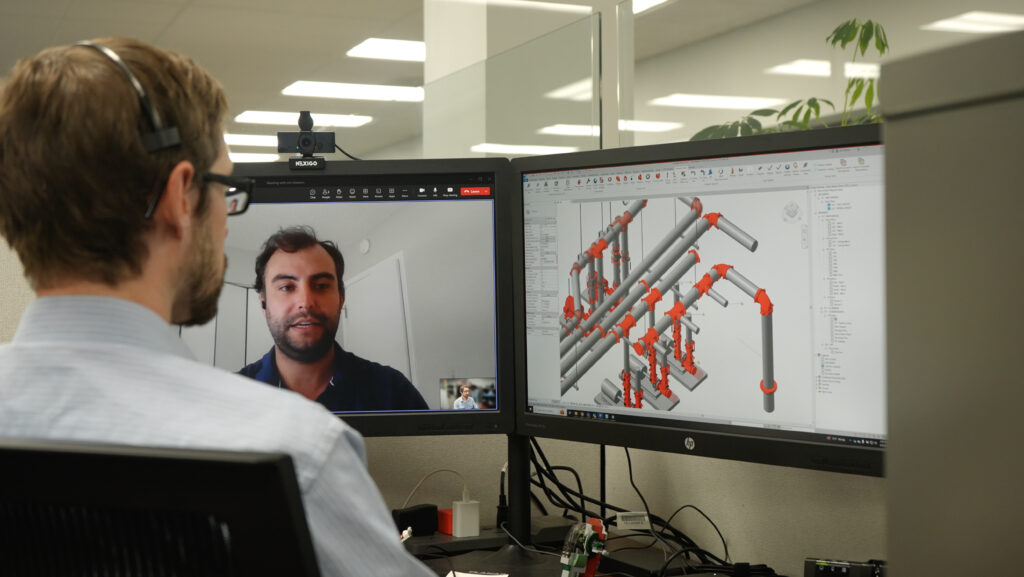
Building information modeling clash detection identifies conflicts in the digital environment rather than during construction, preventing rework and material waste. With detailed models, engineers can calculate material quantities down to the last fitting, avoiding the safety stock that typically gets thrown away at project end. Real-time coordination between trades catches conflicts before they reach the field, where change orders almost always mean waste.
Engineers must think beyond initial installation to consider how materials will perform, adapt and eventually be recovered throughout a building’s entire life cycle. This represents a challenging but essential mindset shift.
Engineers who think ahead ask themselves: Will these components be recoverable or recyclable when the building eventually gets renovated or demolished? Systems that can be taken apart cleanly allow valuable materials to be repurposed instead of ending up in landfills.
Pipe installation and joining methods
Pipe joining methods affect carbon impact immediately upon installation and can compound for years depending on system adaptability. However, while equipment efficiency is often analyzed down to decimal points, installation details can get overlooked despite their potential to affect sustainability goals.
Engineers spend considerable time selecting pipe materials, and the connection method can be equally important for carbon impact. Permanent joining methods like welding or solvent-cemented joints cannot be reused and must be cut out and replaced whenever piping systems need modification.
Grooved couplings take a fundamentally different approach. Unlike permanent joints, these connections can be assembled and disassembled repeatedly without damaging the pipe or fittings. A simple two-bolt design means technicians can make changes with basic hand tools, eliminating the waste stream that comes with cutting out and replacing welded sections.
Here’s where different joining methods stand on carbon impact:
Welded/flanged systems often work together as one integrated system design. Due to the permanence of welded connections, these systems require flanged access points for maintenance and modifications. During installation, welding generates hazardous emissions, metal fumes and solid waste including contaminated rods, wire stubs and slag. During system modifications, welded joints must be cut out and completely replaced. Flanged connections allow disassembly but present carbon challenges: they require substantial material mass from four to 20 bolts per connection, precise alignment and specific bolt-tightening sequences. Gaskets must be replaced during each disassembly, creating additional waste over the system life cycle.
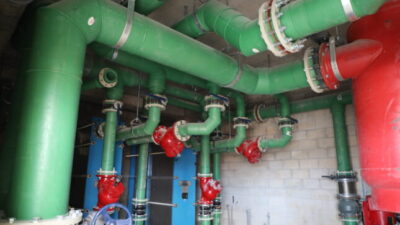
Grooved systems have a flame-free installation process, eliminating installation emissions and hazardous fumes while allowing disassembly for modifications. These systems can incorporate higher recycled content and generally require less material mass per connection. Grooved joints deliver reliable connections that come apart cleanly without damaging pipes or coupling components. When building layouts change or systems need modification, engineers can reconfigure entire sections without generating scrap. Pipes, couplings and gaskets all go back into service, cutting material waste dramatically over decades of building operation.
Joining methods present different carbon trade-offs. Each comes with its own cost structure, installation challenges and maintenance realities. The key is factoring carbon impact into these familiar engineering calculations rather than treating it as an afterthought.
Modularization and prefabrication for waste reduction
According to Autodesk Construction Cloud survey results, 53% of construction professionals identify prefabrication as having the greatest carbon reduction potential. Prefabrication enables faster installation, reducing crew hours, equipment runtime and jobsite energy consumption. All of these factors contribute significantly to a building’s embodied carbon.
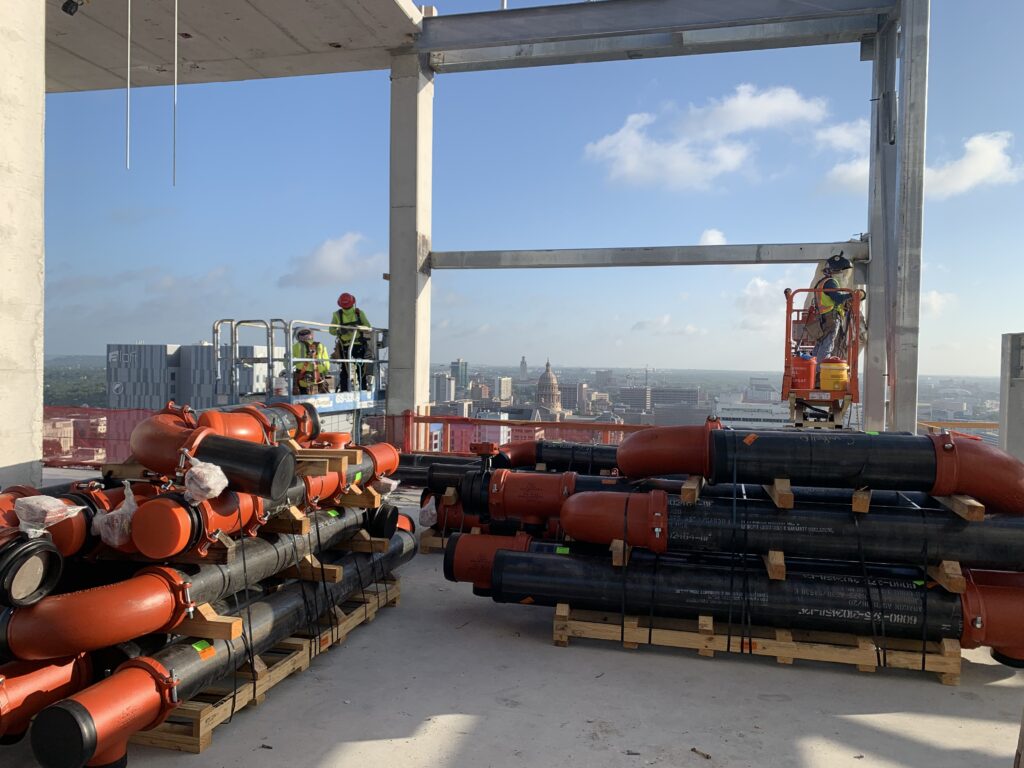
Standardized components support prefabrication by reducing supply chain complexity and enabling optimized production runs with lower energy intensity per unit compared to custom fabrication. Catalog items such as preassembled pump drops and air handling unit drops significantly reduce field joints and installation time. With fewer field connections required, preassembled pipe spools take the guesswork out of installation while reducing material waste.
Designing piping for building operation
The time in which a building is in operation is the longest phase in its life cycle and offers the greatest opportunity for carbon impact, both positive and negative, depending on how systems are designed for maintenance and adaptation.
Consider the math: a building might operate for 60 years or more, with multiple equipment cycles and countless maintenance interventions. Systems that resist these inevitable changes force expensive workarounds and generate unnecessary waste. Design for easy access now and maintenance teams can swap components without the carbon penalty of emergency deliveries and rush repairs.
Grooved systems excel here because they treat maintenance as a design consideration from day one. But good maintenance planning goes deeper than joint selection. Engineers need to think about technician access, system redundancy and keeping operations running during repairs.
Engineers group critical components into dedicated maintenance zones, ensuring technicians have adequate room to work and replace equipment. Strategic valve placement allows maintenance teams to isolate problem areas without shutting down entire buildings.
Redundancy planning prevents emergency replacements that exceed both budgets and carbon targets. Parallel flow paths let engineers rotate equipment during scheduled maintenance, spreading wear across multiple units. This approach keeps systems operational while maintenance happens on schedule.
Physical access only gets a designer halfway there. Engineers who think ahead install diagnostic connections and monitoring points at key locations, giving maintenance teams the intelligence they need to spot problems early. Catching issues before components fail completely avoids the carbon penalty of rush deliveries and emergency repairs.
Smart engineering
Buildings must evolve to remain competitive and meet changing business needs, rarely staying the same for long. Market pressures, technology upgrades and changing work patterns all force facility modifications that impact the layout of piping systems, sometimes multiple times in a single decade. Engineers who design adaptable piping systems positioned for modification and expansion spare building owners the choice between expensive total replacements and outdated infrastructure, avoiding the cycle of ordering, manufacturing and shipping new components.
With approximately 80% of today’s buildings still operating in 2050, now is the time to consider how piping systems specified will evolve and what design considerations they can make to position them to efficiently and sustainably undergo multiple renovation cycles before reaching end-of-life. Engineering teams that apply the design strategies outlined in this article, considering embodied carbon impacts from material selection through end-of-life recovery, position themselves as sustainability leaders and gain early adopter advantage.
Market forces are accelerating this transformation. ASHRAE Standard 240P: Quantification of Life Cycle Greenhouse Gas Emissions of Buildings recently ended a review period, federal “buy clean” policies are expanding and carbon border taxes are affecting supply chains. Early adopters influence these standards rather than adapting to them later. The buildings engineers design today will serve communities for decades. Professional stewardship demands considering their complete environmental impact from day one.
Integrated piping design
Immediate steps engineers can take include asking for manufacturing data during specification and including life cycle carbon requirements in requests for proposals. Collaborating with manufacturers to develop EPDs helps build the industry knowledge base needed for informed decisions. Pilot projects should focus on high-impact decisions around material selection, joining methodology and manufacturing proximity.
Engineering teams can and should expand assessment scope to include complete system evaluations and whole-building carbon analysis. Building strong partnerships with suppliers who prioritize environmental transparency pays dividends in embodied carbon reduction. These relationships provide access to better data and more sustainable products.
Organizations like MEP 2040 have created a community around this challenge. More than 80 firms have committed to net-zero embodied carbon by 2040, sharing strategies and pushing each other toward better solutions.
Embodied carbon impacts compound with every specification decision. The strategies to minimize embodied carbon are available now. Firms that incorporate sustainable design strategies and material selection into their MEP system design and specification today and continually reevaluate the evolving landscape, will have a significant advantage in reducing full building carbon footprint over those who wait for the industry to catch up.