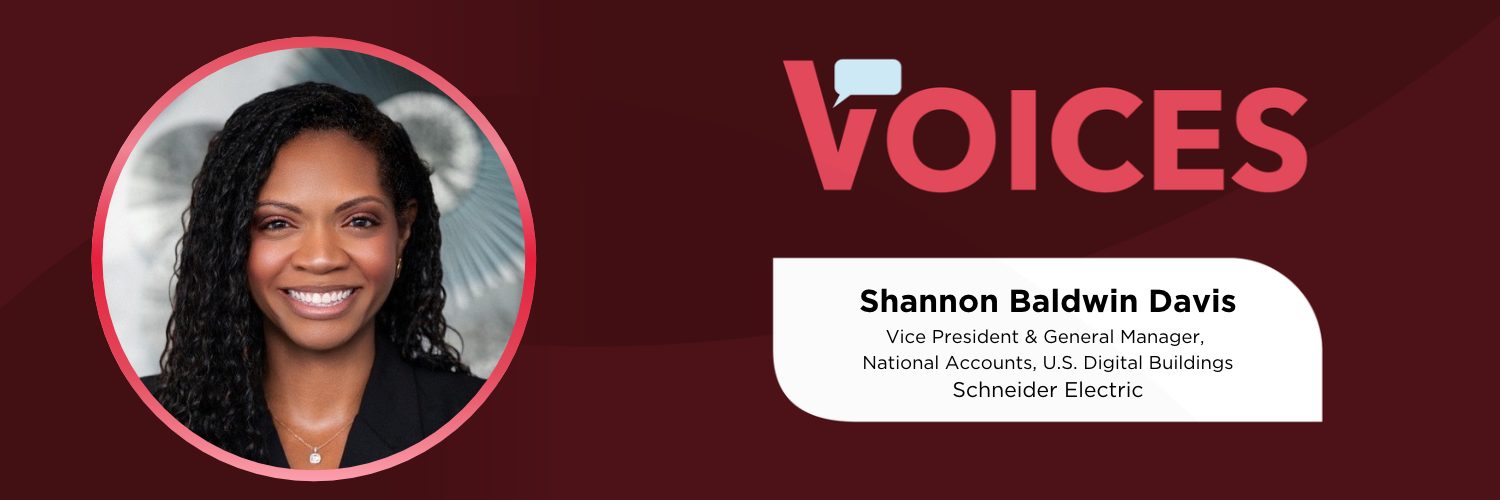
Sponsored by Schneider Electric. In this Voices interview, Consulting Specifying Engineer spoke with Shannon Baldwin Davis at Schneider Electric to learn how women are changing the engineering profession, strengthening technical teams and helping shape the future of the industry.
Consulting Specifying Engineer: Please start off by introducing yourself and your role at Schneider Electric.
Shannon Baldwin Davis: I’m Shannon Baldwin Davis, Vice President and General Manager of National Accounts for U.S. Digital Buildings at Schneider Electric. My team works with some of our largest and most strategic customers in critical buildings and infrastructure, helping them solve complex challenges around energy efficiency, sustainability and digital transformation. I’m also an electrical engineer by training, and that foundation has stayed with me throughout my career as I’ve moved from engineering into commercial and executive leadership.
What changes and progress have you seen within the engineering profession over the course of your career?
When I started my career as an electrical engineer, I was often the only woman in the room. Today, I see a different landscape. There are more women entering engineering, more women moving into leadership roles, leading business units, running major projects and increasingly having a voice in the decisions that shape our industry.
I’ve also seen a shift in how companies think about inclusion. The most successful organizations recognize that inclusion isn’t a side initiative. It’s a business priority.
The profession itself has evolved as well. Education and technology are more accessible, and what an engineering career can look like has broadened significantly.
We’re certainly not at gender parity yet, so there’s still work to do. But when I compare where we are today with where I started my career, the progress is real, and I’m optimistic about the trajectory we’re on.
What perspectives do women bring to technical and project teams?
Women bring different lived experiences and perspectives to technical and project teams, but I think the broader point is that diverse teams perform better because we’re less likely to approach a problem from the same point of view.
The research supports that. McKinsey’s Diversity Matters Even More found a strong association between diverse leadership teams and financial outperformance, while Boston Consulting Group’s research found that companies with more diverse management teams generated significantly more revenue from innovation.
I see that with my own team. Having a variety of voices and perspectives leads to better problem-solving and stronger collaboration across engineering, operations and sales. It means we consider different perspectives before we make a decision, and it helps us better reflect the customers we serve.
Our customers aren’t all the same, so the teams solving their problems shouldn’t all think the same either. When we bring different perspectives to the table, we understand our customers better, challenge our assumptions, and ultimately serve them better.
Where do you see the greatest opportunities to increase women’s representation in engineering leadership?
From my perspective, the greatest opportunity is at that critical transition from technical individual contributor into engineering leadership. Too often, women aren’t given the same stretch assignments, visibility or even the same room to fail forward and learn. We still see situations where men are bet on for their potential, while women are expected to demonstrate a proven track record before they’re given that same opportunity.
That’s where leaders have to be intentional about checking our own biases. McKinsey and LeanIn.Org’s 2025 Women in the Workplace report continues to identify the “broken rung” at that first step into management. It also found that women receive less sponsorship and manager advocacy, particularly early in their careers, and that when women receive the same career support as men, the gap in ambition to advance disappears.
So I don’t think this is fundamentally an ambition problem. I think it’s an access and support problem. And that’s why sponsorship is so important. Mentorship matters. A mentor can advise you, coach you and be a sounding board. But a sponsor advocates for you in the rooms you’re not in. They put your name forward and put their own credibility behind your potential.
I’ve been fortunate throughout my career to benefit from both great mentors and great sponsors, and I feel a responsibility to do the same for others. I try to be intentional about advocating for underrepresented talent and people whose backgrounds or career paths may not fit the traditional mold. Sometimes what someone needs most is a leader willing to give them the opportunity to show what they can do.
How do recruitment efforts and Schneider Electric programs such as WISE and organizations such as SWE and NSBE support women in engineering?
I think it starts with creating the pipeline, but it can’t stop at recruitment. Programs like WISE, Women in Schneider Electric, give people a place to connect around shared experiences, build relationships and create a sense of community. That matters because bringing talented women into engineering is only part of the equation. We also have to create an environment where they feel like they belong and can see a path to grow.
External organizations like SWE, the Society of Women Engineers, and NSBE, the National Society of Black Engineers, are equally important because they help us build relationships with talent early, often before students even graduate, and help them see what a career in engineering can look like.
I’ve personally been a member of both SWE and NSBE, so I’ve seen firsthand how powerful community and visible role models can be. There’s something very real about being able to see someone who has a background or experience like yours succeeding. It makes that possibility feel attainable.
So, to me, these programs aren’t just about recruiting more women into engineering. They’re about creating the community, visibility, relationships and sense of belonging that help women enter the profession, stay in it, and ultimately grow into leadership.
What does the industry need to address next to help shape the future of engineering?
I think the industry needs to focus on retention and advancement, not just recruitment. Bringing more women and underrepresented talent into engineering is important, but we also have to make sure they can see a future for themselves once they’re here. That means visible career paths, meaningful sponsorship, access to opportunities and the flexibility people increasingly expect as the profession becomes more digital and distributed.
I also think we have an opportunity to reimagine how we talk about engineering as a career. Engineering should feel just as exciting and aspirational to young people as medicine, law, technology or entertainment. Too many young people, and particularly young girls, grow up without really seeing what engineers do or understanding the impact they can have.
Engineers are solving some of the biggest challenges of our time, from energy efficiency and resilience to sustainability and digital transformation. We need to make those stories visible earlier so young people can see themselves as part of that future.
Because ultimately, the future of engineering will be shaped by who we inspire to enter the profession, who we create the conditions to stay, and who we give the opportunity to lead.
Was there anything else you wanted to add?
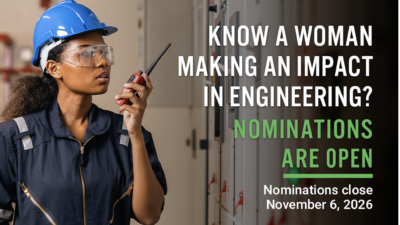
I’d close with a simple call to action: nominate someone. If you know a woman, or a workplace, doing great things in building engineering, recognize them through the Consulting-Specifying Engineer Advancing Women program by November 6. Recognition creates visibility, visibility creates opportunity, and sometimes that recognition can be the thing that opens the next door.
Nominations can be submitted at Consulting Specifying Engineer’s Women Advancing Engineering.