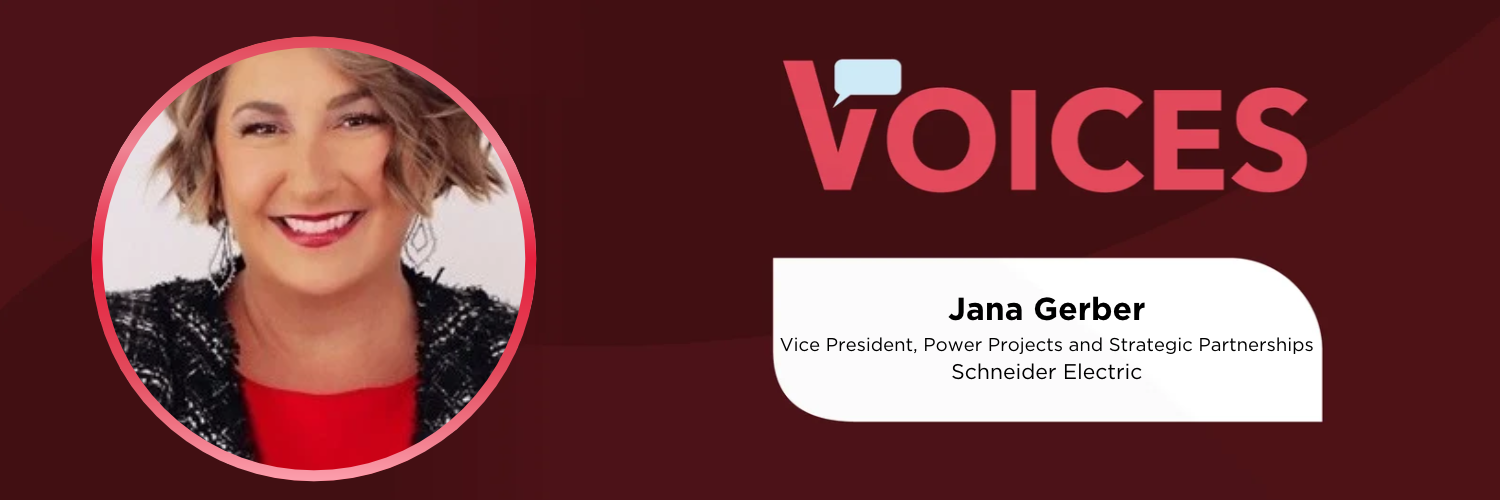
Sponsored by Schneider Electric. In this Voices interview, Consulting Specifying Engineer spoke with Jana Gerber, Vice President of Power Projects and Strategic Partnerships at Schneider Electric, to discuss collaboration and partnership, and how women engineering leaders encourage innovation and bring stakeholders together to solve increasingly complex design challenges in the engineering industry.
Consulting Specifying Engineer: Could you start off by introducing yourself and your role at Schneider Electric?
Jana Gerber: I am the Vice President of Power Projects and Strategic Partnerships. What that means inside of Schneider Electric is that my team is part of our power distribution sales organization focused on the electrical needs of our customers. We’re focused across a national landscape and inside of four primary channels: our end users and the highly electro-intensive segments across those end users, design firms, EPCs and our electrical contractors.
What experiences prepared you for technical leadership, and how did they help you build confidence?
I am an engineer by background, a civil engineer. I started my first few years designing buildings to help them stand up—nothing to do with what I do today in helping to define how buildings operate from the inside out and their electrical systems specifically.
My career has not been a straight line. I started as an engineer. I moved into sales and business development and marketing roles that allowed me to better understand value propositions and how we can talk from a broader perspective about our technical solutions. Through the years, I’ve done more operational roles as well as some commercial sales roles.
I’ve worked on large, complex project pursuits and tendering-type functions, pulling the projects together to make them something that we can sell to a customer and that the business can also execute. I worked in strategic accounts, sustainability consulting, as well as microgrids and now power projects.
What I’ve learned along the way is that you can’t be the person who has all the answers in the room. It’s not about being the smartest technical person in the room. Instead, it’s about knowing to ask why, to ask the right questions, and bring the right expertise together. Then you can have a solid conversation about what’s possible, what the trade-offs are and ultimately, what risks you might have to align around and potentially mitigate.
To me, technical leadership is about bringing people together to solve the customer’s problem. Sometimes that requires conversations that may feel a little uncomfortable in the moment, but those are often the conversations that surface the right information and perspectives. Ultimately, good technical leadership creates enough productive dialogue for the team to move forward with confidence in the decision. For me, it’s been about saying, “I don’t have the answer, but let’s get the right people together and start to talk and work through it, so that we can come to the right answer.”
How do you lead teams through difficult technical decisions?
I would say that we often come to these technical decisions and start pulling together the numbers and the dollar signs and the watts and the voltages, and we don’t step back and make sure we understand what it is we’re solving for. One of the first big things is getting people aligned around what problem we’re solving and who we’re solving it for.
There’s not always one perfect technical answer in some of these things. You’re always balancing safety, reliability, constructability, cost, schedule, sustainability, technical readiness and more. Someone I used to work with ingrained in my head the acronym S.S.B.E.: Scope, Schedule, Budget and Expectations. You put those four points around a box and say, “Okay, what can fit inside of this?” to get to the right technical solution for the customer, because not everything will fit. Sometimes either the business or the customer has to give something up, and you have to be able to communicate why that needs to happen.
I think it’s about getting the right technical experts to have a voice, challenge one another, make sure we all understand what risks are out there, and make a decision based on the best information we have available. There’s always going to be some disagreement in that kind of an approach. Healthy technical disagreement is good, but my role as a technical leader is to make sure we debate those early, make the trade-offs transparent, make a decision and get the team aligned behind it so that we can ultimately solve the problem defined by our customer.
Early on in my career when I was in strategic accounts, we were working with a customer on the East Coast, Penn Medicine. Penn Med was looking to figure out how to integrate technology inside the patient room. We worked closely with the end user, architects, designers, engineers and the contractor channel. They did a lot of surveys with their customers and patients going through their hospitals to figure out, in a time when you feel most vulnerable in a hospital bed, what kind of control can be brought to you to help improve that experience?
That would be one example of aligning on what you’re trying to solve and who you’re trying to solve it for. In this case, yes, it’s for Penn Medicine, but it’s ultimately for that patient in the bed and how they can have more control in that very vulnerable environment.
How do you encourage innovation and collaboration to achieve better customer outcomes?
We always think of innovation as just technical, like some new product or solution out there. But it’s really saying, what is the customer challenge we’re trying to solve? And then let’s think about it not in the confines of just our current today or in the confines of the technical solution, but what could be possible moving forward.
Innovation is often about reframing what’s possible. In a large organization like Schneider Electric, innovation can take many forms, from the products and technologies we develop to how we deliver solutions or structure financial models that help customers overcome barriers to adoption. The answer doesn’t always have to be a new technical solution. Sometimes innovation is about combining different capabilities in a way that makes it easier for a customer to achieve the outcome they’re working toward.
That’s why it’s important to start with the customer’s desired outcome rather than a specific product or solution. A customer may come to us with a defined need, but addressing that need alone may solve only one part of a much broader challenge. Our role is to bring together the right expertise from across the organization and our broader ecosystem, look at the challenge from different perspectives and question traditional approaches. By empowering the people closest to the problem to help shape the solution, we can create more holistic, innovative outcomes for our customers.
Thinking about a more pure technical innovation, customers come to us looking for certain designs, but there are areas where Schneider Electric has some great product innovation that the customer may not know about yet. They’re very used to buying electrical distribution equipment from us. And inside of our equipment families, we are always innovating. Over the last year, we have launched SureSeT™. SureSeT™ is Schneider Electric’s next‑generation, compact, digitally enabled medium voltage (MV) metal‑clad switchgear designed for safer, more efficient and more predictive operations. In the case of your technical solution, it fits all our customer’s technical parameters, but it also has a smaller footprint and a better lead time and a more digital environment—adding real-time monitoring for continuous circuit breaker visibility into asset health and performance
We can help customers to not just think, “This is the way I’ve always done it. Here’s what my specification says. Here’s what I’ve always bought.” Instead, we can encourage them to approach the problem a new way. “Let us help you understand what it is you’re trying to do and what your requirements are and see if we can help to find a new solution.” Or maybe there is a solution already available that they just haven’t worked with in the past, and we can help open their minds to that as well.
What is the value of engaging owners, engineers, contractors and technology partners earlier in the design process?
My team is focused on end users, design firms, EPCs and electrical contractors, and this is the heart of why it’s so cool. It’s a huge opportunity in the industry to bring these folks together to understand not just one perspective that says, “Here’s what the owner’s last plant looks like, here’s the engineer and the way they designed their last project, and here’s the contractor and the way they’ve designed it in the past.”
If we can bring all the parts and pieces together to really understand what’s trying to be achieved, we can find new ways around constructability, doing prefabricated or skidded-type designs, bringing parts of the design together in a way that can be delivered to the site more seamlessly, or thinking differently about the design, with SureSet versus a traditional metal-clad design.
Bringing all those folks together to think about what’s trying to be achieved, where we’re going, where we’re at today and what will be available can help drive innovation. That allows for better decisions around what the architecture looks like, what the resilience of the system may look like and how we can be more standardized across the design.
One thing that’s really important to Schneider Electric, of course, is digital capability. As you think about all those different stakeholders across the life cycle of a project, they each have different perspectives. But if you think about digital in the design and construction, it brings immense value to the owner as they operate that facility or asset throughout its life cycle. That may not be very important to the contractor and the design firm when they’re designing it, but it can create a lot of value downstream in the overall operation.
Bringing all those people together to think proactively about what could be and adding in some of that digital capability—the sensors, the metering, and more—is not a costly addition early on, but it can be costly if you’re adding it later. You’re thinking about each portion of the project—the design, the construction, the operations—in a single conversation to see where you can bring value throughout the entire life cycle, not in those siloed approaches.
How will the upcoming Schneider Electric Tech World bring this ecosystem together to solve for what’s next?
The thing that’s exciting about Schneider Electric’s upcoming Tech World is that it is bringing together this ecosystem. It’s an opportunity for design firms to share how they’re evolving their designs and specifications in response to the major forces reshaping our industry, from electrification and rising power demand to grid constraints and AI.
Tech World is an opportunity to learn from one another, both through the conversations happening on stage and the connections taking place throughout the event. We’re able to showcase our latest innovations and solutions and give customers a hands-on look at what’s possible. Some of the most valuable moments also happen informally, over a cup of coffee or across the table at dinner. It’s about bringing the entire ecosystem together to exchange ideas, build connections and explore what’s possible as we move the industry forward. It’s not just about showing what technology exists today, but about bringing the people who design, build, operate and innovate these solutions together to ask, where are we going next and how do we solve it together?
Schneider Electric wants to be the energy technology partner our customers can rely on to navigate what’s ahead. You can’t be the person with all the answers, and the same thing is true inside of the broader ecosystem. Not one piece or one company holds all the answers to what is possible in the future. Bringing them all together at Tech World is an incredible way to help redefine what is possible.
Consulting-Specifying Engineer is dedicated to encouraging and recognizing the most talented women in the engineering community supporting the building industry. Nominate a deserving woman or organization by November 6, 2026!