Industrial facilities are advancing sustainability through net zero strategies, energy recovery, renewable power and intelligent controls.
Sustainability insights
- Early planning, energy modeling and centralized controls help industrial facilities reduce energy use and carbon emissions without compromising production throughput or uptime.
- Waste heat recovery, on-site solar, battery storage and other alternative energy systems are becoming key strategies for improving efficiency and supporting long-term sustainability goals.
Respondents:
- Matthew R. Merli, PE, Principal/Client Services Director, Fitzemeyer & Tocci Associates Inc., Woburn, Massachusetts
- Darren Rogge, Principal, Jordan & Skala Engineers Inc., Norcross, Georgia
- Jacob Weber, PE, Project Engineer, Affiliated Engineers Inc., Madison, Wisconsin
What level of performance are you being asked to achieve, such as WELL Building Standards, U.S. Green Building Council LEED certification, net zero energy, Passive House or other guidelines?
Jacob Weber: Performance targets vary significantly by owner, project type and business case. An example of the most ambitious project I have worked on was an industrial test lab in Southern California that targeted and achieved LEED Platinum, CALGreen Tier 2 and net zero energy. As a government agency with approved funding and no return on investment requirement, performance goals were prioritized without typical first-cost or payback constraints.
The 403,000-square-foot facility includes light-duty chassis test cells, heavy-duty chassis test cells and engine test cells focused on vehicle emissions validation and research. Energy modeling validated unique heating, ventilation and air conditioning and process cooling strategies that improved projected energy use intensity by approximately 20%. A 3.8 MW photovoltaic array offsets annual energy use, while 1.5 MWh of battery storage helps optimize utility costs.
Darren Rogge: Net zero emissions has been a topic of discussion on many projects lately. The reduction or elimination of fossil fuels has gained traction, and several areas of the country have adopted mandates to eliminate these. There are various components in the mechanical, electrical and plumbing (MEP) systems that contribute to carbon emissions. Determining project goals and the paths to achieve these goals must be identified early on so the design can incorporate or exclude the necessary components.
How are industrial facilities balancing energy efficiency goals with high process energy demands and operational uptime requirements?
Matthew Merli: Energy recovery is critical in these facilities. Making sure that we’re designing, modeling and implementing energy recovery always helps the life cycle of the buildings and their MEP systems.
Darren Rogge: Typically, the process operation is going to drive the discussion. The user has a throughput goal to achieve, and our task is to design the building systems to help achieve that goal. By implementing a centralized control system with monitors on specific processes and equipment, the user can adjust the operation of the equipment to facilitate a lower peak electrical demand and save utility penalty costs.
What role do waste heat recovery and circular energy strategies play in improving overall facility sustainability?
Jacob Weber: Waste heat recovery can play a major role in improving the sustainability of industrial facilities, as many process and utility systems reject large amounts of usable heat. We are seeing larger facilities consider behind-the-meter generation to reduce dependence on utility capacity and decrease energy costs. These large facilities are often looking to reciprocating engines and simple-cycle turbines for quicker lead times and less installation/startup time.
While these systems can be inefficient if the waste heat is not captured, overall thermal efficiency improves significantly when that heat is recovered for process heating or cooling via steam turbine chillers or absorption chillers. Thermal oxidizers can also provide high-temperature waste heat recovery opportunities for the same applications. The key is matching the recovered heat source to a real, consistent facility or process load.
What types of renewable or alternative energy systems have you recently specified to provide power?
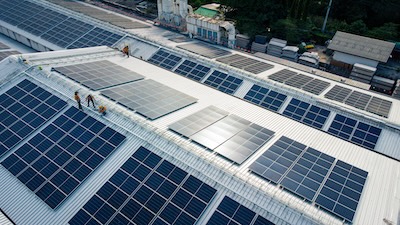
Darren Rogge: We have designed solar, microgrid and fuel cell systems as alternative energy systems. Solar systems have been around for years and clients are more familiar with them. Depending on the amount of energy to be provided, they can take up a large area. With the larger roof area on industrial buildings, solar is a viable option. Microgrids and fuel cell systems typically require a large natural gas supply, which does not align with the net zero goals of many users. This may also provide challenges from the natural gas utility supplier and the respective utility infrastructure limitations.
How has the demand for energy recovery technology influenced the design for these kinds of projects?
Darren Rogge: We have designed heat recovery systems from chilled water equipment to heat domestic water systems in mixed-use buildings. The chillers emit heat during operations that can be captured and used to heat domestic water systems. Facility operation, seasonal differences and hot water demand all play a role in how feasible this system can be.