Codes and standards for industrial facilities are evolving to emphasize energy efficiency, environmental compliance and emerging technologies.
Codes and standards insights
- Engineers are navigating rapidly evolving codes by combining established standards with performance-based design and close coordination with authorities having jurisdiction.
- Energy and environmental regulations are driving earlier planning with greater emphasis on energy modeling, efficient HVAC and long-term flexibility for future code changes.
Respondents:
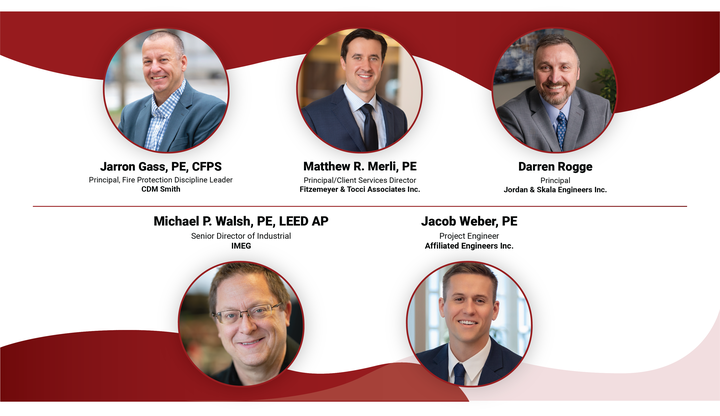
- Jarron Gass, PE, CFPS, Principal, Fire Protection Discipline Leader, CDM Smith, Pittsburgh
- Matthew R. Merli, PE, Principal/Client Services Director, Fitzemeyer & Tocci Associates Inc., Woburn, Massachusetts
- Darren Rogge, Principal, Jordan & Skala Engineers Inc., Norcross, Georgia
- Michael P. Walsh, PE, LEED AP, Senior Director of Industrial, IMEG, Cincinnati
Describe some of the codes, standards and guidelines you commonly use during a project’s design process. Which codes and standards should engineers be most aware of?
Michael Walsh: Engineers rely on a combination of core building and system codes along with industry-specific standards, depending on the manufacturing process. Common baseline codes include the International Code Council including International Building Code (IBC) and related codes, ASHRAE standards for heating, ventilation and air conditioning (HVAC)and energy, and the National Fire Protection Association (NFPA) codes, including NFPA 70: National Electrical Code (NEC) for electrical systems.
Beyond these, many projects require specialized standards such as the U.S. Food & Drug Administration Current Good Manufacturing Practice guidelines for pharmaceutical facilities, NFPA standards for flammable liquids and hazardous materials and environmental regulations governing air emissions, spill prevention and wastewater discharge. Understanding how these layers interact is critical to delivering safe, compliant and functional facilities.
Matthew Merli: There are always the standard types for all jobs, such as IBC, International Mechanical Code (IMC), International Energy Conservation Code (IECC), NEC, NFPA and ASHRAE. For mechanical, we seem to be using the Industrial Ventilation Handbook a lot, especially for industrial clients.
Jarron Gass: Engineers commonly reference the IBC, IMC, International Fire Code (IFC), and NFPA 70 as foundational documents. For fire protection, NFPA 13: Standard for the Installation of Sprinkler Systems, NFPA 72: National Fire Alarm and Signaling Code and NFPA 101: Life Safety Code are essential. HVAC and energy designs often rely on ASHRAE Standard 90.1: Energy Standard for Buildings Except Low-Rise Residential Buildings and the Industrial Ventilation Manual. Engineers should prioritize these plus local amendments, Occupational Health and Safety Administration requirements and process‑specific standards (e.g., NFPA 30: Flammable and Combustible Liquids Code). Staying current with 2024 to 2026 editions is critical because codes are evolving toward greater energy efficiency and resilience while also addressing emerging hazards such as electric vehicle or lithium-ion battery challenges.
Darren Rogge: Typically, the most impactful code to the design is the energy code. The design team needs to evaluate the differences between the IECC and ASHRAE, if both are adopted by the authority having jurisdiction (AHJ), and determine which one best fits the project goals.
How are codes, standards or guidelines for energy efficiency impacting the design of industrial and manufacturing facilities?
Jarron Gass: In line with due diligence, it is imperative to weigh each project against its own merits and to navigate potential unintended consequences that can arise in the pursuit of energy efficiency, particularly in existing facilities. Improvements in efficiency in one area may necessitate upgrades in others, such as adding structural elements to support new photovoltaics or replacing an entire fire alarm system that cannot be expanded to accommodate a renovation.
Typically, it is more straightforward in new projects to incorporate various levels of efficiency and pursue Leadership in Energy and Environmental Design (LEED) certification or other accrediting statuses. Although the return on investment (ROI) tends to be shorter for new builds than renovations, there is typically still an ROI regardless.
Darren Rogge: The equipment manufacturers have had some challenges with producing their updated energy efficient equipment to meet demanding construction schedules. Procurement of equipment can have an impact on the project schedule. The design team may be asked to evaluate alternate equipment that has a better delivery date. This sometimes leads to a compromise in the design, which can have an impact on the life-cycle cost of the facility.
Matthew Merli: The use of energy modeling is becoming increasingly standardized, which is important not just for mechanical, electrical and plumbing (MEP) systems, but also for process loads. In some cases, a building’s process loads may be 90% or more of overall load, so working with clients on how to model those is more important than ever.
Michael Walsh: Energy efficiency codes and standards are increasingly shaping industrial facility design by turning what were once best practices into baseline requirements. Design teams are placing greater emphasis on early energy modeling to evaluate building envelope performance, particularly for facilities with partial conditioning or significant process heating loads.
HVAC systems are being designed for efficiency as well as capacity, often separating process ventilation from comfort systems to optimize both. Lighting design has also evolved, with a focus on controls, power density and daylighting in high-bay spaces. In addition, facilities are incorporating advanced controls and energy monitoring systems to manage peak demand and adapt to evolving regulations and energy cost pressures.
How are evolving environmental regulations influencing system selection and long-term facility planning?
Darren Rogge: The introduction of A2L refrigerants has led to challenges in selecting equipment or requiring a different HVAC system type to serve specific areas to limit the refrigerant amounts. There are specific thresholds that, if exceeded, require additional design considerations and costs.
Matthew Merli: In our world of MEP engineering, the new phase of refrigerants is something we are working with. Recently, it has been an interesting time as R-410A and others are getting phased out and becoming less available. The industry was struggling for a while to supply the equipment with new refrigerants, e.g., R-32, but we seem to have gotten over that hump. With new refrigerants come new design criteria, such as flammability.
Jarron Gass: Regulations on refrigerants and emissions are shifting selections toward low global warming potential alternatives, natural refrigerants and heat pumps. Water use restrictions and wastewater rules favor closed-loop cooling, gray water reuse and increased efficiency in process piping. Long-term planning incorporates future-proofing for tighter limits via modular systems and monitoring.
ASHRAE Standard 15: Safety Standard for Refrigeration Systems, ASHRAE Standard 34: Designation and Safety Classification of Refrigerants and local environmental rules guide compliance. This influences chiller and HVAC choices, often increasing upfront costs but reducing life-cycle emissions and risk. Early coordination with owners on corporate environmental, social and governance goals is key.
Where are codes lagging emerging manufacturing technologies, and how are engineers addressing those gaps in design?
Michael Walsh: Codes often lag emerging manufacturing technologies due to the pace of innovation compared to typical code development cycles. Areas where this is most evident include collaborative robotics and autonomous mobile systems, where traditional safety standards assume fixed equipment and clearly defined work zones.
Engineers are also navigating gaps related to lithium-ion battery technologies and additive manufacturing, where fire protection, hazardous materials handling and emergency response guidance are still evolving. To address these challenges, teams are working closely with authorities having jurisdiction (AHJs), applying performance-based design approaches and leveraging industry best practices to develop solutions that prioritize safety while accommodating advanced manufacturing processes.
Jarron Gass: Codes sometimes lag in areas like battery production, hydrogen technologies, robotics power density and advanced cleanroom processes. NFPA and IBC updates trail rapid technology changes in energy storage or specialized hazards. Engineers address gaps through performance-based design, risk assessments, AHJ negotiations and reference to industry guidelines (e.g., NFPA 2: Hydrogen Technologies Code and ASHRAE for ventilation). We often exceed minimums for safety or insurance and can use computational fluid dynamics modeling or custom/full-scale fire testing to validate solutions. Proactive engagement during code development and variance requests help close gaps responsibly.
Darren Rogge: There are challenges in calculating electrical loads with an automated building. The automation and robotic equipment has a remarkably high connected load value, but the operation of the equipment typically has a lower demand value. The NEC does not provide specific directions on how to diversify these load types. We typically work with the facility operations team and develop a load profile to assist in determining a viable demand factor to be applied. This allows the electrical distribution system to be designed to reflect the actual usage load versus oversizing the equipment to meet connected load values and save unnecessary costs.
What are some of the biggest challenges when considering code compliance and designing or working with existing buildings?
Jarron Gass: Challenges include outdated infrastructure not meeting current IBC/NFPA/ASHRAE requirements, limited space for retrofits and triggering full upgrades when modifying systems. Existing buildings may have legacy hazardous materials or processes conflicting with newer energy or fire codes. Solutions involve phased approaches, equivalency demonstrations and careful documentation. Early coordination with AHJs and using performance-based alternatives (where allowed) mitigate cost and disruption. Building information modeling (BIM) and laser scanning technologies aid in accurate assessments of existing conditions and help define construction limits.
Darren Rogge: Existing buildings come in many shapes and sizes. In addition, these buildings may be decades old and were constructed under older, less stringent codes. One of the challenges associated with these older buildings is modifying the building envelope to meet the current project’s needs. This may include additional roof insulation, wall insulation and insulated dock doors. There can be significant cost in upgrading the building envelope to meet the current code requirements.
Also, depending on the age of the building systems, the life expectancy of the equipment may require that the MEP system equipment be replaced. With the demanding electrical needs to support the automation systems, the existing electrical systems are typically not sufficient, which trickles upstream to the electric utility to determine if their infrastructure has capacity to support the new loads. Upgrading the electric utility infrastructure can be a long and costly process and could delay the project.
Michael Walsh: One of the biggest challenges when working with existing industrial facilities is the lack of complete or accurate documentation, making it difficult to fully understand existing conditions and system capacity. Many facilities also include legacy systems that were designed to older codes or have been modified over time, creating gaps between current requirements and existing infrastructure.
Space constraints and ongoing operations further complicate compliance, as upgrades often need to be phased without disrupting production. Engineers must work closely with owners and AHJs to develop practical, code-compliant solutions that balance safety, cost and operational continuity.