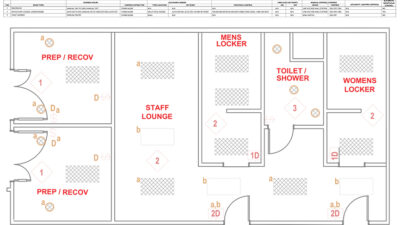
Power over Ethernet (PoE) and wireless lighting controls are gaining traction in health care applications and beyond.
Learning objectives
- Understand the principle, impact and limitations of Power over Ethernet (PoE) and wireless technologies like Bluetooth low energy (BLE) and Wi-Fi in lighting controls
- Analyze the energy savings potential and market trends driving adoption of advanced lighting controls.
- Identify regulatory requirements and practical considerations for implementing PoE and wireless lighting controls in new and existing health care and other critical facilities.
Lighting insights
- Rapid advances in building technology are reshaping lighting systems, with PoE, wireless controls and cloud-based platforms offering more efficient, intelligent and adaptable lighting while introducing cost, infrastructure and code-compliance challenges.
- When properly engineered and regulated, lighting solutions using PoE and wireless technologies can deliver significant energy savings, operational flexibility and long-term value, particularly in health care and mission-critical environments.
Due to the rapid modernization of available technology, engineers are often tasked with implementing new techniques and features within existing infrastructure. Engineers are also expected to deliver the latest, most efficient systems to clients to serve their projects and ideas. It is important that solutions are reliable, application-specific and within the ambit of relevant codes and regulations such as NFPA 70: National Electrical Code (NEC).
Technologies such as wireless lighting controls, Power over Ethernet (PoE) and using a cloud network for lighting management stand out in their applications. None of these solutions is perfect, but if implemented at scale, it has the potential to be cost-effective, dependable, compliant and long-lasting.

PoE is long established as a reliable system for several applications in the mechanical, electrical and plumbing industry. Examples of PoE being used in commercial buildings, hotels and public leisure spaces abound, offering many benefits to owners and managers while also maintaining a pleasant aesthetic and practical utility for the public.
For example, PoE enhances safety and adaptability in lighting by transmitting power and data through a single Ethernet cable. This simplifies installation and reduces complexity when compared to traditional line-voltage wiring.
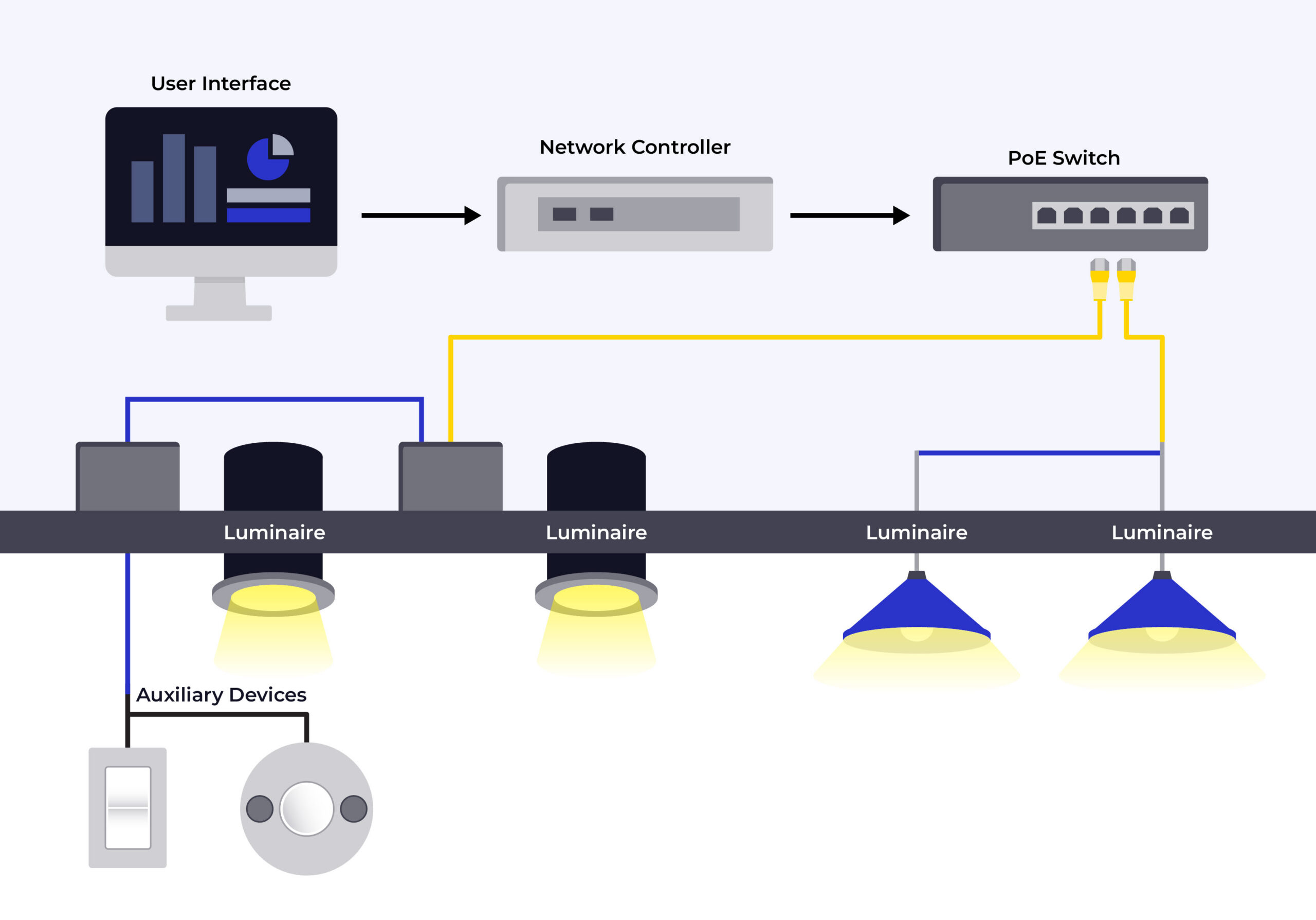
A comparison of traditional versus PoE lighting architectures reveals a fundamental shift in infrastructure. Traditional alternating current (AC) systems use line-voltage AC cables in conduit for power, separate 0 to 10 volt (V) or DALI wires for control and 120 or 277 V panelboards.
In contrast, PoE systems provide both data control and low-voltage direct current (DC) power via a single Cat6 Ethernet connection. They accomplish this by using a PoE network switch as their power source. This change in architecture also has an impact on the system’s intelligence and adaptability. Older systems require physical rewiring to rezone, while PoE systems feature distributed intelligence in each fixture and sensor, allowing for remote rezoning through software.
Further, PoE can automatically use any existing generator and/or information technology (IT) uninterruptible power supply infrastructure, whereas traditional lighting requires specialized AC inverters for power backup.
PoE has made its way into some of the most technology-driven industries like hospitality and commerce. One such example is the Sinclair Hotel in Fort Worth, Texas, which uses PoE to power and control all lighting, window treatments, mini refrigerators and smart bathroom mirrors.
Lighting opportunities in health care settings
Hospitals and health care facilities have yet to realize the practical and safety potential of using PoE-based lighting controls. According to the American Council for an Energy Efficient Economy (ACEEE), while LED retrofits can achieve 30% energy savings, implementing advanced lighting controls can offer an additional 44% energy savings resulting in a payback of less than five years.
Fully integrated smart lighting systems, which involve installing LED luminaires and connecting sensors and controls to a centralized management system with data analytics and adaptive learning capability, could achieve up to 90% energy savings. Smart lighting systems can adjust lights based on a preset schedule or occupancy levels. PoE is considered a more dependable and secure internet of things (IoT) networking choice compared to wireless options, though wireless devices can still be seamlessly connected using protocols such as Wi-Fi, radio-frequency identification or Bluetooth.
The granular data and control capabilities of PoE are the most effective vectors for implementing human-centric lighting (HCL). The color temperature and intensity of light can be changed to accommodate human circadian rhythms with HCL or tunable white lighting.
For example, a PoE system in a hospital can automate a circadian-supportive lighting profile in patient rooms with warm, low light at night to encourage sleep and bright, cool light during the day to encourage alertness.
PoE technology also supports grid decarbonization by enabling seamless integration with renewable energy systems. PoE’s low-voltage DC architecture aligns with solar photovoltaic outputs, eliminating energy losses from AC-DC conversion.
Additionally, PoE lighting controls can help achieve U.S. Green Building Council LEED and Building Research Establishment Environmental Assessment Method certifications through energy and atmosphere: Optimize energy performance, indoor environmental quality and innovation credits.
Finally, one of the major selling points of PoE cabling is that due to its classification as low-voltage network cabling, in many cases installation is not required to be performed by a licensed electrician.
PoE can be acceptable in health care buildings, but its use is highly regulated and must comply with specific provisions of the NEC, particularly Article 517. Article 517.13 outlines strict and mandatory requirements for wiring methods in patient care spaces, including the use of metal raceways or metal-clad cables that qualify as equipment grounding conductors.
PoE systems typically operate within 48 to 57 V DC, which places them under Part VI of Article 517, covering communications, signaling, data systems and systems less than 120 V nominal. Article 517 focuses on minimizing electrical hazards to patients by requiring robust grounding and isolation for circuits that could introduce leakage current.
However, this part is not always enforced in patient care areas and its applicability depends on the location and function of the equipment. Because most PoE-powered devices are considered information technology (IT) or communications equipment, their role in direct patient care is subject to further deliberation. Authorities having jurisdiction (AHJ) still require 48 V systems in conduits regardless of their low-voltage nature to preserve critical circuit continuity. Some vendors note an exception to this, but an AHJ may not allow that.
PoE: A growing trend in lighting control
Due to its advantages, PoE is a growing trend yet building codes have not caught up with allowing its use in certain systems or applications. In building retrofit scenarios, existing infrastructure compatibility poses significant challenges for implementing PoE systems, particularly due to inadequate wiring in many older buildings. Traditional low-voltage wiring must be replaced with Cat5e/Cat6 cabling, a process that entails disruptive renovations and substantial costs.
A study from 2023 highlighted that rewiring a 50,000-square-foot office building for PoE lighting could incur expenses up to $2.50 per square foot, totaling around $125,000, a prohibitive investment for many property owners.
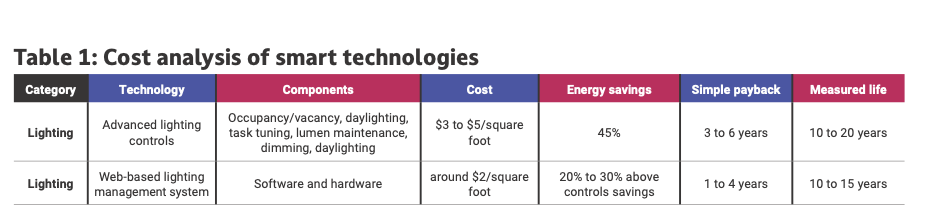
Table 1: Cost analysis of individual smart technologies in design. Figures are a rough estimate and can vary based on location, client preferences and areas of application. Courtesy: Smith Seckman Reid Inc.
Moreover, several experts responding to questions via a PW Consulting market research study expressed that PoE switches, controllers and specialized luminaires are priced 20% to 30% higher than their conventional counterparts, leading developers focused on short-term budgets to opt for less expensive alternatives, potentially overlooking longer-term energy savings.
Compliance with codes from earlier versions of the NEC adds another layer of complexity, as there were no explicit provisions for cables that carry both power and data simultaneously, a core aspect of PoE technology. In the 2023 NEC, patient care vicinity rules are especially strict. Any equipment installed within 6 feet horizontally and 7.5 feet vertically of a patient must meet enhanced grounding and wiring requirements, limiting the installation of PoE devices.
The IEEE 802.3bt (PoE++) standard limits power supply to approximately 90 watts (W) per port (delivering up to 71.3 W to the device after 20% cable losses), which is still sufficient for most modern LED fixtures but requires careful engineering to avoid electrical overload. Further, Ethernet’s 328-foot distance limitation necessitates a robust network of intermediate distribution frames, a standard consideration in modern IT design.
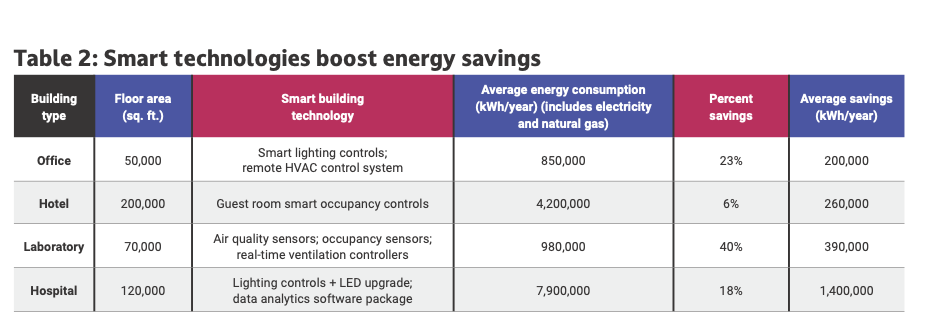
Table 2: Energy savings through smart building technologies integration. Figures are a rough estimate, and real numbers can vary based on scale and areas of application. Courtesy: Smith Seckman Reid Inc.
Lighting retrofit considerations
PoE could be advantageous for newly designed buildings and should also be assessed for feasibility in retrofits. California’s Title 24 energy code recognizes PoE lighting as a compliance pathway, driving sustainability and energy-saving practices into mainstream construction, especially in cities like Los Angeles. These developments result in corporate net-zero commitments, with an increase in the number of LEED Gold-certified buildings.
Utilities like National Grid offer per-watt rebates for PoE installations, accelerating adoption in retrofits. In addition, the goals of organizations like NFPA are intimately aligned with the safety and resilience of PoE systems.
PoE naturally lowers danger by substituting a low-voltage, Class 2 system for the common 120 or 277 V wiring in patient care areas, in accordance with the guidelines of NEC and NFPA 99: Health Care Facilities Code. PoE is the most practical and elegant platform to meet and surpass the more granular controls, daylight harvesting and plug-load management required by energy regulations such as ASHRAE Standard 90.1: Energy Standard for Buildings Except Low-Rise Residential Buildings and the International Energy Conservation Code (IECC).
Demand for hybrid lighting solutions
More awareness of PoE-based lighting controls is needed to pave the way for better implementation of this technology in building systems. Future revisions to the NEC and other related codes are also needed to help clarify the use of PoE lighting for specific applications such as patient care spaces in hospitals. This will help foster broader adoption and make compliance easier for facilities. PoE will not replace the entirety of the AC systems in place but instead will help meet demand for hybrid solutions in mission-critical environments.
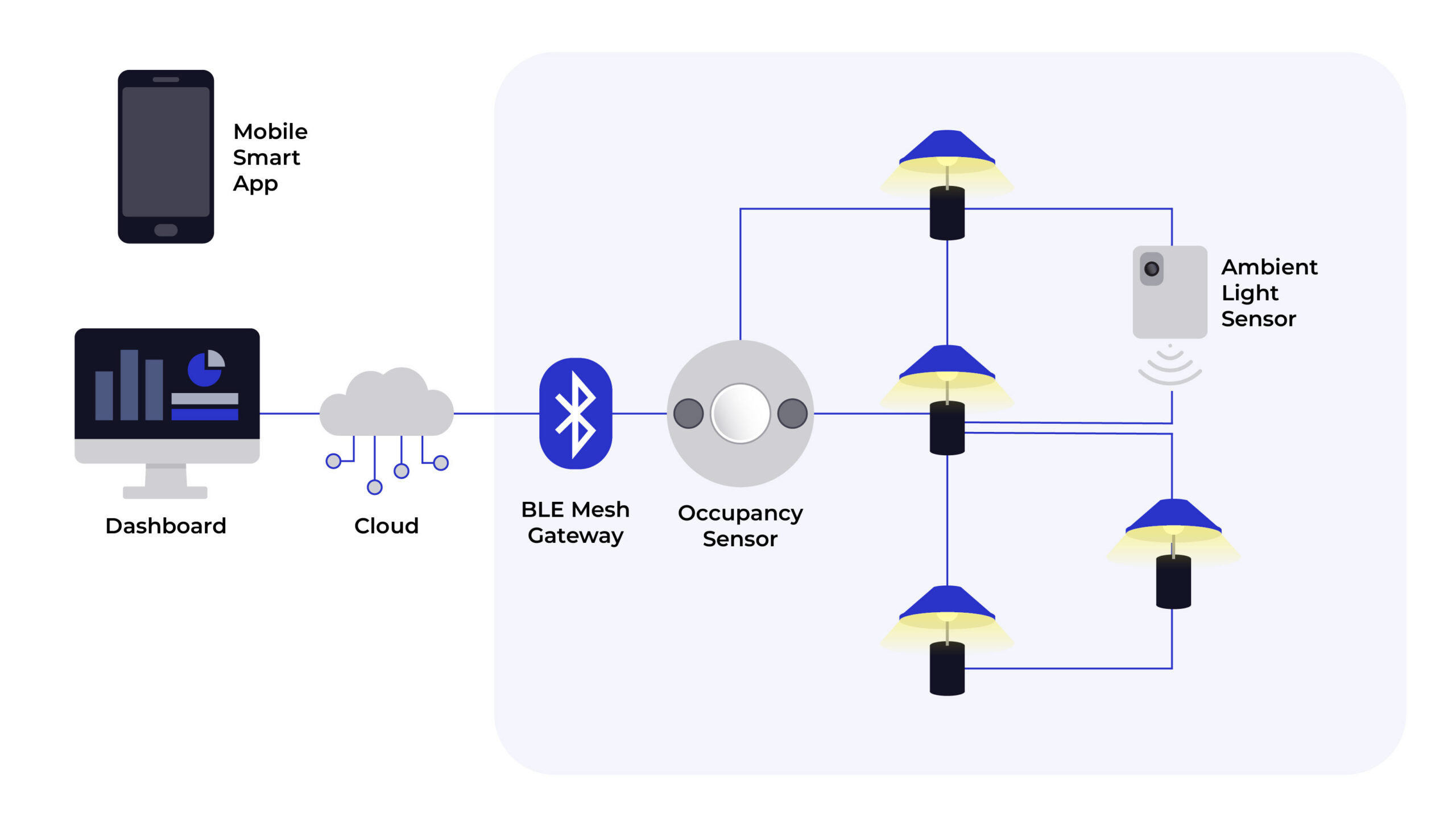
Another big part of this demand for hybrid solutions has been wireless controls. IoT has been an industry buzzword and for good reason. Voice-controlled systems are now common in houses of all shapes and sizes where they do much more than simply report the weather. Smart lighting solutions with wireless sensors and controls can be centrally managed through a web-based lighting management platform. Smart appliances and lighting fixtures compatible with these systems are increasingly in demand.
The question, however, remains whether health care and mission-critical facilities will allow seamless integration of these systems.
Wireless technology options
Wireless lighting controls can be deployed to improve energy efficiency, circadian rhythm alignment and flexibility in space usage. Modern engineers are well-versed with Wi-Fi-compatible fixtures and Zigbee (a wireless communication protocol designed for low-power applications) because these technologies have been publicly trialed in smart lighting for a few years now.
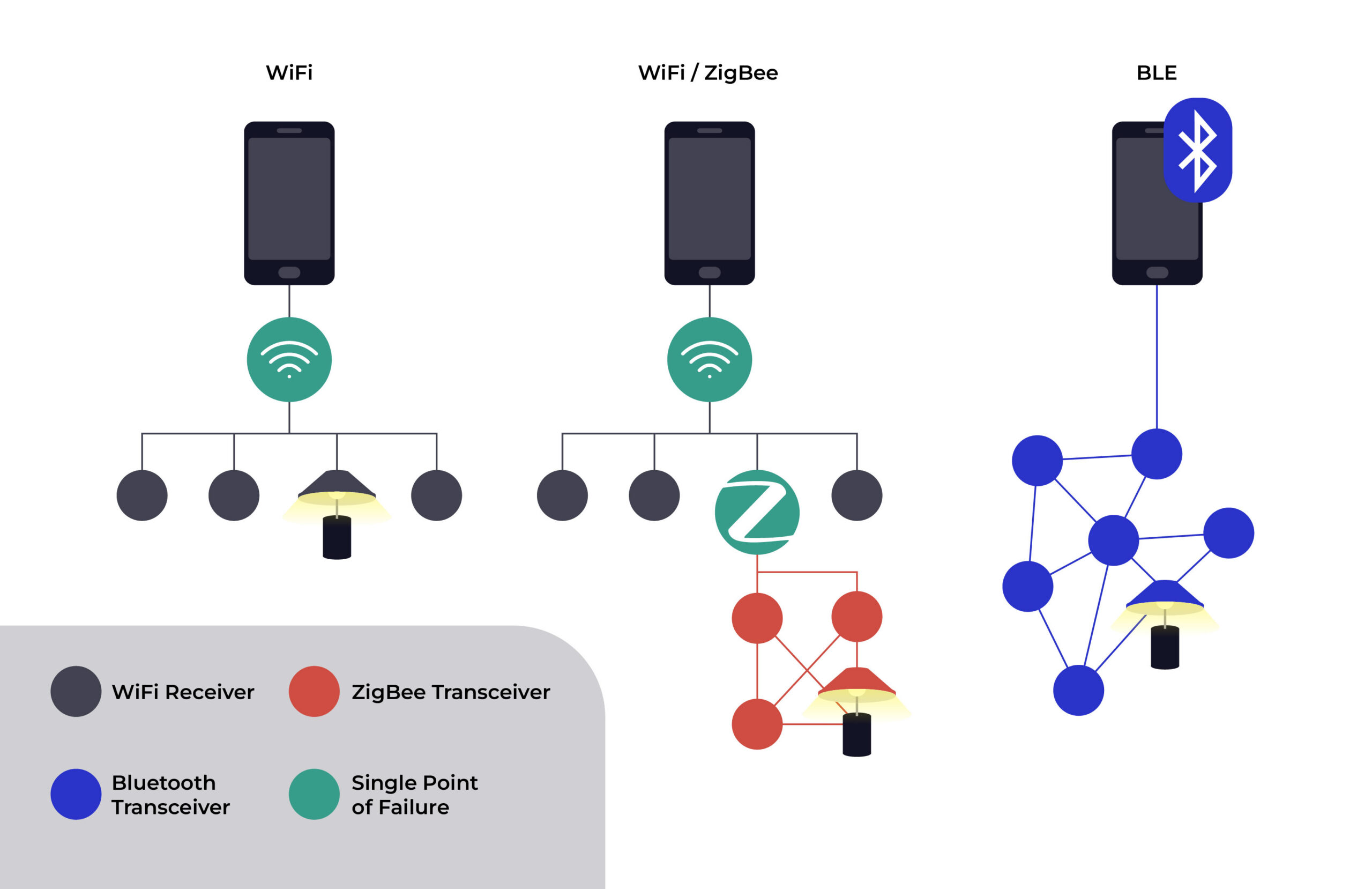
These technologies, however, have several drawbacks that hinder ease of adoption. Most phones and tablets do not have Zigbee, so an extra dongle or gateway would be required to connect a control device to the lights. Having a single gateway to the system not only raises total cost but also carries a risk: If it fails, the user might not have another way in.
Conversely, Wi-Fi is present in most mobile devices but serves merely to link the device to a Wi-Fi router. To communicate with a lighting system after that, one would still need a different kind of connection, like Zigbee. This results in a minimum of one single point of failure.
Bluetooth low energy (BLE)-compatible lighting control systems function through embedding BLE radios into luminaires, drivers, sensors and switches, allowing for wireless communication without the need for separate control cables. These systems use BLE’s low-power protocol to send commands between devices, including on/off, dimming and color customization. BLE is the only low-power radio technology that is present in almost all smartphones and tablets produced in recent years. In sophisticated configurations, Bluetooth mesh is used to establish a many-to-many network in which each node relays messages, ensuring scalability and dependability across enormous buildings.
Experts argue that while BLE is more secure, its application is limited due to its low-range characteristics. While this is true, the alternatives are not much better. Wi-Fi is much faster in terms of data transfer but uses significantly more power. In a large health care facility, that would mean a significant investment in technology and maintenance for a system that is still very susceptible to interference. BLE is less prone to interference and more secure because it uses frequency-hopping spread spectrum modulation, while Wi-Fi and Zigbee primarily use direct-sequence spread spectrum-based techniques and do not employ rapid frequency hopping in the same manner.
Unique BLE Mesh networks can be applied to each room or area, like patient rooms, which solves two problems. First, independent systems are easier to identify and maintain in the event of failure. Second, these systems are constrained by physical areas, eliminating concerns about short-range applications.
Direct device pairing is made possible by Bluetooth controllers, which are well suited to settings that value ease of use and quick response times. This method gives users immediate control over adjacent lighting fixtures while reducing reliance on external networks. In upscale patient rooms, and even in patient corridors and receptions, these systems can add a layer of comfort and customization. A growing trend in this technology has also been its integration with smart, voice-activated devices. This allows for easy voice-controlled lighting in patient spaces, adding yet another layer of ease.
BLE gaining momentum in lighting control
Delivering code-compliant solutions is a top priority for consulting and specifying engineers. Zigbee and BLE are communications protocols, not physical wiring methods or devices. Compliance with NEC, NFPA standards or IECC is determined by the specific listed and labeled electrical equipment that uses these protocols and its adherence to installation requirements.
If a device using Zigbee or BLE is “listed” — certified by a recognized testing lab like UL and IEEE 802 — and installed according to its listing and the relevant NEC articles (e.g., those for low-voltage or specific equipment types), it should be compliant.
Wireless infrastructure requires power and in spaces where access to power outlets is limited, engineers need to make sure owners are open to the idea of periodic maintenance and battery replacements, especially in sterile areas. More importantly, wireless lighting controls deployment must be compatible with large-scale, enterprise-grade network security and relevant IT security regulations.
BLE has gained momentum since 2017, but adoption has been relatively slow in health care design. According to a 2025 article by Future Market Insights Inc., the BLE industry is predicted to develop rapidly, reaching $39.1 billion in 2035. The industry is predicted to increase at a compound annual growth rate of 12.5% between 2025 and 2035.
For hospitals, this technology has the potential to reduce costs and enhance efficiency. Eliminating the need for wires, conduits and connectors significantly reduces costs in large-scale projects like hospitals, sports arenas, research facilities and even hotel ballrooms. General lighting remodeling or updates can cost anywhere between $3 to $5 per square foot, with wireless components driving most of the savings.
BLE Mesh networks are rarely inaccessible, and most controls manufacturers have in-house smart applications that do not require any subscription or licensing fee to work with compatible luminaires. Although the initial expense of the network equipment, gateways and nodes must be considered, there are significant operating savings.