Designing fire protection systems for battery storage is complex, and engineers should understand various approaches.
Learning objectives
- Understand how the 2024 IFC and NFPA 855 establish requirements for lithium-ion and lithium-metal battery storage in warehouse settings.
- Learn how factors such as state of charge, storage configuration and separation distances affect battery fire protection and code compliance.
- Know when hazard analysis, fire detection, sprinkler design and coordination with the authority having jurisdiction are needed for battery storage projects.
Battery storage insights
- Battery storage in warehouses now requires a hazard-specific approach under the 2024 IFC and related NFPA standards, with requirements tied to factors such as state of charge, separation distance, fire detection and sprinkler design.
- Battery protection strategies can no longer rely only on traditional commodity classifications, because large-scale lithium-ion storage presents distinct fire, off-gassing and deflagration risks that demand early coordination with the authority having jurisdiction and a qualified fire protection engineer.
The increasing use of lithium-ion battery-powered products has created new fire protection and code challenges across multiple sectors, from manufacturing and transportation to storage and end use. Within warehouses, those challenges become particularly important, as large-quantity storage introduces hazards that traditional commodity/occupancy-based design approaches do not fully address.
Code requirements for battery storage
Historically, model fire codes addressed batteries primarily in the context of lead-acid systems installed in energy storage systems applications. Until the 2024 code cycle, the International Fire Code (IFC) did not contain storage-specific requirements for lithium-ion/lithium-metal batteries. In the high-piled combustible storage chapter, lithium-ion batteries were recognized as a “high-hazard” commodity in the 2021 edition, but there was still no dedicated storage requirement framework.
That changed in the 2024 code cycle, when the IFC added Section 320, Lithium-Ion and Lithium Metal Battery Storage. The 2024 International Building Code also identifies the occupancies used for the storage of lithium-ion and lithium-metal batteries within Group S-1 moderate-hazard storage occupancies under Section 311.2.
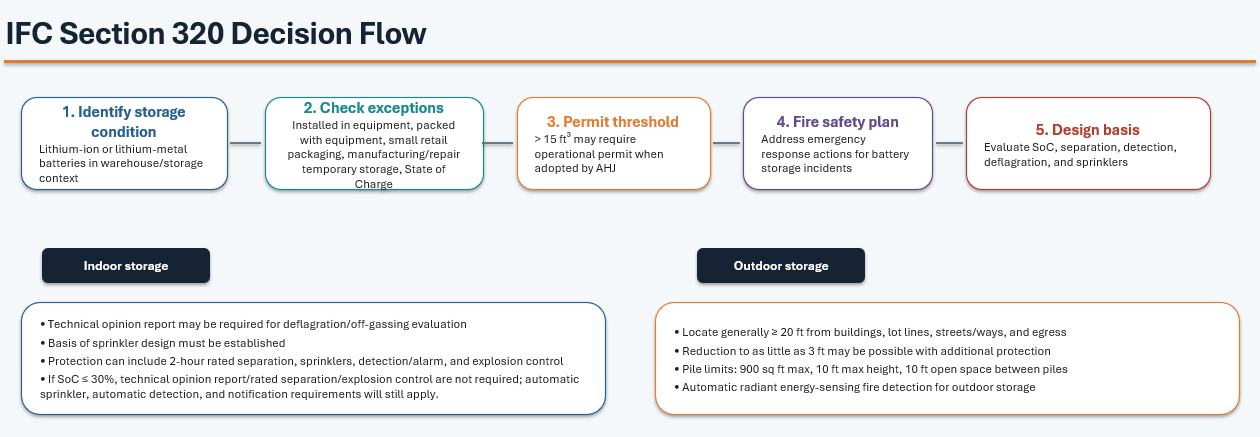
There are several exceptions to the IFC Section 320 requirements. They include:
- New or refurbished batteries installed in equipment, devices or vehicles they are intended to power.
- Batteries packed for use with such equipment.
- Batteries in original retail packaging rated at not more than 300 watt-hours (Wh) for lithium-ion batteries or containing not more than 25 grams of lithium metal for lithium-metal batteries.
- Temporary storage during battery manufacturing before final quality control.
- Temporary storage during vehicle manufacturing or repair .
These thresholds are important because they help distinguish incidental/small retail storage from larger storage that triggers the more specific requirements of IFC Section 320.
Where those exceptions do not apply, the regulatory requirements become much more significant. Under IFC Section 320.2, an operational permit is required when adopted by the authority having jurisdiction (AHJ) for storage exceeding 15 cubic feet (typically the volume of two 55-gallon drums) of lithium-ion or lithium-metal batteries. This operational permit requirement allows the AHJ to review the proposed storage arrangement and determine the protection measures required under the locally adopted code. The code also requires the fire safety plan to address emergency response actions for an incident involving such battery storage.
Indoor battery storage requirements
For indoor storage, the code ties protection requirements not only to the storage arrangement but also to the state of charge (SoC). IFC Section 320.4 may require a technical opinion report to evaluate the potential for deflagration from flammable gases released during a thermal event and to establish the basis of design for the automatic sprinkler system. Additional requirements can include
- Two-hour fire-resistance-rated separation
- Automatic sprinklers
- Automatic detection and alarm systems
- Explosion control
The code also recognizes reduced hazard at lower energy levels. If the SoC is limited to 30% or lower, then the technical opinion report, two-hour fire separation and explosion control are not required. However, the automatic sprinkler system and fire alarm system are still required. For designers, the hazard is no longer evaluated solely by storage quantity or area, but also by hazards posed by the stored material.
Outdoor battery storage requirements
The outdoor storage provisions follow a similar logic to the indoor ones, but they address the hazard through separation distance, pile area and storage height. Under IFC Section 320.4.3, outdoor storage of lithium-ion or lithium-metal batteries is generally required to be at least 20 feet from buildings, lot lines, public streets, public alleys/ways and means of egress. The designer can reduce that distance to as little as 3 feet if they provide additional protective features.
The storage arrangement itself is also limited. The outdoor pile requirements are as follows:
- Limited to 900 square feet
- Must not exceed 10 feet in height
- Must be separated from adjacent piles by at least 10 feet of open space
- Must use automatic fire detection that uses radiant energy-sensing technology for system activation
Coordination with NFPA codes
The IFC framework closely aligns with NFPA 855: Standard for the Installation of Stationary Energy Storage Systems and many of the requirements in Section 320 are informed by NFPA 855 Chapter 14, which addresses the storage of lithium-metal and lithium-ion batteries.
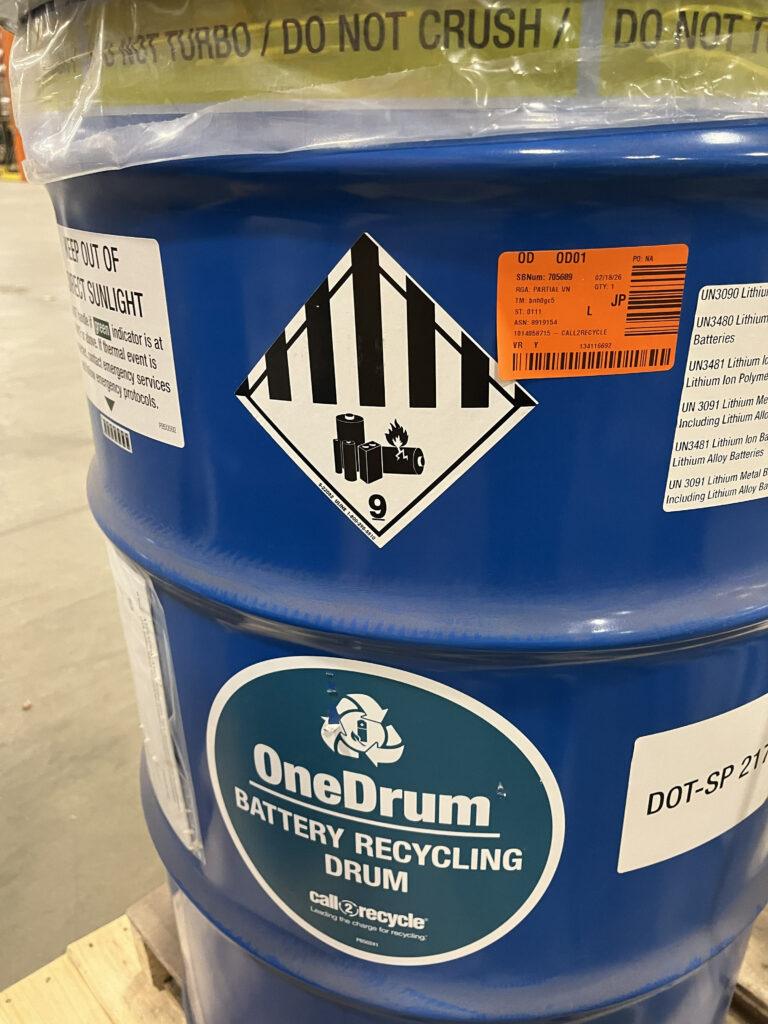
NFPA 855 Chapter 14 requirement, follows a similar approach to separation, detection and hazard evaluation. It also recognizes some collection and storage methods, such as metal drums filled with fire-suppressant material and containers approved for transportation.
As per Section 14.5, a registered design professional with expertise in fire protection engineering must be the one to prepare a written hazard analysis so they can evaluate the possibility of deflagration resulting from the off-gassing of flammable vapors during thermal runaway, like the technical opinion report requirement in IFC.
Fire detection and suppression
For outdoor storage, NFPA 855 also requires automatic fire detection, but only when the aggregate storage area exceeds 400 square feet. The 2023 edition was more specific, naming only air-aspirating or thermal-imaging detection for indoor automatic fire detection. In the 2026 edition, that language was broadened to allow detection systems installed in accordance with NFPA 72: National Fire Alarm and Signaling Code.
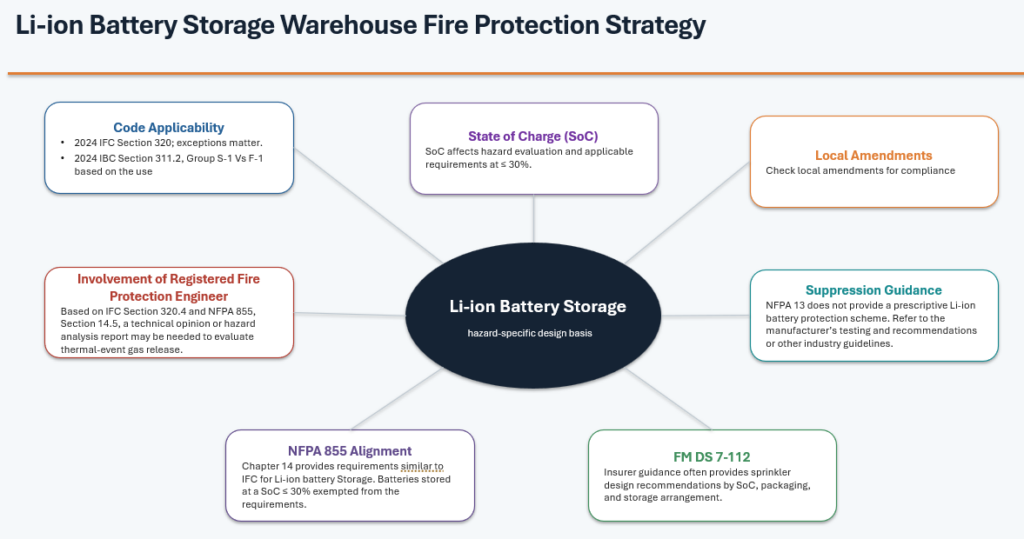
Although both the IFC and NFPA 855 direct users toward NFPA 13: Standard for the Installation of Sprinkler Systems, NFPA 13 still does not provide a prescriptive protection scheme for lithium-ion batteries and other battery chemistries containing combustible electrolyte. That remains one of the more difficult issues for designers.
As a result, current warehouse practice often relies heavily on insurer guidance, especially FM Data Sheet (DS) 7-112, Lithium-Ion Battery Manufacturing and Storage. FM DS 7-112 is particularly useful because it relates sprinkler protection to practical storage conditions, including SoC, packaging and storage arrangement. At the same time, its scope should be understood carefully; it does not include lithium-metal batteries, nor does it apply to manufacturing and storage occupancies that repurpose or provide a second use for lithium-ion cells.
For new and refurbished battery/cell/module storage within its scope, the protection approach changes depending on whether the SoC is above or below 60%. The protection scheme depends on the packaging materials used and whether they have internal or external plastic or the use of expanded plastic, because these can materially affect fire severity.
However, lithium-ion batteries may be stored up to 15 feet high beneath a 45 feet maximum ceiling in solid-pile or palletized arrangements without in-rack sprinklers, provided pile depth does not exceed 15 feet and aisles are at least 10 feet wide and protected in accordance with FM DS 8-9 – Storage of Class 1, 2, 3, 4 and Plastic Commodities, using quick response sprinklers.
Above those limits or SoC above 60%, the storage will need to be stored on racks with in-rack sprinklers and horizontal barriers at every 12-foot interval.
Taking a hazard-specific approach to batteries
For warehouse design, lithium-ion battery storage can no longer be treated as routine commodity storage. Occupancy classification, code exceptions, permit thresholds, separation distances, hazard analysis and the sprinkler basis of design all need to be addressed early and deliberately with the involvement of an experienced fire protection engineer.
Lithium-ion battery storage code requirements are moving away from broad commodity assumptions and toward a more hazard-specific approach based on SoC, separation, off-gassing, deflagration potential and sprinkler performance. With NFPA 800: Battery Safety Code also under development as a provisional standard, that trend will likely continue.
Many AHJs also adopt local amendments that can change how these requirements apply in practice. In addition, lithium-ion battery storage is not always straightforward, as some manufacturers use specialized packaging, thermal barriers or suppressant materials that may affect the hazard differently than the code or published guidance originally intended.