In this roundtable, engineers discuss current trends for office buildings and where the industry is headed in the future.
Learning objectives
- Identify how energy efficiency goals and considerations are impacting the design of new and existing office buildings.
- Understand how to design for hybrid work schedules and key amenities desired by employers and the workforce.
- Learn how changes in commercial real estate are affecting office building design.
Office building insights
- Office building design is shifting toward decarbonized, flexible and health-focused systems.
- Electrification, advanced filtration, air quality monitoring and adaptive ventilation are reshaping offices to meet energy codes, carbon regulations and post-pandemic expectations for occupant health and comfort.
Respondents:
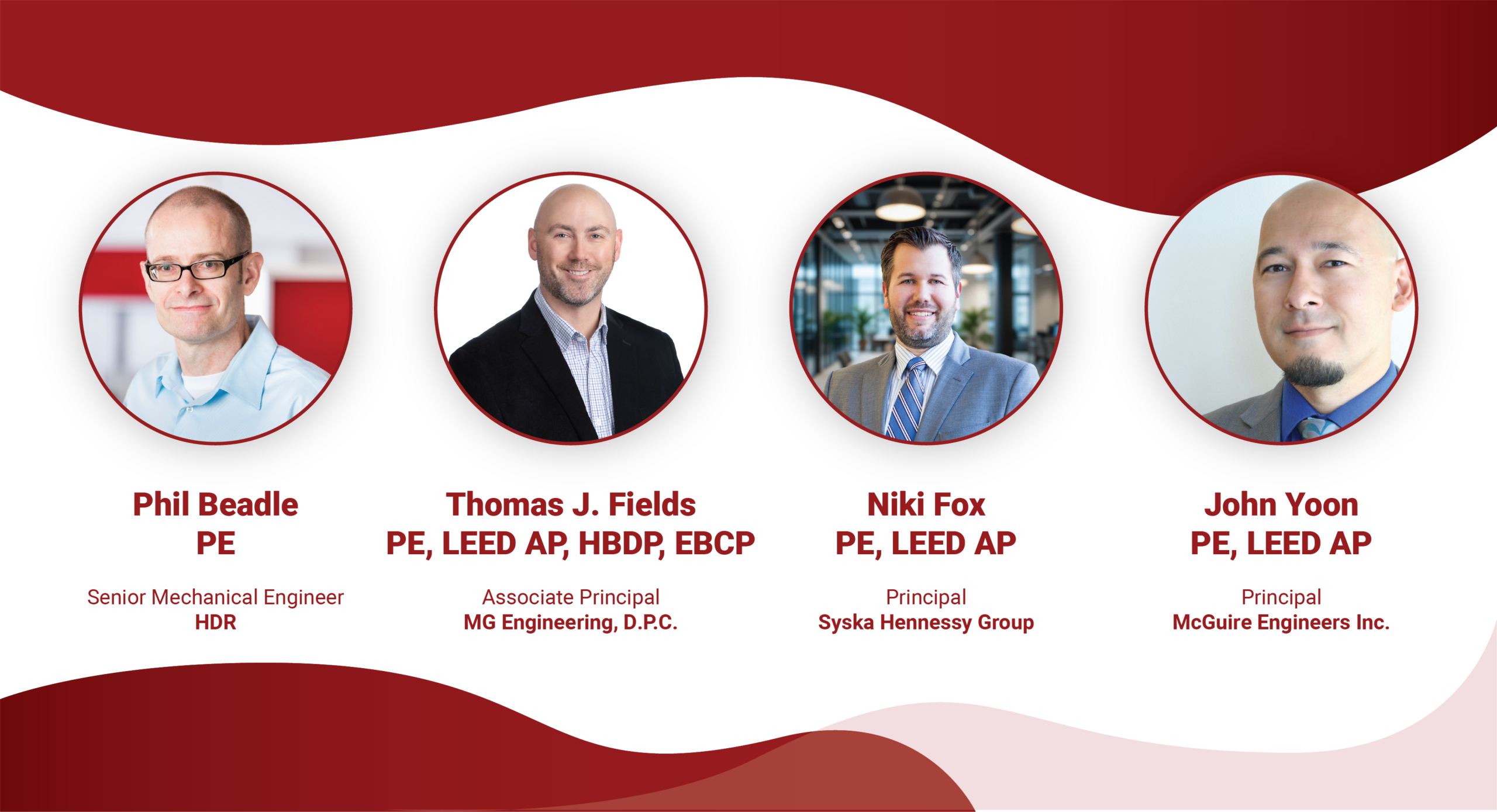
- Phil Beadle, PE, Senior Mechanical Engineer, HDR, Phoenix
- Thomas J. Fields, PE, LEED AP, HBDP, EBCP, Associate Principal, MG Engineering, D.P.C., New York
- Niki Fox, PE, LEED AP, Principal, Syska Hennessy Group, New York
- John Yoon, PE, LEED AP, Principal, McGuire Engineers Inc., Chicago
What are the biggest current trends for office building design?
Phil Beadle: A key trend in office building design is the holistic integration of ventilation air with energy reduction goals. This involves rethinking system configurations to bring heat rejection equipment closer to the air-conditioned spaces — using technologies such as chilled beams, variable refrigerant flow (VRF), cooling air terminal and radiant units. These are paired with dedicated outdoor air systems (DOAS), which deliver dehumidified ventilation air directly to the occupied spaces. This approach serves to decouple latent and sensible cooling loads, with latent cooling exclusively concentrated at the DOAS to control dewpoint and humidity.
However, there is an annual energy trade-off in moving away from traditional central air handling unit (AHU) and overhead ducted variable air volume (VAV) systems, due to the loss of shoulder-season airside economization when using a DOAS with limited airflow only for ventilation and not cooling/heating.
To mitigate condensation risks in decoupled sensible-only cooling systems, it is important that the DOAS maintains the internal dewpoint below the chilled water temperature within this equipment’s cooling coils whenever the heating, ventilation and air conditioning (HVAC) system is in operation. This includes enabling the DOAS and controlling the dewpoint prior to enabling the sensible-only cooling equipment for morning cool down if there are any off hours.
Depending on how slow the building dewpoint is reduced to setpoint after any unoccupied building setbacks and how long the dewpoint takes to recover, continuous 24/7 DOAS operation may be preferred. This allows the building to stay under dewpoint control and provides pressurization that mitigates moisture migration into the building.
Thomas Fields: Decarbonization and the electrification of buildings is the most important trend in the industry. Coming out of the COVID pandemic, building occupancy continues to increase. With higher occupancy comes higher energy use. This increased use is happening against new laws and codes such as New York City’s LL97, which are mandating reduced carbon footprints. Designs must cater to the higher tenant experience while meeting the requirements of these new standards.
Niki Fox: Electrification and decarbonization.
John Yoon: We’re seeing a resumption of the “amenities race” in Class A commercial real estate (CRE). These amenities take on multiple forms such as imaginative in-building dining options, expanded group fitness facilities, multi-use areas geared towards social interaction, decor with a softer residential feel and more. Prior to the pandemic, these types of amenities were used by employers to attract and retain millennial and Generation Z talent. However, now they are being used to help motivate people to return to the office.
While these value-added construction activities would seem to be a net positive for the market in general, there is a darker side for engineers. Lending interest rates remain higher compared to prepandemic levels. Constructing those desirable amenities still requires money, but the amenities themselves generate minimal revenue for the building owners. To make matters worse, rent rates are flat or trending lower with many building owners giving prospective tenants significant rent concessions that further reduce operating income.
These and other factors impact building owners’ access to capital to fund improvements. The end effect is that there is pressure to reduce costs for the other things that the tenants cannot see/touch/feel, like the underlying mechanical, electrical, plumbing and fire protection systems that we design and specify. This means making some hard choices regarding quality and functionality of those systems. Often, it’s hard to make the case for anything other than minimum code-compliant solutions.
What future trends do you anticipate in the coming years for these kinds of buildings?
Phil Beadle: The COVID-19 pandemic and the guidance from the ASHRAE Epidemic Task Force highlighted the need for more adaptive ventilation strategies in office buildings. Standardized outdoor ventilation airflow with the potential for periodic increased airflows in response to airborne infectious agents would require a flexible design factor for years to come. In terms of airflow and aerosol exposure, the way air conditioning is applied at the occupied spaces is evolving. Systems like displacement ventilation, either with underfloor air distribution or side wall diffusers, are gaining traction to increase ventilation effectiveness and mitigate air mixing.
Taking ventilation and cooling airflow one step further, there is potential to integrate air conditioning with modular furniture systems. This would allow for personalized thermal comfort control by delivering conditioned air to critical zones — such as individual workstations, video displays and computing devices — while maintaining background cooling for the unoccupied environment to meet the demands of envelope, lighting and miscellaneous heat loads.
This type of change in ventilation and cooling airflow represents a significant departure from conventional overhead mixed-air systems and will require a dynamic shift in architectural design. As many office-type buildings can be developer-led, this will also impact how buildings are planned, executed and operated — demanding closer collaboration between architects, engineers and facility managers to align the design intent with occupant health, comfort and energy performance.
Thomas Fields: The integration of artificial intelligence (AI) for measuring, verifying and operating buildings will be a game changer, with systems learning how to optimize building performance. This will allow building operators to pinpoint inefficiencies and address them quickly.
Niki Fox: Increase in sensor technology for data and controlling of systems from heating, ventilation and air conditioning (HVAC) to lighting.
John Yoon: Scarcity drives market value. Unfortunately, there is an overabundance of vacant Class B and C office space in many major markets. While Class A CRE is rebounding with a “flight to quality,” the market for lower quality multi-tenant Class B and C properties will remain depressed. The expectation is that this situation will only get worse as prepandemic 5- and 10-year office tenant leases continue to expire and are not renewed in those buildings. As half-full Class B and C buildings become unable to meet their debt obligations, more of those buildings will slip into receivership. This will have a net effect of driving overall property values further downward.
With this emerging financial reality, it will no longer be possible to cost-effectively reposition many of these distressed office properties. The obvious trend will be toward adaptive reuse of those properties for other uses like multifamily residential and data centers. However, those conversion projects have their own challenges, both from a design and financial standpoint. Often, the success of adaptive reuse project hinges on the availability of financial incentives from the local municipalities. Those incentives are commonly bundled with requirements related to energy efficiency, sustainability and other things that influence our designs.
While hybrid work is still considered a norm, many companies are issuing return-to-office mandates. How are shifting workforces impacting design?
Phil Beadle: Where office spaces continue to maintain prepandemic workstation layouts, a noticeable shift has occurred: Occupancy levels often fall short of original design conditions due to the model of hybrid and remote work models. This results in underutilized spaces — fewer people, devices and heat-generating equipment. However, the air conditioning zones are typically still conditioning the entire office floor plate as if fully occupied.
This presents the opportunity to rethink zone sizing. Reducing the area per HVAC zone can allow for smaller zones having better prospects for occupancy temperature set point resets along with increased lighting zones control — improving both energy efficiency and occupant comfort.
With occupancy levels fluctuating widely throughout the day or week, HVAC systems must be capable of greater turndown in capacity. Equipment must be flexible enough to handle low-load conditions without compromising performance or indoor air quality (IAQ).
Additionally, some companies are downsizing their office footprint due to less staff occupying the space simultaneously — reducing lease costs and implementing hoteling or hot-desking strategies.
Thomas Fields: The trend for shared spaces and smaller overall office space has begun, but additional space for amenities and services is appearing.
Niki Fox: They’re increasing virtual coordination with all outside consultants. Internally it is a mix of virtual and in-person design coordination.
John Yoon: Because of work from home or hybrid work policies, tenants don’t need the same amount of space and/or don’t find their current spaces conducive to retaining talent. As such, we’re seeing much smaller, densely designed tenant spaces. However, with hybrid work schedules, those office spaces are often semioccupied or unoccupied for several days during the work week. That variability in occupancy makes the controllability of the systems that we specify incredibly important in keeping operational costs for a building in check. Volatile energy costs only make this worse.
What types of office building assessment programs are owners adding to ensure tenants are breathing healthy, clean air?
Phil Beadle: A growing trend in office building design is the increased interest in and adoption of continuous monitoring — and potentially active control — of indoor environmental quality. While carbon dioxide monitoring has been the standard in high-occupancy spaces such as conference rooms, the scope is now expanding to include additional air monitoring metrics such as airborne particle matter, particle count, volatile organic compounds and ozone.
To mitigate airborne contaminants, several strategies are emerging:
- Targeted ventilation increases: temporarily increasing the outdoor ventilation airflow, presuming that the HVAC supply air is cleaner than the zone air with increased filtration (carbon and HEPA). This is easiest to implement with DOAS design ducted directly to zones with poor air quality.
- Ultraviolet A (UVA) disinfection: UVA light can be safely used within occupied spaces to deactivate pathogens, offering continuous disinfection with appropriate dwell time.
- Emerging technologies: Innovations such as bipolar ionization, UV catalyst systems and titanium-based purification methods are gaining attention for their potential to neutralize airborne contaminants.
During the pandemic, many of these strategies were explored for retrofit into existing systems. However, it was often found that legacy HVAC equipment could not accommodate increased ventilation or filtration without significant upgrades.
Thomas Fields: International WELL Building Institute and LEED certifications are used to push healthy spaces. Since COVID, technologies such as bipolar ionization and higher filter efficiency ratings have become commonplace in office spaces.
Niki Fox: Increased levels of filtration, with MERV-13 being the new baseline.
John Yoon: With the pandemic slowly fading in the general public’s memory and corporate environmental, social and governance initiatives losing momentum in the current political environment, the demand for standalone IAQ assessments has dropped off. However, this isn’t to say that they aren’t still important. IAQ assessments such as ASHRAE Standard 62.1: Ventilation for Acceptable Indoor Air Quality studies frequently go hand-in-hand with other programs like Energy Star. It should be remembered that assessments like ASHRAE 62.1 were included in Energy Star to ensure that owners weren’t compromising building occupants’ health and safety by taking shortcuts on the way to energy efficiency.
How are engineers designing office facilities to keep costs down while offering appealing features, complying with relevant codes and meeting client needs?
Phil Beadle: Engineers are beginning to consider and evaluate the potential of “low pressure” airflow systems in the form of ductless VRF systems with DOAS, hydronic four-pipe chilled beams with or without local DOAS airflow control or variable air flow diffuser systems applied to traditional recirculation AHU.
The application of DOAS with local air conditioning equipment allows reduced ceiling plenum heights, which directly impacts the cost of the building’s envelope along with the structure. For the variable air flow diffusers and if the DOAS supply air is low pressure with no or limited terminal unit control, the cost of controls could also be reduced.
Thomas Fields: While systems and technologies change, the tried-and-true integrated design approaches with diligence and proper coordination are the keys to cost-effective projects. Engineers must educate other project stakeholders on the necessity of preventive maintenance, equipment access and control strategies that ensure longer efficient system life cycles.
Niki Fox: For energy optimization, leveraging AI and machine learning.
John Yoon: With time and budget constraints, the temptation is to generate quick prescriptive designs. The first step toward accomplishing those goals is knowing what your clients’ needs are. Many clients aren’t particularly savvy when it comes to understanding the mechanical, electrical and plumbing systems that we design. While clients may not understand the underlying technical principles, simply explaining the relative pros and cons of each design option can be incredibly helpful in allowing them to make an informed decision.
What should engineers target when designing office buildings with a focus on long-term adaptability and resiliency for future technological and societal changes?
Phil Beadle: The future of office work continues to evolve, balancing return-to-office initiatives allied with flexible work-from-home models. While no one can predict the exact trajectory, one aspect is clear: Flexibility and modularity in system design will be essential. HVAC systems that allow for cooling capacity that can be more easily adjusted and physically moved will be better equipped to respond to changes in heat load demands driven by occupancy changes.
The ongoing technological adjustments between localized servers and increased edge or cloud computing raises questions about future cooling demands. Will an increase in computational demands for facilities also increase local loads for data cooling in facilities? Or will cooling loads decrease as computation and storage moves to centralized data centers? The answer may vary depending on the building owner’s operational strategy and information technology infrastructure.
Meanwhile, many office buildings still apply legacy ASHRAE standards that potentially may no longer reflect real-world conditions. Offices use laptops instead of towers, energy-efficient displays and distributed printing is no longer used. These changes suggest that real-life assessments of envelopes, occupant density, lighting and equipment loads should inform design decisions in lieu of standards.
The perception may suggest this shift is reducing flexibility, but the potential is that more accurate and responsive system design can be implemented.
Thomas Fields: Flexibility and modularity are important concepts to remember. It is difficult to predict all future trends, so the ability to modify portions of building infrastructure without a full overhaul allows for resiliency.
Niki Fox: I recommend creating separate operational technology networks for all the controls and automation systems, allowing for ease of integration of new system components.
John Yoon: Energy markets are increasingly in flux due to increased demand by new data centers/industrials, decarbonization efforts and lack of transmission/generation to accommodate that growth. This has the net effect of decreasing utility reliability and increasing operational costs for building owners. Simply increasing energy efficiency may not be enough.
To address this, many states are changing utility regulatory requirements to include funding for virtual power plants (VPP) and distributed energy resources. The basic concept behind VPPs is that while new grid-scale electrical generation and transmission infrastructure is difficult to construct in a reasonably short timeframe, smaller scale energy resources deployed by building owners can help fill the void if aggregated in sufficient quantities and effectively coordinated with grid needs.
These resources could be behind-the-meter battery storage, curtailment services, photovoltaic generation and others. VPP incentives may eventually reduce energy costs and enhance resiliency for building owners and as such should be taken into consideration when designing new buildings.
What types of products or systems are you importing from the design of other building types, such as outside air, combined heat and power (CHP) or other technologies?
Phil Beadle: At Orange County Sanitation District’s headquarters (HQ) building, a unique opportunity emerged to enhance sustainability by leveraging waste heat from the adjacent Water Treatment Plant 1. The plant uses digester gas to run three engine generators, which produce electricity to offset electrical power from the grid.
Based on the proximity of the HQ building to the Central Power Generation System, the concept of using any excess energy was investigated and the heating energy produced by the engine oil coolers was not being reclaimed. This heat source was not previously considered for use in Plant 1 as the maximum temperature is 130°F. However, this temperature aligned with the HQ building heating water design with reduced building heating loads and operation at 120°F. This made it feasible to use the waste heat to meet the heating demand for the entire HQ building.
To implement this, piping to the engines’ oil coolers waste heat exchangers was tapped and pumped through new heat exchangers, which provide isolation between the “plant” water and building heating hot water system. The heated water was then distributed through existing underground piping tunnels and run across a new bridge crossing Ellis Avenue and connecting to the HQ building.
An original design solution — later removed during value engineering — also proposed using this waste heat hot water to preheat the domestic hot water and provide a reduced hot water load to then only lift to 140°F acceptable storage conditions.
Thomas Fields: Systems that were originally in medical facilities have migrated to office buildings. This includes UV light systems, bipolar ionization and increased filtration efficiencies.
Niki Fox: Convergence and integration of mechanical and electrical systems into one overall platform to operate more efficiently.
John Yoon: CHP systems are rare due to their inherently high operational costs and lack of scalability. There must be a very specific use case to support it. While the concept of using whatever fuel is most economical and/or environmentally sound at any given time seems attractive, in practice it often doesn’t end up being viable. For example, a client that had an established CHP plant with a district steam and chilled water system to support multiple large buildings chose to remove their gas turbines and install more conventional equipment when it was time for replacement. While thermal storage to take advantage of lower overnight electrical costs and provide resiliency still made sense, generating electricity was a losing proposition.