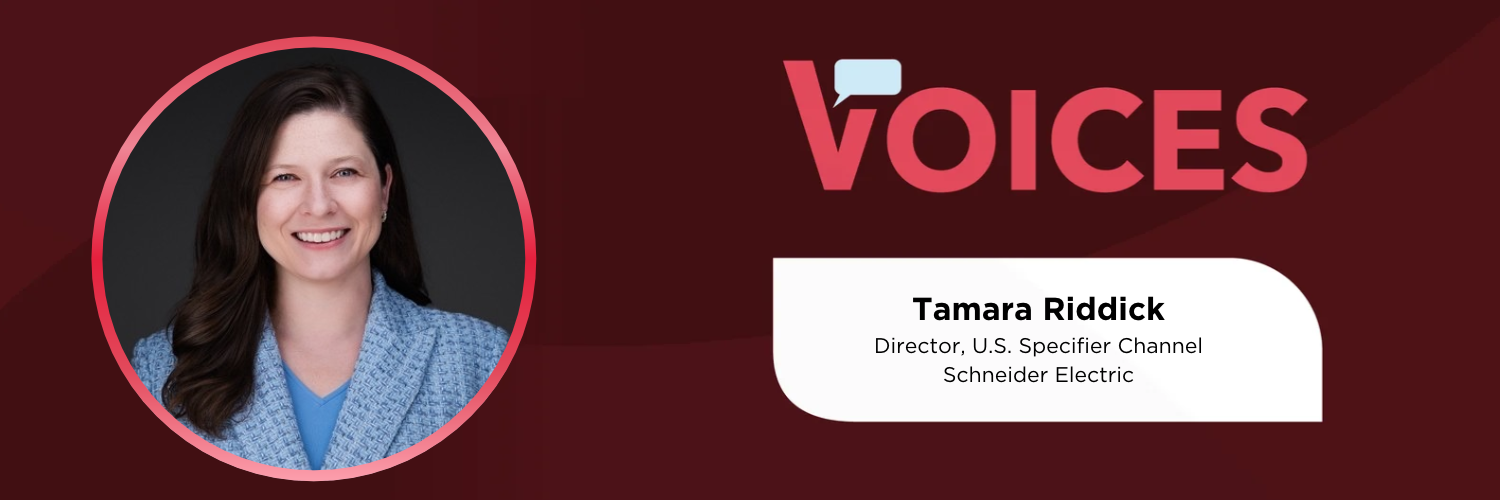
Sponsored by Schneider Electric. In this Voices interview, Consulting Specifying Engineer spoke to Tamara Riddick, Director, U.S. Specifier Channel at Schneider Electric, to discuss building the next generation of engineering talent through mentorship and education, and how the engineering community benefits from attracting and retaining more women while preparing for rapidly evolving technologies across the industry.
Consulting Specifying Engineer: Please start off by introducing yourself and your role at Schneider Electric?
Tamara Riddick: I’m Tamara Riddick, Director of the U.S. Specifier Channel for Power Distribution Sales at Schneider Electric. I lead a team of 48 people working with design firms and engineers across the country. Our role is really to be a resource to the engineering community, helping them navigate design challenges and connecting them with the expertise, solutions, and support they need throughout the design process.
How can the engineering community attract, develop and retain more women?
I think it starts with a few things. Number one is making sure that companies are investing in engineering programs early on, with school-age children. Having programs within schools helps make sure that women understand that if they’re exceptionally good at certain things within the STEM realm, engineering could be a great path. For me specifically, power system engineering is a fantastic path, and these women could one day be within our organization.
The next step is creating opportunities for them to experience engineering firsthand, particularly through internships and partnerships with colleges and universities. We had an intern who worked with us over the past couple of years in an engineering capacity. Through that experience, she was able to see our engineering community, our culture, and the different career paths available at Schneider Electric. Next year, she’ll be joining us full time as a digital consulting application engineer (CAE). She found a team and a purpose that really resonated with her, and now that’s her dream role. To me, that’s a great example of what can happen when we create exposure and opportunity early.
From there, I think what’s critical is retaining these women. We need to attract the talent, cultivate the talent and then keep them. That means making sure we’re leading with empathy, providing opportunities and making sure they know the path to grow, to lead and to have a long-term career. I think we do that exceptionally well. I’ve been at Schneider Electric for 15 years because I found the right mentors, sponsors and leaders to advocate for me and show me a path to get where I am today.
And finally, representation matters. Women need to see other women succeeding and leading across the engineering community because it helps make those possibilities real. That’s another area where I think Schneider Electric has done a great job, and I’m looking forward to seeing what other companies and leaders are doing well and what we can learn from one another through this program.
What role do mentorship and sponsorship play across organizations and the engineering industry, and how does Schneider Electric help foster those relationships to support career growth and leadership development?
Mentorship and sponsorship are both important, and they are different. I have a few mentors that I call and ask, “Can you provide guidance and support on the best way to navigate this?” Those people are vital.
And then there is sponsorship. These are the people who are in rooms that you are not in, who are able to talk highly about you based on what they know about you, what you want to do in your career and what your strengths are. They can speak to those strengths and help cultivate a career path for you, bringing you opportunities you may otherwise not be aware of.
One thing I learned early in my career and have enjoyed applying is something called a personal board of directors. I learned this from a mentor: don’t just have these mentors and sponsors in mind, put it down on paper. Decide that these are your people and communicate this to them. Let them know they’re on your personal board of directors. Make sure they know how important they are to your success and what they have done to help you accomplish something in your career. I’ve done this several times, and it’s very rewarding because they also invest more in you as a result. I think they get a lot from it too. They enjoy hearing that feedback about how they’ve supported you.
At Schneider Electric, we have lots of different development opportunities, including mentor cohorts and sponsorship. We have a buddy system that pairs more tenured talent with early career talent so they can cross-collaborate on different topics. I think they both learn from one another. We also have a leadership development program where people early-in-career from universities come into Schneider Electric and participate in a rotation program so they can learn different parts of our business. I think those are important things to employ in your company.
We also have employee resource networks (ERNs), including Women in Schneider Electric, as well as networks for Black professionals, Asian professionals and veterans. You can find common ground with people within the organization that’ll help facilitate those relationships—find mentors, find sponsorship.
Finding these relationships externally is just as important as internally. One of the important things for our engineers is to be a part of industry associations like IEEE, to build up relationships within the industry overall, learn from one another and continue to facilitate that exposure and experience.
All of these experiences have influenced how I lead today, and how I encourage my organization to lead their teams. I’m intentional about sponsoring others and cultivating the mentors and sponsors who can help shape my next chapter.
What emerging technical skills should engineers focus on as technologies evolve?
One of the hottest topics is AI. It’s critical for us to know how to use it, how it’s going to change our industry and how to apply it. But I think the bigger skill is learning how to work effectively in a world where digital technologies are becoming a part of the engineering discipline and evolving every day.
The way we work with AI and some digital technologies is going to be completely different in three to five years. Having an understanding of AI and data analytics is important because they’re changing the way we design, analyze and make decisions. At the same time, you need to know about electrification, automation, energy management and cybersecurity. All of these things are intersecting and converging, but you don’t necessarily need to be an expert in all of them. You need to stay curious and interested, and have enough fluency to speak to them, know what they are and understand how they impact your specific part in the electrical industry.
Technology is moving so quickly that I couldn’t forecast what we need to know in the next five to ten years. But I do know those that stay curious and interested and stay abreast of these evolving technologies are going to be ahead of all of us.
How does your team help support learning and professional development for engineers, and what role do programs such as Innovation Days, mySchneider on-demand learning, Codes & Standards training, and other educational resources play in helping professionals stay current as the industry evolves?
Education is a huge part of our channel, both externally and internally, because we’re not going to be effective externally if our internal community isn’t experienced enough. We continue to partner across Schneider Electric to raise awareness of the educational resources and expertise we can bring to our customers and partners.
One key example this year is our Innovation Day series. We’ve gone to different cities within the United States to host our Innovation Days. It’s a full day of accredited learning (PDH/CEU) for our engineering community to learn about the codes and standards, industry trends and the latest technologies.
They can learn about different technologies and products based on what they might need to upskill on in those local areas. They also get exposure to their peers in the industry and their local Consulting Application Engineer from Schneider Electric.
We also recognize that in-person events don’t always work for everyone. Sometimes it’s difficult to take a day away from work, especially because a lot of our design firm engineers are billable, and that’s quite critical to them. They might need something a little more crafted for them, so we have on-demand PDH learning through our mySchneider portal. You can gain personal development accreditations and interface with our Consulting Application Engineers through that portal. Through myschneider you can also access our design tools and resources. We also have other tools relevant to those in the design stage.
Another important area is codes and standards. As requirements evolve, including changes with the NEC 2026, we’re making sure our consulting application engineers are well versed in these changes and what they mean for their local area. They are a tremendous resource for design firms to better understand what they need to know the changes and their impacts.
Beyond that formal education with Innovation Days and the mySchneider portal, we have 30 field Consulting Application Engineer in local areas who can come into your office and do a lunch and learn and support you from a technical perspective. We also have a digital team providing inside support that responds within 24 hours to whatever you might need. They can answer questions, give you access to tools and resources, and collaborate on new conceptual ideas for how to design your latest project.
For us, it’s about making sure we’re continually advocating to educate those in the industry. With the different ways we’re supporting them, we’re meeting everyone where they are.
What advice would you give the next generation of engineers?
Staying curious and interested in the profession and what’s new is vital, and making sure other people know you’re curious and doing those things is just as important. It’s about building relationships through different organizations that support the electrical and mechanical engineering communities, as well as your internal network, to better support yourself and others, and facilitate a better industry.
One other thing I can tell you from experience: for different roles that you’re pursuing—or maybe roles you don’t even know you’re pursuing yet—don’t wait until you feel completely ready. Put your name out there, experiment and see what might unfold. Some of the opportunities that have stretched me the most, including my current role, were ones where I didn’t have the answer to everything walking in. But I’ve learned the most, grown the most and enjoyed it the most. You learn by stepping into new situations, asking questions, and discovering more about yourself and others by being a little uncomfortable sometimes.
Don’t underestimate the importance of relationships. They help you in your career, but they also help you build technical expertise. I love that our consulting application engineers share with one another so frequently. We have a chat where I see them engage regularly to support each other so that we can better support the industry. Find your mentors, find your sponsors and find the people who are going to support you. Be willing to learn from people who have experiences different from yours. That’s a big part of why we’re doing this program—recognizing people who have different experiences and have been supportive of the industry.
Don’t feel like your career has to follow a specific path. Mine certainly hasn’t taken the form I would have thought 10 years ago, but taking the path that led me here has been so beneficial because of everything I’ve learned. Another thing to lean into, especially as a woman in this profession and as a mom, is understanding there are different seasons in life. Empathize with yourself, be kind to yourself and give yourself permission to navigate different seasons—knowing when it’s time to push, and when it’s time to enjoy the role you’re in and do it well.
You don’t have to have your entire career mapped out. Stay curious and interested in new concepts and ideas. Say yes to opportunities that stretch you. Surround yourself with people internally and externally across the industry. Find your mentors and supporters, lean into them, support them in return, and you’ll be successful.
The Consulting-Specifying Engineer Women Advancing Engineering program recognizes the most talented women in the engineering community supporting the building industry. Nominate a deserving woman or organization by November 6th!