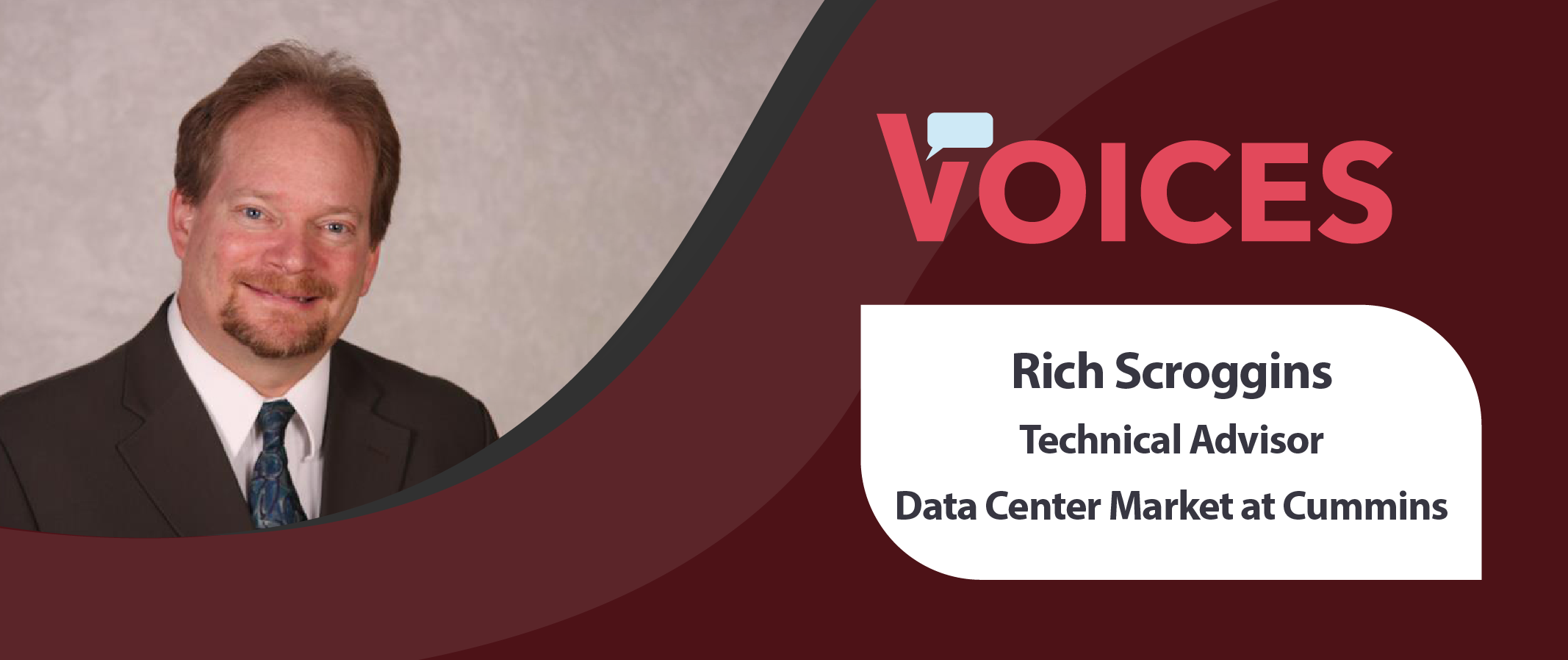
This article is sponsored by Cummins. In this Voices interview, Consulting Specifying Engineer spoke with Rich Scroggins, Technical Advisor on the Data Center Market team at Cummins, to discuss how the explosive growth of AI workloads, combined with grid constraints and carbon reduction mandates, is redefining approaches to power systems.
Consulting Specifying Engineer: AI is reshaping data center design. How is this surge in computer power impacting the way we think about backup and onsite power systems?
Rich Scroggins: The biggest concern is the amount of raw power data centers are requiring. Utilities are getting strained, and some now mandate demand response for large loads. They have a peak power problem, not necessarily an average one, so they need large loads like data centers to disconnect from the grid at times. That’s called a flexible load — something that can come on or off the grid — which helps address those challenges. So utilities are starting to require that data centers use onsite power to remove load.
Another change is rack power density. Typical racks are 30 to 40 kilowatts, but some AI loads are hundreds of kilowatts or close to a megawatt. That changes how power is distributed inside server rooms. You’re putting more power in a smaller space.
We expect to see more medium voltage distribution. It reduces electrical equipment footprint and lowers cost. Lower current means lower cabling cost, which likely means more medium voltage generator sets.
The third change is volatility. Today’s data center loads are steady — thousands of servers fluctuating at different times, averaging out. With AI, server loads are synced. They peak or drop together, which causes problems for the grid and for generator sets that don’t handle fluctuating loads well.
Grid availability has become a major constraint in many regions. Can you walk us through the different use cases you’re seeing and how Cummins tailors power strategies to each?
The first is the flexibility use case, where your data center becomes a flexible load that can go off the grid to support the utility.
Studies show that utilities can take on more load without adding infrastructure if that load is flexible. If you can go offline during peak times — no more than 300 or 400 hours per year and 2 to 4 hours per event — utilities gain what’s called curtailment-enabled headroom. They have more capacity if you help alleviate those peaks with on-site assets.
The second is temporary power. Some data centers deploy before the utility infrastructure is ready; usually it’s the transmission, not the generation. They need on-site power for a few months to two years, running 24/7 for at least part of the facility until distribution is in place.
We call that a bridging power use case. The asset runs continuously, then shifts into the flexibility role when the utility is built out.
From a technological standpoint, what are the technical trade-offs between diesel, natural gas and battery energy storage — especially when considering performance, scalability and emissions across those different use cases?
Diesel is the incumbent in backup power and has worked well for a long time. The challenge is when it’s used beyond emergency power. The EPA defines “emergency” as only when the utility is out. For demand response or flexibility, the generator must be Tier 4 certified.
Tier 4 means about a 90% NOx reduction from Tier 2, which is the standard for standby. That can be done with third-party after-treatment, but certification for non-emergency use must come from the manufacturer. It also has a requirement that the generator shuts down if emissions controls fail. That is known as an inducement and has been a poison pill in data centers, since shutdown creates a single point of failure. So data centers have never wanted to participate in grid support programs
That’s starting to change. Demand response is becoming mandatory. A recent EPA interpretation allows emergency generators to run in non-emergency operation, if mandated by the utility, for up to 50 hours per year without Tier 4 certification. That helps support flexibility.
But challenges remain. Some sites are in nonattainment areas with poor air quality and must stay under annual NOx limits under Title V of the EPA. That’s manageable in small facilities, but large data centers with 80 to 100 megawatts of diesel backup can hit those thresholds quickly.
The second technology getting attention is natural gas. Its NOx emissions are about the same as Tier 4 diesel with after-treatment. For flexibility use cases running hundreds of hours per year, natural gas has lower fuel costs and better operating expense. But for 50 hours a year, diesel has better total cost of ownership.
Challenges with natural gas include pipeline capacity. Large centers are often in rural areas, and pipelines may not support 100 megawatts. Extending them is expensive — over $2 million per mile — and requires permitting.
There’s also transient performance. Natural gas generators don’t start or take load as fast as diesel. UPS can mitigate this problem by supporting server loads with batteries for longer periods, but that affects battery life. Service level agreements between data centers and their customers may also limit how long you can run on batteries.
Cooling loads are another issue. They’re not on UPS, and if they lose power during a utility outage, thermal runaway can happen in about 30 seconds. Fast-start natural gas generators help, but the race condition is real.
The third technology gaining interest is battery energy storage. The challenge is autonomy. Most data centers expect 24 to 48 hours of backup. Battery systems, mostly lithium-ion, top out around four hours before cost limits their feasibility. To use batteries as backup, you’d need to change your operating strategy. They’re not right for every site, but they can complement other assets.
As more data centers consider demand response or grid-interactive operations, what does that mean for generator sizing, control topologies and integration with utility standards?
Most designs today are modular or radial, with each server room backed by its own generator, usually 2.8 to 3.2 megawatts, paired with 5,000-amp low-voltage distribution. That’s been the standard, with non-paralleled generators operating at low voltage.
As we move into demand response and taking the whole site offline or even exporting power to the grid, medium-voltage paralleling brings clear benefits.
One is fuel savings. In modular systems, many generators aren’t fully loaded. Some run near their rated power, others at 30%, but all must operate. In a parallel system, you aggregate load and run only what you need. If your load is 60%, you run only 60% with headroom, and shut off the rest. When you’re running 500 hours instead of 50, that fuel savings adds up.
Some hyperscalers go further, sizing on-site power closer to average load. If the average is 70%, and you maintain 110% of peak for redundancy, you can size smaller and save on CapEx. Colos may not be able to do this due to their Service Level Agreements , but others can.
With natural gas, you don’t get as much power from gas engines as diesel in the same footprint. If you need 3 megawatts, fewer gas options exist than diesel.
But paralleling helps, meaning generator size matters less. If you need 30 megawatts, any mix that adds up to 30 Megawatts works. You can use smaller sets or, in some cases, larger 5-megawatt medium-speed gas sets.
Another benefit, especially with AI and high power density, is space savings. When you push a lot of power into a small footprint, server rooms shrink, but low-voltage distribution doesn’t. You still deal with bulky 5,000-amp systems. Medium-voltage distribution reduces that footprint.
That implies more medium-voltage generators. A medium-voltage paralleling system supports high power density.
Also, servers run on DC power. Rethinking distribution, there’s value in using high-voltage DC: lower losses and a more direct feed to the servers.
We’ll likely see solid-state transformers that take medium-voltage AC and convert it to 800 volts DC. So, it’s not about generator sizing, but the advantages of a medium-voltage paralleling architecture.
How should engineers think about life cycle emissions, fuel flexibility (like HVO or hydrogen blends) and future-proofing backup solutions to support ESG goals?
Sustainability and lifecycle emissions are a major focus in the data center space, and for Cummins. Lifecycle assessments, or LCAs, are becoming a requirement — first from hyperscalers, now from all key suppliers.
Lifecycle emissions go beyond tailpipe emissions. They include all the carbon tied to manufacturing the generator set, even down to how green the steel is. Data centers are asking generator, steel and concrete suppliers to provide these assessments. Cummins supports that, as do others in the industry. Consulting engineers may need to factor this into supplier selection.
Hydrotreated vegetable oil (HVO) is another trend. It’s a drop-in diesel replacement with no engine modifications required. You might see a slight reduction in power, but carbon intensity drops about 70% compared to ultra-low sulfur diesel. It’s also lower in carbon than natural gas and most hydrogen available today, which is typically extracted from natural gas and carries a similar carbon burden.
The challenge with HVO is availability. Hyperscalers and colos often commit to a first fill with HVO but may need to refill with diesel. That’s one of its advantages: it can be mixed. It’s not free; it costs more and is harder to get, but it holds promise as the supply chain matures.
As for future-proofing, instead of focusing only on fuels like hydrogen, which has potential but also challenges, I’d emphasize battery energy storage. It enables renewables. Wind and solar are intermittent, and batteries help bridge that gap.
Even if you don’t have renewables onsite today, deploying batteries now for flexibility or demand response means you’re ready when an offsite wind or solar farm becomes available.
How is Cummins investing in next-generation technologies — whether in fuel cells, microgrids or digital tools — to meet the evolving needs of high-performance, sustainable data centers?
We’re actively investing in battery energy storage systems. We’ve launched our first line BESS products for the 50 Hz market, aimed at commercial and industrial use, from a few nodes up to one megawatt, two megawatt-hours.
We’re expanding into 60 Hz markets and plan to manufacture batteries in the U.S. over the next couple of years. Right now, our modules come from Asia, like most others, but we’ve formed partnerships to build them here, for both power generation and mobility markets.
We’re also investing in hydrogen technologies, including PEM fuel cells and electrolyzers. Electrolyzers use electricity to produce hydrogen on-site.
As for microgrids, we view them as a capability, not a product. A microgrid draws from multiple sources and optimizes their operation, whether to earn demand response revenue, cut carbon, or meet five-nines reliability.
We’re building that capability. In the near term, we provide diesel and natural gas generator sets, batteries, and eventually fuel cells. We may not offer solar or wind, but we focus on the control systems that tie everything together, along with the expertise to implement and support them.
For us, microgrids are a business rather than just a product, and it’s one we’re actively developing.
What’s your advice to consulting engineers, operators and developers working on power infrastructure in this fast-changing landscape? How should they engage with suppliers like Cummins to deliver smarter, faster and greener solutions?
I’d say, look at us as partners, not just equipment providers. We want to be part of the solution. Maybe diesel isn’t right. Maybe it’s natural gas and battery energy storage. Maybe a hydrogen source supports a fuel cell.
Take an “all of the above” approach. Keep an open mind. Engage local authorities. Every air quality board has different rules, so work with someone who knows the contacts and emissions consultants.
Utility operators also vary in their requirements. So again, see them as partners, not just suppliers.
As the grid changes, we’ll need a mix of solutions. Every site is different. You need partners with experience across markets and technologies.
For more information, visit cummins.com.