During conversion from office space to residential units, fire protection engineers have many fire and life safety considerations.

The commercial office building market shifted dramatically during COVID and the trend continues as housing requirements in larger cities take center stage. Cities like Chicago — my hometown — are repurposing vacant central business district offices into residential units, trying to ease the 28% office vacancy rate reported in the city at the end of 2025.
Adaptive reuse is hardly new and building owners clearly prefer to have full occupancy with paying tenants rather than vacant office space. These buildings are often near transit and jobs, making them appealing to tenants while expanding housing options. What could possibly go wrong?
Rezoning, structural issues, energy efficiency, floor plate considerations, housing goals and architectural design all come into play. Chicago, for example, has a rule in which residential projects with more than 10 units require a zoning change that makes 20% of the spaces affordable. The risks for owners and developers are high; conversion to residential is costly and can include a lot of red tape.
Looking at the topic from a fire protection engineer’s perspective can make conversion even more daunting. Office towers are frequently designed around open floor plates, while residential buildings feature compartmentalized layouts, higher privacy requirements, varied occupant behavior and a different relationship with the fire and life safety system. While fire protection engineers understand various hazard classifications, the shift in use from office to residential may necessitate additional expertise in parking structures, mixed-use buildings and compartmentation/passive fire protection.
In Chicago, many buildings in the central business district date to the building boom after the 1871 Great Chicago Fire, and the average age of Class B buildings is more than 50 years. Engineers are working with some interesting challenges.
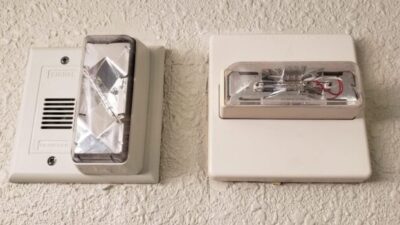
Conversion to residential creates a fundamentally different relationship between occupants and the fire alarm system. These changes directly impact intelligibility, layout-driven notification coverage and system zoning. New partitions, doors, closets and corridor turns reduce speech intelligibility. Even if a voice system was originally installed in the office, it may not provide clear messaging inside new condos unless speakers are redesigned or supplemented. New sleeping rooms within the converted space demand different audible notification contingent on national and local codes and standards.
Ultimately, office-to-residential conversions demand that fire protection engineers treat mass notification systems and emergency communication systems as a redesign challenge, not a reuse problem. Intelligibility degradation, partition-driven device coverage gaps and residential occupant behavior often leave the existing system misaligned with the new risk profile. Targeted upgrades and a documented emergency communication plan are usually necessary.