A focus on fire alarm, smoke control and low-voltage life safety system circuits shows electrical system cables’ pathway survivability requirements.
Learning objectives
- Define pathway survivability and how it applies to different life safety systems.
- Understand how to determine required pathway survivability levels.
- Discover best practices for life safety system survivability.
Survivability insights
- Survivability for life safety system pathways has evolved through successive editions of NFPA 72 and the International Building Code, which now provide detailed criteria for how circuits must be protected so they remain functional during fire conditions.
- These code provisions clarify when survivability is required and outline how designers can match survivability methods to building construction, evacuation strategies and system topology.
- While many types of electrical system cables (e.g., emergency lighting, emergency generators, elevator power, etc.) could have pathway survivability requirements, this article will focus on fire alarm, smoke control and related low-voltage life safety system circuits.
The most common requirement for pathway survivability is for an emergency voice/alarm communications system, also known as a voice fire alarm system, installed in a building that uses partial evacuation or relocation strategies.

However, NFPA 72: National Fire Alarm and Signaling Code also includes pathway survivability requirements for nonvoice fire alarm systems that use partial evacuation or relocation strategies, in-building and wide-area mass notification systems, firefighters’ telephone systems and two-way emergency communications systems for rescue assistance (e.g., area of refuge, stairway, elevator landing and occupant evacuation elevator lobby emergency communications systems). Smoke control systems, often controlled by the fire alarm system, will be discussed as a good example of how building codes can influence survivability installation requirements.
Since its original release in 1993, the NFPA 72, formerly the National Fire Alarm Code, has required pathway survivability in some form for fire alarm circuits and other life safety system circuits. Over those years, requirements have changed and many requirements have been added or modified. In that same time, pathway survivability requirements have been added to model building codes like the International Building Code (IBC). What is pathway survivability as it relates to these codes? And how can a designer, engineer, installer and authority having jurisdiction (AHJ) navigate this complex subject?
Since first being included as a term in 1993, NFPA 72 defines pathway survivability as “the ability of any conductor, optical fiber, radio carrier or other means for transmitting system information to remain operational during fire conditions.” It is the ability of a conductor (i.e., wire) or multiconductor cable to withstand elevated temperatures, as would be experienced during a fire and continue to operate as intended.
In the United States, conductors or cables meant to be survivable without any other protection are listed to UL 2196 Fire Test for Circuit Integrity of Fire-Resistive Power, Instrumentation, Control and Data Cables. This standard evaluates the integrity of cables for their ability to maintain circuit integrity when subjected to a standard time-temperature test exposure of up to 1,800°F for two hours and an associated water hose stream test. Listed cables and cable assemblies are known as “circuit integrity” cables. This article will focus on these hard-wired pathways, although any pathway (e.g., wireless) must meet the same performance requirements.
Navigating the survivability code requirements
As previously noted, NFPA 72 has long required some form of pathway survivability. The initial survivability requirements from 1993 were rewritten in the 1999 edition and specific levels of pathway survivability were added in the 2010 edition. The 2016 edition added important exceptions based on the rated building construction, while the 2022 edition added a new Level 4 pathway survivability option. The 2025 edition of NFPA 72 provides a large amount of information on this subject.
Chapter 12 of NFPA 72 contains the performance criteria of the various levels of pathway survivability. These levels of survivability are not hierarchical, where a higher number level is superior to a lower number level, but rather it is simply a list of levels with different performance criteria. All levels of pathway survivability must be installed in compliance with the applicable sections of NFPA 70: National Electrical Code (NEC) Article 728, Fire-Resistive Cable Systems and Article 760, Fire Alarm Systems (see Table 1).
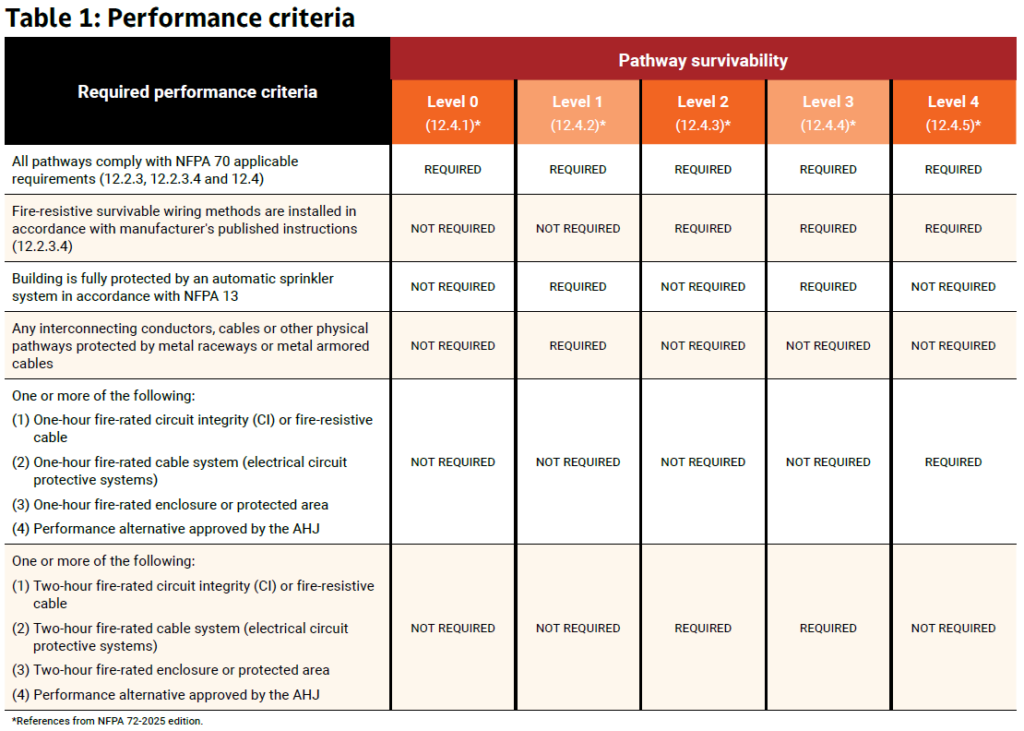
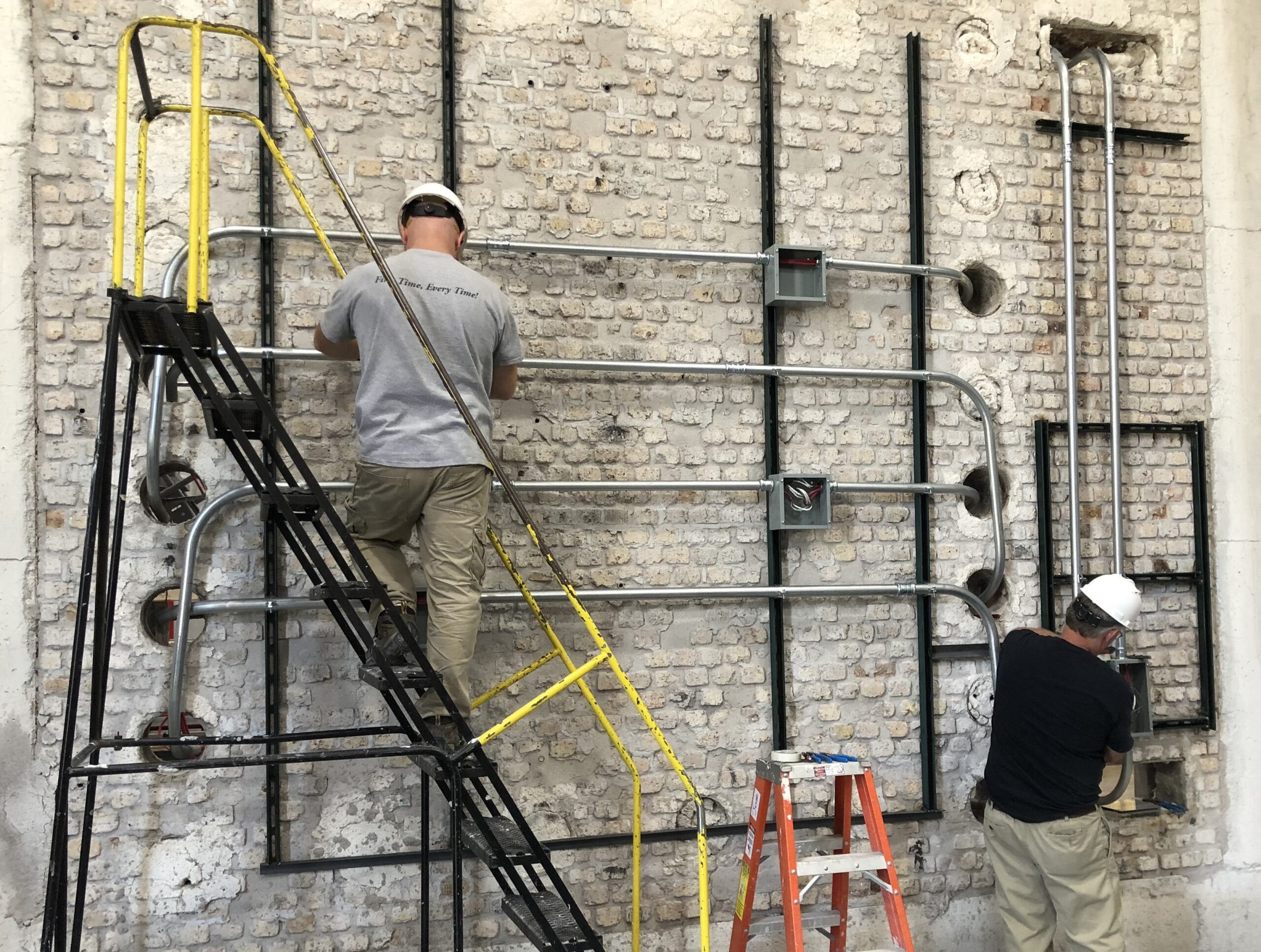
Where fire-resistive wiring methods are used, they must be installed in accordance with the cable manufacturer’s published instructions. Level 1 pathway survivability allows conventional fire alarm rated wire (e.g., fire power-limited plenum and riser) to be installed in a fully sprinklered building where those cables are installed in metal raceway (i.e., conduit) or metal armored cables. Level 2 and 3 pathway survivability require two-hour fire-rated cables or enclosures and Level 3 adds the requirement of a fully sprinklered building. Level 4 pathway survivability, which was added in the 2022 edition of NFPA 72, requires one-hour fire-rated cables or enclosures.
While Chapter 12 defines the levels of pathway survivability, it does not mandate when such levels must be used. Those mandates are found in Chapter 23 and 24. For nonvoice, tone-based fire alarm systems (e.g., occupant notification using horns, chimes, etc.) that use partial evacuation or relocation strategies, as noted in NFPA 72-2025 section 23.10.2, the pathway survivability requirements of voice-based systems found in Chapter 24 must be provided.
This change in the 2025 edition was made to align nonvoice and voice-based systems that use partial evacuation or relocation strategies. In the 2022 edition and prior, the only requirement for tone-based systems was that they be designed so that attack by fire within one notification zone shall not impair control and operation of notification appliances outside of that zone.
In NFPA 72-2025 section 24.3.14, we find most of the pathway survivability requirements pertaining to distinct types of fire alarm and emergency communications systems. This section requires that we understand three important pieces of information, in descending order:
- What evacuation sequence will be used in the building — general evacuation or partial evacuation/relocation?
- What is the fire resistance rating of the building’s major structural components (e.g., walls, floors, beams, columns, etc.)?
- What pathway classification and wiring topology will be used for the emergency communications system notification appliance circuits, notification appliance control circuits and communication and control circuit pathways?
With this information, the required pathway survivability level can be determined and designed.
For systems that do not employ partial evacuation or relocation, also known as general alarm operation, any level of pathway survivability can be used. For systems that employ partial evacuation or relocation, some level of pathway survivability or equivalency, must be used.
A high-rise building is the best example of a building using partial evacuation, where the building code requirement of evacuating the alarm floor, floor above and floor below is the normal evacuation sequence. A second example is a nonhigh-rise hospital or health care facility that often operates on a shelter-in-place or relocation evacuation sequence and thus pathway survivability requirements must be considered, especially within a common floor with multiple compartments or evacuation and refuge zones.
Once it is determined that partial evacuation or relocation will be used, then the fire resistance rating of the building’s major structural components must be determined. This is because the pathway survivability should be commensurate with the fire-rating of the structure. A building that has no fire resistance construction or one-hour fire-rated construction is not required to install two-hour circuit integrity cabling.
Rather, NFPA 72 recognizes that there is no benefit in providing increased protection for circuits more than what the building itself is providing. Buildings, including high-rises, that are built with one-hour construction but are provided with two-hour exits and other provisions need to be reviewed in more detail to comply with the correct level of survivability, which is usually the most stringent requirement.
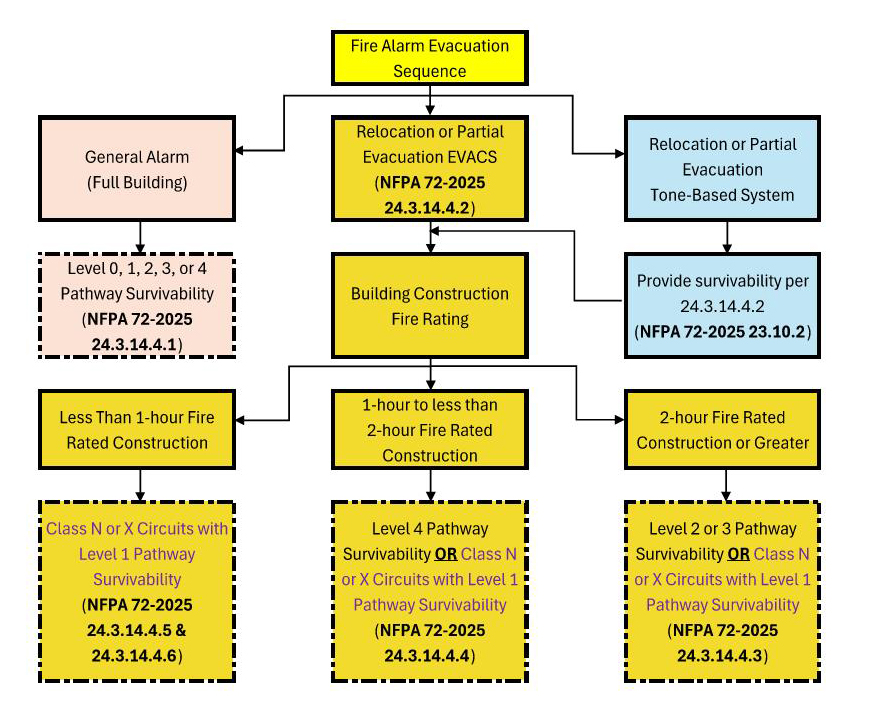
Figure 3 demonstrates how the building construction determines the pathway survivability level. Two-hour fire-rated construction requires Level 2 or 3 pathway survivability, whereas one-hour fire-rated construction requires Level 4 pathway survivability. If the building has no fire-rated construction (i.e., less than one-hour fire-rated construction), then redundant and fault-tolerant pathways of Class N or X circuits are required to be installed with a Level 1 pathway survivability.
Significantly, both the 2022 and 2025 editions of NFPA 72 allow Class N or X circuits to be installed with a Level 1 pathway survivability in buildings with one-hour (per section 24.3.14.4.4) or two-hour (per section 24.3.14.4.3) fire-rated construction as an approved alternative to providing two-hour circuit integrity cable or two-hour fire-rated enclosures. This represents a significant opportunity for cost savings, but it requires the fire alarm designer or engineer and the vendor to provide compliant circuits and wiring topology in the building in compliance with section 24.3.14.4.6.
While the description above applies to fire alarm systems, NFPA 72 Chapter 24 applies the same requirements to firefighters’ telephone systems (i.e., two-way in-building wired emergency services communications systems), two-way emergency communications systems for rescue assistance and elevator landing two-way emergency communications systems.
Pathway survivability for IBC Section 909
In addition to the survivability requirements previously outlined in NFPA 72, the IBC, specifically Section 909, contains requirements that apply to the design and installation of control wiring associated with certain smoke control systems to ensure that they can operate during a fire. The two-hour protection requirement for stair pressurization fans and ductwork has existed in the IBC dating back to the 2000 edition. In the 2009 edition, language for control and power wiring to comply with the same protection requirements were introduced. The elevator hoistway pressurization system protection requirement has existed in the IBC since the 2003 edition when the pressurization alternative to elevator lobbies was introduced.
It is important to note that the two-hour requirement does not apply to all smoke control systems. For example, atrium smoke exhaust systems are not required to feature rated control wiring.
The 2024 edition of the IBC requires control wiring, in addition to fans, ductwork and power wiring, for stair (i.e., smokeproof enclosure) pressurization systems to be located outside the building, within the exit enclosure or protected by two-hour fire resistance rated construction (section 909.20.6.1). Three permitted exceptions to the base options are to use UL 2196 listed circuit integrity cable with a rating of not less than two hours, to encase the cable with not less than 2 inches of concrete or to use a listed two-hour fire-resistance electrical circuit protective system or listed fire-rated wrap/foil on a conventional cable installed in a conduit.
The IBC requires elevator hoistway pressurization “fan systems” to be protected with the same fire-resistance rating required for the associated elevator shaft enclosure (section 909.21.4.1). This section, however, does not contain the specific protection requirements for control wiring as found for stair pressurization systems.
Because elevator shaft enclosures must be of two-hour rated construction if over three stories (section 713.4), it can reasonably be assumed that the intent is for the same control wiring requirements and exceptions to apply to elevator hoistway pressurization systems as is required for stair pressurization systems. However, the applicable AHJ should be contacted to verify that assertion.
It is also important to note that in addition to the survivability requirements for control wiring, the IBC requires all wiring, regardless of voltage, to be fully enclosed within continuous raceways as defined by NEC section 909.12.2. The ICC Code Commentary provided with the Code clarifies that a raceway, as defined by the NEC, must be used and that manufactured cable systems such as metal-clad (MC) cable are not permitted.
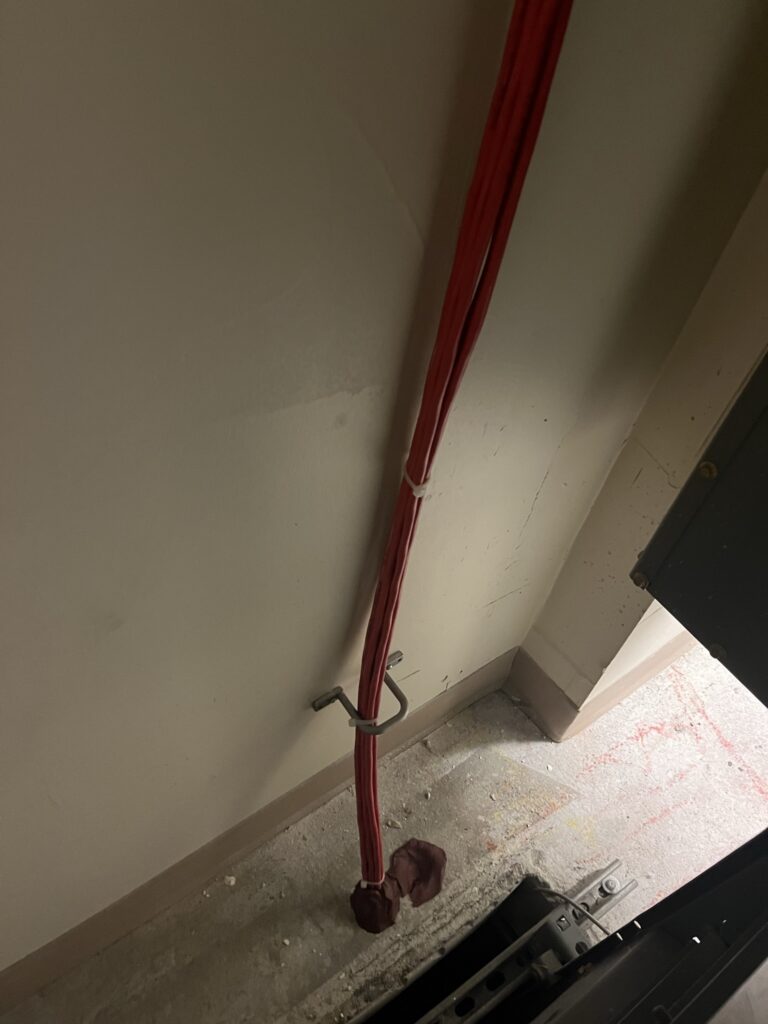
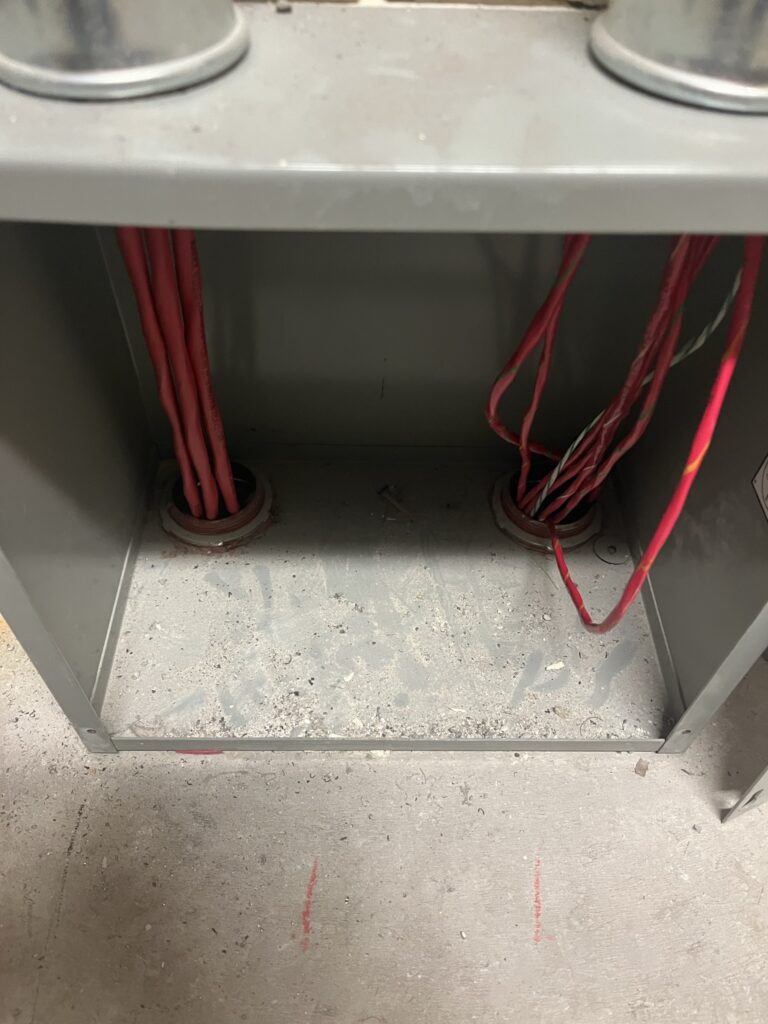
The term “control wiring” is intended to apply to wiring providing command inputs to smoke control fans, dampers or doors from the UL 864: Standard for Control Units and Accessories for Fire Alarm Systems listed control unit, which can either be a fire alarm control unit or a building management system control unit. It would also be applicable to cable between a listed control unit and the required graphic smoke control panel (i.e., firefighter’s smoke control station in NFPA 72), as well as data communications in system architecture with networked control units.
How to comply with the requirements
Whether trying to comply with the pathway survivability requirements in NFPA 72 or the IBC, the challenges of complying with the requirements are similar. Where the requirements exist for two-hour fire-resistance rated protection of circuits, the following methods, as permitted by the applicable code, can be used for wiring inside the building:
- Use fire-resistance rated construction or enclosures.
- Using a listed fire-barrier system such as concrete/masonry or gypsum board construction.
- Encase the cable/raceway in 2 inches of concrete.
- Use UL 2196 fire-resistive cables:
- Install exposed (i.e., “free air”) circuit integrity cable.
- Install circuit integrity cable inside compliant raceways per the cable’s listing.
- Install manufactured cable systems (e.g., mineral insulated or MC cable).
- Use UL 1724 electrical circuit protective materials.
- Install noncircuit integrity cable in raceways with a fire-resistive rated wrap.
- For NFPA 72 required survivability, use Class N or Class X circuits complying with Level 1 pathway survivability in accordance with NFPA 72 section 24.3.14.4.6 as an approved alternative for two-hour protection. With AHJ approval, this option may be approved for smoke control systems.
As previously noted, the IBC requires smoke control wiring to be installed in a continuous raceway. Therefore, listed “free air” cable and manufactured cable systems are not permissible options for control wiring associated with these systems.
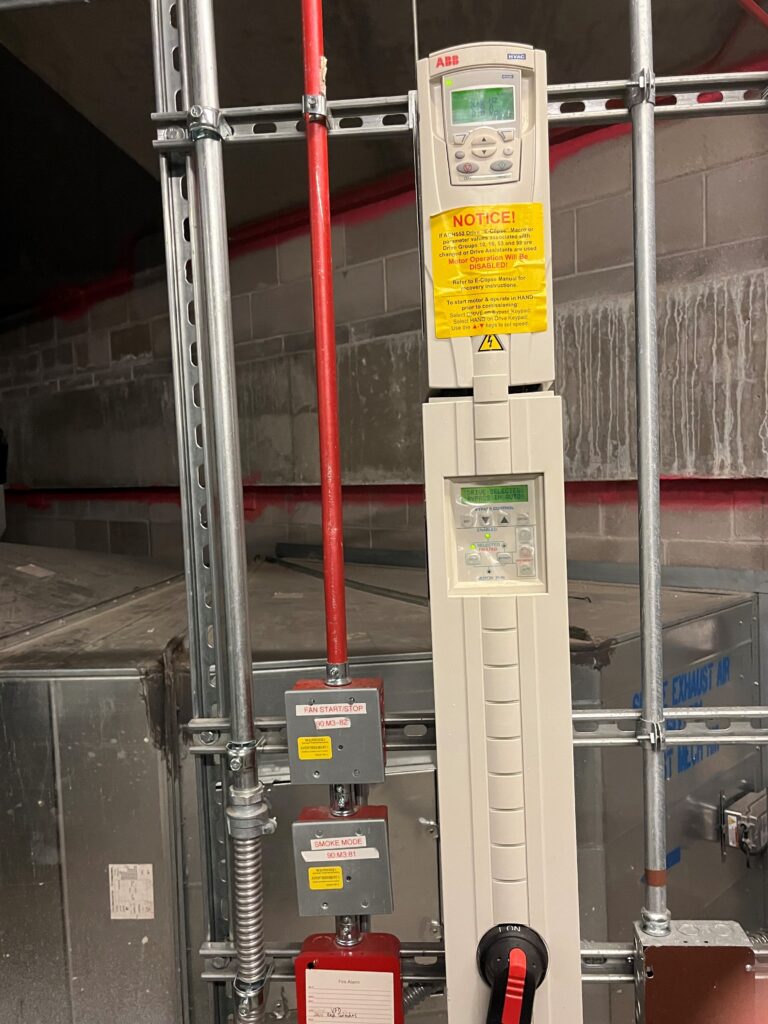
Compliance with code requirements for pathway survivability also requires compliance with the various product listings of the components that are used. It is important to note that with respect to listed fire-resistive cable and electrical circuit protective materials that the UL 2196 listing carries specific requirements with respect to cable supports, enclosures, attachment to structure, raceway materials and even the pulling lubricant that aligns with the installation that underwent that manufacturer’s fire testing. These specific requirements are part of the listing and are detailed in the manufacturers’ published instructions for each type of circuit integrity product that they offer.
When engineers are specifying these systems, it is important to note the following items:
- For circuit integrity cable systems installed in conduit, typically electrical metallic tubing or intermediate metal conduit must be used. Rigid metal conduit is not permitted.
- Each manufacturer’s listing contains specific requirements (i.e., specific manufacturer’s brand names) for the allowable raceway, couplings, fittings and clamps. Products from other manufacturers are not permitted.
- For all fire-resistive rated systems there are specific requirements for support types and spacing. Attachment is typically required to be made to a masonry or concrete wall/floor carrying the same rating as the cable system. Attachment to other rated assemblies should be reviewed and approved by the AHJ.
- If fiber optic cable is required for fire alarm network wiring, alternative performance methods or products may be necessary due to the lack of UL 2196 listed products currently on the market.
Pathway survivability best practices
A typical high-rise building would need to address pathway survivability for fire alarm occupant notification, stair pressurization systems, elevator hoistway pressurization systems (if applicable), as well as life safety systems used for rescue assistance communications systems. Clearly understanding which circuits need pathway survivability becomes important.
Fire alarm pathway survivability applies to circuits necessary to initiate activation of notification appliances, which usually applies to the following:
- Control units, amplifiers and power supplies associated with notification appliance circuits serving floors other than where the equipment is located.
- Audio and data network connections between fire alarm control units and notification appliance control equipment.
- Audible (e.g., loudspeaker) and visual (e.g., strobe) circuits originating on a floor other than the one they serve.
- Signaling line circuits used for activation of audible or visual circuits from notification appliance booster panels, power supplies or amplifiers.
- Two-way communication circuits for firefighter telephone, emergency and rescue assistance communications systems.
For smoke control systems, the survivability requirements would apply to the following:
- Control units associated with inputs and outputs to stair (or elevator) pressurization systems.
- Connection between firefighter’s graphic smoke control panels and control units.
- Data network connections between fire alarm control units on the same network where one control unit takes inputs that are activating outputs connected to another control unit.
- Signaling line circuits (fire alarm) or control wiring (building automation system) associated with inputs or outputs to stair (or elevator) equipment (e.g., fans, dampers, doors, etc.)
While providing listed circuit integrity cable can offer flexibility in installation, there is an inherent added cost when compared to standard duty cables due to premiums associated with the cabling itself and more stringent installation and support requirements. The use of rated building construction (e.g., rated shafts or stacked rated rooms or closets) can minimize the use of required fire-resistive rated cables and cable systems, while providing compliant pathways for the various systems that require pathway survivability.
Figure 5 shows an example of a high-rise building’s riser diagram where a combination of stacked rated closets and selective use of circuit integrity cable can be used to comply with applicable codes while minimizing the cost of circuit integrity cables.
By using a building’s rated construction (e.g., rated rooms, closets, shafts or enclosures), standard duty cabling and raceways can be installed. For fire alarm occupant notification dedicated to a specific floor or zone, once those circuits enter that dedicated floor or zone (i.e., within their notification zone) pathway survivability no longer applies and standard cable is used.
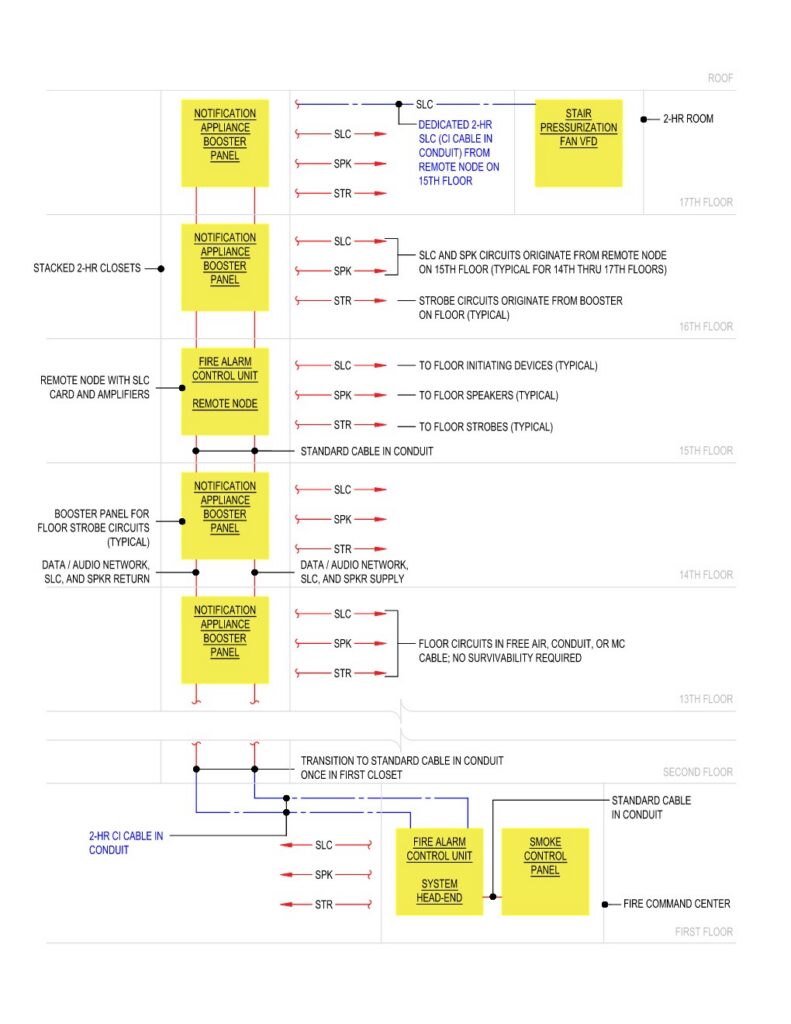
However, stair/elevator pressurization control circuit survivability requirements apply up to the point where the circuit terminates on the interface relay of the controlled equipment. Due to this requirement, many designers use dedicated signaling line circuits in dedicated raceway for the smoke control equipment.
Surviving survivability
Unfortunately, it is impossible to detail all the specific requirements, exceptions and unique situations that may be faced when trying to comply with pathway survivability. But pathway survivability can be survived by identifying what systems require pathway survivability, what circuits within those systems require pathway survivability, what evacuation sequence will be used, what fire-rated building construction is provided and what circuit wiring and topology will be deployed.
These critical factors need to be established early and documented so that various trades can work together and so the AHJ can understand and approve these installations. The care taken during the design process will ensure these critical life safety systems will operate as intended during the worst of circumstances.