Smart buildings are no longer defined by isolated technologies but by the ability to integrate data and orchestrate outcomes across systems.
Learning objectives
- Understand the role of integration platforms in moving beyond traditional building automation systems, enabling interoperability across IT, OT and user experience systems.
- Identify the expanded dimensions of ROI for smart buildings — including operational efficiency, risk reduction, occupant experience and ESG compliance — and see how integration supports these outcomes.
- Recognize why integration-first planning is essential for AI readiness, data life cycle management and future scalability and apply lessons learned from real-world case studies to their own projects.
Integration insights
- A truly smart building is defined by integration — the ability to unite data and coordinate outcomes across diverse systems rather than relying on isolated technologies.
- Through integration, buildings evolve into dynamic enterprise platforms that manage resources, enhance user experience and enable continuous innovation.
The phrase “smart building” is used often, yet rarely with precision. For some, it conjures images of automated lighting, sensor-controlled thermostats or keyless entry systems. For others, it means a workplace app that allows employees to book a desk or a sustainability dashboard showing live energy use. These are all useful features, but none of them by themselves make a building truly smart.
A smart building isn’t defined by a single technology, nor by the presence of a building automation system (BAS). It is defined by its ability to integrate data and orchestrate outcomes across systems. Smart is not a layer applied at the end, but a platform designed from the beginning.
This distinction matters now more than ever. Owners and operators face a complex set of demands, including enhancing resilience, reducing operating costs, protecting systems against cyberthreats, meeting aggressive sustainability and environmental, social and governance (ESG) commitments and accommodating remote arrangements, At the same time, technology expectations are rising, driven by the rapid advances in artificial intelligence (AI) and digital twins, both of which rely on clean, integrated data.
Smart buildings, in this context, are not a final product or checklist. They are a continuous journey rooted in integration. With integration in place, buildings evolve into enterprise platforms, operating systems that manage resources, support people and deliver insights at scale. Without it, “smart” initiatives remain siloed and underwhelming.

From BAS to integration platform
For decades, the BAS was the beating heart of building technology. BAS platforms controlled heating, ventilation and air conditioning (HVAC) — and sometimes lighting and safety systems — and they remained essential to daily operation. But while they excel at equipment-level automation, they were never intended to serve as true integration engines.
Protocols like BACnet and Modbus made it possible to connect devices, but they were designed for local control, not for data sharing across an enterprise. Vendor ecosystems around BAS platforms often create lock-in, requiring building owners to keep sourcing hardware and software from the same supplier if they want their systems to remain compatible. Expanding into new technologies or data domains under this model is slow, expensive and often incomplete.
Most importantly, BAS teams are skilled at managing building controls but are not tasked with integrating mobile apps, human resources (HR) platforms or ESG reporting tools. Expecting them to evolve into enterprise data managers is both unrealistic and unfair.
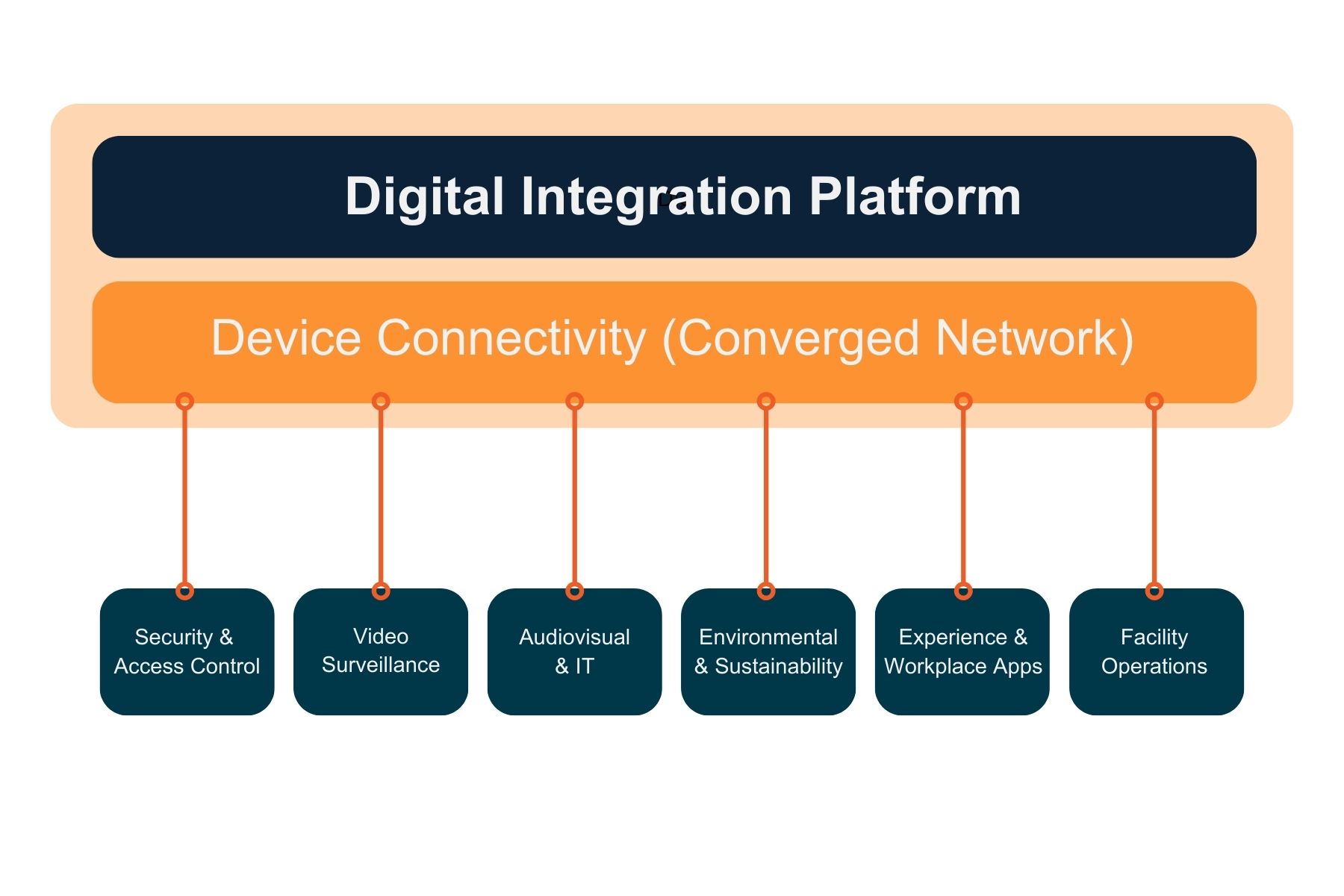
This is why the integration platform has emerged as the new centerpiece of smart buildings. It does not replace the BAS; it complements it. The BAS remains the local controller of HVAC, lighting and other equipment. The integration platform acts as the nervous system, ingesting data from across the building, normalizing it and making it available for analytics, automation and user experience.
A robust integration platform is vendor-agnostic and supports open application programming interfaces, allowing it to bridge systems that were never designed to work together. It ensures data security by improving monitoring and governance, while also offering flexibility, supporting edge processing for latency-sensitive tasks and cloud scalability for portfolio-level analytics. In this way, it provides the foundation for a building to evolve as technology and organizational needs change.
Beyond the BAS: Connecting the full ecosystem
When integration becomes the focus, the boundaries of a smart building expand far beyond HVAC and lighting. The list of systems that can be integrated is broad and constantly growing:
- Security and access control: From badge data to biometric readers, these systems generate rich data on occupancy and identity. When integrated, this data can be used to automate workflows (e.g., automatically granting visitor Wi-Fi credentials) or to measure energy use per occupant for ESG reporting purposes.
- Video surveillance: Cameras have become data sources as much as security tools, generating analytics on occupancy, crowding and traffic flows. When combined with other systems, they can improve safety while also informing space planning.
- Audiovisual and information technology (IT) systems: Integrated conferencing platforms and room booking systems can ensure hybrid meetings run smoothly, while occupancy data can automatically release underused rooms back into circulation.
- Environmental and sustainability systems: Air quality sensors, submeters and water monitoring platforms support both wellness and carbon reduction goals, providing real-time feedback to occupants while streamlining ESG reporting.
- Tenant and workplace apps: Mobile platforms that enable users to reserve rooms, order meals or find friends or colleagues are most powerful when tied directly into the building’s operational data, ensuring that digital experiences align with physical conditions.
- Facility operations: Computerized maintenance management systems (CMMS), asset tracking tools and predictive maintenance solutions gain relevance when they receive automated data feeds rather than relying on manual entry.
The real breakthroughs occur in the connections between these systems. An occupancy sensor doesn’t just dim lights when a room is empty; it can trigger cleaning schedules, adjust HVAC loads and feed use analytics to workplace strategists. A visitor management system doesn’t just print badges; it can link access control, elevator dispatch and even catering orders. Air quality readings don’t just appear on a dashboard; they can be published to employee apps, influencing wellness perceptions and ultimately talent retention.
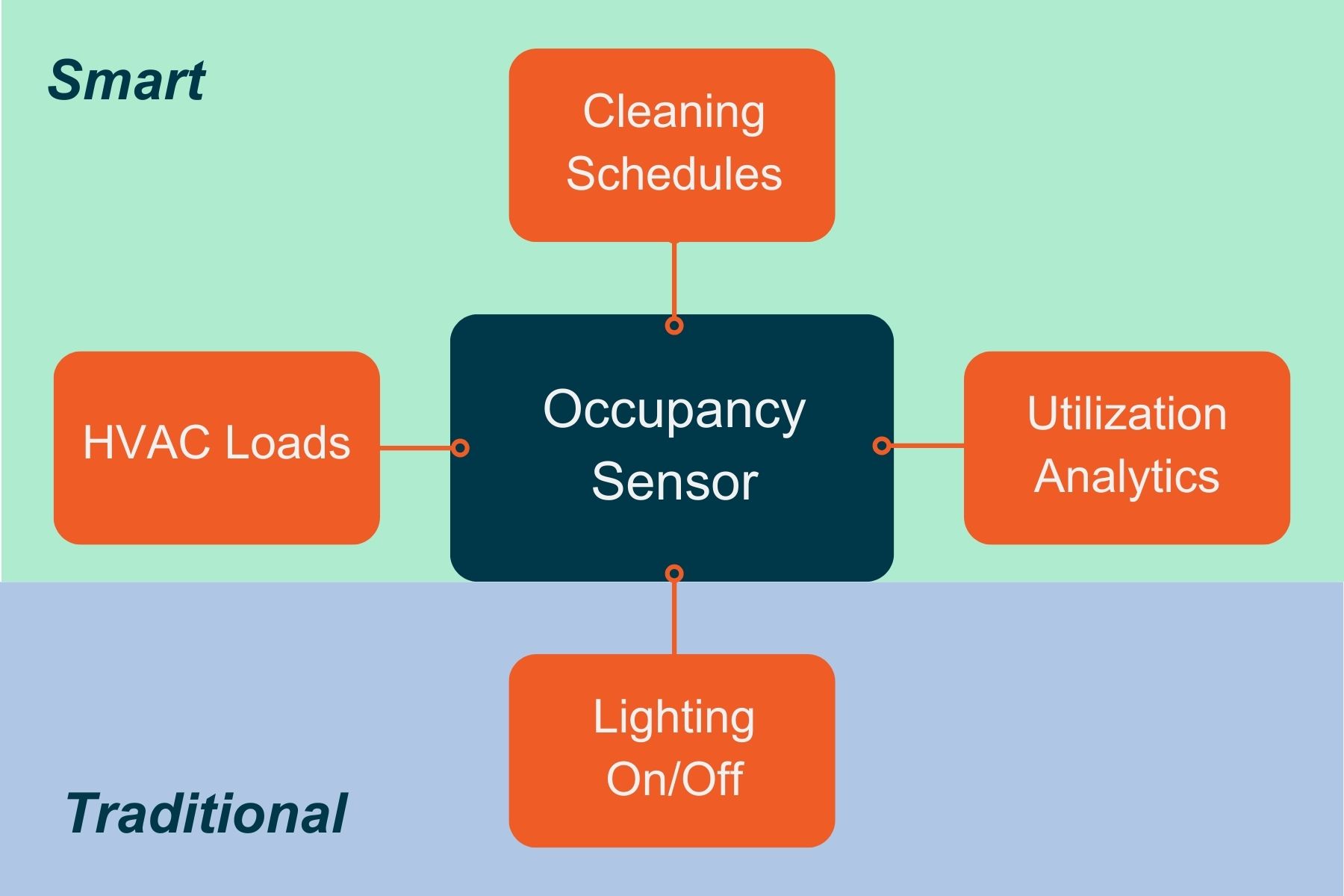
This is where integration becomes transformational. A building designed as a platform can continuously orchestrate outcomes across domains, creating value far beyond the sum of its parts.
ROI beyond predictive analytics
For much of the past decade, the discussion around the return on investment (ROI) of smart buildings has been dominated by energy efficiency and predictive maintenance. Those remain compelling benefits, but they only scratch the surface. An integration-first approach reveals a much broader return on investment that cuts across operational, financial and human dimensions.
Consider operations: A fault detection system that simply generates alerts is helpful, but one integrated with a CMMS that automatically generates and assigns work orders saves hours of staff time and shortens response cycles.
For sustainability, continuous data capture across water, waste and energy systems makes it possible to automate ESG reporting, reducing compliance costs while enhancing investor confidence. While these systems have traditionally relied on BAS-connected meters for monitoring and trending, a digital integration platform provides far greater benefit by aggregating multiple systems — not only BAS points, but also submeters, occupancy sensors and enterprise databases — into a normalized, analyzable format. This enables building teams to correlate energy performance with occupancy, asset health and comfort conditions, producing insights that are both more granular and more actionable than those provided through BAS alone.
For tenants and employees, integrated systems have a direct impact on comfort, convenience and wellness — outcomes that correlate with lease renewals, productivity and recruitment success.
At the portfolio level, integration allows owners to benchmark building performance, identify outliers and allocate capital more effectively. For example, comparing energy use intensity across similar assets can pinpoint where investment will generate the greatest payback.
Integrated systems also reduce risk, providing greater resilience and visibility across operations. A digital integration platform supports this resilience not by preventing power loss, but by maintaining data integrity and system continuity during disruptions. By aggregating and storing data in the cloud or at distributed edge nodes, the platform preserves operational visibility and historical records even if local systems go offline, allowing analytics and recovery to resume seamlessly once power or connectivity is restored.
The digital integration platform also enhances cybersecurity visibility by consolidating logs, device inventories and access records across systems that were once isolated. This centralization enables real-time monitoring, anomaly detection and policy enforcement that would be nearly impossible to achieve within disconnected platforms.
However, it also introduces new considerations. Connecting building systems to a cloud-based platform expands the potential attack surface and increases system interdependence, which can complicate threat mitigation. For this reason, effective digital integration platforms must be deployed within a zero-trust framework, enforce role-based access controls and integrate with enterprise security operations to ensure visibility does not come at the cost of vulnerability.
When all these factors are considered, ROI moves from being a narrowly defined cost-savings exercise to being a driver of enterprise value. Smart buildings stop being an expense line item and become a source of competitive advantage.
AI: Built on integration
AI has captured the industry’s imagination and rightly so. The promise of buildings that can anticipate needs, adapt in real time and even operate autonomously is compelling. But AI is only as good as the data it consumes.
In siloed environments, AI can optimize an individual subsystem, such as predicting HVAC faults. That’s useful but limited. In an integrated environment, AI can analyze occupancy, weather, energy pricing and tenant comfort together, making holistic decisions about how a building should operate.
Integration provides the breadth and quality of data needed for AI to be meaningful. With normalized, structured data, AI can forecast demand, simulate various usage scenarios and support natural-language queries, such as, “Which floor has the highest energy use per occupant this week?”
Generative AI can even auto-produce manuals, training documents or sustainability reports. Over time, closed-loop AI systems may allow buildings to self-adjust without human intervention.
But none of this happens without integration. AI must be seen as the consumer of integration, not the substitute for it. Integration first, AI second, is the order that makes AI credible, safe and valuable.
Integration as the starting point
Despite these realities, integration is too often treated as an afterthought. Technology packages are layered into projects at the end of design or smart features are introduced during procurement. This approach almost always leads to increased costs, inconsistent functionality and long-term underperformance.
The better approach is to embed integration from the start. This means defining desired outcomes — such as ESG compliance, user experience and resilience — at the programming stage. It means mapping the data needed to achieve those outcomes and designing infrastructure, ranging from cabling and networking to edge and cloud capacity, that can support them. It also requires aligning stakeholders across IT, facilities, sustainability, HR and finance early, rather than leaving them to grapple with systems after handover.
This shift has profound benefits. Commissioning can validate not only that systems are functioning but that data is being captured accurately and shared appropriately. Turnover to operations is smoother because the building is delivered with integrated data pipelines in place. And life cycle costs are reduced because integration is built in rather than bolted on.
Integration cannot be an overlay. It must be the foundation of the design.
Data as a life cycle asset
Once integration is embedded, data itself becomes a life cycle asset—a resource to be managed, improved and leveraged over time.
In planning, data informs which key performance indicators should guide decision-making. In design, it dictates which sensors and interfaces are required, as well as how data will be tagged and shared. In construction and commissioning, data quality and connectivity are tested alongside physical systems. In operations, data supports dashboards, alerts, predictive insights and cross-system workflows. In the long term, data enables continuous improvement, feeding lessons learned back into new projects and capital planning cycles.
This life cycle perspective ensures every stakeholder group benefits. Facilities teams get streamlined alerts and maintenance processes. Sustainability leaders receive automated, auditable ESG reporting. Finance gains reliable forecasts. IT improves insight into systems to monitor health and cyber risk. HR and workplace strategists can link space use and air quality to employee satisfaction.
An integration platform makes this possible by serving as the building’s nervous system — continuously collecting signals, interpreting them and distributing them in ways that add value across the enterprise.
Integration enablers and challenges
Achieving this vision requires robust technical foundations. Integration platforms rely on standards and schemas such as BACnet, Modbus, Project Haystack, Brick Schema and ASHRAE Standard 223P: Designation and Classification of Semantic Tags for Building Data to ensure interoperability. Middleware and orchestration platforms help unify diverse systems. Digital twins are an increasingly used applications that provide spatial context to operational data.
Cloud and edge architectures must be balanced: the edge for latency-sensitive control loops and the cloud for portfolio-wide analytics and AI model training. Cybersecurity must be treated as integral, not peripheral. Zero-trust architectures, network segmentation and role-based access controls ensure that, as IT and operational technology converge, vulnerabilities are managed.
But technology is only part of the challenge. Organizational silos between IT, facilities and real estate can prevent alignment. Legacy systems often resist interoperability, while vendor lock-in discourages openness and innovation. Financial models that separate capital and operating expenditures complicate investment in life cycle strategies. Even with all the systems in place, adoption is not automatic. Operators must be trained to use and trust new tools and tenants must perceive value in engaging with them.
These challenges are real, but not insurmountable. With clear governance, early stakeholder involvement and an integration-first mindset, they can be overcome. The key is recognizing that integration is not just technical plumbing but organizational strategy.
Integrated buildings as enterprise platforms
The narrative of smart buildings has matured. What began as incremental automation has become a broader vision: buildings as enterprise integration platforms. This shift acknowledges that the real value of “smart” is not in isolated features or predictive analytics alone, but in the ability to integrate, normalize and act on data across systems and stakeholders.
Integration platforms are what make this possible. They transform buildings into operating systems, orchestrating data, supporting people and enabling continuous evolution. They allow ROI to expand across efficiency, sustainability, experience and resilience. They provide the foundation for AI to move from hype to reality. And they reframe data as a life cycle asset that benefits every stakeholder.
The next phase is autonomy: buildings that make real-time decisions, informed by AI and grounded in robust integration. Achieving that vision will require collaboration among architects, engineers, technologists and operators; the adoption of open standards; and, above all, a recognition that integration cannot be an afterthought. It must be the starting point.
The future of smart buildings belongs to those who adopt this perspective and build accordingly.
Case study
Integration first: Elevating the office building experience
An office wanted sustainable and smart design and achieved it with an integrated approach.
When a global law firm set out to develop a new 150,000-square-foot office in New York City, it saw the project as an opportunity to bring its global smart building vision to life. The firm had already articulated high-level goals around workplace quality, sustainability and technology, but lacked the localized guidance necessary to turn strategy into actionable decisions for the project.
The challenge was twofold: deliver on enterprisewide standards while also creating a workplace that supported International WELL Building Institute alignment, net-zero readiness, operational efficiency and an elevated employee experience, all within a fast-paced construction schedule.
The gap quickly became clear. Broad strategic goals did not easily translate into design choices or technology specifications, leaving questions around how to scope, prioritize and sequence smart building initiatives. At the same time, global information technology (IT) and security policies established boundaries that had to be respected locally, necessitating careful navigation to avoid compromising functionality.
The consulting team responded by creating a tailored basis of design grounded in user journeys and experience groups. This framework allowed the project team to prioritize initiatives that would deliver tangible value for both occupants and operators. From there, a set of targeted use cases was identified to guide design and implementation.
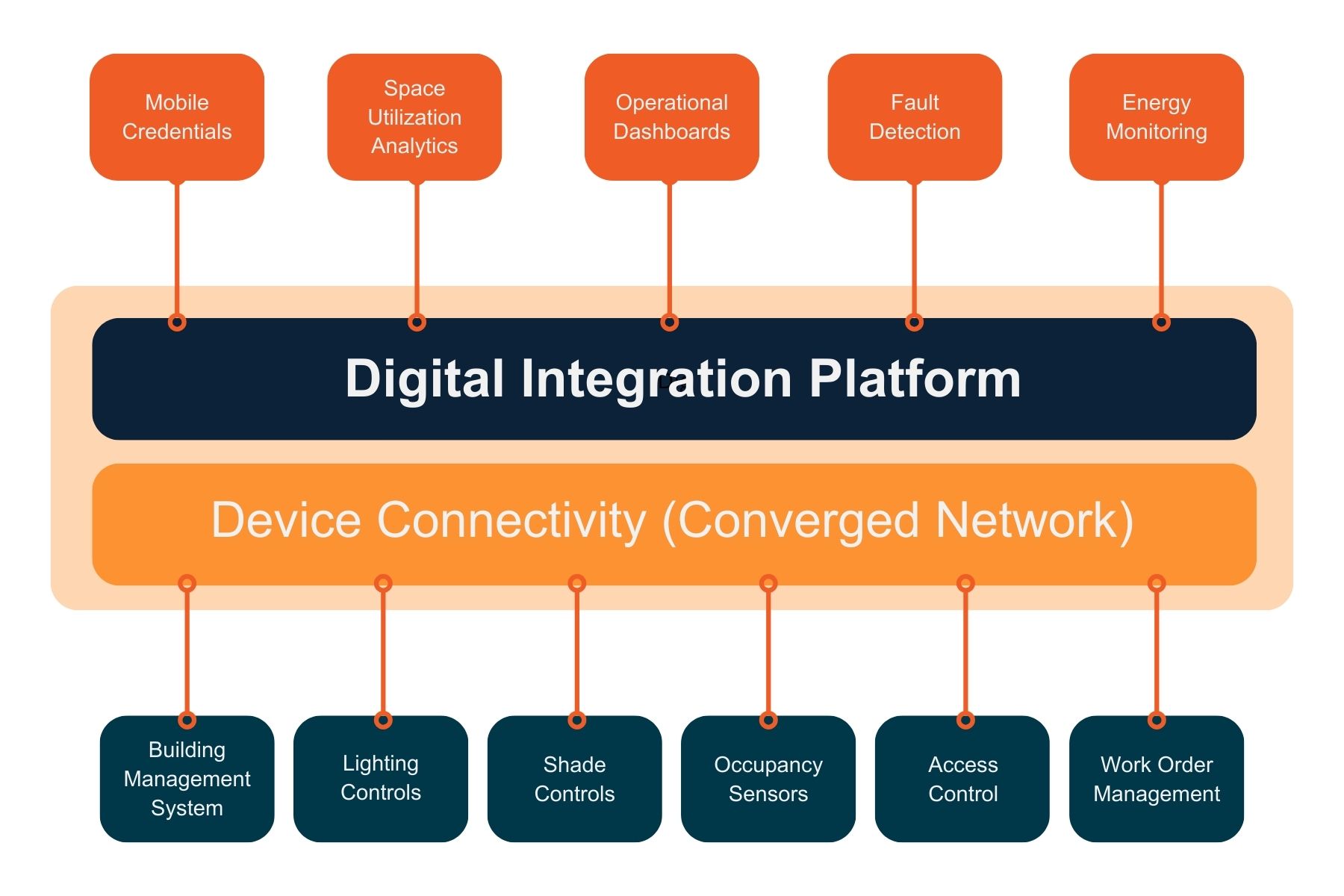
Hybrid work planning was supported by space use analytics, while operational dashboards provided centralized visibility across building systems. Mobile credentials streamlined access and printing workflows, fault detection tools enabled proactive maintenance and energy monitoring created a foundation for net-zero performance.
The integration strategy was anchored by the KODE Labs internet of things (IoT) platform, which served as the backbone for data aggregation and connectivity. Core systems integrated into this platform included the building management system, lighting and shading controls, occupancy sensors, access control and the work order management system. This provided the vendor-agnostic foundation needed to normalize data and orchestrate outcomes across multiple systems.
Critical to the project’s success was enterprise coordination. The consulting team worked closely with global stakeholders to ensure alignment with established standards, including C-Cure access control policies and architectural governance frameworks. Acting as translators between global mandates and local execution, they ensured the project remained compliant without sacrificing the functionality needed to meet user expectations.
Execution was supported by continuous engagement throughout construction, IT deployment and vendor coordination. Commissioning included point-to-point validation, application programming interface data testing and dashboard readiness checks, culminating in a structured user acceptance testing process. Each use case was validated against scorecards, providing confidence that objectives had been met and that the building was delivering measurable value.
The outcome illustrates how smart buildings are no longer defined by isolated systems or proprietary controls but by the ability to integrate, analyze and act on data across an ecosystem. By establishing an integration platform at the center of its strategy, aligning with enterprise IT standards and grounding decisions in clear use cases, the firm created a WELL-aligned, net-zero-ready workplace with a digital foundation capable of evolving with organizational goals.
This project demonstrates a broader truth about smart building development: success depends less on individual technologies and more on how they are integrated, prioritized and aligned with organizational vision. The integration-first approach ensured that the strategy was translated into daily operations and it created a framework that can scale to future initiatives. For other organizations, it underscores the importance of treating integration as the foundation, not the finish line, of a smart building journey.