In this roundtable, engineers talk about some of the most important codes and standards impacting office building design and retrofit.
Building codes and standards insights
- Modern office design is increasingly shaped by evolving codes and standards that prioritize decarbonization, indoor air quality and flexibility.
- Learn how engineers must balance owner expectations, tenant needs and budget constraints while navigating rapidly changing energy, ventilation and safety requirements.
Respondents:
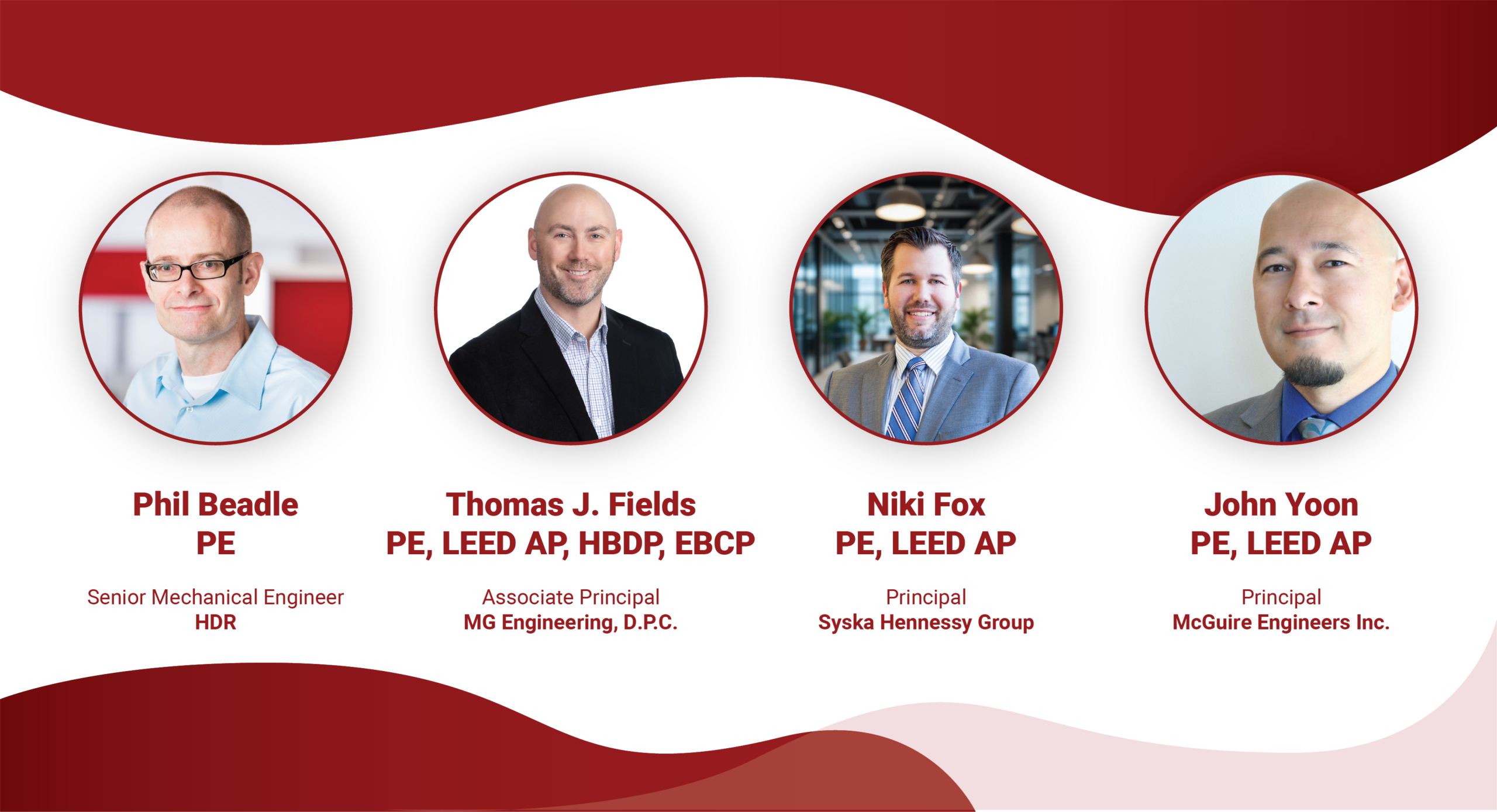
- Phil Beadle, PE, Senior Mechanical Engineer, HDR, Phoenix
- Thomas J. Fields, PE, LEED AP, HBDP, EBCP, Associate Principal, MG Engineering, D.P.C., New York
- Niki Fox, PE, LEED AP, Principal, Syska Hennessy Group, New York
- John Yoon, PE, LEED AP, Principal, McGuire Engineers Inc., Chicago
Please explain some of the codes, standards and guidelines commonly used during the project’s design process for office facilities. Which codes/standards should engineers be most aware of?
Phil Beadle: The specific design codes as required by the authority having jurisdiction (city, county) with local amendments include the International Mechanical Code, which references ASHRAE Standard 62.1: Ventilation for Acceptable Indoor Air Quality and the International Energy Conservation Code, which references ASHRAE Standard 90.1: Energy Standard for Buildings Except Low-Rise Residential Buildings. There may also be other energy or sustainable requirements (i.e., LEED) where projects require ASHRAE Standard 55: Thermal Environmental Conditions for Human Occupancy compliance.
There are many factors within ASHRAE 55 when establishing and achieving sustainability certifications. Achieving acceptable thermal comfort includes a combination of environmental factors — including air temperature ranges, humidity levels and air speed — along with personal factors such as the occupant’s activity level metabolic rate and their clothing type.
In addition to conforming to the requirements of national codes and standards, along with COMcheck, many states have implemented their own measures (i.e., California Title 24). Additionally, federal designs include requirements in accordance with the Unified Facilities Criteria.
Thomas Fields: Obviously the latest codes in effect in the municipality should be followed. For New York State and New York City, the energy codes are changing at the end of the year and will have several new requirements. With the shift to A2L type refrigerants, engineers should reacquaint themselves with ASHRAE Standard 15: Safety Standard for Refrigeration Systems.
Niki Fox: Local and national codes along with code bulletins.
John Yoon: Every jurisdiction is different. A great place to start is simply performing a search for the local building department, which will normally list the construction codes adopted by that jurisdiction. While versions of the same basic codes are used fairly consistently across the country, it’s not unusual to come across a town with a long list of local amendments. Doing that initial search will uncover most of those types of issues. There are a few local requirements, like New York City’s electrification law, Local Law 154 or Chicago’s Electrical Code environmental air plenum requirements that are unique and can come as a rude surprise if you don’t do your homework.
What are some best practices to ensure that such buildings meet and exceed codes and standards?
Phil Beadle: For ASHRAE 62.1 ventilation compliance, decoupling the ventilation air component from other air conditioning units through the application of dedicated outdoor air systems (DOAS) units ensures accuracy to meet code compliance. The DOAS system would include separately ducting the ventilation makeup air directly to each space within a dedicated ducting distribution system.
The DOAS system can be clearly shown to meet code with the exact amount of outdoor air, instead of ASHRAE Ventilation Rate Procedure for mixed air systems.
A DOAS ventilation air system is easily adaptable if spaces change occupancy type, versus a mixed air system, and this would be especially important for any future renovation project.
For LEED projects, the DOAS systems may be applied with at least 30% additional outdoor air ventilation to achieve the indoor environmental quality increased ventilation credit for “improved occupant comfort, well-being and productivity.”
Thomas Fields: The integration of heating, ventilation and air conditioning (HVAC) controls with other trades including lighting, room scheduling and others can help drive projects toward higher efficiencies and satisfied tenants. Proper system sizing with accurate load calculations ensure that equipment can be operated in an efficient manner.
Niki Fox: We use a project checklist to ensure codes are followed and the correct version is being applied.
John Yoon: Codes change all the time. Just because you knew what was in an older version of the code doesn’t mean that it’s the same in the current code. There are also some emerging technologies like battery storage, where the code changes dramatically between revision cycles. Continuing education is key to keep ahead of these changes.
How are codes, standards or guidelines for energy efficiency impacting the design of such buildings?
Thomas Fields: Energy codes are changing, focusing on source energy and long-term system costs. Building codes are requiring ongoing building performance compliance with baseline metrics. An example of this is New York City’s LL97.
Niki Fox: Codes are driving an increase in efficiencies in lighting power densities and HVAC equipment.
John Yoon: Codes related to mechanical, electrical and plumbing (MEP)systemshave typically focused on health and safety. However, energy conservation codes have rigorous requirements that often seem at odds with those traditional construction code requirements. In addition, compromises made in the architectural design of the building envelope can place an additional burden on the MEP engineer to design additional energy credit measures to meet minimum point requirements as defined in section C406 of the International Energy Conservation Code.
What types of systems and technologies are ahead of the code/standard curve? Have you specified something that doesn’t fall into any code requirements?
Phil Beadle: In response to the pandemic, extensive research was conducted to identify the best practice for promoting indoor air quality and reducing the spread of airborne pathogens.
One finding showed that low humidity (<40%) provided an environment for longer viability/higher risk of airborne infectious aerosols cross contamination and the recommended target humidity range of 40% to 60%.
Maintaining this “low-end” (40%) minimum humidity within office buildings is not typically included in designs and humidity is not regulated for thermal comfort standard requirements. Therefore, we are seeing an increasing need to add humidifiers into office building air handling systems, which now requires clean water for dispersal. This may require treatment, sanitization and additional equipment maintenance in addition to increased energy use when either applying isothermal or adiabatic humification systems.
Thomas Fields: Smart building analytics, likely using artificial intelligence, will be the future of building controls and metrics. This will be integrated into additional technologies, including on-site energy storage, advanced occupancy sensors and other technologies that exceed minimum code requirements.
Niki Fox: Variable refrigerant flow systems are ahead of the curve.
John Yoon: Distributed energy systems/distributed energy resources infrastructure that is integrated with dynamic load management is technology that is ahead of the curve but will probably become more commonplace as state governments start to adopt more aggressive energy policies to address decarbonization and electrical grid reliability.
What are some of the biggest challenges when considering code compliance and designing or working with existing office facilities?
Phil Beadle: Achieving code-compliant ventilation and filtration during renovations depends heavily on the building owner’s expectations and the extent of the renovation scope. If the intent is to retain and refurbish existing air handling equipment such as fans and coils, then the feasibility of meeting updated ventilation and filtration requirements becomes limited.
Replacing “like-for-like” equipment in aging office facilities is always a significant challenge. Previously allocated mechanical rooms, plenums and vertical distribution pathways may not accommodate the demands of a modern office and associated HVAC systems.
These may significantly drive the overall scope of an office renovation if not identified early in design, which should include selective demolition, such as shafts, to ascertain actual installation versus historic record as-built documentation.
Thomas Fields: The electrification of existing office buildings is the largest challenge we face. This will require full cooperation between municipalities, utilities and building owners. Existing owners will face new costs and possible fines with their older building stock that rely on fossil fuels for heating. Engineers need to design phased building upgrades while minimizing impact on existing tenants.
Niki Fox: Existing conditions and changes in the code from when the building was initially built.
John Yoon: In no particular order:
• Meeting current code requirements and/or operational life expectations with obsolete equipment.
• Validating the performance/capacity of existing equipment without adequate documentation.
• If existing equipment cannot be reused, educating the client why. Many clients expect that redeveloping an existing building should be significantly less expensive than new construction. This is not aways the case.
• If a building is currently occupied, how to phase major MEP infrastructure improvements without disrupting existing occupants.
• Living within the physical space constraints of the existing structure: Creating new shafts and carving out new equipment rooms are often deal breakers.
What are some of the challenges that exist between what the building owner wants, how the building needs to accommodate occupants and complying with particular codes and standards?
Phil Beadle: Building owners often seek “bulletproof” systems: low-maintenance, reliable solutions that their facilities teams are familiar with operating and maintaining. This preference for proven system types can sometimes be at odds with the push to meet increasing energy efficiency targets, modern code requirements and sustainability goals, all within the constraints of a fixed construction budget.
Higher energy efficiency usually means using the latest and often more complex equipment, a different system operation and possibly tailored for beneficial electrification and energy recovery. Achieving optimal year-round system efficiency often requires a sophisticated controls design and sequence of operations. However, these can introduce a level of complexity that may not be fully understood by existing operations staff.
These efficient system designs may be contrary to the owners’ initial wants or expectations and typically have a price that may challenge the budget. Additionally, there may be numerous value engineering reviews and decisions made during the project that changes system designs to reconcile the system types and efficiencies with the construction cost.
Thomas Fields: In office buildings, the tenant requirements, landlord rules and regulations and lease language may not always align. Understanding the discrepancies between these documents about infrastructure often falls to the engineer. We must combine what the tenant wants with what the building has to offer when it comes to capacity and controls. The advent of laws like New York City’s LL97 force both tenant and landlord to be aware of energy efficiency and new language in leasing is requiring tenants to be mindful of their energy use.
Niki Fox: The cost to electrify the building.
John Yoon: MEP systems are often considered a necessary evil by clients. Most don’t want to spend money on MEP systems unless there is a clear return on investment or code mandate that they were provided. After all, most of the systems are hidden in back-of-house areas and no one knows about them until they don’t perform as expected. While engineers typically fixate on the enhanced functionality aspects of these systems, focus first on helping the client understand the basics: why they are required and the relative pro/cons of each of your engineered solutions. This approach can better serve them in the long run. While the client may not fully understand all the technical minutia associated with the systems, they have a better understanding of what it takes to run their business than you do. If you can find that intersection of what they need and what the systems can do, they should be more than able to make an informed decision.