
Data center power systems typically include generators, UPS, transfer switches and redundant distribution networks designed for reliability and code compliance.
Learning objectives
- Understand the distinctions between emergency, legally required and optional standby power.
- Learn about the typical power components in data centers.
- Identify key codes and standards for reliable power systems.
Power insights
- Mission critical facilities, such as hospitals and data centers, require continuous, reliable power because interruptions can endanger lives or cause severe financial loss.
- To ensure resilience and operational continuity, these facilities use systems like uninterruptible power supplies, generators and transfer switches designed according to strict codes and standards (such as NFPA 70 and NFPA 110) that govern emergency, standby and legally required power classifications.
Mission critical facilities need to be resilient and redundant to safeguard lives, data and essential systems operations when the utility power fails. Backup power systems provide the necessary resiliency needed to keep these facilities running and increase the availability and uptime.
Mission critical facilities must maintain continuous power availability for essential electrical loads, always ensuring maximum reliability. Electrical systems should be designed in such a way that power continuity across these facilities is governed by performance as well as codes and standards.
There are several codes and standards to reference for these power systems:

- American National Standards Institute
- International Building Code
- NFPA 1: Fire Code
- NFPA 70: National Electrical Code (NEC)
- NFPA 101: Life Safety Code
- NFPA 110: Standard for Emergency and Standby Power Systems
- NFPA 111: Standard on Stored Electrical Energy Emergency and Standby Power Systems
- TIA-942-C: Data Center Infrastructure Standard
- UL 1778: Standard for Safety for Uninterruptable Power Systems
- UL 1008: Transfer Switch Equipment
- Uptime Institute
- Applicable local codes and amendments.
NEC Article 700 classifies backup systems in four types as emergency systems (701), legally required standby systems (702), optional standby systems (702) and Critical Operations Power Systems (708).
NFPA 110 establishes performance requirements for the installation, maintenance and operation of emergency power supply systems (EPSS). It ensures reliable backup power for critical facilities during utility outages, covering aspects like system classification, testing and fuel supply.
NEC 708 defines Critical Operations Power Systems, which are installed to support facilities or parts of facilities that, if not operational during a disruption, could impact national security, public health, public safety or critical infrastructure.
Knowing the differences between emergency/life safety and legally required standby in mission critical facilities is important when specifying electrical systems.
These backup power systems can be designed and installed using several key components like automatic transfer switches (ATS), generators, uninterruptible power supplies (UPS) and power distribution units (PDU), and supported by fuel storage and conditioning systems.
How to classify power in data centers
Data centers are classified in two ways (see Table 1):
Table 1: Types of data centers
| Data center type | UPS topology | Generator topology | Fuel/runtime | Key focus |
| Enterprise | N+1 | Single/N+1 | 2–4 hours | Cost-effective, basic reliability |
| Colocation | N+1/2N | N+1 | 24–72 hours | Service-level agreement compliance, tenant isolation |
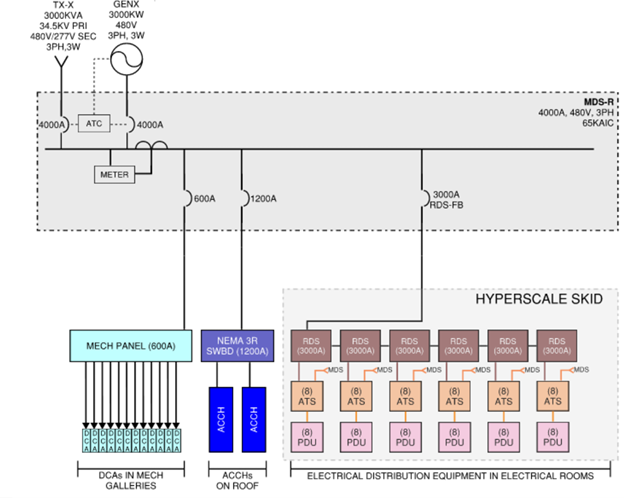
| Hyperscale | N+1/2N | 2N/multiple strings | 24–72+ hours | Fault tolerance, continuous global service |
| Edge | Single/N+1 | Optional/small genset | Minutes–1 hour | Low-latency, local continuity |
| Modular | N+1 | Mobile N+1 | Portable/mission-specific | Quick deployment, remote operation |
| Telecom | N+1/2N | N+1/dual source | 48–72 hours | Network uptime, remote monitoring |
Table 1: This shows data center type and their topologies. Tier III and IV data centers as per Uptime Institute usually employ 2N or 2N+1. Hyperscale and colocation type date centers employ the same architecture as well. Courtesy: WSP
- By tier or by availability as defined by Uptime Institute: Tier I to Tier IV.
- By function/type of service
- Enterprise data centers
- Colocation data centers
- Hyperscale data centers
- Edge data centers
- Modular/containerized data centers
- Telecom data centers
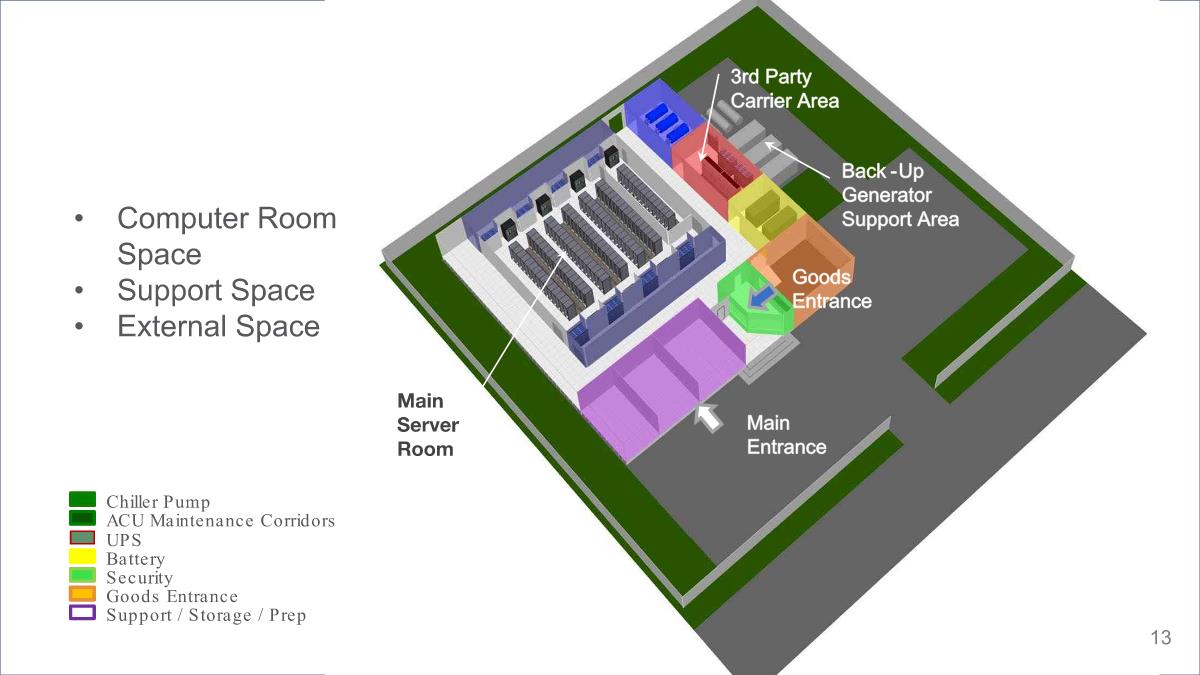
Space is used many different ways in data centers:
- The computer room is where all the main servers, storage equipment, cabling infrastructure, power distribution, etc., will be placed.
- The support area is the place for mechanical equipment like chillers, operations center, storage, electrical and generator plant rooms located.
- A typical usable information technology (IT) equipment area where servers, storage and network gear are installed is called “white space.”
Standards like TIA-942 require and ASHRAE TC9.9 recommend that UPS, batteries and PDUs should be in dedicated spaces, which are separate from or outside of white space.
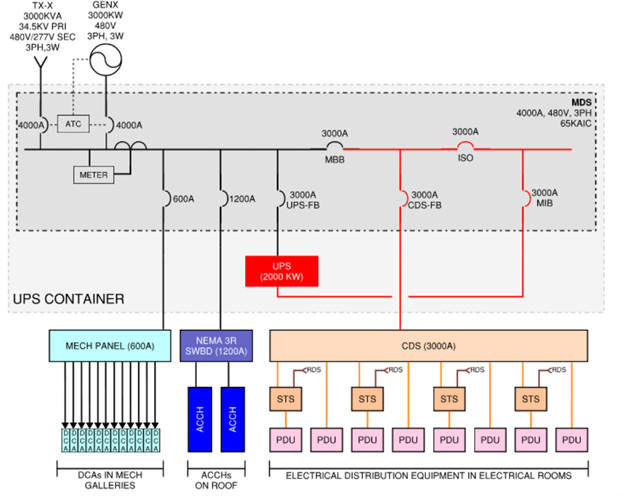
Most typical electrical designs or distribution systems in data centers will involve service from utility power lines, transformers, generator sets, switchgear, UPSs and power distribution units. This article mainly focuses on emergency power distribution, which consists of generators, UPS and power distribution units.
Power distribution units and UPSs
PDU is an electrical panel that takes high-capacity input power from a UPS or switchgear and distributes power in a controlled way with individual circuit breakers that feed Individual racks/cabinets. In a typical mission critical facility, these will be placed in data hall floor.
These PDUs will also step-down voltage from utility/UPS to server usable voltage. These are designed to have multiple functions including load monitoring, power quality monitoring and redundancy support along with circuit protection.
A UPS conditions the main power supply to provide clean alternating current power to IT equipment. It also stores power for use when utility grid fails until generator power is available or supply fault is cleared. A traditional UPS consists of rectifier/charger, inverter and battery units that will be online from milliseconds to seconds in the event of main failure.
Types of UPS:
- Static, on-line, insulated gate bipolar transistor/IGBT transformer-less with battery or flywheel
- Static, line-interactive, transformer-less with battery or flywheel
- Static, adaptive off-line/line-interactive/on-line
- Rotary, line-interactive/on-line with battery or flywheel
- Rotary, line-interactive with electrically coupled flywheel
- Diesel-rotary, line-interactive with mechanically coupled flywheel and integral diesel engine
- Diesel-rotary, line-interactive with battery and integral diesel engine.
UPS variants:
- Off-line: Very rarely used for data center loads
- On-line: Legacy protection and still dominant
- Line-interactive: Growing acceptance driven by lower losses.
A UPS cannot be the sole source of emergency power in mission critical facilities. It can be part of the emergency/critical power system. For long duration backup power fuel fired generators should be used. Also, the UPS energy density is much less compared to a generator.
Specifying batteries as power systems
There are several types of batteries typically used in data centers.
- Lead acid: Traditional large-scale UPS batteries, which typically contain positive and negative plates separated into diluting sulfuric acid the chemical between lead and sulfuric acid generating electric current. This type needs regular maintenance and needs ventilation system to remove dangerous gases.
- Valve-regulated lead acid: Most common in data centers and hospitals. Relatively low upfront cost, compact and sealed. Sealed makes them low maintenance.
- Lithium-ion: This type of batteries use lithium metal oxide(LiCoO2) or lithium iron phosphate (LiFePO4) or nickel manganese cobalt (NMC) as a cathode, typically graphite as an anode and lithium salt. The lithium salt in an organic solvent is separated by a thin polymer film that prevents short circuiting, allowing ion flow and is best suitable for data centers and mission critical UPS due to their high energy density, longer life, low maintenance, fast charging and high efficiency.
While sizing batteries, a five-minute backup consideration is practical and for Uptime Institute Tier III and IV data centers need minimum 15-minute backup time. Most batteries are never used for more than few minutes per year. In data centers, 25% of the dropped loads are due to problems with batteries when they are poorly maintained.
UPS redundancy for data centers
Resilience is the ability to withstand major disruption. All mission critical applications must be available through all types of outages. To achieve resilience, electrical engineers need to implement subsystem redundancy in systems design. Redundancy means duplication of components beyond the minimum capacity to ensure critical IT infrastructure operates continuously without interruption when one or more UPS units fail or are taken offline for maintenance. UPS redundancy is typically implemented in configurations like N+1, 2N and 2(N+1) configurations.
If “N” is the capacity needed to operate the system, N, N+1, 2N and 2N+1 are the configurations that are used in distribution of backup power to data centers. Where each N represents a UPS module N topology meets the need with basic requirements with no redundancy.
- N+1: One additional unit/path/module more than the base requirement; to support a single failure, the stoppage of a single unit will not disrupt operations.
- 2N: Two complete units/paths/modules: Fully redundant system with two independent distribution systems for every one required for the base system; failure of one entire system will not disrupt operations.
- 2(N+1): Two complete (N+1) units/paths/modules; failure of one system still leaves an entire system with a resilient component.
Diesel rotary UPS systems
Diesel rotary UPS (DRUPS) system is a type of UPS that combines kinetic energy storage unit (flywheel) with a diesel generator to provide both short-term ride-through power and long-term backup power. It is widely used in mission critical facilities such as data centers, hospitals, airports and semiconductor plants where both power quality and reliability are crucial.
DRUPS have both advantages and disadvantages:
- No large battery banks are required, which drastically reduces maintenance and replacement costs
- High reliability and long life
- Better power quality
- Smaller footprint
- Environmentally safer as there is no lead acid or lithium for disposal.
At the same time due to high initial capital cost, startup time and high space requirements, these types of systems are preferred in facilities like semiconductor and pharmaceutical manufacturing.
Modern thinking on UPS for mission critical facilities is changing regarding mission critical facilities with the emphasis of energy efficiency and modularity. The ultimate modularity is the containerized data center.
Containerized UPS for data centers
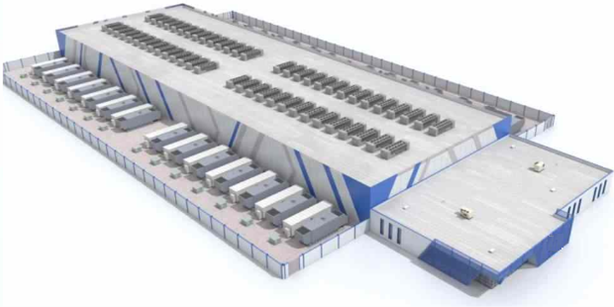
There are many types of prefabricated infrastructure container products such as UPS rooms, chillers and generator containers. The benefits of this prefab, container solution are built to be transported, reduced cost of construction and portability and flexibility of relocation.
Keeping the UPS and its corresponding switchgear in containers not only saves white space inside data halls but also has many advantages like speed of deployment, standardization, space efficiency and flexibility.
Generator power
Diesel generators sets are critical backbone for backup power in data centers because uptime and reliability are essential. They provide backup power when utility supply fails. They are designed to work in coordination with UPS systems. Typical crank/start time is a few seconds to 30+ seconds depending on performance as per NFPA 110. Engineers must design the size of generator to carry the entire IT load plus support systems which include cooling, fire protection, security, lighting, etc.
Generator sets can be specified as:
- Emergency standby power rating: Short duration alternative to utility power.
- Prime rated power rating: Unlimited alternative to utility power.
- Continuous power: Operates continuously at constant load mostly for remote sites.
- Data center continuous.
While sizing generator along with classification type, engineers have to consider site altitude and ambient conditions as well.
Generator sets are recommended to be loaded at least for 30% load to avoid engine damage, wet stacking and carbon buildup. Running a light load reduces reliability and increased maintenance costs.
Generator sizing and fuel
In a data center, there will be two different selections for diesel generators: one for main purposes and another for house load. The generator used for main purpose typically known as the critical generator. Critical generators are sized such that they provide continuous backup to IT load and its corresponding cooling load. Typical IT load in a single hall of a data center is called a data block or critical block.
Generators used for house or administration offices typically known as house generator or facility generator. House generators supply non-IT loads like lighting, elevators, fire pumps, fire alarm, office, administration support spaces and building infrastructure power.
A single critical generator for both IT and building loads could lead to oversized and inefficiency. Splitting the IT load and house loads to dedicated gensets allows better load management and redundancy. In most cases both types share common fuel system but remain electrically isolated.
Fuel storage depends on the runtime of the facility as per NFPA 110 and tier levels for data centers. The more runtime required, the bigger the fuel storage capacity. Mission critical facilities have large fuel requirements for installed capacity they need to maintain at least 48 to 72 hours of fuel. For Level 1 EPSS in areas of higher seismic risk (seismic design category C, D, E, F), 96 hours of fuel operation without refueling is required if it is determined that the location demands that period of operation.
Typical data centers employ multiple generators to back up the critical load and each generator sits on its own fuel tank, which can store fuel for approximately 24 hours. These tanks must comply with UL 2085.
Generators can be equipped with day tanks, polishing systems and selective catalytic reduction (SCR) exhaust systems.
SCR is an after-treatment technology used on diesel and gas generators to reduce nitrous oxides (NOx) emissions. It works by injecting urea or ammonia into the exhaust gas stream before it passes through a catalyst. The catalyst promotes a chemical reaction that converts NOx into nitrogen and water.
U.S. Environmental Protection Agency Tier 4 compliance helps meet air quality permits, especially in regions with strict emission rules in states like California. This system also reduces environmental impact and enables the use larger gensets in urban areas.
Power consumption in a data center
In a typical Tier III or IV data center, most of the electrical load will be IT load. IT load relates to equipment within the data center like servers, storage, active network equipment, etc. IT load will be backed up by UPS. UPS will be backed by generators.
Critical generator size depends on the data block or critical block size. Usually, these critical blocks will have IT load of 2 megawatts (MW) and cooling load of 1 MW, which when combined makes up 3 MW size. But these IT load and cooling load capacities will change from project to project and client to client.
A typical data center is designed to have multiple critical blocks. For each critical block, a dedicated generator is considered. Generator redundancy is a critical design consideration for data centers to ensure uninterrupted power supply during utility outages or equipment failures.
Glossary
Automatic transfer switch (ATS) is an electrical switching device that automatically transfers the power supply from the primary source to the secondary source when it detects a power failure or unacceptable voltage/frequency levels in the primary source. ATS typically transfer time is 50 to 200 milliseconds, which is equivalent to 3 to 12 cycles at 60 Hertz per UL 1008. When a generator is the backup source, ATS first sends a start signal to the generator, which may take 5 to 10 seconds to reach stable output before transferring load. During this time, UPS units maintain uninterrupted power to the load.
Critical Operations Power Systems (COPS) goes beyond typical emergency or legally required standby systems as they are intended to remain operational during and after events such as natural disasters, terrorist attacks or similar emergencies.
Emergency power are systems that are designed to ensure continuous and reliable operation during power outages or critical failures. It provides electricity to egress lighting, fire alarm systems fire pumps, automatic doors and similar equipment when primary power sources such as utility power fail. These systems are specifically designed to protect the life and safety of personnel.
Legally required standby power systems are required by municipal, state, federal or other codes or by any governmental agency having jurisdiction. These systems are intended to automatically supply power to selected loads (other than those classed as emergency systems) in the event of failure of the normal source. These systems do not include loads that are considered emergency and essential to the safety of human life. Article 701 of NEC defines this section.
Optional standby power systems are the systems that typically provide backup power for systems that are covered in Article 702 of NEC such as data processing, communication, heating and refrigeration systems in mission critical facilities. Any failure or disruption can have severe consequences, including significant financial loss, risk of safety or harm to human life; therefore, they cannot afford even a moment of downtime.
Static transfer switches (STS) are devices with same functionality as ATS with faster switching speed, usually less than 4 milliseconds. STS used solid state thyristors that make their transfer time nearly instantaneous, so that IT equipment does not get affected during transition.