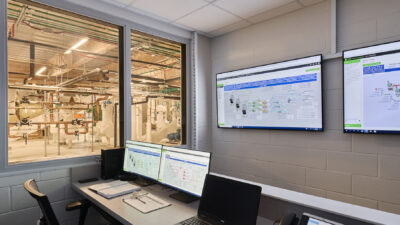
Building automation and controls are used in hospitals and health care facilities, and automated systems are enhancing the patient experience.
Automation insights
- Automation is reshaping hospital operations as building systems, clinical environments and regulatory reporting increasingly rely on integrated controls and real-time data, allowing facility teams to demonstrate compliance and improve efficiency with greater precision.
- Growing expectations for intelligent infrastructure mean automation must now support interoperability across legacy platforms, clinical technologies and IT networks, pushing designers to plan for flexible, scalable systems that can evolve without disrupting patient care.
From your experience, what systems within hospitals, health care facilities and medical campus projects are benefiting from automation that previously might not have been?

Caleb Marvin: Automation systems are being used within these types of facilities to help demonstrate compliance with CMS to the accreditation organization. Graphics, logs and trending of room conditions allow the facility to log and show compliance with all regulations making the process during accreditation surveys much easier. Some unique innovations include a dedicated user interface dashboard that logs the room conditions for all operating rooms logging temperature, humidity and pressure. The panel may be used to log when and why rooms are out of setpoints and as manual overrides when certain specific conditions require the room outside of the standard ranges such as low temperatures required for certain procedures.

Meagan Gibbs: Over the past few years, we have seen a significant shift in how automation is applied across health care facilities. Systems that traditionally require manual oversight, such as HVAC controls, lighting systems, patient check-in kiosks and even pharmacy inventory management, are now being automated to enhance efficiency and reduce human error.

Jason Butler: Automation of alarm triaging, such as fault diagnostics algorithms, is one way health care facilities are benefiting from automation in building system controls. Key to this is correct alarm prioritization and preventing alarm fatigue. Another automation benefit is leveraging building controls and intelligent system diagnostics to help automate regulatory reporting.

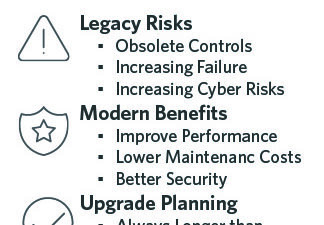
Richard Vedvik: Every older hospital campus benefits from replacing pneumatic control systems with modern BAS, which provide precise management and remote monitoring capabilities. Energy monitoring systems help operators identify anomalies when systems are offline or operating outside of normal conditions, enabling proactive maintenance and reducing downtime in critical areas like operating rooms and patient wings.
What types of system integration and/or interoperability issues have you overcome for these projects and how did you do so?
Caleb Marvin: One of the toughest challenges is providing a usable interface for all the points that are available from all the equipment that is installed in health care facilities. Many pieces of equipment can be provided with a BMS connection to translate any and all points available. The difficulty is establishing what available points are mapped such that the software interface is useful to the end users. The Engineer’s coordination with the controls contractor and the user iss imperative in establishing what points help the facility properly control equipment and what diagnostic points help identify problems to address.
Meagan Gibbs: Integration and interoperability are always critical challenges, especially when dealing with legacy systems and vendor-specific platforms. One recurring issue is the lack of standardized communication protocols between building automation systems (BAS) and health care IT systems. Establishing strong collaboration between IT, facilities management and clinical teams from the outset helps to avoid silos and ensures that system integration is considered during the early design phases.
Richard Vedvik: Existing control systems present a challenge with every project for a few reasons. The first is compatibility with new control systems, either forcing the engineer to stick with the existing system or expand the project scope to replace controllers over a larger area. Secondly, users and facility staff may want to stick with what they know, not what’s maximally energy efficient or beneficial. We have a national presence and that lets us see what every market is doing, but suggesting a system or strategy that is new to the client is commonly met with hesitation or resistance to change. A third reason is the unfortunate side effect of changing BAS systems. In these scenarios, the existing BAS software is not unprogrammed when devices are removed, leaving errors in the existing system. And then the new system is only representing portions of the campus, requiring facility staff to look in two places to find information.
In what way is the need for more smart technology and features in such buildings affecting your work on these projects?
Richard Vedvik: We take the time to explain the different options to our clients, trying to answer their questions and make recommendations on what is maximally beneficial to the health care system. This takes more time and the project schedule is rarely built around the decision-making process, which puts extra strain and pressure on the design team to meet deadlines while major decisions are not made.
Meagan Gibbs: The push for smarter health care environments has deeply influenced both design and project execution. Our teams are now involved earlier in the planning process to ensure the infrastructure supports future-ready technologies. Our workflows have evolved to incorporate coordination with IT and clinical operations much earlier than before. Smart features, such as real-time location systems (RTLS), adaptive lighting, predictive maintenance and voice-activated systems—require robust network infrastructure and power planning. Designing with flexibility and scalability in mind has become a necessity, ensuring the facility can adopt new tech without major retrofits in the future.
Has the internet of things (IoT) come up in discussion or been implemented on such projects? How has this integration impacted the project? If so, please give an example.
Meagan Gibbs: Typically, the use of the internet-of-things begins as data logging, for example asset tracking or environmental point monitoring. Scaling this securely across facilities and campuses has not been fully vetted. ASHRAE Guideline 36 (2026) emphasizes the increased need for the internet of things data in high performance building sequences.
Jason Butler: Hospitals have many different low voltage systems performing different tasks, from building operation to biomedical and patient monitoring. Electronic medical records systems are by themselves complex and constantly being upgrades, but there are many facilities realizing the benefits of integrating and sharing data across these systems. The ongoing challenge often rests with the institutions data teams to ensure security and HIPPA compliance.

John Bowling: In my opinion, IoT devices are the future.
For the BAS system, the install costs are acceptable while providing increased speed and additional troubleshooting tools. However, if they are not installed properly, these systems will become more of a burden for the IT department. We have one client that will not use I/P-based VAV box controllers because of the “red tape” they have to go through with the IT department.
Integrating other “smart” systems and devices also can be integrated easily, but once integrated, the local staff is challenged with maintaining the “smart” system and will often find loopholes to make it usable.
Richard Vedvik: IoT was more of an industry buzz word than a request by clients. The reality is that the IoT concept is built-into products without the Owner or design team needing to do anything. Buildings already have Wi-Fi coverage for every square inch, meaning the only real hurdle for these devices is the IT Department, who commonly resists such connectivity for legitimate security reasons.
How is the use of artificial intelligence (AI) impacting design considerations for these buildings?
John Bowling: I hear a lot of marketing around AI in BAS. Currently, the only consideration we make in design is to make sure nomenclature remains consistent. This will make future AI applications easier to implement.
Richard Vedvik: The knowledge that AI will have an impact throughout our industry does not change how we are designing buildings because there are no changes to make at this time. AI will be embedded into systems that are already being specified and installed, allowing for future enhancements in automation without requiring immediate redesigns.
Cybersecurity and vulnerability are increasing concerns. Are you encountering worry/resistance around wireless technology and IoT as the prevalence of such features increases? How are you responding to these concerns?
Jason Butler: Absolutely and rightfully so. Many health care systems have experienced cyberattacks and whether they have or not, their technology group is focused on limiting the potential access points. Beyond building infrastructure systems, many medical equipment vendors and systems also vie for connection to the network. One of our biggest roles as consulting engineers is being a conduit for information and education; making sure the right people exchange the right facts to make an educated decision whether access to the network for a given technology is safe and the benefits are worth any small risks that might exist.
John Bowling: Because we are focused on reliability, wireless tech is not approved in our designs.
Richard Vedvik: Because health care networks contain access to patient information, IT departments are rightfully suspicious of connectivity by devices with little to no security. I agree with the IT department, security in IoT devices is somewhere between poor to non-existent, so we prioritize robust protocols and collaborate closely to address vulnerabilities.