Lighting controls and lighting systems are integral to modern building design, balancing design vision, energy efficiency, occupant comfort and compliance with increasingly stringent codes.
Learning objectives
- Understand key owner requirements for lighting control systems — what stakeholders typically value and how to recognize those needs.
- Know the pros and cons of networked versus stand-alone lighting control systems, with decision criteria that help structure the requirements from schematic design through construction.
- Recognize key features of lighting controls that add the most value to a facility, prioritized for impact on energy, user experience and long-term operations.
Lighting controls insights
- Strong lighting controls start with clear project requirements, balancing code compliance, design intent and long-term operations.
- Networked systems with occupancy and daylight response improve energy performance, flexibility and user comfort over a building’s lifecycle.
Lighting and lighting controls design at its most fundamental level involves two key aspects: creating light and managing light. While it sounds straightforward, no project is ever that simple. The art of lighting design — creating light — requires balancing architectural vision, budget constraints and longevity by thoughtfully integrating light into a space.
The other aspect — managing light — tends to be overlooked. Many designers get sidetracked with fancy interfaces and ambiance. While crafting the user experience is critical, it is the behind-the-scenes components of the lighting control system that are essential to realizing that experience.

It is the glorious, amazing and technically necessary kit of parts that makes the design vision come true. Yet the understanding and design of this system is too often neglected, falling in a hazy scope gap between lighting design and electrical engineering, at times even defaulting to sales representatives over design professionals.
Designing and engineering a lighting control system is complex and takes thought and consideration to get it right. The key to unlocking this challenge is engaging a lighting design professional to navigate and guide the process of lighting controls to ensure visual, functional, and technical requirements are met.
Understanding the key performance requirements for a lighting control system is essential to achieving the desired experience and aligning with code and sustainability requirements. Further, the owner’s project requirements (OPR) may outline additional key performance metrics required for a project. Building on those requirements, understanding the drivers of capital expense versus operations and maintenance will lead to a balanced system design approach.
System requirements
A deep and thorough understanding of project requirements sets the foundation for a value-driven lighting control system design. Lighting control system requirements can fall into three primary categories, including code-driven requirements for energy/sustainability, design vision and goals for visual performance of the lighting and OPR. The OPR is key because it can establish many project requirements. At the same time, it leaves a lot of room for interpretation as to how those requirements are addressed as the design progresses. Some typical OPR considerations may include:
- Economic factors
- System integration and interoperability
- System flexibility and expandability
- User expectations
- Facility purpose and operating schedules
- Enhanced energy and sustainability goals
- Maintenance requirements
- Degree of automation
- Ease of use and maintenance
- Control zoning and sequence of operations
Understanding how different aspects of the OPR will be implemented and following through on these obligations can often be a challenging road to navigate. Further, the code-driven requirements and capabilities of a lighting control system define many of its features. The design vision and OPR must build upon and direct how the code-required functionality is ultimately executed to achieve project requirements.
Code-driven requirements for lighting controls
Building code requirements for lighting control systems have evolved over time to drive these systems to a high level of functional capability. From networked solutions to individual addressability, complexity can ramp up quickly.
Energy codes such as ASHRAE Standard 90.1: Energy Standard for Buildings Except Low-Rise Residential Buildings and International Energy Conservation Code (IECC) share the following requirements:
- Automatic shutoff: All nonemergency lighting must have automatic shutoff via occupancy sensors or time scheduling.
- Daylight-responsive controls: Required in daylight zones to reduce electric lighting when sufficient daylight is available.
- Task tuning: Ability to adjust light levels for specific applications independently.
- Dimming capability: For spaces with multilevel lighting requirements, setback requirements and daylighting requirements.
These code requirements lay the foundation for functionality but are ultimately not a design solution. The challenge is finding the system that meets these requirements, allows the design vision to be realized and aligns with the OPR.
Meeting or exceeding these code requirements is often part of a project and/or the OPR and may include meeting specific U.S. Green Building Council LEED or portfoliowide energy-use intensity (EUI) reductions. Lighting as a system often represents 10% of total energy use in a typical commercial building and in high-performance buildings such as museums, laboratories and health care facilities, the lighting share of the EUI can increase to 15% or more. Demand-responsive strategies — task tuning, scheduling and daylight harvesting — to manage peak loads and utility costs become essential components of an energy strategy for a facility.
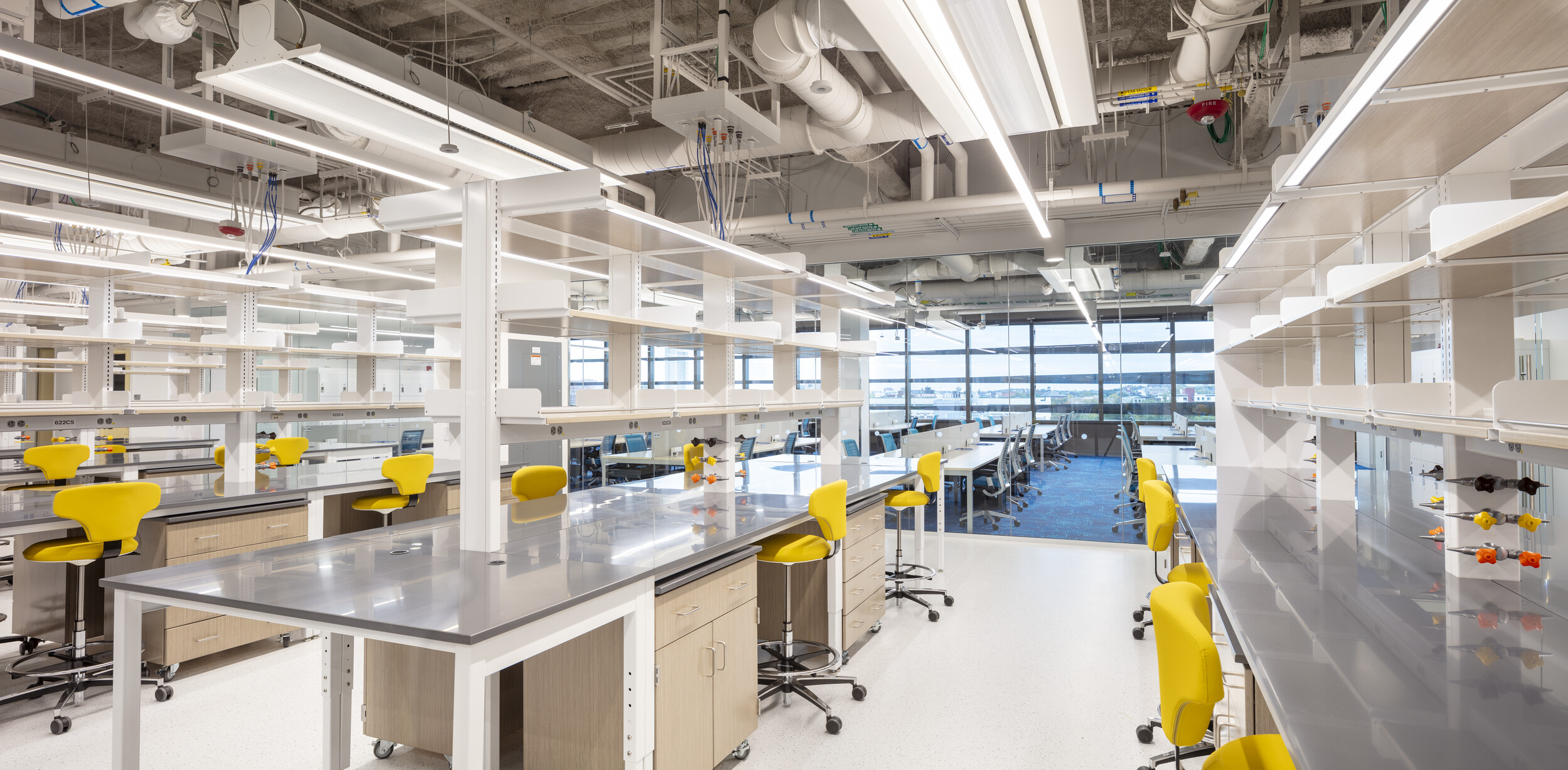
Project example: Lighting controls at Northeastern University EXP
Northeastern University EXP building, completed in 2023, is a 350,000-square-foot, LEED Platinum-certified research and academic facility in Boston. EXP set ambitious goals to be a new standard for sustainable, flexible and collaborative environments for the Northeastern campus and for h igher education in general. The building’s lighting and controls strategy was central to achieving its ambitious energy, sustainability and user-experience goals. From the outset, the project team prioritized a lighting system that would:
- Maximize energy efficiency and daylight use.
- Support a wide range of activities, from research labs to makerspaces and social areas.
- Provide flexibility for future changes in programming and occupancy.
- Enhance user comfort and visual quality.
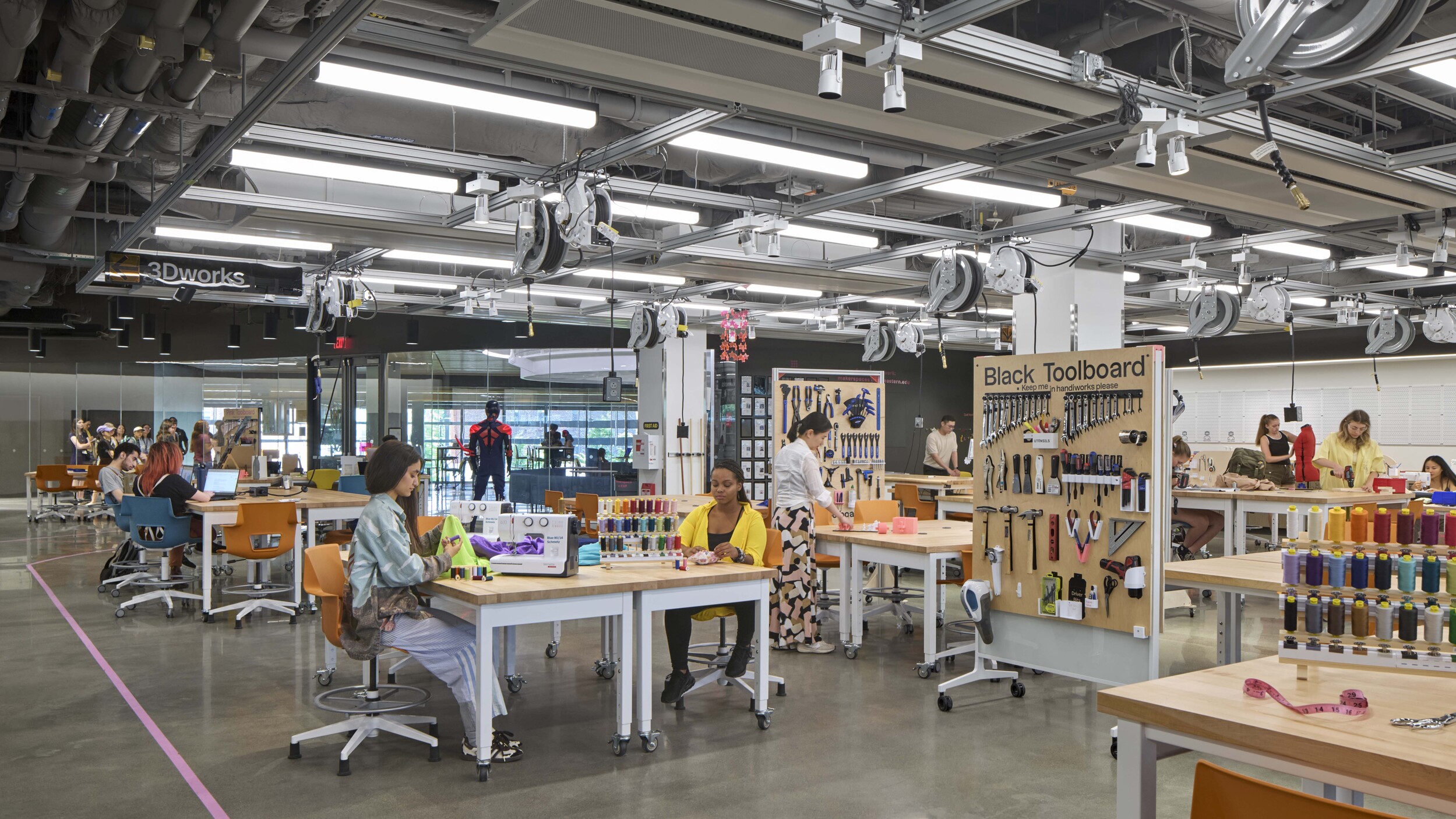
The EXP building features a fully networked digital lighting control system as its backbone. This system integrates multiple control technologies including digital addressability, traditional 0- to 10-volt (V) dimming functionality, digital multiplex and Bluetooth protocols to enable maximum flexibility and responsiveness across diverse spaces. Key features include:
- Networked controls: The system is centrally managed and allows for local overrides and scene setting. It automatically dims or powers down lights based on occupancy and available daylight, conserving energy and extending luminaire life.
- Tunable white lighting: In signature spaces such as the central stair and atrium, tunable white LED fixtures are controlled via a combination of 0- to 10-V and individual addressability, allowing dynamic adjustment of color temperature and intensity to match circadian rhythms and architectural intent.
- Task and ambient layering: In makerspaces and labs, general ambient lighting is paired with individually controlled task lights. These task lights support both flexibility and user control as well as energy efficiency.
- Daylight integration: Automated shades and daylight sensors work in concert with electric lighting controls to maximize daylight harvesting, reduce glare and maintain visual comfort throughout the deep floorplate.
The lighting controls were carefully coordinated with the building’s architectural and mechanical systems. Device locations, power packs, distributed zone controllers and LED drivers were strategically placed for accessibility and ease of maintenance. The system’s user interface was designed to be intuitive, supporting both building management and end-user adjustments. This intuitive design extended to management of the system by facility engineers, as the system selection was ultimately driven by maintaining consistency with other systems already in place on campus. Performance and value outcomes include:
- Energy efficiency: The lighting design achieved a 30% reduction below ASHRAE 90.1 code requirements for lighting power, contributing to EXP’s LEED Platinum certification. The building realized a 50% improvement in energy use over typical lab buildings, with lighting controls playing a significant role.
- User experience: Occupants benefit from high-quality, visually comfortable environments that adapt to changing daylight and occupancy patterns. The ability to tune lighting scenes and color temperature enhances both well-being and productivity.
- Flexibility: The networked system supports future reconfiguration as research and teaching needs evolve, protecting the university’s investment and supporting long-term sustainability.
The Northeastern University EXP project demonstrates how advanced, networked lighting controls can deliver measurable energy savings, support dynamic academic environments and enhance user experience. The integration of digital controls, tunable white lighting and daylight-responsive strategies positions EXP as a model for sustainable, future-ready campus buildings.
Standardization of lighting controls
For Northeastern and the EXP project, having the lighting control system not only as a networked solution but one that can integrate with the campuswide network of lighting controls provided tremendous value, including:
- The ability to remotely access and manage building lighting allows the energy management team to rapidly respond to user needs.
- Consistent use of the same technology and control platform across much of the campus allows for greater responsiveness with reduced training. For many projects on campus, the building automation team can start-up and commission a system on its own, ensuring that desired outcomes can be achieved.
- Establishing a standard is beneficial for ongoing maintenance, allowing for an attic stock of components that can be used for many buildings. Combined with an in-house ability for system programming, this can drastically reduce downtime for any component failure without relying on third-party vendors for support.
- System support from the manufacturer as needed yields enhanced value. With standardization across multiple buildings, the level of system support provided by manufacturers and vendor technical support teams results in tremendous value. For each technical challenge that is solved, the university’s energy management teams learn how to address issues if they come up in other buildings. “
Networking versus stand-alone controls
Capital costs can often be a significant driver for a project, with the pressure of meeting project goals in a delicate balance with the available capital funding. Lighting controls are not immune to these pressures and the option of stand-alone controls in lieu of a networked solution often arises as a value-management tactic to reduce cost and complexity through simpler approaches to lighting controls.
When considering the use of stand-alone controls, it is important to understand who will be ultimately managing the facility and how the decision for a single building or project fits in the context of a larger portfolio of managed properties.

A stand-alone facility with local on-site electrical support could realize value in stand-alone controls, particularly if maintenance support is provided by electricians who are most comfortable with nondigital solutions. For maintenance, components can be easily kept as an attic stock inventory and replaced in the field by electricians. With minimal digital interactions required, device settings can be manually adjusted and applied in the field.
Hybrid solutions can add value where spaces with less lighting control complexity can use stand-alone devices for lower capital cost and easy maintenance, while areas with higher complexity may opt to use a strategic, more focused application of a networked solution. This can strike the balance of capital cost reduction with management capability for spaces that need greater control capability such as scene controls, astronomical time clock events or digital integration with other systems.
Benefits of networked lighting controls for maximizing value
For a facility that has remote support and/or management by a building automation team, a networked system will pay dividends in the long run. The marginal cost of a networked system versus the use of stand-alone controls is best managed through reducing design complexity. Much of the value achieved through a stand-alone control solution is driven by the simpler approach to control intent (e.g., fewer zones of control, fewer devices and a focused control approach).
For a facility that operates 24/7, the capability of a networked system to allow a facility manager to remotely manage the system can be critical. Eliminating the need for a technician to physically go to a system/device problem can allow for more immediate response to making changes. Benefits include user satisfaction and reduced operational costs.
Flexibility is greatly enhanced with a networked system, as user preferences (e.g., dimming setpoints or occupancy sensors time-outs that are too fast or too slow) can be adjusted instantly by the facility manager without anyone needing to physically enter the space.
Long-term adaptability is enhanced with networked controls. As building use changes over time, schedules can be adjusted, functionality can be updated and light levels can be tuned digitally.
System integration through BACnet
On the EXP project, the building automation team found that BACnet integration of the lighting control system with the building management systems (BMS) provided significant value. Having learned from experience on the Interdisciplinary Science and Engineering Complex next door, by allowing lighting control sensors to send data to the BMS, the ability to modify heating, ventilation and air conditioning system programming was enhanced through detailed occupancy data.
Demand management
Another noted benefit was the ability for a lighting control system to respond to a utility demand management scenario, also known as demand-side management. This strategy enables utilities to impact the amount of energy customers use at a given time through a demand reduction, which in turn can reduce the utility’s need for peak generation. In the case of Northeastern, the demand response supports reducing peak loads across multiple buildings for an aggregate campus reduction.

The university’s energy management team noted that while a small decrease in lighting output within any given building may not be a large demand reduction, the aggregate of reductions across many buildings can have a substantial impact. In a campus application, where utility demand is based on a campus-level metered connection, small reductions across a portfolio of projects enable a measurable demand decrease and energy savings. These reductions have little to no effect on end-user experience within the buildings.
System flexibility and long-term maintainability
Design of a lighting control system that allows for system flexibility is a common topic on many projects and is more commonly referred to as adaptive reuse. Per the AIA, adaptive reuse can be summarized as “intentionally designing the building so that adapting it for future uses is not impossible or cost prohibitive.” The lighting control system can play a key part in this adaptability, as it can allow a space to adapt to changing use cases without the need for physical interventions.
For this Northeastern University building, individual addressability of luminaires can lead to long-term satisfaction of building occupants. The spaces at Northeastern frequently see diverse uses and when these spaces can be designed for control of individual lights, this provides greater functionality for any kind of user request.
Smarter design at the outset of a project can have long-term effects on building use, including:
- Where possible, grouping and locating lighting controls equipment in electrical rooms creates less disruption in the space and allows for electrical and building automation teams to address hardware/equipment maintenance directly.
- Where distributed devices (such as powerpacks) are required, providing a level of rationality to the layout with thoughtful, consistent locations used throughout a building makes long-term maintenance easier.
- The construction team should provide clear, complete shop drawings showing all equipment locations, particularly if remote drivers for lighting fixtures are used.
- Wiring strategies should be considered for long-term facility operations, not for ease of installation during construction.
Advanced lighting controls
Lighting design is a cornerstone of architectural and interior planning, influencing aesthetics, function, energy efficiency and occupant well-being. With the rise of advanced lighting control systems, a common misconception is that technology can act as a cure-all for any design condition. However, the principles of good design remain and placing an undue reliance on technology to resolve issues that should have been addressed during planning does not set a project up for success.
The foundation of successful lighting lies in designing to meet requirements from the outset, with a strong emphasis on understanding and implementing all project requirements into both the design and control strategy:
- Design for operational efficiency: During design, focus on system solutions that will lead to the greatest operational efficiency and make the biggest difference for the life of a project. Meet users where they are and help guide them to what will lead to maximum operational life over the next 50 years.
- Embrace new technology: As the world heads into an increasingly digital future, having a team of individuals that can manage a digital-based system sets any facility up for success. As the prevalence of artificial intelligence rapidly emerges, the intelligence of a facility depends on the inherent networked capabilities. Adapting to change and prioritizing infrastructure investments represent essential choices that designers must be prepared on regarding how best to guide clients.
- Collaborate with a trusted design partner: Leaning on the experience of a lighting design professional is key to finding the balance between operational capability and capital costs. However, that design professional must also listen to and understand client expectations while navigating code and project-driven requirements.