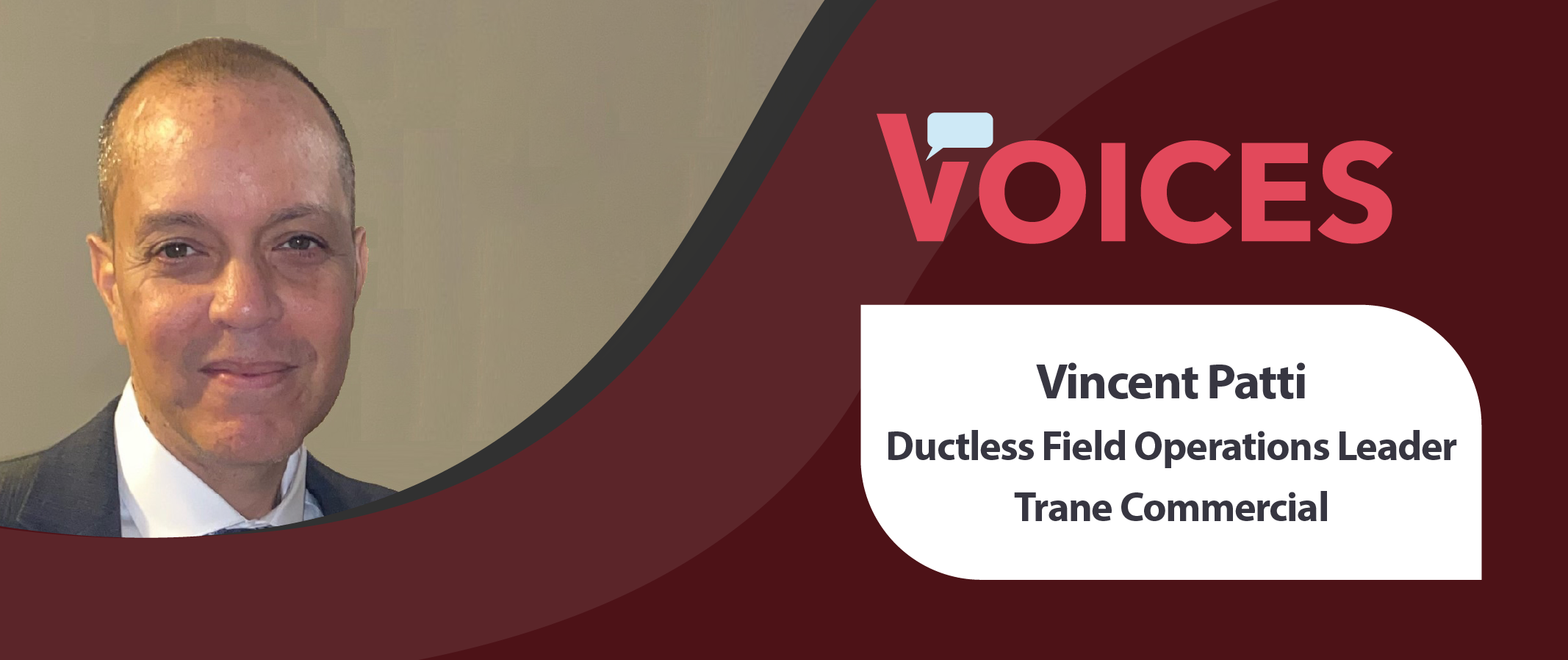
This article is sponsored by Trane. In this Voices interview, Consulting Specifying Engineer spoke with Vincent Patti, Ductless Field Operations Leader at Trane Commercial, to discuss the ways Trane supports engineers in designing ductless and VRF systems, and how its nationwide team of specialists and training centers help engineers and contractors deliver successful installations.
Consulting Specifying Engineer: Can you give us an overview of your role as the Ductless Field Operations Leader at Trane and what your day-to-day responsibilities entail?
Vincent Patti: My primary focus is to develop the post-sale strategies so that we, as Trane, can support our customers in the best fashion necessary.
When we think about presale, we also think about post-sale. They are two different buckets. The Presale side is where the design engineers work with our Trane team to help them design and apply equipment. For example, a design engineer has a vision, they put that on paper, they connect with Trane, and Trane will help them select the proper equipment.
A project will go out to bid, a winning contractor will be awarded, fast-forward and the shipment of the equipment will occur. That’s when I look at post-sale. Now that the customer has the equipment, what do they need to do to get that equipment successfully installed? That gives us two sides. There’s the visionary side with the engineer, but then there’s an execution side with the post-sale, the field-installed equipment.
My team specifically focuses on executing the installation of this equipment at an extremely high level. We have 54 Ductless Technical Specialists across the nation, and those individuals are our subject matter experts, who focus solely on Trane Mitsubishi Electric Ductless, and VRF equipment. These individuals are assigned to every single project that we sell, and they are a one-on-one liaison for that contractor. They can call them on their cell, text them, email them. But furthermore, these individuals will be on-site with the contractor as their resource.
Think about an engineer who is specifying equipment. They may not know who is installing it. But knowing that we at Trane have these individuals available to support the contractors is extremely impactful.
Another opportunity that we offer our customers is our training centers. Currently, we have 18 centers across the U.S. Next year, we’ll be opening one more, which will be our 19th. The idea is: Do we have a center in a location where a customer can reasonably get there? Are we asking them to fly somewhere? No, we want to have these centers strategically placed so that they can jump in a car and get the design and installation training that they need.
In what ways do your Ductless Technical Specialists support engineers in the design of ductless and VRF systems, and how do they assist contractors during installations? How does this support contribute to the overall success of these projects?
Our post-sale Ductless Technical Specialist teams work directly with our Ductless Dales Specialist teams. Typically, on the pre-sale side, the Ductless Sales Specialists have the relationship with the engineers, but the ductless technical specialists really understand what the job requires to work seamlessly from a field perspective.
It’s one thing to read a sequence of operations on paper, but when we implement that in the field, our Ductless Technical Specialist will translate that back to our Ductless Sales Specialist. That means when they’re having the conversations with the engineers, we know this is probably a situation where we can adjust, maybe tweak some things on the design side, so that at the end of the day, the product that we’re outputting is exactly what the engineer is looking for.
Our relationship from a post-sale perspective doesn’t necessarily directly connect with the engineers on a daily basis, but indirectly through our Ductless Sales Specialists and our Trane Account Managers. We collectively work as a team to make sure that the engineers have the information they need to properly design the equipment.
With 18 training centers across the United States, how does Trane ensure that engineers, contractors and technicians are well-trained and up to date with the latest technologies and installation practices?
There are different avenues for this, so I’ll speak on the engineering side. We have a tool we refer to as Diamond System Builder. Think about an engineer laying out a project, and there are tons of pieces of equipment to select.
This tool allows an engineer to select a piece of equipment and successfully pair it with the right outdoor unit. So, if you think about stepping back, imagine you’re driving through a neighborhood and you see a small residential ductless system. They’re all over the place. That system is not compatible with a large VRF system, so if the engineer mistakenly connected these two, that program that we have will say, wait a second, these two are not compatible, we need to connect a different indoor unit.
What we do is offer this training for all our engineers, and we have 126 commercial sales office (CSO) locations throughout the United States, where an engineer can connect with a local CSO and get specified training on this design software. That’s really the beginning stages of the project .
Can you share any success stories or examples where your team’s support significantly improved the outcome of a ductless or VRF installation project?
For my side, post-sale and field execution, what the team does on a daily basis becomes the norm, if that makes sense. We’re constantly supporting contractors on-site every day, so the crisis that we may avert is done through a situational type of scenario.
I’ll give you an example of something that happened recently.
We had a contractor we were supporting, and we shipped them equipment for a couple of different sites at one time. Now, think about their warehouse. They have a couple of projects going on, they have equipment in their location, and their mindset is, “We want the equipment, we will go out to the site, and we will deliver that equipment ourselves to the location when we’re ready.”
So, they gear up, they load up some equipment and bring it to a site. They connect with our DTS, our DTS sets a kickoff meeting up to review the project. We look at all the equipment as part of our inspection, which means we realize that there is one unit there that is the incorrect voltage. We start digging into it and realize that the unit they grabbed from their local office was meant for another site.
Think about how this could have been rigged, could have been wired, and what kind of catastrophic event that could have been after the fact. Situations like this happen all the time, all day, and that’s just proactive, install-related problems. Just think about the level of support that a contractor will have, knowing that if they need any support, they are not calling an 800 number, they are calling a person who’s going to be on-site with them as a dedicated 1:1 support person.
That level of confidence is important, because the skill set between various contractors differs greatly, but we kind of level that playing field by being there to support contractors that have limited experience, contractors that are very experienced and anywhere in between.
How does Trane’s approach to field operations and training differ from other companies in the HVAC industry?
The first question we ask ourselves is: are we putting our contractors in the best position to win? And if we’re not offering installer training, we don’t believe that we’re putting ourselves, or putting them, in the best position to win.
Our training center platform is continually growing. Trane believes in it wholeheartedly. We will continue to invest in this, because we believe if the contractor’s equipped with the tools that they need, there is a better outcome. And that goes back to the engineering design aspect. If an engineer has created a vision, well, that’s limited by the installing contractor.
And knowing that the execution is absolutely paramount to a successful outcome, we have the ability to kind of bring these folks into our organization, hold their hand, give them the training they need and get them squared away.
The next thing we think about is the Diamond Designer class, which is kind of the proactive approach. If we have the vision of the design properly executed from the beginning — if we marry those two together, we have a really good design.
We have very good execution from a field perspective. We have individuals that will be on-site, holding the contractor’s hand during the entire process and beyond. We believe that this level of customer experience is hard to top, and the feedback we receive is incredible.
For more information, visit Trane.