This year’s Salary Report reveals high-paying jobs with lots of pitfalls for MEP/FP engineers.
MEP/FP engineering insights
- The 2025 Consulting-Specifying Engineer Salary Report shows that while MEP/FP engineers are earning record-high compensation, they are simultaneously facing growing workloads, economic uncertainty and anxiety over rapid technological change.
- Firms are struggling to balance strong financial performance with the urgent need to train younger engineers, address staffing shortages and integrate emerging tools like artificial intelligence without eroding human expertise.
The latest Consulting-Specifying Engineer Salary Report reveals a complex reality for engineers specializing in mechanical, electrical, plumbing and fire protection (MEP/FP) systems: While compensation has reached new heights, so too have professional pressures and technology anxieties. The data highlights that this field, represented by mechanical (48% of respondents) and electrical/power (39%) engineers, is navigating a period of financial uncertainty alongside critical operational challenges.
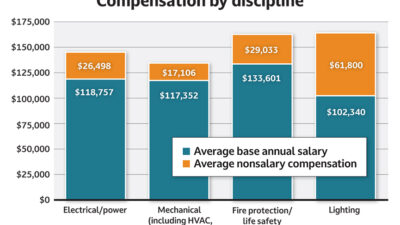
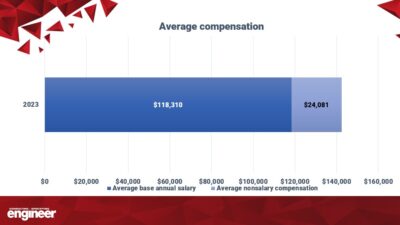
On the plus side, the long-term trend in compensation is robust. Since 2014, average base salaries for engineering professionals have risen by 23.5%, climbing to $122,456 in 2024. Furthermore, nonsalary compensation — including bonuses and profit sharing — has soared by an even greater 86.8% since 2014, with 73% of engineers receiving an average of $23,760 in 2024. Electrical/power engineers lead the financial gains, reporting the highest average base salary at $132,836, closely followed by mechanical engineers at $117,913. This financial buoyancy underscores the value placed on these essential building system disciplines.
However, these financial gains are shadowed by massive workload pressures. The top challenge cited by respondents is the pressure to reduce project timelines and costs (41%), which increased slightly from 37% last year. This was immediately followed by coping with shifting client expectations and demands at 27%, down from 38% last year. This reality translates directly to individual engineers, who report working an average of 43 hours per week, up from last year’s 41 hours per week. And at the higher end of hours worked, the percentage of respondents who worked 50 or more hours per week rose from 17% last year to 24% this year.
This relentless workload, coupled with economic uncertainty and staffing concerns — such as the noted shortage of junior team members — is exactly what keeps one-quarter of engineers awake at night.
Looking ahead, technological changes represent both a promise and a threat. While professionals anticipate that tools like artificial intelligence (AI) and advanced smart sensors will be important in the next six months, 44% of respondents express significant concern that AI will replace human decision-making. Engineers, therefore, face a mandate to adapt rapidly, even as 34% report difficulty keeping up with new software and technologies. For MEP/FP firms, the challenge is clear: leverage record compensation to attract and retain talent while simultaneously investing in the training needed to harness these new tools, transforming AI from an existential threat into a powerful design partner.
The critical shortage of new and up-and-coming engineers remains a pressing issue that threatens the long-term health of the MEP/FP field. One-quarter (25%) of survey participants specifically cited difficulties with having “not enough junior team members to prepare for the future” as a top challenge. This concern is rooted in demographic statistics: the average engineering professional in the survey is 52 years old and only 23% are under the age of 40. Addressing this knowledge transfer gap is vital, especially given that only 7% of respondents are under 30.
Firms are actively trying to bridge this divide by prioritizing tactics like internships/co-ops (57%) and college/university placement offices (43%) to recruit new talent. Crucially, the veteran workforce shows strong engagement, with 58% of respondents participating in mentoring programs, confirming that management understands that preparing the next generation is essential for minimizing future staffing crises.