ASHRAE Standard 90.1 is an energy efficiency standard often referenced in the International Energy Conservation Code. Learn to navigate both for building energy standards.
Learning objectives
- Review the scope and intent of ASHRAE Standard 90.1 and the International Energy Conservation Code.
- Learn how states and municipalities adopt and enforce ASHRAE 90.1 as part of the energy code.
- Understand the different prescriptive and performance paths in ASHRAE 90.1 and the IECC to achieve building energy compliance.
ASHRAE 90.1 insights
- The IECC and ASHRAE 90.1 together form the foundation of U.S. building energy regulation, with the IECC serving as an enforceable code and ASHRAE 90.1 providing detailed, system-specific minimum efficiency requirements for most nonresidential buildings.
- Because jurisdictions adopt different editions and may prioritize ASHRAE 90.1 as an alternative compliance path, careful alignment with local code adoptions is essential to avoid design errors and rework.
Many different editions of energy efficiency codes, standards and rules have been adopted and adapted by various jurisdictions across the country which requires research and discussion with the authority having jurisdiction during the schematic phase of a building’s design to avoid mistakes and missteps as the design progresses.

International Energy Conservation Code (IECC) and ASHRAE Standard 90.1: Energy Standard for Buildings Except Low-Rise Residential Buildings are two primary documents that provide energy conservation requirements for buildings.
The IECC is an enforceable legal document outlining energy efficiency requirements for design and construction of residential and commercial buildings. The IECC mentions ASHRAE 90.1 as a supplemental requirement that provides jurisdictions with optional requirements to reach “zero energy” buildings.
The IECC is published by the International Code Council, an organization that also creates and updates other international codes such as the International Mechanical Code. ASHRAE 90.1 is an energy efficiency standard, often referenced and incorporated into the IECC, which establishes minimum energy efficiency requirements for design and construction of buildings other than low-rise residential buildings and covers building envelope, heating ventilating and air conditioning (HVAC) systems, service water heating, power, lighting and other equipment.
ASHRAE 90.1 applies to new buildings and systems, new portions of existing buildings, specifically identified new systems and equipment in an existing site, new systems and equipment in existing buildings or new equipment and building systems that are identified as being part of process applications. The standard also provides methods for determining compliance.
Intent and scope of ASHRAE 90.1
ASHRAE 90.1 is a standard with more detailed and system-specific requirements organized into five sections. Each section provides general requirements as well as the different compliance paths to be followed.
Building envelope: Section 5 of ASHRAE 90.1 provides standards for building envelope. One of the major drivers of this section is the climate zone (detailed in ASHRAE Standard 169: Climatic Data for Building Design Standards), which then impacts many additional sections of the standard such as building envelope, heating and cooling systems and HVAC systems using economizers.
ASHRAE 90.1 breaks down the building component requirements according to climate zone. Building components include the minimum or maximum U and R values and solar heat gain coefficients for various types of roofs, walls, floors, doors and fenestrations. The climate zone should be determined at the start of a design, as that will affect not only the building envelope section but also the other sections described herein.
HVAC systems, equipment and controls: Section 6 of ASHRAE 90.1 covers requirements for HVAC. The scope of this section is mechanical equipment and systems in new buildings, additions to existing buildings and alterations to HVAC and refrigeration in existing buildings. This section states minimum equipment efficiencies and control guidelines for different types of spaces and equipment including air-source and water=source heat pumps, computer room air conditioning (CRAC) units and other packaged cooling equipment, cooling towers and other heat rejection equipment, gas-fired and oil-fired equipment, commercial refrigerator and freezer systems. This section provides the predominate information on energy efficiency.
Service water heating systems and equipment: Section 7 addresses service water heating systems and equipment in new buildings, additions to existing buildings and alterations to existing service water heating systems and equipment.
Power: Section 8 of ASHRAE 90.1 describes power requirements that apply to all power distribution systems and equipment in new buildings and offers more specific guidelines when dealing with existing equipment and system infrastructure. This section includes an alternate compliance path for CRAC systems that does not need to meet the mandatory provisions that other paths do in which power distribution systems and equipment serving a computer room with information technology (IT) equipment load greater than 10 kilowatts (kW) must instead comply with ASHRAE Standard 90.4: Energy Standard for Data Centers.
Lighting systems, equipment and controls: Section 9 of ASHRAE 90.1 outlines lighting requirements that apply to building lighting equipment and systems, including systems serving the interior spaces of buildings and exterior applications.
IECC as a model code
The IECC is a model code with more broad performance-based requirements. The IECC provides market-driven requirements, which focus more on solving the user’s problems and the needs of the market at the time for the design and construction of commercial buildings and provides the minimum efficiency requirements for them. The IECC provides jurisdictions with the option of supplemental requirements, including ASHRAE 90.1, which provides pathways to achieving the minimum efficiencies required.
In addition, the IECC includes a section for all residential buildings. The IECC is a model building code, meaning it is meant to serve as a model code that municipalities can adopt and amend to account for more specific local conditions.
The IECC references ASHRAE 90.1 as an alternative compliance path, thus allowing some jurisdictions to use the IECC to adopt ASHRAE 90.1 entirely. Section C401.2.2 of the IECC states that commercial buildings should comply with ASHRAE 90.1. ASHRAE 90.1 sets the standard for certain equipment performance requirements while the IECC provides broader overall building performance specifications. In cases where the IECC has stricter requirements, those requirements take precedence.
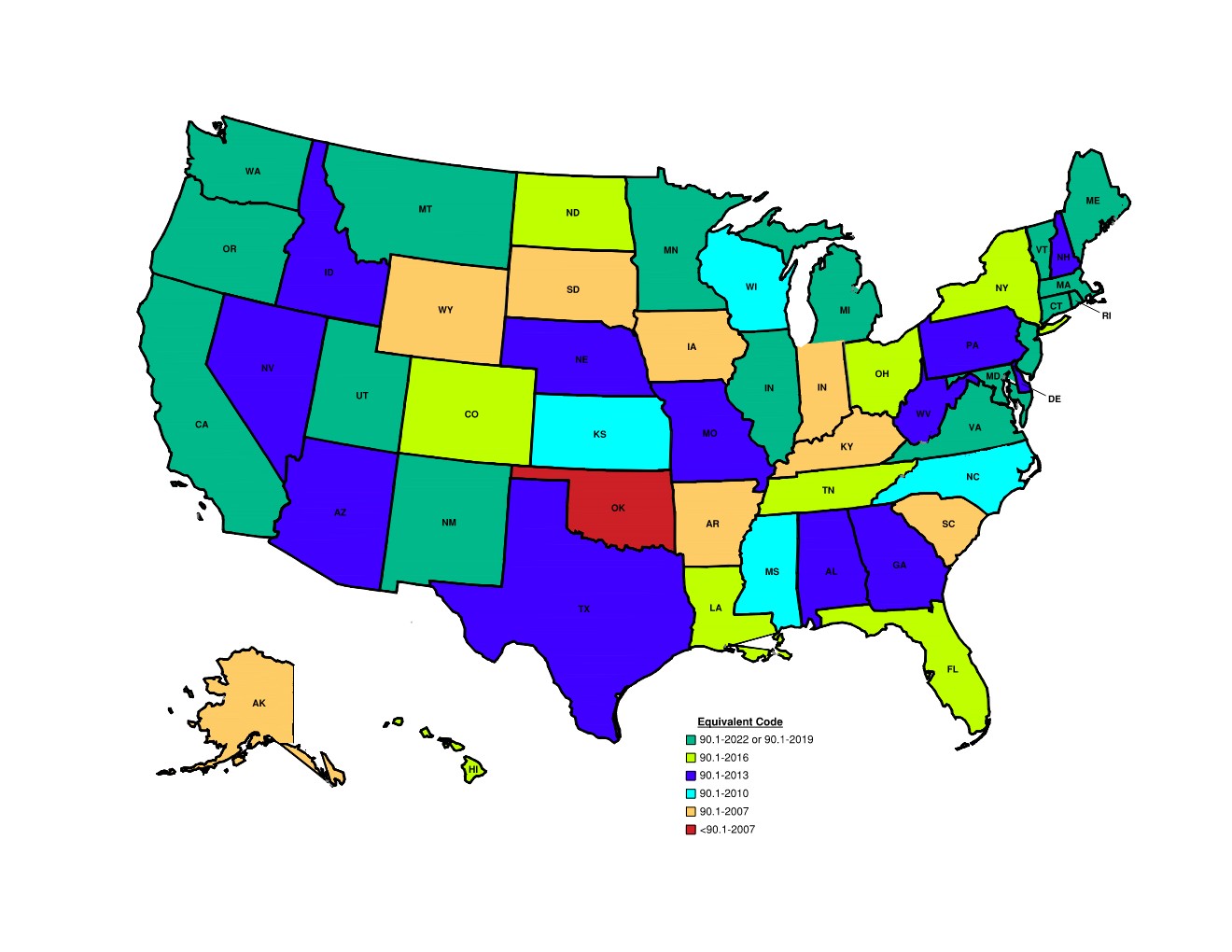
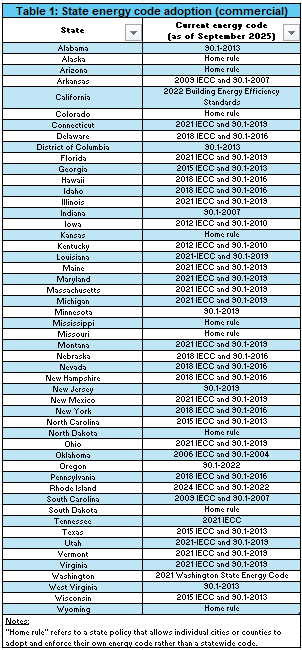
Most states have adopted a current or past edition of both the IECC and ASHRAE 90.1 as their energy codes. Alabama, Washington, D.C., Indiana, Minnesota, New Jersey, Oregon and West Virginia adopted ASHRAE 90.1 as their current commercial code.
Following the correct code
Jurisdictions can choose which edition of the IECC and ASHRAE 90.1 to follow; therefore, throughout the United States, different states have adopted different editions of each standard. Oklahoma, for example, still references the 2004 edition of ASHRAE 90.1 and adopts the 2006 edition of the IECC as its base energy code. Many states have incorporated stricter requirements into their adopted energy codes and some states in the northeastern United States, such as Massachusetts, have gone further and created “above-code” appendices, referred to as “stretch codes.”
Some municipalities and jurisdictions within a state use the “home rule,” which allows the municipality or jurisdiction to have the primary authority to adopt, implement and enforce building energy efficiency codes. These local requirements are stricter than the requirements of the IECC and ASHRAE 90.1. The states that allow their local governments to use the “home rule” include Arizona, Colorado, Kansas, Missouri, North Dakota, South Dakota, Texas and Wyoming.
The codes have evolved substantially during the past 20 years; the requirements in one state can be different from those in another state using newer editions of these codes (see Table 1).
Achieving code compliance
The IECC and ASHRAE 90.1 provide different paths for evaluating compliance. Path determination depends on criteria such as the condition (new or existing) of a building or system and the desired performance goals. The compliance pathways in the IECC are the prescriptive method, the total building performance method or compliance with ASHRAE 90.1.
ASHRAE 90.1 Section 4 details the compliance paths as conformance with sections 5 through 11, Section 12 the “Energy Cost Budget Method” or Appendix G “Performance Rating Method.” Sections 5 through 11 detail specific paths for the different building components.
The Energy Cost Budget Method is a method that can be used in place of the prescriptive pathway for proposed design compliance unless the design does not have a mechanical system. This method compares the estimated annual cost of energy for the proposed building to the cost for a minimally compliant building, given requirements from the prescriptive path. The Performance Rating Method (also referred to as Appendix G in ASHRAE 90.1), uses a performance cost index equation to compare new buildings and additions with a baseline building.
Focusing on Section 6 “HVAC Systems, Equipment and Controls,” there are five different compliance paths offered: the simplified approach, prescriptive path, alternate compliance, energy cost budget and performance rating. There are also overall mandatory provisions that all compliance paths, except for the simplified approach, must follow. All mechanical equipment systems, including systems that qualify for the simplified approach, must still comply with the requirements in Sections 6.1 “General,” 6.7 “Submittals,” and 6.8 “Minimum Equipment Efficiency Tables.”
Additionally, all refrigeration equipment and systems must comply with the prescriptive compliance path, while all HVAC systems must comply with one of the compliance paths — prescriptive or otherwise.
Simplified approach (Section 6.3 in ASHRAE 90.1): This approach is an optional path for compliance that can only be followed if all HVAC systems in the building qualify. To qualify, the building must be two stories or less, have a gross floor area less than 25,000 square feet and each HVAC system must comply with all the requirements outlined in Section 6.3.2; the first of these requirements is that the system serves a single zone.
Mandatory provisions (Section 6.4 in ASHRAE 90.1): Section 6.4 covers the mandatory provisions that all the following compliance paths must abide by. This section references the tables in 6.8.1 that provide minimum equipment efficiencies for standard rating and operating conditions. Additionally, this section provides minimum equipment efficiencies for nonstandard operating conditions, verification and labeling requirements and control and diagnostic requirements.
Prescriptive compliance path (Section 6.5 in ASHRAE 90.1): Section 6.5 covers the prescriptive compliance path. This pathway provides details about when different types of equipment are and are not required.
For example, to comply with this section, air or fluid economizers must be provided unless there are individual fan-cooling units with a supply capacity less than the minimums listed in the section’s tables (in which case an economizer is not necessary). This is the most comprehensive and stringent compliance pathway because all the system components must meet the criteria and because the pathway can be followed for nearly all design cases.
Section 6.5 also provides tables listing the efficiency and other equipment requirements by climate zone, as outlined in the building envelope section of this document, as well as any exceptions. The equipment outlined in this section include:
- Economizers — fluid and air, simultaneous heating control — hydronic systems, dehumidification, humidification, preheat coils and ventilation air heating control.
- Air system design and control — fan systems and variable air volume efficiency and control.
- Hydronic system design and control — boilers and chillers.
- Heat-rejection equipment — air-cooled and evaporative condensers, dry coolers, open- and closed-circuit cooling towers and any other heat-rejection equipment used in comfort cooling systems.
- Energy recovery — exhaust air energy recovery, heat recovery for service water heating and space conditioning, dehumidifier energy recovery.
- Exhaust systems — transfer air, kitchen and laboratory exhaust, radiant heating.
- Refrigeration systems — refrigerated display cases, walk-in coolers and freezers connected to remote compressors, condensers or remote condensing units.
Alternative compliance path (Section 6.6 in ASHRAE 90.1): There are two compliance paths under Section 6.6.
- The first is the computer room system path for HVAC systems, which only serves the needs of a computer room with IT equipment and a load greater than 10 kW, wherein ASHRAE Standard 90.4 must be met instead. All other HVAC systems must follow the prescriptive compliance path in Section 6.5.
- The second is the mechanical system performance path, which was newly incorporated in the 2022 edition of 90.1, and applies when HVAC systems in the building meet the criteria in Section L.1.1.1. To comply with L1.1.1, the following criteria must be met:
- The HVAC system type must be included in Table L1.1.1.
- The system must serve a building type included in the section but not those system types excluded in L1.1.2.
- The system must also be powered by grid-delivered electricity, natural gas, propane, renewable electricity, renewable thermal energy or distillate fuel oil. To comply, the proposed design’s total system performance ratio (TSPR) of the HVAC system must be greater than or equal to the TSPR of the reference building divided by the mechanical performance factor.
Energy cost budget (Section 12 in ASHRAE 90.1): This is a performance-based method that cannot be used for building designs without a mechanical system. Compliance by the energy cost budget method requires that the design energy cost be less than or equal to the energy cost budget × (1-(energy credits required/1,000) × an adjustment factor.
Performance rating method (Appendix G in ASHRAE 90.1): This is a method that allows more flexibility in design. Trade-off are allowed when exceeding compliance in some prescriptive areas can allow for not meeting some requirements in other areas.
However, this method still has mandatory sections that must be met by all proposed building designs. This method is useful in project-specific applications and allows a “tradeoff” where some requirements do not need to be met if they can be made up in other areas by exceeding other requirements. Credits can be available for selecting more efficient HVAC and service water heating equipment, optimizing a window area and correctly sizing HVAC equipment. Equations and models comparing a general baseline HVAC system, based on standard practice, to the proposed design are used to determine whether different aspects of the building comply.
Mechanical system performance rating (MSPR) method (Appendix L in ASHRAE 90.1): The MSPR is mentioned as an alternative compliance path in section 6.6. To use this method, the building must comply with all of the criteria listed in L1.1.1 and L1.1.1.1. Many types of HVAC systems are excluded from the MSPR, which are detailed in L1.1.1.2.
Section L2.1.5 provides guidance on how to calculate the total system performance ratio (TSPR), which is the basis of proving compliance with this method. A simulation program is used to calculate both the TSPRp (proposed) and TSPRr (reference) using input for the proposed design and requirements from the appendix. The simulation program must be approved by a code official as well as meet minimum capability requirements outlines in L3.2.1 to be used. Unlike appendix G, this method does not allow tradeoffs.
Navigating ASHRAE 90.1
ASHRAE 90.1 provides requirements and guidelines for the design of various sites and buildings. By following this standard, compliance with the IECC typically can be met, and it is also important to ensure the design meets the jurisdictional requirements.
Both the IECC and ASHRAE 90.1 provide performance-based and prescriptive pathways to ensure compliance with the energy requirements. ASHRAE 90.1 works within the IECC as an alternative compliance path to the IECC.
New editions of the IECC and ASHRAE 90.1 are continually being released, so it is important to keep up to date with new editions. The 2022 edition of ASHRAE 90.1 included a lot of updates such as new compliance path options like the MSPR, part load modeling and energy credits.
Navigating the energy efficiency codes and standards can be a daunting and often confusing part of a design because states can adopt and reference multiple codes and standards with varying equipment or system requirements and compliance paths. In some cases, states even adopt a “home rule” that allows individual cities or counties to adopt and enforce their own energy code rather than a statewide code. For that reason and to avoid changes and rework later, a designer must research and carefully align with the version of the code that is adopted within the jurisdiction.