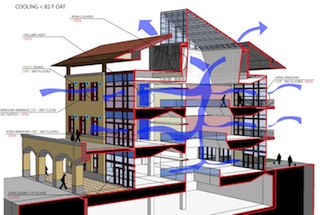
Although LCCA of individual system alternates is often valuable, it is important to recognize the whole building return on investment that is the basis for a building’s overall success. A brief example of such an analysis is included here for the Stanford Yang and Yamazaki Environment and Energy Building.
The results show the diversity of financial returns when energy investments are grouped into load reduction, passive systems, active efficient systems, energy recovery, self generation, and renewable energy offsets. The bold red line indicates the bundled performance of all strategies taken together. The results of this analysis helped convince Stanford University to elevate the performance of all future new and retrofit projects to a LEED Gold/Platinum level of energy performance.
Post-occupancy review
Energy consumption models developed during building design rarely match actual operating energy consumption when buildings are built and operated. Instead, energy models produced during design are intended to be indicative of relative performance between a code-derived baseline model (e.g., ASHRAE 90.1 or Title 24 compliant) and a design model reflecting the actual building design.
The focus on relative versus actual consumption is widely considered acceptable and is attributed to differences between simulation assumptions and actual operating conditions that influence energy consumption. Such conditions include changes to scheduling of equipment and lighting, occupancy density and behavior, climate variation, construction variances, and improper or incomplete commissioning. Some of these conditions are appropriate and can be addressed in a calibrated model, while others reflect an area of physical or operational deficiency that should be remedied.
Comparison and scenario evaluation of the Y2E2 facility post-occupancy showed that it uses more energy in absolute terms than the design stage model predicted. It also showed that the building saves more energy than initially predicted. As a result, there are larger absolute cost savings that actually provided a better return on investment. It should be noted that the percentage increase in relative energy performance remained consistent and only the absolute values varied. The caution from this review is that even though building physics can predict the relative performance of a building well, the absolute measure is more difficult, highlighting the need for rigorous sensitivity studies.
Roberts is an associate principal and energy and resources business leader in Arup’s San Francisco office. His experience ranges from climate-responsive building engineering and consulting to community energy systems, net-zero energy, and climate-positive design. Rhodes is a senior engineer in Arup’s San Francisco office, specializing in high-performance mechanical system design and energy monitoring. Hespe is a senior energy and sustainability designer in Arup’s San Francisco office, specializing in passive and ecological building design.