Field experience can teach us a lot of things that simply can not be learned in the classroom. In fact, some of the most valuable (and sobering) lessons I have learned as a designer have come from working out in the field with the systems I and others have designed. That statement is not intended to discount the value of the classroom experience. The reality is that the two learning environments compliment each other. The field provides endless lessons in applied physics while the class room knowledge provides the tools necessary to understand what you are seeing and the insight required to troubleshoot and optimize operating systems.
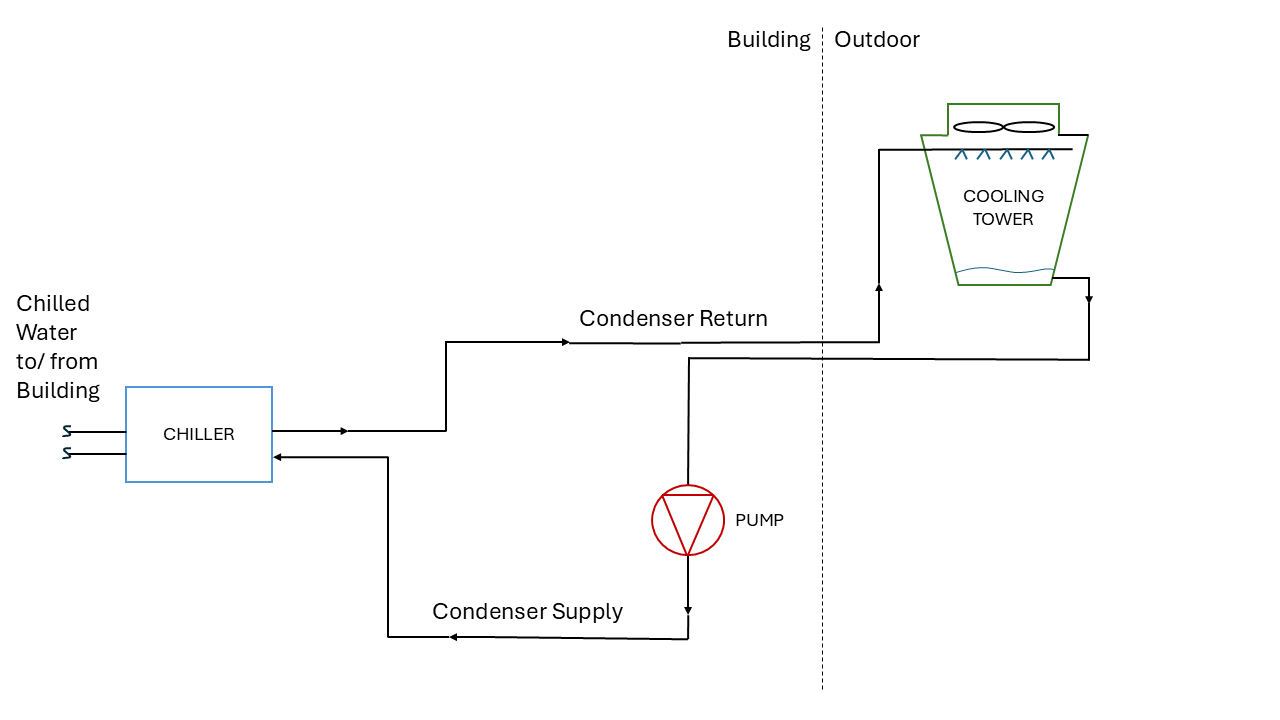
Currently, I'm working with a team of folks to bring some new systems on line that are part of a library renovation project on a college campus. One of the first systems we started to work with was the condenser water system, which is illustrated in the form of a system diagram in the two figures below.


One of the first issues that came up when the contractor placed the system on line was that the cooling tower basins would overflow in some operating modes. This is unacceptable because it wastes water and water treatment chemicals in addition to creating a mess on the roof. This is not an unusual problem in my experience and there are a lot of things that can cause it including the adjustment of the make-up system, balancing issues, obstructions in the piping, piping symmetry (or lack there-of), and, for multiple cell towers, the size of the equalizer line interconnecting the basins. I'm planning on looking at each of these issues in detail via a string of blog posts, starting with this one.
On the project in question, the designer had specified an oversize equalizer connection (8" versus the standard 6" size normally supplied by the manufacturer). Unfortunately, the towers were delivered and installed with the standard size connection and the issue was not identified until it was noted by an inspector who was looking over the towers after they had been bolted to the steel that supports them. The designer's off-the-cuff assessment upon learning of the oversight was that it would probably be O.K. and that we should take a "wait and see" stance before spending a lot of time and money retrofitting the towers in the field to provide the specified connection size.
As you have probably guessed, when the basin overflow issue came up, the undersized equalizer was immediately pointed to as the culprit. As a result, I decided to do a little math and see how big a factor the undersized equalizer was in the context of the installed and operating system. That way, we would have a better understanding of where to focus our attention as we worked to identify and correct the root cause of the problem. I'll discuss that calculation in a minute, but first, here is a little background information that you will need to follow where I am heading.
The arrangement of the towers on the project in question and some critical dimensions related to the overflow problem are illustrated below along with a picture of the tower outlet connection when it was first being piped up.


Note that the difference between the required operating level and level at which the tower basin will begin to over-flow is only a matter of inches. You can also deduce from the photo and dimensions on the drawing that an 8" outlet on a basin with a 7" operating level does not leave much margin for error in terms of running below the intended operating level. This particular tower is provided with a special fitting on the inlet, designed to create a siphon effect and keep the discharge line fully flooded even though the operating level is below the top of the outlet. Here is a picture of that if you haven't seen one before.

As you can probably see from the photo, it would not take much of a drop in operating level to defeat the fitting. If that were to occur, then we would run the risk of entraining air into the suction side of the condenser pumps, causing cavitation and loss of flow and subsequent loss of cooling when the chillers tripped off line. The bottom line is that for this cooling tower (and many others), maintaining a satisfactory basin water level can be a game of inches and the equalizer line or lines that interconnect the basins in a multiple cell tower have an important role to play in that game.
In general terms, the equalizer is intended to do what its name implies; provide a path for water to easily transfer between the tower basins, thereby equalizing the level between them. But, any real pipe with flow in it will have a pressure drop and the flow through an equalizer line will generate a level difference between the basins it interconnects that is a direct measure of the pressure drop created by that flow. When discussing pressure drops in piping systems, we are accustomed to thinking of a loss of 1 or 2 feet as not being very significant. And, relative to a system with say 50 or 60 feet of pressure drop or more, it probably isn't (energy conservation implications aside). But 1 or 2 feet of pressure drop equates to 12 to 24 inches of pressure drop and in the game of inches we are playing when we attempt to maintain a satisfactory basin water level in a cooling tower, that much pressure drop could mean we loose!
To understand if the equalizer line on the library cooling tower could be a significant problem, I decided to estimate how much flow would have to occur through it to generate a level difference of 3 inches between the two interconnected basis. I picked 3 inches because that is the difference that would trigger overflow in one basin if the other basin's level control system was holding the desired water level. I estimated the condition that would trigger overflow by calculating the loss through the equalizer for at a flow rate selected at random and then using the square law to extrapolate that information to other flow rates. The following table illustrates my calculation for the 6 inch connection provided as well as the 8 inch line requested by the designer. The graph illustrates my extrapolation via the square law.


It's important to recognize that the square law has its roots in the Darcy-Weisbach equation and assumes fully developed turbulent flow. At some of the very low flow rates that might occur in the equalizer line, this is probably not the case and the pressure loss will be lower than predicted. Since I was just looking for a limiting condition vs. an absolute answer, I felt comfortable using the square law to extrapolate my pressure loss calculation. But, if someone wanted to know exactly how much flow a 3" level difference would create between the basins, I would need to do some more math.
Some of you may be wondering where I came up with some of the numbers in my table. The friction rate for the pipe at the different flow rates can be found in a number of sources including the ASHRAE Pocket Guide and other ASHRAE publications, text books, piping handbooks, etc. Another option is to use one of the circular slide-rules that are out there like Bell and Gossett's System Syzer , an electronic version of which can be downloaded from there website. The loss for the wide open butterfly valve comes straight from manufacturer's data . The entry and exit losses also can be found in references like ASHRAE. I pulled the numbers I used from Crane's technical paper #410 - Flow of Fluids Through Valves, Fittings, and Pipes which was originally published in 1942 and is somewhat of a classic in the industry. My copy is a 1957 edition from a used book store (the physics governing all of this haven't changed much over time) but you can obtain a current copy from Crane's technical support website for a modest cost and its a good reference to have on your bookshelf if you are working with piping systems.
As you can see from my results, it would take a fairly significant flow rate in the context of the system to create a 3 inch level difference; probably 250 gpm or more, which is in the same ball park as the design flow rate for one cooling tower cell. In other words, to create a level difference significant enough to cause one basin to overflow even though the other was at the required water level, all of the water from the cell with the high level would have to be exiting the basin through the equalizer line, an unlikely situation unless there is an obstruction in the outlet from the cell. Thus, my conclusion was that the root cause of the problem probably was something else. As a side note, you can see that the larger equalizer creates a much larger margin for error and would in fact be desirable if you could get it up-front, but probably not worth the trouble to add it by retrofit in this particular situation.
The project commissioning team's investigation in the field bore out the conclusion I reached in my analysis; i.e. the issue was not the equalizer. In the next post, I'll look at some of the other potential causes of the overflow problem, including the one that created the issue for us at the library project.