Industrial Cool and Comfort
Cooling strategies for industrial facilities promote both energy efficiency and workplace comfort
By Donald Nurisso, P.E., Member and Jon Wintermeyer, P.E., Treasurer, ASHRAE Golden Gate Chapter San Francisco -- Consulting-Specifying Engineer, 6/1/2002
When cooling large industrial facilities that have high heat loads, substantial gains in efficiency can often be achieved by taking a new look at existing technologies (see "Slower Fans for Lower Costs," p. 36) and strategies.
For example, lowering the entering condenser-water temperature (ECWT) to water-cooled chillers is a well-known strategy for reducing energy use. But successful implementation of this approach depends on a determination of the exact reset curve.
The Air-Conditioning and Refrigeration Institute (ARI) Standard 550/590-98 allows for lowering the ECWT—as a function of reduction in load on the chiller—by approximately 3°F per 10% reduction in chiller load, down to a minimum of 65°F. While this standard offers a good framework, it does not always supply the most energy-efficient solution.
The recent retrofit of a large industrial facility, for example, required an examination of the ARI reset schedule to determine whether it was actually the most energy efficient. The facility had a constant internal chiller heat load of 500 tons, which peaked at 2,600 tons in the summer. Existing capacity was multiple 1,400-ton chillers with inlet-vane control.
Because there were significant hours of chiller-plant operation at the 500-ton load point, the chiller manufacturer proposed a change to one of the chillers—providing a VFD-controlled 750-ton chiller, and reusing the existing 1,400-ton condenser barrel and chiller barrel. Obviously, a chiller operating at two-thirds load—a 750-ton chiller operating at a 500-ton load—is more efficient than a chiller operating at 35% load: i.e., a 1,400-ton chiller operating at the 500-ton load point.
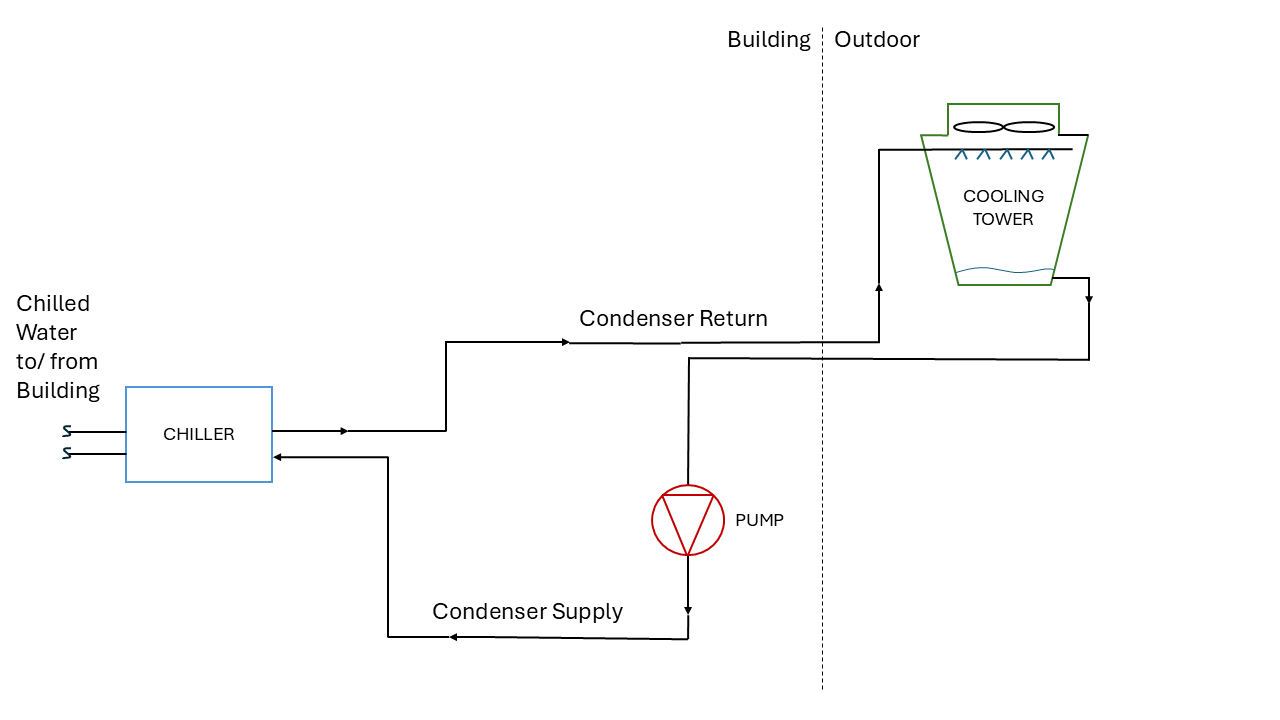
In addition to the chiller conversion, the retrofit included fitting the cooling tower fans with variable-frequency drive (VFD) control. The chiller and cooling tower manufacturers—utilizing a design ECWT of 80ºF—provided mix-match curves for three load points: 400 tons, 700 tons and 1,200 tons.
Creating these mix-match curves required some coordination: For each load point, the chiller manufacturer determined the heat rejection and kilowatts-per-ton efficiency of the chiller. Armed with these data, mechanical system designers were then able to request the cooling tower vendor to determine the speed of the VFD that would handle this heat-rejection load. From the load calculations, the designing engineers knew the mean-coincident wet-bulb temperatures for each load point—information that was required by the cooling tower vendor to determine performance of the tower.
In addition to 80ºF, ECWTs of 75°F, 70°F, 65°F, 60°F and 55°F were evaluated, as well as the sum of the chiller-motor kW plus the cooling-tower motor kW. Load points for the 750-ton and 1,400-ton chillers at the different ECWT were studied and are plotted in Figure 1, p.34.
Analyzing the setpointsFor the 1,400-ton chiller—when at the 1,200-ton load point and design outside-air (OA) wet-bulb temperature—the cooling tower was unable to provide water colder than 80°F, the original design point. When the same chiller was operated at the 700-ton load point, it was most efficient at an ECWT of 70°F. There is an asymptotic shape to the curve, with a minimum point of power consumption at 70°F. This power consumption is the sum of chiller motor energy plus cooling tower motor energy.
On the other hand, when the 1,400-ton chiller was operated at the 400-ton load point, the most efficient ECWT was 60°F. This curve has not developed an asymptote; power draw is still pointed downward at 60°F, implying that colder ECWT will decrease energy consumption. However, the chiller manufacturer would not allow operation of the chiller below 60°F ECWT.
Also, when the 750-ton VFD-equipped chiller was operated at the 700-ton load point, it was most efficient at an ECWT of 70°F—another asymptotic curve. At the 400-ton load point, it was most efficient at a load point of 400 tons but has not yet reached an asymptote curve.
Plotting sensitivityThe sensitivity of the two chillers' energy use was plotted as a function of ECWT and load point of the chiller. Data for both chiller sizes is shown graphically in Figure 2. Note the differing shape of the curves, implying that the VFD-controlled 750-ton chiller is much more efficient at part-load operation points. For each 1°F decrease in ECWT, the power draw of the VFD-controlled chiller decreases 2%, while power draw of the other chiller decreases 1%.
Finally, all data was summarized to generate the three reset schedules given in Figure 3. The curve that is marked "most efficient" shows an increase in the ECWT at the 72.5°F load point, because one goes from two 1,400-ton chillers operating at 52% load to one 1,400-ton chiller operating at 90% load. The reset schedule based on OA temperature requires only information on OA temperature, whereas the "most efficient" reset schedule requires load feedback on each chiller's load point, a more expensive controls modification.
With this load distribution, an operating penalty of less than 3% energy use was incurred, when comparing the most efficient reset schedule with the OA-temperature reset schedule. The ARI reset schedule fell in the middle. One can conclude that at lower OA temperatures, the "most efficient" schedule is substantially more efficient than the ARI schedule.
Figures 4 and 5 show the outside-air temperature frequency chart and a chart of plant cooling load vs. outside air temperatures, respectively.
VFD and part loadThe VFD-controlled chillers are substantially more efficient at part-load operation. For chillers required to operate substantial hours at low outdoor-air wet temperatures at part-load, it is worthwhile to explore chiller operational data with the chiller manufacturer. Chillers are very sensitive to part-load conditions. One can do better than ARI reset, especially when there are many hours of operation at low load conditions.
|